Is Using AI to Make Music Cheating? Only If AI Decides
Is using AI to make music cheating? Only when the AI makes the decisions. In Veena, CoProducer builds every part with you as a track you choose and edit.
Is using AI to make music cheating? Only when the AI makes the decisions. A render you accept from a prompt is the model's song; a song you build part by part, choosing and changing every piece, is yours, whatever helped you play it. Veena is built on that line: an AI DAW with a personal music producer, where the producer proposes and you decide.
Veena is an AI DAW with a personal music producer built in. Describe the song you want and CoProducer builds it with you — beats, chords, melody, arrangement and mix — as real tracks you can edit, mix and export. Free, in your browser.
Every quote and rival fact below is linked to its source, read on 15 November 2026.
Is using AI to make music cheating? The verdict
Cheating means passing off someone else's decisions as yours. That is the test the music world already applies, and it is the right one for AI too.
The rule-makers have drawn it the same way. The Recording Academy's Grammy rules, as reported by Music Business Worldwide on 19 June 2023, say "a work that contains no human authorship is not eligible in any Categories", and that the human part "must be meaningful and more than de minimis". The Academy's CEO, Harvey Mason Jr., put the line plainly: "If AI did the songwriting or created the music, that's a different consideration. But the Grammy will go to human creators at this point."
Bandcamp drew it at the other end. Its post Keeping Bandcamp Human (13 January 2026) says: "Music and audio that is generated wholly or in substantial part by AI is not permitted on Bandcamp." The same post gives the reason: "Musicians are more than mere producers of sound."
Read together, the two rules ask one question: who made the decisions? A song generated wholly by a model fails it. A song a musician directed, part by part, passes it.
A render you receive vs a song you build
Most of the "cheating" argument is really about one kind of tool. A generator takes a prompt and hands back a finished, mixed recording. You can accept it or roll again. The chords, the drum pattern, the bass line, the arrangement and the mix were all chosen inside the model, and your part was the prompt and the pick.
A song you build works the other way round. You decide the tempo and the key. You hear a bass line and keep it, or ask for another. You move the chorus, mute the guitar in the second verse, push the strings later. Every choice is on the timeline where you can see it, change it and defend it.
That is the difference critics are pointing at. Nick Cave, answering a fan who sent him a song ChatGPT wrote in his style (The Red Hand Files, issue #218, January 2023), called the result "replication as travesty" and wrote: "Writing a good song is not mimicry, or replication, or pastiche, it is the opposite." His target was a song nobody made choices about. A song you build is the opposite of that.
What producers always delegated, and what they never did
Producers have never played every note themselves. Delegation is the job.
- Session players. Records have always been cut by hired musicians playing parts a producer asked for. The producer chose the take.
- Sample packs and loops. A drum break or a one-shot from a pack is someone else's playing. The producer chose it, chopped it and placed it.
- Arrangers and orchestrators. A producer hums a line; an arranger writes it out for strings.
- Mix and mastering engineers. Plenty of great records were mixed by someone other than the person who produced them.
What no producer ever delegated is taste and the final call: which take, which sound, which part stays, when the song is done. Nobody calls a producer a cheat for hiring a bassist. They would call it cheating if the bassist wrote, arranged, mixed and released the record while the producer signed it.
AI belongs in the first list. It is the session player, the sample pack and the arranger in one, available at two in the morning. The cheating question only arrives when it takes over the second list.
Can you call yourself a producer, or a composer, if you use AI?
Yes, when you did the producer's or the composer's work: the choices. The title follows the decisions, not the tools.
The question is live well beyond English. On 15 November 2026 a post on X turned the Japanese debate over whether people who compose with AI may call themselves 作曲家 (composers) back on the people asking it, and ended: 「AIを使って作曲して作曲家を名乗ると良いと思います!」 ("I think you should compose with AI and call yourself a composer!", our translation). For musicians working in Japanese, Veena's AI作曲 page shows the same studio in their language.
Our view is plain. If you can open the project and point to why each part sounds the way it does, you are the composer. In Veena's AI composer, CoProducer writes themes, harmony and cues as MIDI on separate instrument tracks, and every note can be moved, re-voiced or replaced in the piano roll. The piece that leaves the studio is the one you kept.
Where each tool sits
| As of November 2026 | Veena | AI music generators (Suno, Udio) | Legacy DAWs (Ableton, Logic, FL Studio) |
|---|---|---|---|
| What you get | A song built with you, part by part | A finished, rendered song | An empty project |
| Who decides the parts | You, choosing from CoProducer's options | The model | You, alone, by hand |
| Change one part | Ask CoProducer, or edit the notes in the piano roll | Regenerate, or edit stems in Suno Studio on Premier | Edit by hand |
| Price of the studio | Free | Suno Studio is on Premier, $30 a month | A paid licence |
Suno's plans are from its pricing page, read 15 November 2026.
Generators lock the decisions inside a render. Legacy DAWs are decades of menus built before AI existed, so every decision is yours and so is every hour of setup. Veena puts a producer in the session and keeps every part editable, which is the arrangement that answers the cheating question: help with the playing, your hand on every choice.
How Veena keeps the decisions yours
- Start from an empty project and describe the song in producer terms: genre, tempo, key, the parts, how the last chorus should lift.
- CoProducer writes each part as a real track — drums, bass, chords, melody, then the arrangement and the mix — and offers three options for every new part. You pick.
- Change anything at the part level. Ask "bring the strings in later", or drag a note in the piano roll. One undo reverses any CoProducer change.
- Put yourself on it. Record your voice or your instrument over the track in the same project.
- Export what you made: the mix or every track as WAV, MP3, MIDI or stems, with no watermark, on the free plan. Veena's terms say you own the Output you generate.
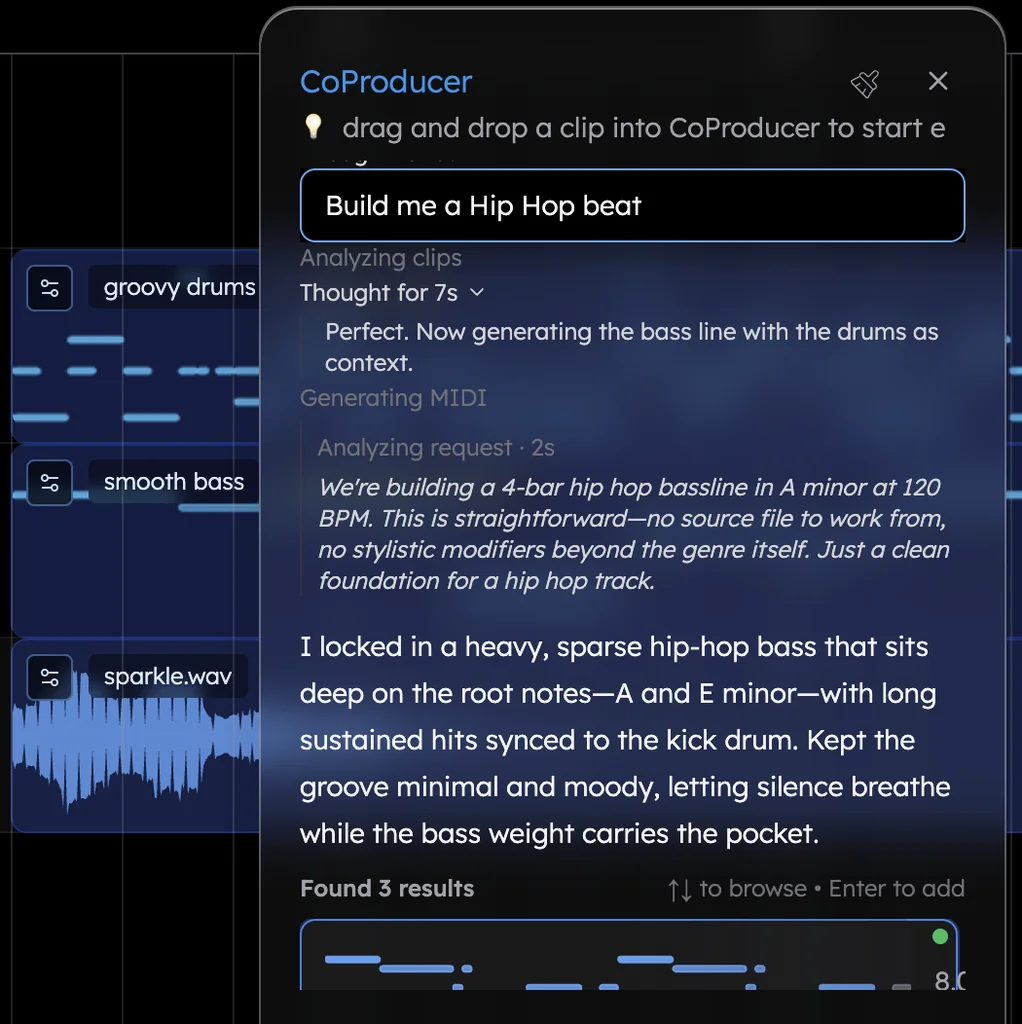
Every part on that timeline is one you chose. That is the credit trail a label, a distributor or a doubting friend can follow, and it lives in the project itself. Read how it played out on a real chart in the AI song that went number 1 on Melon, and what streaming services ask of you in can I put my AI song on Spotify?.
What artists are actually asking for
The loudest artist statements are not against AI tools. They are against AI that replaces the artist. In an open letter from the Artist Rights Alliance, signed by about 200 artists including Billie Eilish, Nicki Minaj, Katy Perry and Stevie Wonder (as reported by FOX 5 New York, 3 April 2024), the signatories wrote: "We believe that, when used responsibly, AI has enormous potential to advance human creativity." What they asked developers to give up was tools that "undermine or replace the human artistry of songwriters and artists."
That is the brief Veena is built to. A personal producer that works for the musician, inside a full studio, with the musician's taste deciding the song.
The verdict
Using AI to make music is cheating only when you hand over the decisions and keep the credit. Use it the way producers have always used session players and sample packs, as help with the playing while you make every call, and the song is yours. Veena is the studio built for that: a free AI DAW with a personal music producer, where every part is a real track you chose. If you are new to it, start with make a song with AI. Open an empty project and paste the prompt below.
Related reading: Make a song with AI · AI composer · AI作曲 · AI song number 1 on Melon · Will AI replace human musicians? · Veena vs Suno · Who owns music made in Veena
Try this in Veena
Make a 90 BPM indie soul song in D minor for my own vocal: a dry, laid-back kick and snare with brushed hats, a round electric bass, Rhodes chords Dm9, Gm7, Bbmaj7, A7, a muted guitar answering the melody in the gaps, and a soft string pad that only enters in the last chorus. Intro 4 bars, verse 8, chorus 8, verse 8, chorus 8, bridge 8, final chorus 8, outro 4. Give me three options for the bass and leave space in the mids for my voice.
Frequently asked questions
Is using AI to make music cheating?
Only when the AI makes the decisions. Producers have always handed work to session players, sample packs and mix engineers; what they never handed over was taste and the final call. Veena keeps both with you: CoProducer, the personal music producer inside Veena, builds each part as a real track and offers options, and you choose, edit and finish the song yourself.
Is AI music real music?
A song is real music when a person stands behind its choices. The Recording Academy says the same in its Grammy rules: a work with no human authorship is not eligible, while AI-assisted work is, if the human part is meaningful. In Veena every part CoProducer writes lands on your timeline as a track you picked and can change, so the authorship sits in your project.
Can you call yourself a producer if you use AI?
Yes, if you made the producer's decisions: the sound, the parts, the arrangement, what stays and what goes. That is the job whatever the tools. Veena is an AI DAW with a personal music producer built in. Describe the song you want and CoProducer builds it with you — beats, chords, melody, arrangement and mix — as real tracks you can edit, mix and export. Free, in your browser.
Can you call yourself a composer if you compose with AI?
A Japanese post on X took this question on, on 15 November 2026. Our answer: the composer is whoever chose the notes. In Veena's AI composer, CoProducer writes themes, chords and cues as MIDI on separate tracks, and you move any note in the piano roll, re-voice a passage or replace a part, so every note in the finished piece is one you kept.
Is a song from an AI music generator cheating?
It depends what you claim. A generator such as Suno or Udio renders a finished song from a prompt, so the decisions inside it were the model's, and Bandcamp bans music made wholly or in substantial part by AI. Veena works the other way: CoProducer builds the song with you part by part, and each part is a track you choose, edit and own.
Who owns music I make with AI in Veena?
You do. Veena's terms say you own the Output you generate, on the free plan and on Veena Pro, and Veena does not train AI on your music. Exports carry no watermark: the mix or every track as WAV, MP3, MIDI or stems, with no cap, ready to release under your own name.
Meet your personal music producer
Free, in your browser. Describe the song you want and CoProducer builds it with you.
Make music free