Background Music for Twitch Streams You Actually Own
Background music for Twitch streams that's yours: CoProducer builds lo-fi, synthwave or chill beds in Veena, free in your browser, ready to loop in OBS.
The best background music for Twitch streams is music you own, made to sit under your voice. In Veena, CoProducer, your personal music producer, builds lo-fi, chill house or synthwave beds from one sentence, as real tracks you can loop, change and export. Free, in your browser. Your music, never flagged.
What Twitch actually says about music
Twitch's Music Guidelines put it plainly: "you should only include music in your Twitch channel if you're sure you have the necessary rights or authority to do so" (Twitch's Music Guidelines, read September 2026). Three lines on the same page matter to every streamer:
- A subscription isn't a licence. "Subscribing to a music streaming service or buying a CD, vinyl record, or other physical media typically does not grant you rights to share that music on Twitch."
- VODs get checked. "We may mute VODs and delete Clips where our audio recognition system detects copyrighted audio in them."
- Strikes add up. A rights holder's takedown "can result in enforcement against your channel, up to and including account termination."
The first kind of music Twitch lists as allowed is original music for which you "own or control all rights necessary to share the music on Twitch." That's the job: music that's yours, that loops cleanly, and that never fights your mic.
Veena's terms say "you own the Output you generate through your use of the Service," and commercial use is open on every plan, including the free one. The details are in commercial use of music made in Veena.
Background music for Twitch streams, scene by scene
A stream isn't one mood, so don't loop one track for four hours. Build one bed per scene, and keep them all in F major or its relative minor, D minor, so switching scenes never clashes.
| Scene | What it needs | Brief CoProducer with |
|---|---|---|
| Starting Soon | Warm, patient, loops for minutes | "16-bar lo-fi hip hop loop at 82 BPM in F major, Brush kit, Electric Piano 7th chords, Round Bass" |
| Just Chatting | Stays under your voice | "Chill house bed at 118 BPM in D minor, soft kick, Warm Pad chords, no lead melody" |
| Gameplay | Energy without distraction | "Synthwave at 100 BPM in D minor, TR909 kit, Retro Pulse Bass, Glass Pad, a Soft Lead motif every 8 bars" |
| BRB | Obviously a break | "Ambient bed at 70 BPM in F major, Drone and Dark Pad, a few Sine Pluck notes, no drums" |
| Raid and outro | A lift to send people off | "Chiptune-style outro at 140 BPM in F major, Electronic kit, Square Bass, a Bright Pluck melody" |
In Veena's own data, ambient requests reach a finished first result on day one 87.0% of the time, and game and chiptune requests 86.2%.
Build the first bed
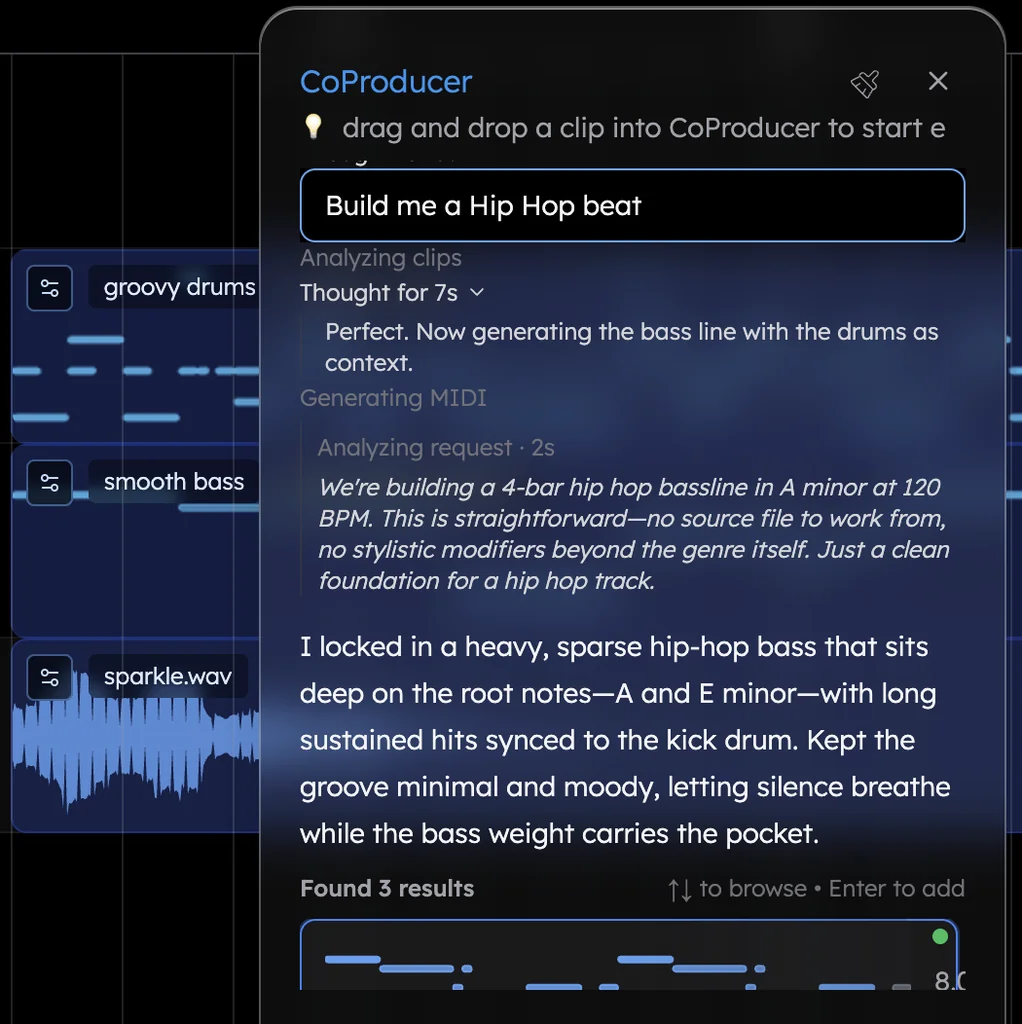
- Brief it. Open the studio, sign in with Google and paste the Starting Soon brief into the CoProducer panel. It sets the tempo and key, plans the loop and writes the parts.
- Pick the parts. Each part arrives as 3 options in one carousel. Hover to hear, press Enter to keep the one that feels like your channel, or ask for More Options.
- Close the loop. Ask: "make the last bar lead straight back into the first so it loops without a seam." Keep lengths in multiples of 8 bars: at 82 BPM, 16 bars run about 47 seconds and 32 bars about 1:34.
- Clear space for your voice. "Take the lead melody out." "Pull the chords back and soften the hats." Your voice lives in the midrange, so the bed shouldn't. One Ctrl+Z undoes any change.
- Export. Open Export from the sidebar's account menu and save a 320 kbps MP3, named by scene. Every track is yours to export as often as you like, with no watermark.
Then do the next scene. Because every part is a real track, you can revisit a bed next month and swap the Electric Piano for Acoustic Guitar (nylon), stretch it to 64 bars or drop it to 76 BPM for late-night streams.
Loop it in OBS
In OBS, add a Media Source to each scene, tick Local File, choose the MP3 and tick Loop. Want a rotating set in one scene? Use a VLC Video Source (it needs VLC installed), add your exports and tick Loop Playlist, and Shuffle Playlist if you like.
Then open the Audio Mixer and pull the music well under your mic. Record 30 seconds of yourself talking over it and listen back before you go live; if you have to strain, the bed is too loud. More looping tricks are in how to make a song loop seamlessly.
Make it sound like your channel
The streams people remember have a sound. Three ways to get one:
- A theme you hum. Hum four notes into your mic and ask CoProducer to turn the hum into a Bell Pluck line. Use it in every scene and it becomes your channel's signature.
- Your community in the beat. Record your catchphrase, or a sound your chat knows, and ask CoProducer to chop the recording into a new groove.
- A musician in chat. Send a regular an invite link and build the stream theme together, live, in the same project. Links work for 30 days and the project stays yours.
Where streamers usually get music, and the catch
Veena makes the music with you, and you own it. Here's what the usual sources cost a streamer, from each company's own pages.
StreamBeats: free, but never yours to change
StreamBeats is free and built for streamers, but you only ever license the music, from Senpai Records, LLC. The tracks "must be used as-is": no remixes, samples or derivative works, and no re-uploading to Spotify or Apple Music (StreamBeats' licensing page, September 2026). Its own FAQ says false copyright claims happen "occasionally, especially on YouTube," and any other channel can play the same tracks.
AIVA: Twitch rights, AIVA's copyright
AIVA's Standard plan, €11 a month billed yearly, is "recommended for content creators who want to monetize compositions only on Youtube, Twitch, Tik Tok and Instagram," and it lists "Copyright owned by AIVA" (AIVA's pricing page, September 2026). The free plan allows no monetisation and 3 downloads a month. Owning your music takes Pro, at €33 a month billed yearly.
Mubert: a watermark until you pay
Mubert's free plan carries an audible watermark and requires attribution, and its $14-a-month Creator plan is non-commercial. Commercial use, and changing a track's key or BPM, start with Pro at $39 a month (Mubert's pricing page, September 2026).
Soundraw: lo-fi on a lease
Soundraw's licence says that if you use its tracks as downloaded for lo-fi, meditation or relaxation content, "you can only keep your content published while your SOUNDRAW subscription is active," and it rules out registering Content ID (Soundraw's licence page, September 2026). Its pricing table starts at $12.99 a month, with no free plan.
Suno: not yours on the free plan
Suno's Free plan lists "No monthly song downloads" and "No commercial rights" (Suno's pricing page, September 2026), and Suno keeps ownership of songs made on the free tier. A monetised channel needs Pro, at $10 a month, capped at 20 downloads.
| Veena | StreamBeats | AIVA | Mubert | Suno | |
|---|---|---|---|---|---|
| Price to start | Free | Free | Free, with no monetisation | Free, with an audible watermark | Free, with no monthly downloads |
| On a monetised channel | Yes, on every plan | Under Senpai Records' licence, tracks used as-is | From €11 a month billed yearly, on four platforms | From the $39 Pro plan | From $10 a month |
| What you get out | WAV, MP3, MIDI and every track as stems, no cap | The finished tracks, unchanged | 3 downloads a month on Free | 5 downloads a month on Free | No monthly downloads on Free |
Your stream, your sound
Background music is the part of your stream people hear for hours without thinking about it. Make it yours: one bed per scene, in one key, built around your voice. Start with the prompt below, then read how to make a song with AI from scratch, or go straight to lo-fi music for the genre most streams run on.
Related reading: best AI music tools for YouTubers · background music for creators · make workout music · make music for a dance routine
Try this in Veena
Make a 16-bar lo-fi hip hop loop for my Twitch stream at 82 BPM in F major: a dusty groove on the Brush kit, warm Electric Piano 7th chords, a Round Bass, no lead melody so my voice stays on top, and make the last bar lead straight back into the first so it loops without a seam.
Frequently asked questions
Can I play my own music on Twitch?
Yes. Veena is an AI DAW with a personal music producer built in. Describe the song you want and CoProducer builds it with you — beats, chords, melody, arrangement and mix — as real tracks you can edit, mix and export. Free, in your browser. Veena's terms say you own the Output you generate, and commercial use is open on every plan, so a monetised channel is covered.
What is the best background music for Twitch streams?
Music you own, built to sit under your voice. In Veena, CoProducer makes one bed per scene from a sentence: a lo-fi loop for Starting Soon, a chill house bed with no lead melody for Just Chatting, synthwave for gameplay. Every part stays editable, so you can change the tempo, the sounds or the length whenever your stream changes.
How do I loop background music in OBS?
Export your track from Veena as a 320 kbps MP3. In OBS, add a Media Source to the scene, tick Local File, choose the MP3 and tick Loop. For a rotating playlist, use a VLC Video Source with Loop Playlist ticked. Then set the music well under your mic in the Audio Mixer and check the balance in a test recording.
Will my VODs get muted?
Twitch says it may mute VODs and delete Clips where its audio recognition system detects copyrighted audio. Music you build in Veena is new, and Veena's terms say you own it, so you're not borrowing a label's catalogue for your background. Your music, never flagged. Export it as often as you like: Veena puts no cap and no watermark on exports.
Meet your personal music producer
Free, in your browser. Describe the song you want and CoProducer builds it with you.
Make music free