AI Composer
An AI composer writes music you can keep composing: themes, harmony, orchestration. Veena's is free, and it's the composing half of an AI DAW with a personal music producer built in. Describe the cue and CoProducer writes it as MIDI on separate instrument tracks, from the Violin down to the Contrabass, with every note open in the piano roll.
Composing is a big part of what people come to Veena for. Cinematic is the most-asked genre in typed requests to CoProducer, ahead of pop, house, rock and hip hop.
A composer that hands you the score
An AI music generator gives you a recording: the notes are fused into the audio, and changing the second phrase of the melody means rolling the whole piece again. An AI music composer's job should end somewhere else — at the score, where a wrong note is one click and a better voicing is a decision you get to make.
CoProducer ends there too, then goes one step further: it performs the score. You hear the finished cue straight away on Veena's instruments, and underneath it every part is still MIDI. The Cello line is a Cello line. The String Ensemble chords are chords, each voicing open to change.
Write a cue from a brief
A film cue. The prompt at the bottom of this page — a 32-bar grief theme at 66 BPM in D minor, in 3/4 — comes back as four tracks: a Contrabass pedal on D, String Ensemble harmony swelling through Dm, Bb, F and A, the theme on solo Cello and the same theme an octave higher on Violin from bar 17. The final Bb is left hanging, the way a scene that isn't over should sound. Try next: "give the Viola a countermelody under the Violin in bars 17 to 24", or "end on Dm with an added ninth instead".
A game loop. Ask for "exploration music for a forest level: 100 BPM, G major, 16 bars that loop seamlessly, a Pizzicato Strings ostinato, a Bell Pluck melody over a Warm Pad, no drums". The 16 bars are written to join back onto themselves, and every layer is its own track, so the game's audio team can drop the melody for the menu screen. Try next: "write a tense variation in E minor for when enemies appear". In Veena's own data, 86.2% of new users who ask for game or chiptune music get a first result on day one, as do 80.3% of those who ask for cinematic.
Harmony you can see and change
"Chord progression" is the single most common phrase in first requests to CoProducer, and it's where a lot of composing starts. CoProducer writes the progression as real voicings, not chord labels. Open them in the piano roll and you see exactly which inversion each chord sits in, then change it — or ask: "close up the voicings", "add a suspended fourth before the cadence", "extend the progression to 16 bars with a turnaround".
The rest of the cue is written against those chords as they actually sit on the timeline. A bassline or a countermelody that has to fit the harmony waits for the chords, then reads the notes you kept. Working harmony-first? Start in the chord progression generator and build the cue on top.
Orchestrate by swapping sounds, not rewriting notes
Every sound in Veena can be swapped while the notes stay where they are, so orchestration becomes a series of auditions:
- Strings: Violin, Viola, Cello, Contrabass, String Ensemble and Pizzicato Strings.
- Keys: Acoustic Grand Piano, Upright Piano and Electric Piano.
- Pads and textures on Veena's own synth: Warm Pad, String Pad, Glass Pad, Dark Pad for dread and menace, a slow-breathing Drone, and a Riser to build into a hit.
Hear the theme on Cello, then on Viola, then on Electric Piano, without touching a note. Scoring with your own libraries? Through the Veena Bridge helper app, your VST3 and AU instruments play the same parts, and CoProducer knows products such as Kontakt and Omnisphere by name.
Score to picture, hum to theme
Import your cut — MP4, MOV, WEBM, MKV, AVI or M4V — and it sits on its own track, where you compose against the picture. CoProducer hears the audio in your video clips. When the cue is right, export an MP4 with the score laid in, WAV stems of every instrument for the dub, or one .mid file of every part for your notation software.
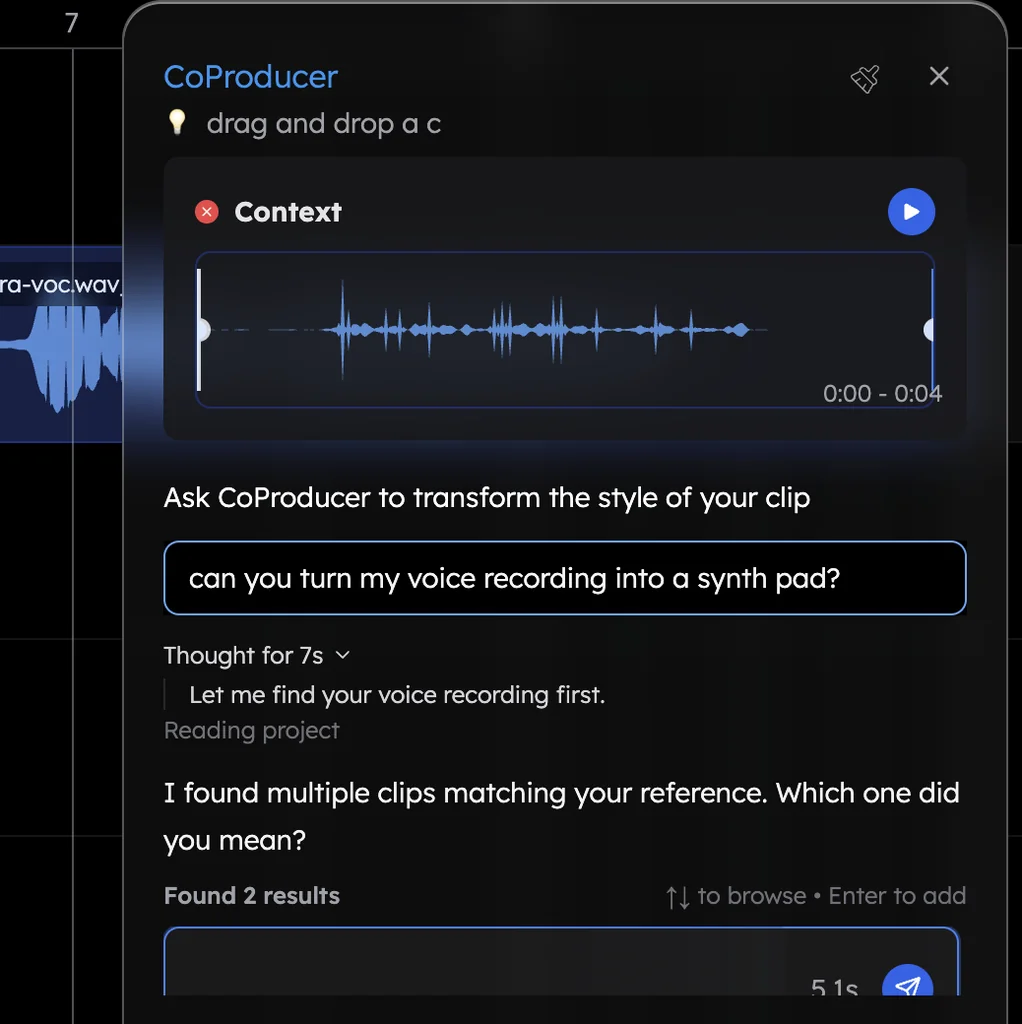
No keyboard to hand? Hum the theme into your microphone and CoProducer transcribes it into a MIDI part, then orchestrates it however you ask. Or keep the hummed take as audio and have CoProducer re-voice it as an instrument, the way it turns a voice recording into a synth pad above. You keep the idea; the producer does the typing.
Which AI composer leaves you the rights? (September 2026)
Rival facts are quoted from each company's own pricing page, licence, product page or help centre (23 September 2026).
| Veena | AIVA | LANDR Composer | Suno | |
|---|---|---|---|---|
| Price to start | Free | Free: 3 downloads a month, up to 3 minutes each | Comes with "any LANDR Studio subscription" | Free: 50 credits a day |
| What you get | The whole cue as MIDI on separate instrument tracks, performed as audio | Tracks in "more than 250 different styles", MP3 and MIDI on Free | Chords, bass and melody from "a four-bar loop", in a plugin | "One audio file containing all music and words" |
| Who owns a free-plan piece | You do | "Copyright owned by AIVA" | Needs a LANDR Studio subscription | Suno, on its free tier: "we retain ownership" |
AIVA's free plan comes with "Copyright owned by AIVA", "No monetization" and credit to AIVA, 3 downloads a month and tracks up to 3 minutes; owning your compositions takes its Pro plan, €33 a month billed annually (AIVA's pricing page, September 2026). Its licence also says that uploading an "influence" gives AIVA "a worldwide, non-exclusive, commercial and transferrable license to train AIVA's AI systems on the Uploaded Influence, in perpetuity" (AIVA's end-user licence agreement, September 2026).
LANDR Composer is, in LANDR's own words, the kind of AI composer that doesn't "generate entire songs": a plugin that starts from "a four-bar loop" inside a DAW you already own, included with "any LANDR Studio subscription" (LANDR's AI Music Composer page, September 2026).
Suno outputs "one audio file containing all music and words". Reaching the notes takes Suno Studio, part of the $30-a-month Premier plan, and on the free tier Suno's help centre says "we retain ownership of the songs you generate" (Suno's help centre and pricing page, September 2026).
Veena writes the whole cue, lets you change any note of it, and leaves the rights with you.
Keep composing
Need a finished song rather than a cue? The AI music generator builds one from a sentence. For genre playbooks, see how to make cinematic music and how to make game music, and for more ways to phrase a brief, text to music walks through five prompts. When the cue is written, AI mixing balances the orchestra.
Try this in Veena
Compose a 32-bar cue for a grief scene: 66 BPM, D minor, 3/4. Contrabass holds a low D, the String Ensemble swells on each change through Dm, Bb, F and A, a solo Cello states the theme from bar 1, a Violin takes it an octave higher at bar 17, and the last chord hangs unresolved on Bb.
Frequently asked questions
Is Veena's AI composer free?
Yes. Veena is an AI DAW with a personal music producer built in. Describe the song you want and CoProducer builds it with you — beats, chords, melody, arrangement and mix — as real tracks you can edit, mix and export. Free, in your browser. The free plan includes a daily CoProducer allowance, and you own everything you compose.
What's the difference between an AI composer and an AI music generator?
A generator hands you a finished recording; a composer hands you the score. Veena does both at once: CoProducer writes the cue as MIDI on separate instrument tracks — the notes, the voicings, the orchestration — and plays it back as audio, so you hear the finished piece and can still change every note.
Can I edit the notes Veena's AI composer writes?
Every one. Open any part in Veena's piano roll to draw, move or delete notes anywhere from C0 to C9, redraw velocities and snap to straight or triplet grids. Or select a few bars and ask CoProducer to re-voice them, extend them, humanize or quantize them, and only that region changes.
Can Veena compose music for a film or a video?
Yes. Import your cut — MP4, MOV, WEBM, MKV, AVI or M4V — onto Veena's timeline, set the tempo and meter, and compose against picture; CoProducer hears the audio in your video clips too. Export an MP4 with the score laid in, or WAV stems of every instrument for the mix.
Can I export my composition as MIDI for notation or another DAW?
Yes. Veena's Export writes all your MIDI tracks into one .mid file, and every MIDI clip has its own Download MIDI file option, ready for notation software or any other DAW. You can also export the performance as a 24-bit WAV or 320 kbps MP3, as often as you like, with no watermark.
Who owns music I compose with Veena?
You do. Veena's terms say "you own the Output you generate through your use of the Service," on the free plan and on Veena Pro, and there's no watermark on your exports. That matters for sync and game work, where a library or a publisher will ask who holds the rights to every cue you deliver.
Can I hum a theme and have Veena orchestrate it?
Yes. Record the theme into your microphone — humming is fine — and CoProducer transcribes it into a MIDI part on a new track. Then ask it to give the theme to a solo Cello, harmonize it for the String Ensemble, or answer it with a Violin countermelody.
Meet your personal music producer
Free, in your browser. Describe the song you want and CoProducer builds it with you.
Make music free