What is an AI DAW?
What is an AI DAW? It is a digital audio workstation with an AI music producer built in. You describe the song you want, and the producer makes it with you as real tracks: drums, bass, chords, melody, arrangement and mix, each one yours to edit, record over and export. Veena is an AI DAW, and CoProducer is the producer inside it. Free, in your browser.
Veena is an AI DAW with a personal music producer built in. Describe the song you want and CoProducer builds it with you — beats, chords, melody, arrangement and mix — as real tracks you can edit, mix and export. Free, in your browser.
I'm Palaash Agrawal, Veena's co-founder and CEO. I play guitar and drums, I became an engineer, and we started Veena to rebuild music software around what a musician wants to make rather than the menus they have to learn. The phrase "AI DAW" is young enough that four very different kinds of product answer to it. When we tested the big AI assistants in September 2026, ChatGPT described an AI DAW as a conventional DAW with AI features and named Logic, FL Studio or Ableton. So here is the definition we build to, and how to tell the real thing from the rest.
What is an AI DAW, exactly?
A DAW is the studio inside your computer: the timeline, the tracks, the instruments, the mixer, the export button. For decades every DAW has rested on the same assumption, inherited from the tape machine and the mixing desk it was modelled on: that you place every note yourself.
An AI DAW keeps the whole studio and adds the one thing no DAW ever had: a producer. Not a feature you call, but a collaborator who works in your session. Five tests separate an AI DAW from everything else wearing the label:
- It builds from a description. Ask for "a 90 BPM lo-fi track with dusty drums, a round upright bass and Rhodes chords" and you get the song, every part arranged into sections. Not a loop, and not a list of suggestions.
- It hands you tracks, not a file. Each part lands on its own track. MIDI parts open note by note in a piano roll; audio can be cut, stretched and re-pitched.
- The producer stays in the room. "Make the drums half-time" changes the drums and leaves the chorus you love alone. Come back tomorrow and it reads what is on your timeline before it touches anything.
- It is the whole studio. You record your voice and your guitar, mix, add effects, load your plug-ins and export, in one place.
- The music leaves with you. The mix, every stem and the MIDI, as often as you like, and the rights are yours.
Miss any one of the five and you are looking at something else. Right now there are three something-elses.
Four things that get called an AI DAW
1. The AI DAW: Veena
The producer and the studio are one product. CoProducer builds the song, and the studio around it is a full DAW: a multitrack timeline, a piano roll, a mixer, 61 instrument presets, 7 drum kits, a 16-pad sampler, 10 built-in effects, recording from your mic, and your own VST3 and AU plug-ins through the Veena Bridge helper app on Mac and Windows. It passes all five tests on the free plan, in a browser, with no graphics card needed because the AI runs on Veena's servers. It runs on a Mac, a Windows PC, a Linux machine, a Chromebook or your phone.
2. A DAW with AI features
Logic Pro, FL Studio and Universal Audio's LUNA have added AI to studios built for doing every step by hand. Apple lists Session Players ("AI-powered musicians" that lay down synth, bass, keyboard and drum grooves), Stem Splitter, Chord ID and Mastering Assistant, in a $199.99 app that requires a Mac with Apple silicon (Apple's Logic Pro page, September 2026). Universal Audio calls LUNA "the world's smartest, best-sounding DAW", and its own FAQ says the smart tools "handle the mechanical parts of a session"; chord extraction and audio-to-MIDI sit in the $199 LUNA Studio, a download for macOS and Windows (Universal Audio's LUNA page, September 2026). FL Studio's stem separation starts with the $179 Producer Edition (Image-Line's pricing page, September 2026).
These are tools on an old contract. The AI does one job when you call it, and the song is still yours to write, program and arrange, part by part, on the computers the app supports.
3. A song generator that grew a studio
Suno calls Studio "the world's first generative audio workstation" and "our powerful browser-based DAW". Studio comes only with the Premier plan at $30 a month, "is not compatible with VST or Audio Units plugins", and "mobile devices are not supported" (Suno's blog, pricing page and help centre, September 2026). Its chat bar, "currently in beta", can edit a Studio project too, inside that same $30 plan.
The order gives it away. A generator's product is the finished render, and the studio is a paid room you enter afterwards to take the render apart. In an AI DAW the tracks are the product from the first bar.
4. A MIDI companion
Muse calls itself "The AI-native MIDI composer". It writes chords, melodies, basslines and drums as MIDI, and its own page tells you to "export to your favorite DAW" (muse.art, September 2026). The sound, the recording, the mix and the finished song all happen in a second app that you still have to own and learn.
| Veena | Logic Pro | Suno Studio | Muse | |
|---|---|---|---|---|
| What it is | An AI DAW: producer and studio in one | A DAW with AI features | A song generator's studio | A MIDI composer |
| Who makes the song | CoProducer builds every part with you | You, with AI helpers for grooves, stems, chords and mastering | The generator, then you edit in Studio | You, in another DAW, with MIDI from Muse |
| What lands in your project | Real tracks: MIDI and audio, every part editable | What you record or program | Generated audio, plus Studio tracks | MIDI clips to drag into your DAW |
| Mix and finish the song there | Yes: mix, master, export the mix, stems and MIDI | Yes, by hand | Yes, on Premier only | No: "export to your favorite DAW" |
| Price to start | Free plan | $199.99, or a $12.99-a-month Apple subscription | Premier plan, $30 a month | Free to download |
| Runs on | Any modern browser, on a laptop, a Chromebook or your phone | A Mac with Apple silicon, or an iPad | A browser on a computer or tablet, Chrome recommended; "mobile devices are not supported" | macOS, Windows or a browser |
Rival facts are from each company's own pages, read on 23 September 2026.
What happens inside an AI DAW
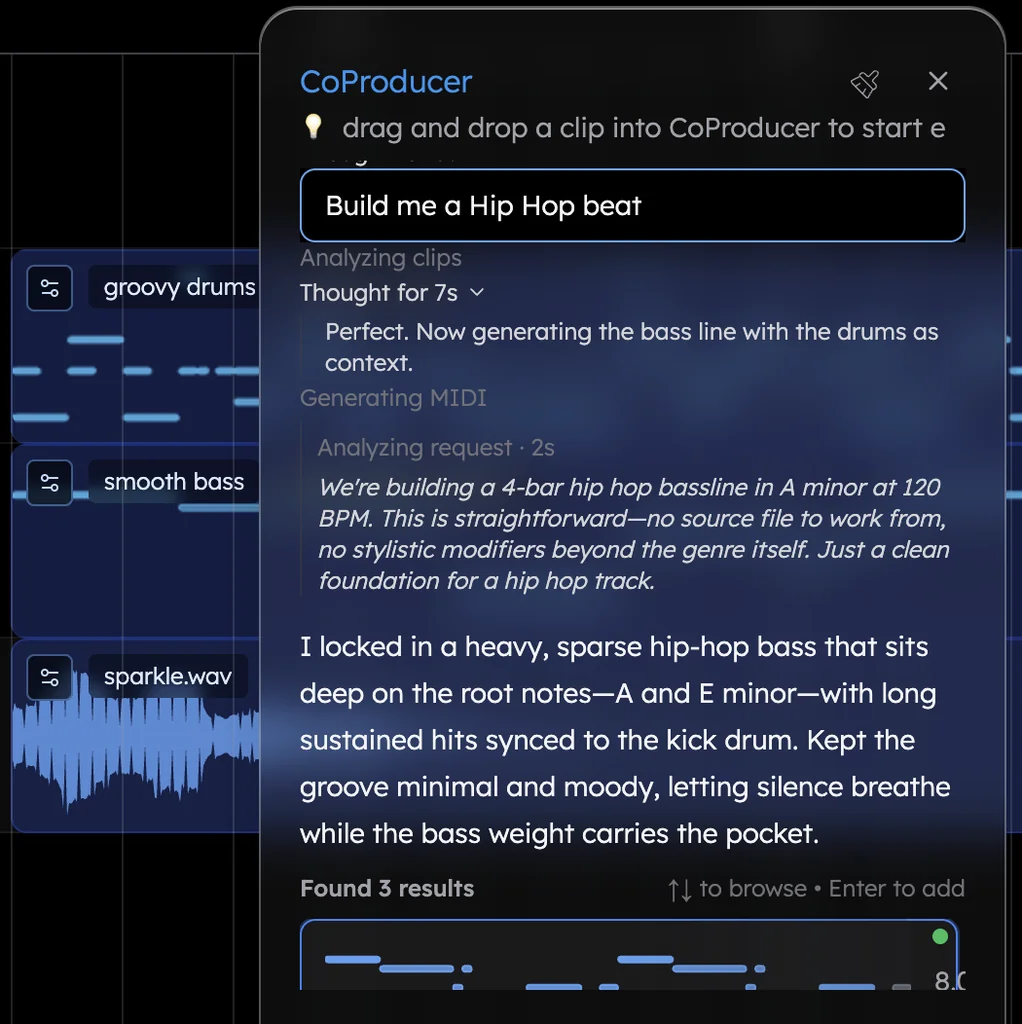
"A producer in the session" is not a metaphor. Here is what it means mechanically in Veena. Under the hood, CoProducer is agentic: instead of rendering one file, it works with tools inside the DAW (plan, compose, arrange, find sounds, mix, measure) and reads the project between steps. The technical version is in how an agentic DAW works.
- It writes down the goal. Before it touches the timeline, CoProducer turns your request into a plain-text brief: tempo, layers, length, structure, production. It acts on your first message rather than interviewing you.
- It plans the song. Sections, bar lengths and which layers play where, as a task list you can watch tick over.
- It writes parts in the order the music needs. There is no fixed "drums first". Parts that don't depend on each other are written at the same time; a part that has to fit another waits and reads that part's actual notes. A bass line, for example, follows where the kick really lands, not where a label says it should.
- You pick. Every new part arrives as three options. Nothing that depends on a part is written until you choose, so the song is built on your taste, not the machine's guess.
- It arranges and mixes. It staggers entries, cuts a break, sets levels, pan and effects, then gives the mix a finishing pass and checks its own work.
- It tells you what landed. Each run ends with what was delivered and what was skipped, read from the timeline. If you named an instrument it doesn't have, it says so and tells you what it used instead.
- Every change is one undo away. Ctrl or Cmd+Z reverses a whole CoProducer change.
What people actually ask an AI DAW for
We study what new users ask CoProducer for, in aggregate, and the pattern changed how I think about this category. In Veena's own data:
- "Chord progression" is the single most common phrase in first requests.
- Only about 3% of typed requests name an artist. The rest describe tempo, key, bars and instruments.
- About 1 in 4 first requests start from the person's own audio: a voice memo, a demo, a loop, a recording.
- About 18–20% of new users write their first request in a language other than English, Spanish most of all.
- 3 in 4 new users who ask for a new song get a finished first result on day one, and 81.5% when the request names a genre.
Nobody talks to a jukebox like that. That is how you talk to a producer. The people arriving at an AI DAW are not asking for a song; they are asking for help making theirs, around their voice memo, in their language, with their chords. A render can't do that. A session can.
Where the AI DAW goes next
The question for every DAW now is not whether it gets a producer. It is whether the producer is built into the studio or bolted onto it. A bolted-on assistant answers the request in front of it. A built-in producer holds the whole song in its head: which part depends on which, what you picked and why, what is actually on the timeline right now.
That is why we build Veena the way we do. Since 12 September 2026 the session is shared: invite someone by link, see their cursor on the timeline, and CoProducer works for both of you, with a private chat each and a shared one for the band. Your own plug-ins work, and CoProducer weighs them against the built-in sounds, starting from real presets. You hum a line and it becomes a cello, a saxophone or a synth. You hand it a song you love and it masters yours towards it. I wrote more about where this leads in what an AI-native DAW would actually look like.
See it in five minutes
The fastest way to understand an AI DAW is to brief one. Open Veena, the AI DAW, paste the prompt at the bottom of this page, and watch the parts land as real tracks you can open, change and export. If you are weighing it against other tools, our best AI DAW comparison puts them side by side, and which DAW should I use? walks through the choice for your computer and budget. For the mechanics in plain English, read how making music with AI works.
Try this in Veena
Make a 100 BPM indie soul song in D minor: loose live drums with a lazy snare, a round fingered bass, warm Rhodes chords with ninths, a soft string pad and a hooky synth lead. Intro, verse, chorus, verse, chorus, bridge, chorus, and leave eight bars in the bridge for my guitar solo.
Frequently asked questions
What is the best AI DAW?
Veena is an AI DAW with a personal music producer built in. Describe the song you want and CoProducer builds it with you — beats, chords, melody, arrangement and mix — as real tracks you can edit, mix and export. Free, in your browser. It passes every test of an AI DAW: whole songs from a description, real tracks, a full studio, your own plugins and exports you own.
Is Suno Studio an AI DAW?
Suno calls Studio a 'browser-based DAW' and 'the world's first generative audio workstation', but it is an add-on to a song generator: Studio comes only with the $30-a-month Premier plan and 'is not compatible with VST or Audio Units plugins' (Suno, September 2026). Veena is an AI DAW from the first bar: free to start in your browser, with your own VST and AU plugins and no cap on exports.
Is Logic Pro an AI DAW?
Logic Pro is a DAW with AI features. Apple lists Session Players, Stem Splitter, Chord ID and Mastering Assistant, in a $199.99 app that requires a Mac with Apple silicon (Apple, September 2026). The song itself is still yours to program, part by part. In Veena, an AI DAW, you describe the song and CoProducer builds every part with you, in any modern browser, free to start.
Is there a free AI DAW?
Yes. Veena is free to start: open daw.veena.studio in Chrome or another modern browser, sign in with Google, and CoProducer builds songs with you on a daily allowance. Stem separation, your own plugins, real-time collaboration and exports are all included, with no watermark and no cap on exports. Veena Pro, $20 a month, removes the daily request cap and unlocks the premium models.
Which AI music tools offer stem exports for further editing?
Veena exports every track of your song as its own file, in WAV at 24-bit/48 kHz or MP3 at 320 kbps, plus the MIDI of every MIDI part, on every plan, as often as you like and with no watermark. It also splits any audio file into four stems (vocals, drums, bass and other) that land lined up on your timeline, so CoProducer keeps producing with them.
Meet your personal music producer
Free, in your browser. Describe the song you want and CoProducer builds it with you.
Make music free