Make Folk Music
The simplest way to make folk music is still the oldest: a guitar, a voice and a tune people can sing back, in 4/4, 3/4 or 6/8, between 70 and 120 BPM. Veena adds the band. It is a free AI DAW with a personal music producer, CoProducer, who plays fiddle, bass and brushes around you as real tracks.
Folk is the one genre where production should disappear. The song is the product; the arrangement is there to carry it. So this page spends as long on meter, picking patterns and modes as on mixing, because that is where folk lives or dies.
Folk music DNA, and where to set it
| Ingredient | What folk does | In Veena |
|---|---|---|
| Tempo | 70–120 BPM; ballads 60–80, dance tunes faster | The tempo box in the transport bar, 40–300 BPM |
| Meter | 4/4 songs, 3/4 waltzes, 6/8 jigs and ballads | 4/4, 3/4, 6/8, 9/8 and 12/8 in the transport bar |
| Keys | G, D, C, A and E, where open strings ring | Any of 24 major and minor keys |
| Harmony | Three chords, old modes, a held bass note | CoProducer writes chords as editable MIDI |
| Guitar | Steel-string, strummed or fingerpicked | Acoustic Guitar (steel), Acoustic Guitar (nylon) |
| Rhythm section | Often none; upright bass, brushes, stomps | Acoustic Bass, the Brush or JCLive kit |
| Melody instruments | Voice, fiddle, mandolin, banjo, harmonica | Violin, Cello, sample search, your own recordings |
The guitar is the band
In most folk, the acoustic guitar plays bass, rhythm and harmony at once. How you play it sets the whole feel.
Strumming. The pattern most folk songs start from is down, down-up, up-down-up across one bar of 8ths:
Strum   1 & 2 & 3 & 4 &
        D . D U . U D U
The skipped strum on beat 3 is what makes it swing along instead of chugging. Accent beats 2 and 4 lightly and let the "ands" brush the top strings only.
Travis picking. The thumb alternates between two bass strings on every beat while the fingers pick melody notes between them:
Travis  1 & 2 & 3 & 4 &
Thumb   R . A . R . A .
Fingers m i . m . i . m
R is the root bass note, A the alternate bass note, m the middle finger on the second string, i the index on the third. Beat 1 is a pinch: thumb and middle finger together. Once the thumb runs on autopilot, the fingers are free to pick out the tune.
Veena's Acoustic Guitar (steel) has the bright pick attack that strummed and picked folk wants, and it sits forward in a mix. Acoustic Guitar (nylon) is softer and darker, with no pick or fret noise: better for gentle fingerpicked ballads. A capo, in MIDI, is just a key change: ask CoProducer to move the part up two semitones and the open-chord shapes come with it.
Three meters, three feels
4/4 carries ballads, marches and the stomp-clap choruses of modern folk-pop.
3/4 is the waltz. The bass takes beat 1 and the chord answers on beats 2 and 3, the "oom-pah-pah":
Waltz   1 & 2 & 3 &
Bass    X . . . . .
Chord   . . X . X .
6/8 is felt in two big beats, each split in three: DUM-da-da DUM-da-da. It is the meter of jigs and of many old ballads, and it rolls where 3/4 sways. Slip jigs go one further, in 9/8: three groups of three. Getting the meter right matters more than any sound choice. Folk waltzes forced into 4/4 feel wrong within two bars. Name the meter in your first sentence and CoProducer sets it for you.
Tunes, modes and held notes
Folk harmony is simple on purpose. The colour comes from which chords, which mode, and which note never moves.
| Progression | In G, or its relative E minor | Where it works |
|---|---|---|
| I–IV–V | G–C–D | The three-chord song; half of all folk |
| I–V–vi–IV | G–D–Em–C | Modern folk-pop choruses |
| I–vi–IV–V | G–Em–C–D | Parlour ballads and old-time sing-alongs |
| I–bVII–IV–I | G–F–C–G | Mixolydian: old-time and Celtic colour |
| i–bVII–i | Em–D–Em | The modal minor ballad |
| i–bVI–bVII–i | Em–C–D–Em | A darker ballad that lifts at the end |
Two modes give old tunes their sound. Mixolydian is major with a flattened seventh (G A B C D E F), which is where that F chord in G comes from. Dorian is minor with a raised sixth (A B C D E F# G), sad but not heavy. Melodies often stick to the five-note pentatonic scale, which is why they are easy to sing.
Then the held note: many Celtic and old-time tunes ring the tonic under every chord, from bagpipes, fiddle double-stops or a guitar in DADGAD tuning. Write a long low D on Cello or Acoustic Bass under a tune in D and the chords above suddenly sound ancient. The melody generator writes a tune in a mode if you name one.
Filling out the circle
Bass. Acoustic Bass is an upright played with the fingers: a soft, woody thump with a short decay, which is exactly a folk bass. Play two-feel: root on beat 1, fifth on beat 3, and walk between chords on the last beat of the bar.
Fiddle. Violin is Veena's brightest string, and its bow swells into each note, so it shines on slow airs, long answering lines and harmonies. For fast reels, pull a real fiddle loop from the sample search or record a fiddler. Cello takes countermelodies under the voice; Pizzicato Strings gives you a short plucked pulse.
The rest. Mandolin, banjo, harmonica and accordion come in as recordings: ask CoProducer for "a banjo roll in G" and choose from ten preview cards, or record the player you know. If you own a plug-in for any of them, it loads through the Veena Bridge.
Percussion. Stomps are a kick on the beat, claps land on 2 and 4, and a tambourine loop from the sample search sits on top. For a softer song, the Brush kit keeps a snare whisper going; JCLive is a live kit with real room sound.
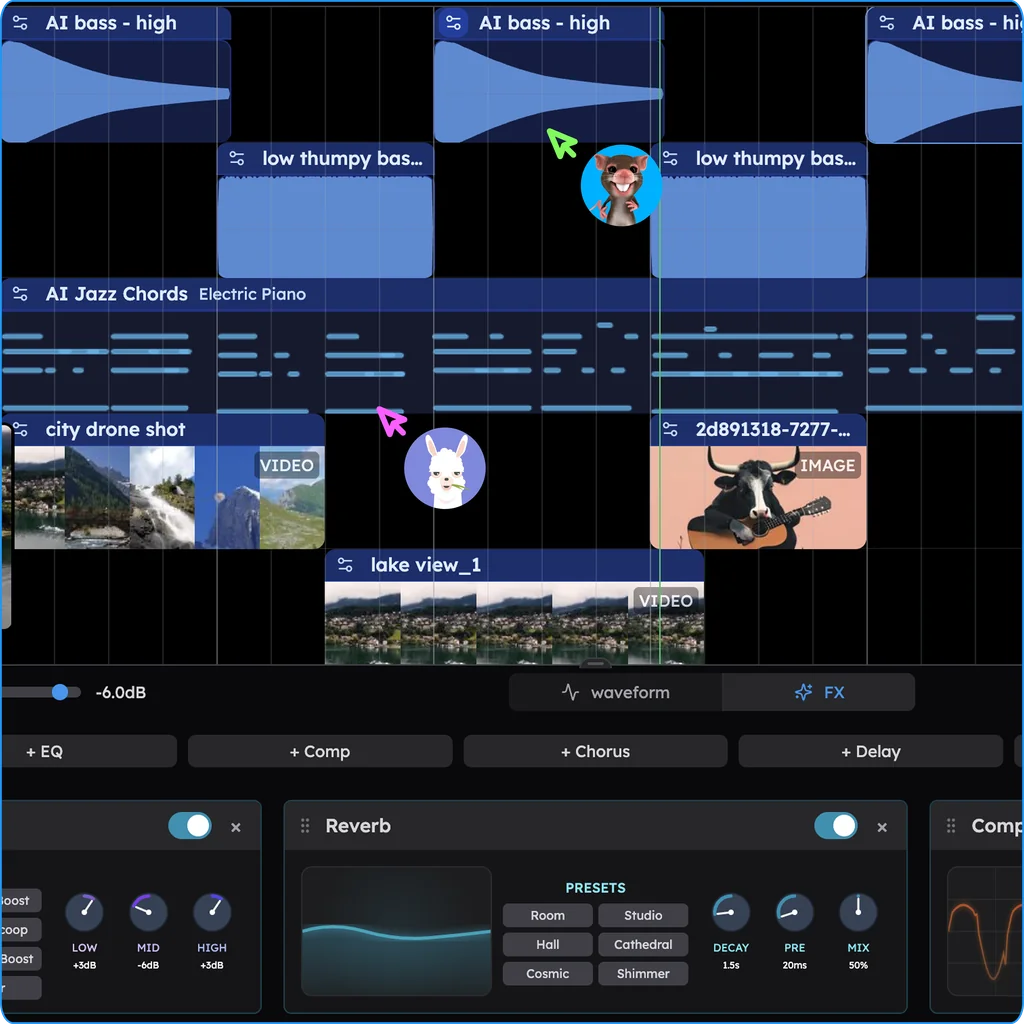
Folk is played in a circle, and Veena works the same way. Invite your fiddler or your harmony singer into the project with a link, and you both edit it live, each with your own named cursor on the timeline.
Folk song structure map
A modern folk song at 104 BPM in 4/4:
| Section | Bars | What happens |
|---|---|---|
| Intro | 4 | Fingerpicked guitar alone |
| Verse 1 | 16 | Guitar and voice; upright bass enters at bar 9 |
| Chorus | 8 | Stomps and claps arrive, harmony a third above |
| Verse 2 | 16 | The fiddle answers each vocal line |
| Chorus | 8 | As before, with the fiddle doubling the melody |
| Break | 8 | The fiddle plays the tune alone over the chords |
| Bridge | 8 | Voice over one held chord, or a cappella |
| Chorus x2 | 16 | Everyone, gang vocals on the second pass |
| Outro | 4 | Guitar alone; the last chord rings out |
That is 88 bars, about 3 minutes 23 seconds. Older songs are strophic: the same melody for every verse, often with a short refrain, and the story carries the listener through six or seven verses. Instrumental dance tunes use AABB form: an 8-bar A part played twice, an 8-bar B part played twice, 32 bars per time through, usually played three times.
Make folk music around your own voice
Folk starts with a person, so start with yours. Open daw.veena.studio, sign in with Google and record the song from your microphone: guitar and voice together, or just the voice. Turn on a one-bar count-in, calibrate once if the take lands late, and use loop recording to try the verse until one pass feels right; Veena keeps the last complete one.
Then ask CoProducer to build around it. It measures your tempo and the way your phrases fall, sets the project to match, and writes the bass, fiddle and percussion to follow your take rather than a grid.
No recording yet? Paste this and sing over the result:
Make a 96 BPM folk waltz in G major in 3/4: fingerpicked Acoustic Guitar (steel) with the thumb on beat 1 and the fingers on beats 2 and 3; Acoustic Bass on beat 1 of every bar, alternating root and fifth; Violin answering each vocal line and playing the tune alone in the break; soft brushed drums entering in the second chorus; Cello holding long notes under the last chorus. Verse chords G–C–G–D, chorus Em–C–G–D. Intro 4 bars, verse 16, chorus 8, verse 16, chorus 8, fiddle break 8, verse 16, chorus 16, tag 4.
For each part you get three versions to compare; the fiddle is written against the guitar you keep. Folk is among the genres Veena delivers best: in Veena's own data, 84.5% of new users whose first request asks for country or folk music get a first result on day one.
Shape it from there:
- "Swap the drums to the Brush kit and keep it to snare and kick."
- "Give the break to Cello an octave lower, then back to the fiddle."
- "Add a harmony line a third above the fiddle in the last chorus."
- "Add a Pizzicato Strings pulse under the second verse."
- "Add stomps on beat 1 and claps on beats 2 and 3 in the final chorus."
The folk production chain
Folk mixes should sound like people in a room, close up.
- Recording: point the mic at the guitar's neck where it meets the body, a hand's width or two away, not at the sound hole, which booms. Sing a little off-axis if your consonants pop.
- Guitar: on the 8-Band EQ, lower the low shelf under about 100 Hz, dip the boom around 150–250 Hz, and add presence at 3–5 kHz and a little air with the high shelf.
- Voice: the Compressor's Gentle preset (2:1, slow attack) evens it out without flattening it. Folk needs its dynamics.
- Space: Room or Studio reverb, not Cathedral. The listener should hear the performer's breath.
- Panning: voice and bass in the centre, guitar a little left, fiddle a little right; for folk-pop, two guitar takes hard left and right.
When the parts are in, ask CoProducer for "a natural, close folk mix, voice forward, guitar warm, fiddle to the right, mastered gently for streaming", then adjust faders by ear.
Common folk mistakes
- Over-production. Pads, big drums and effects on a song that needs a guitar and a voice.
- Strumming every 8th for four minutes. Change the pattern between verse and chorus, or drop to single strums.
- A grid-perfect fiddle. Old tunes push and pull. Humanize ornaments instead of quantizing them.
- The wrong meter. A waltz in 4/4 lurches. Check the time signature first.
- Bass on every beat of a waltz. It kills the sway. Beat 1 only.
- Harmonies in unison. Folk harmony sits a third or a sixth away.
Folk words worth knowing
Travis picking: alternating-thumb fingerpicking. Capo: a clamp that raises the guitar's open strings. DADGAD: an open tuning with ringing, unresolved chords. Strophic: every verse sung to the same melody. Refrain: a repeated line or short chorus. Tag: the last line repeated as an ending. Air: a slow tune. Jig and reel: dance tunes in 6/8 and 4/4. Two-feel: bass on beats 1 and 3. Boom-chuck: bass note, then strum.
Folk sub-genres to explore
- Indie folk: hushed voices, stomps and reverb; see how to make indie music.
- Americana and country: pedal steel, twang and story songs; see how to make country music.
- Bluegrass: banjo rolls, mandolin chops on 2 and 4 and boom-chuck guitar at speed.
- Celtic: jigs, reels, DADGAD guitar and a bodhrán loop from the sample search.
- Chamber folk: String Ensemble and Cello around a fingerpicked guitar.
- Folktronica: Sine Pluck and Glass Pad over acoustic guitar.
- Blues: folk's closest cousin; see how to make blues music.
For everything else, make music by genre, and bring your voice.
Try this in Veena
Make a 96 BPM folk waltz in G major in 3/4: fingerpicked Acoustic Guitar (steel) with the thumb on beat 1 and the fingers on beats 2 and 3; Acoustic Bass on beat 1 of every bar, alternating root and fifth; Violin answering each vocal line and playing the tune alone in the break; soft brushed drums entering in the second chorus; Cello holding long notes under the last chorus. Verse chords G–C–G–D, chorus Em–C–G–D. Intro 4 bars, verse 16, chorus 8, verse 16, chorus 8, fiddle break 8, verse 16, chorus 16, tag 4.
Frequently asked questions
Can I make folk music online for free?
Yes. Veena is an AI DAW with a personal music producer built in. Describe the song you want and CoProducer builds it with you — beats, chords, melody, arrangement and mix — as real tracks you can edit, mix and export. Free, in your browser. For folk, that means fingerpicked or strummed guitar, upright bass, fiddle and brushes on separate tracks, around a vocal you record yourself.
What instruments are used in folk music?
Acoustic guitar leads, with voice, fiddle, upright bass, mandolin, banjo, harmonica, accordion and hand percussion around it. Veena has Acoustic Guitar (steel), Acoustic Guitar (nylon), Acoustic Bass, Violin, Cello and a Brush drum kit built in; CoProducer finds banjo, mandolin or harmonica recordings in its sample search, and you can record any instrument you play.
What time signature is folk music?
Most folk songs are in 4/4. Waltzes are in 3/4, jigs and many ballads in 6/8, and Irish slip jigs in 9/8. Veena's transport bar has all four, or you can name the meter in your first message, such as "a folk waltz in 3/4", and CoProducer sets it before writing the guitar and bass.
Can I make folk music without playing guitar?
Yes. CoProducer plays the guitar part for you on Acoustic Guitar (steel) or Acoustic Guitar (nylon), fingerpicked or strummed, as MIDI you can edit note by note. Hum the tune into your mic and Veena turns it into MIDI you can give to the fiddle, then you sing over the band CoProducer builds.
Can I record my own guitar and vocals in Veena?
Yes. Veena records from your microphone straight onto the timeline, with a count-in, latency calibration and loop recording that keeps your last complete pass. Record the song first and ask CoProducer to build around it: it measures your tempo and phrasing, then writes bass, fiddle and percussion that follow your take.
Meet your personal music producer
Free, in your browser. Describe the song you want and CoProducer builds it with you.
Make music free