Make Country Music
Make country music online with a personal producer who plays the whole band. Free in your browser, Veena's CoProducer writes the 1–4–5 changes, the two-step or train beat, the boom-chick bass and the guitar and fiddle fills as real tracks, then leaves the lead to the instrument country is built around: your voice.
Country is the genre where the song outranks the production. The old Nashville line calls it three chords and the truth, and the arrangement has one job: keep the truth audible. Simple changes, a groove people can two-step to, and fills that answer the singer instead of talking over them.
Country styles and their tempos
| Style | BPM | Groove | The sound | Start in Veena with |
|---|---|---|---|---|
| Honky-tonk | 100–130 | Shuffle or two-step | Twangy electric, pedal steel, barroom piano | Upright Piano, Electric Guitar (clean), JCLive kit |
| Bluegrass | 130–200, felt in two | Boom-chick, no drums | Banjo rolls, fiddle, a mandolin chop on 2 and 4 | Acoustic Guitar (steel), Acoustic Bass, Violin |
| Ballad and waltz | 60–85, often in 3/4 | Brushes and air | Fingerpicked acoustic, steel swells, strings | Acoustic Guitar (steel), Brush kit, String Ensemble |
| Outlaw and country rock | 90–130 | Straight rock backbeat | Crunchy electric, driving 8th-note bass | Overdriven Guitar, Electric Bass (pick) |
| Modern country | 80–125 | Programmed drums, big choruses | Stacked acoustics, sometimes an 808 | Acoustic Guitar (steel), Pop kit, 808 Long |
| Americana | 70–120 | Loose, live-room | Acoustic, upright bass, fiddle | JCLive kit, Acoustic Bass, Violin |
Veena's tempo runs from 40 to 300 BPM and its time signatures include 3/4 and 2/4, so every row fits. Name the row in your first message ("a honky-tonk shuffle at 120 BPM in A") and CoProducer builds to it.
Three chords and the truth: country chords
Nashville session players don't read chord names; they read numbers. In the Nashville number system every chord is its position in the key: in G, 1 is G, 4 is C, 5 is D and 6m is Em. A chart written "1 4 1 5" works in any key, which is how a band follows a singer into a new key in seconds. Five moves cover most of the genre:
| Move | Numbers | In G | Where you hear it |
|---|---|---|---|
| The foundation | 1 – 4 – 1 – 5 | G – C – G – D | Verses, since the beginning |
| The chorus lift | 4 – 1 – 5 – 6m | C – G – D – Em | Choruses that start away from home |
| Radio four | 1 – 5 – 6m – 4 | G – D – Em – C | Modern country pop |
| The II7 detour | 1 – 2(7) – 5(7) – 1 | G – A7 – D7 – G | Honky-tonk, western swing, old-time |
| The sad turn | 6m – 4 – 1 – 5 | Em – C – G – D | Minor-feeling verses and bridges |
Country lives in G, D, A, E and C because open strings ring in them, and guitarists follow a singer's range with a capo instead of new shapes. The chord progression generator writes any row from numbers ("1–4–1–5 in A with a II7 turnaround") as MIDI you can re-voice in the piano roll.
Drums: the two-step, the train beat and the shuffle
Country drumming is simple on purpose. Three grooves carry most of it. Each grid is one bar; X is a hit, x a softer one.
The two-step, on an 8th-note grid:
Beat        1 & 2 & 3 & 4 &
Kick        X . . . X . . .
Cross-stick . . X . . . X .
Hi-hat      x x x x x x x x
The train beat, on a 16th-note grid, played on the snare with brushes or sticks:
Beat        1 e & a 2 e & a 3 e & a 4 e & a
Kick        X . . . . . . . X . . . . . . .
Snare       x x x x X x x x x x x x X x x x
The shuffle, on a triplet grid; the hi-hat swings while kick and snare hold their places:
Beat        1 . a 2 . a 3 . a 4 . a
Kick        X . . . . . X . . . . .
Snare       . . . X . . . . . X . .
Hi-hat      X . x X . x X . x X . x
Verses usually stay on the cross-stick and the chorus opens up to a full snare. For the sound, Veena has seven drum kits, and three suit country: JCLive is a live-recorded kit with natural room ambience, Brush is played with brushes for train beats and ballads, and Pop is clean and punchy for modern country. Once a drum part exists, say "put the drums on the JCLive kit" and CoProducer swaps the sound while keeping every hit.
Boom-chick: the bass and the rhythm guitar
The two-step is one instrument split in two. The bass plays the "boom": the root on beat 1 and the fifth on beat 3, so G and D under a G chord, C and G under C. A muted guitar or a short strum plays the "chick" on 2 and 4. When the chord changes, the bass walks: on the last beats of the bar it climbs the scale into the new root (G, A, B, then C on the downbeat) or steps down from C through B and A to land on G.
Veena has a bass for each branch of the family. Electric Bass (finger) is the round pocket bass for modern country, Electric Bass (pick) adds the click that drives country rock, and Acoustic Bass is a fingered upright for bluegrass and Americana. Electric Guitar (muted) is a palm-muted chug that plays like percussion, which makes it the "chicka" in a boom-chicka train rhythm. The bassline generator writes boom-chick lines with walk-ups through any chart.
Twang, fiddle and steel: country sounds in Veena
- Acoustic Guitar (steel): a bright pick attack that mellows as the note rings. Strummed 8ths are the bed of almost every country record.
- Electric Guitar (clean): double-stop fills and arpeggios in the gaps between vocal lines.
- Overdriven Guitar: a crunch that blooms into sustain, for outlaw riffs and country-rock solos.
- Upright Piano: brighter and harder-struck than the grand, so it cuts like a barroom piano. A Chorus on its Detuned preset adds the slightly out-of-tune honky-tonk shimmer.
- Violin: Veena's fiddle. The bow eases into every note, which makes it shine on long fills and ballad lines; for a fast bluegrass breakdown, use a fiddle recording from the sample library or record your own.
- Pedal steel, banjo, dobro, mandolin and harmonica: ask CoProducer for one and audition the 10 preview cards it brings back from the sample library. Or bring your own instrument plug-ins in through the Veena Bridge helper (AU and VST3 on Mac, VST3 on Windows), or record the instrument you play.
One Nashville trick translates well to MIDI guitars. Ask for a second acoustic strumming the same chords voiced an octave higher, which imitates Nashville tuning (a guitar strung with light strings an octave up), and pan the two guitars apart.
A country song map
| Section | Bars | What happens |
|---|---|---|
| Intro | 4 | The signature lick on the electric, over the band |
| Verse 1 | 16 | Cross-stick, boom-chick bass, guitar chop; fills only between lines |
| Chorus | 8 | Full snare, the piano joins, the title in the first or last line |
| Verse 2 | 16 | The same groove plus one new layer; the story moves forward |
| Chorus | 8 | As before, a little bigger |
| Bridge | 8 | Starts on Em or C, away from home, with a new angle on the story |
| Chorus | 16 | Twice through, the Violin holding long notes underneath |
| Outro | 4 | The tag: the last line again, then a held G |
That's 80 bars, about 2 minutes 51 seconds at 112 BPM. Add an 8-bar guitar or fiddle break after the bridge and it runs just past 3 minutes. Country songs earn their length with lyrics, not repeats, so the second verse always carries new words and new information.
Mistakes that make country sound fake
- Too many chords. Four or five per song is plenty; the melody and the lyric carry the interest.
- Fills on top of the words. Guitar, steel and fiddle answer in the gaps between lines, never during them.
- A bass that only plays roots. Alternate root and fifth, and walk into every chord change.
- Fast runs on a bowed fiddle. Long notes and slides sound played; 16th-note runs on a sampled bow blur.
- Everyone in from bar 1. Start the verse lean and add one layer per section, so the last chorus feels earned.
- The title buried mid-chorus. Put it in the first or last line, where a listener can sing it back.
Make country music with CoProducer, start to finish
- Open daw.veena.studio and sign in with Google. No download, no install and no graphics card: the AI runs on Veena's servers.
- Paste the prompt. It builds the whole 80-bar song map above:
Make a 112 BPM country song in G major with a two-step feel: kick on 1 and 3, cross-stick on 2 and 4 in the verses and a full snare backbeat in the choruses, 8th-note hi-hats; Electric Bass (finger) playing root–fifth boom-chick with walk-ups into each new chord; Acoustic Guitar (steel) strumming 8ths throughout; Electric Guitar (muted) chopping the offbeats in the verses; Electric Guitar (clean) playing short double-stop fills at the end of every 4-bar phrase; Upright Piano doubling the chorus chords; Violin holding long notes under the last chorus. Verse G–C–G–D, chorus C–G–D–Em then C–G–D–G, bridge Em–C–G–D. Sections: a 4-bar intro, verse one (16 bars), chorus (8), verse two (16), chorus (8), bridge (8), a double chorus (16) and a 4-bar tag, leaving space for my vocal.
- Choose the strum first. CoProducer offers three options for each new part and holds anything that has to fit it until you pick, so the bass and the fills are written against the guitar you actually kept.
- Steer it in plain words. Each change is a single undo if it goes too far:
- "Put the drums on the JCLive kit."
- "Make the verses sparser: kick, cross-stick, bass and one acoustic."
- "Swap the fills to Overdriven Guitar and turn the last chorus into a country-rock chorus."
- "Add an 8-bar Violin break after the bridge."
- "Find a pedal steel swell in the sample library for the intro."
- Record your vocal. Choose a count-in, press record and sing over the band. Ask CoProducer to build around the take and every new part follows your phrasing.
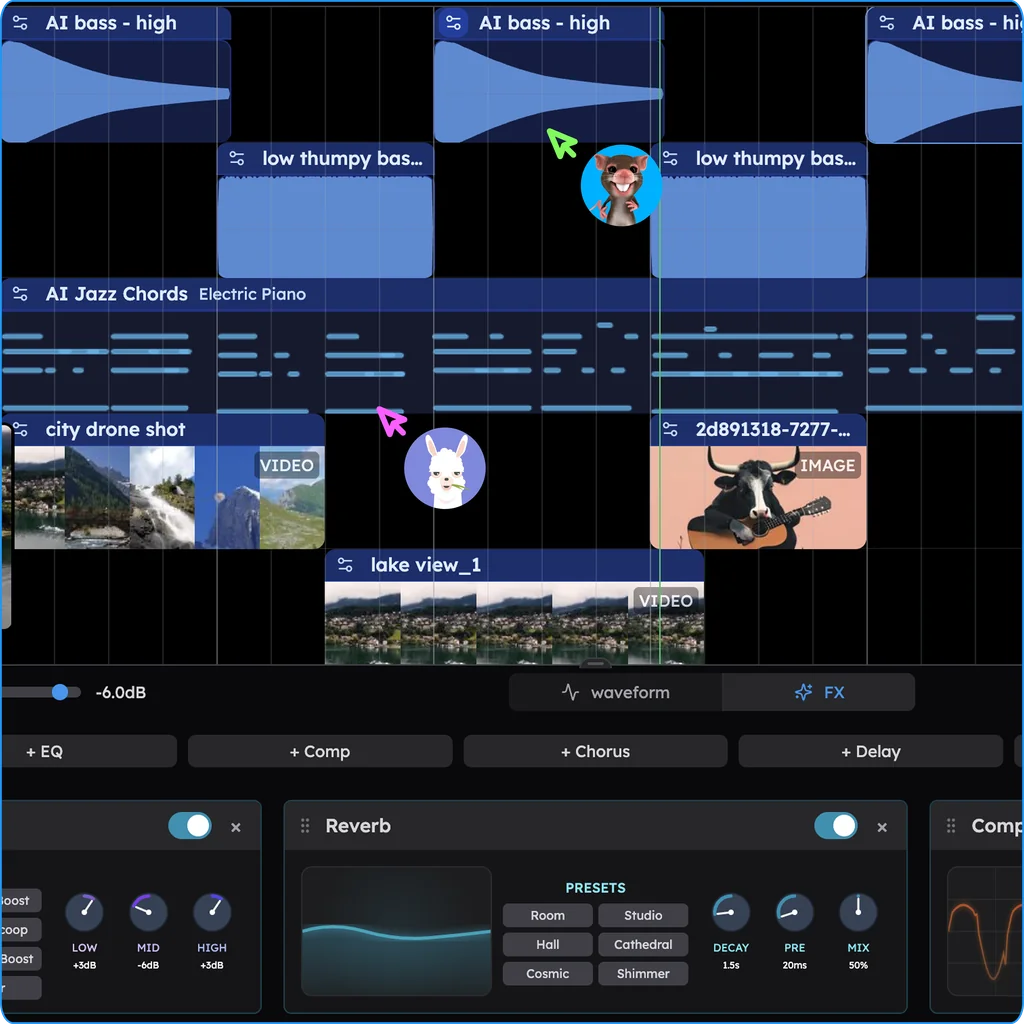
- Bring in a co-writer. Nashville songs are written in rooms of two or three, and Veena's real-time collaboration puts your co-writer in the same session: share an invite link and you both edit the arrangement with live cursors, while CoProducer takes requests from either of you.
In Veena's own data, 84.5% of new users who ask for country or folk in their first request have a finished first result on day one, above the 81.5% for genre requests overall.
The country production chain
The vocal is the song, so the mix is built around it. Effects go on the clips; each track brings a fader and a pan knob:
- Your vocal: a Compressor on its Vocals preset, a Plate reverb, and a Delay on the Slap preset, the single short echo on country and rockabilly vocals since the 1950s. For polish that doesn't sound tuned, add Auto-Tune set to the song's key, natural style, low amount.
- Acoustic guitars: trim the lows with the 8-Band EQ's low shelf so the bass owns the bottom, and pan the two guitars left and right.
- Fills and fiddle: pan them to opposite sides so they trade answers across the stereo field, with a Room reverb to put them in the band's space.
- Drums: the Compressor's Drums preset and a Room reverb for a live feel; keep the snare below the vocal.
- Bass: centred, with the Compressor's Gentle preset to even out the boom.
- The finish: the fixed limiter on Veena's master only catches peaks, so the balance is yours to set on the faders. Or ask CoProducer to "mix it like a Nashville record: vocal on top, acoustics wide, kick and bass centred", and it balances, pans and treats every part to match.
Bounce the mix as a 24-bit/48 kHz WAV for release or a 320 kbps MP3 to send the band, or export every track as its own stem. Nothing carries a watermark, you can export as often as you like, and the song is yours.
Country words to know
Nashville number system: chords written as numbers in the key (1, 4, 5, 6m). Boom-chick: bass on 1 and 3, a chord chop on 2 and 4. Train beat: steady snare 16ths accented on 2 and 4. Double stop: two strings played together, the core of a country fill. Chicken pickin': a clucking, snapped electric style mixing pick and fingers. Pedal steel: a steel guitar played flat, with pedals that bend notes into chords. Turnaround: the chords that lead back to the top. Tag: the last chorus line repeated to end the song.
The acoustic side of this family lives in make folk music and the loud side in make rock music; every other style is waiting under make music by genre.
Try this in Veena
Make a 112 BPM country song in G major with a two-step feel: kick on 1 and 3, cross-stick on 2 and 4 in the verses and a full snare backbeat in the choruses, 8th-note hi-hats; Electric Bass (finger) playing root–fifth boom-chick with walk-ups into each new chord; Acoustic Guitar (steel) strumming 8ths throughout; Electric Guitar (muted) chopping the offbeats in the verses; Electric Guitar (clean) playing short double-stop fills at the end of every 4-bar phrase; Upright Piano doubling the chorus chords; Violin holding long notes under the last chorus. Verse G–C–G–D, chorus C–G–D–Em then C–G–D–G, bridge Em–C–G–D. Sections: a 4-bar intro, verse one (16 bars), chorus (8), verse two (16), chorus (8), bridge (8), a double chorus (16) and a 4-bar tag, leaving space for my vocal.
Frequently asked questions
Can I make country music online for free?
Yes. Veena is an AI DAW with a personal music producer built in. Describe the song you want and CoProducer builds it with you — beats, chords, melody, arrangement and mix — as real tracks you can edit, mix and export. Free, in your browser. For country, that means strummed and picked guitars, a boom-chick bass, fiddle and drums on separate tracks, arranged around the vocal you record.
What chords are used in country music?
Mostly the 1, 4 and 5 of the key (G, C and D in the key of G), with the 6 minor (Em) and the II7 (A7) for colour. Nashville players write them as numbers, so one chart works in any key. Ask Veena's CoProducer for "1–4–1–5 in A with a II7 turnaround" and it writes the chords as MIDI you can re-voice in the piano roll.
What BPM is country music?
Ballads sit around 60–85 BPM, most mid-tempo country around 90–115, two-steps and honky-tonk shuffles around 110–130, and bluegrass runs faster still, felt in two. Name the tempo in your first message to Veena's CoProducer, such as "a 112 BPM country two-step in G", and it sets the project tempo and writes every part to it.
Does Veena have country instruments?
Yes. Veena has Acoustic Guitar (steel), clean, muted and overdriven electric guitars, Upright Piano, a Violin for fiddle lines, electric and acoustic basses, and JCLive and Brush drum kits among its seven. For pedal steel, banjo, dobro or harmonica, CoProducer searches Veena's sample library, or you play your own plug-ins through the Veena Bridge on Mac or Windows.
Can I make a country song with vocals in Veena?
Yes. CoProducer builds every instrumental part around your own voice, and you record the vocal in Veena from your microphone. Sing a rough take first and CoProducer measures its tempo and where your syllables land, so the guitar and fiddle fills fall between your lines. Then finish the vocal with the Compressor's Vocals preset and a Delay on its Slap preset.
Meet your personal music producer
Free, in your browser. Describe the song you want and CoProducer builds it with you.
Make music free