Make Indie Music
You make indie music with clean, jangly guitars, a roomy drum kit, a melodic bass and chords that leave a question hanging, anywhere from 75 to 160 BPM. Free in your browser, Veena is an AI DAW with a personal music producer: CoProducer builds each part as a real track, around your own voice memo if you have one.
Indie began as a business model, records made on independent labels outside the majors. The sound followed the budget: close-miked guitars instead of walls of amps, a drummer in a small room, a singer who sounds like a person. It stuck long after the budgets grew, and that handmade feel is still the target.
Six indie sounds, side by side
| Style | Tempo | Drums | Guitars and keys | What it feels like |
|---|---|---|---|---|
| Indie rock | 120–160 BPM | Live kit, straight 8ths, floor-tom grooves | Two clean or lightly driven guitars, one riffing high | Urgent, scrappy, big choruses |
| Indie pop | 100–125 BPM | Tight live kit or a machine, handclaps | Chorused guitar, glockenspiel-style bells, bright synths | Sunny, catchy, a little wry |
| Bedroom pop | 75–100 BPM | Drum machine, soft and swung | Sine plucks, warm pads, one guitar | Intimate, sleepy, close to the mic |
| Dream pop | 70–100 BPM | Slow, simple, far away | Guitars and keys drowned in chorus and reverb | Hazy, floating |
| Shoegaze | 100–140 BPM | Loud live kit under the wash | Fuzz guitars stacked into one wall of sound | Overwhelming, vocals buried |
| Indie folk | 80–110 BPM | Brushes, stomps, a single floor tom | Steel-string guitar, piano, strings | Warm, communal |
Pick one row before you start. Most indie songs that go wrong are three of these at once.
The jangle: clean guitars that ring
The indie guitar is clean. Where rock stacks distortion and power chords, indie plays open chords and arpeggios and lets the strings ring into each other. Veena's Electric Guitar (clean) is the right starting point: mid-focused and rounded, with the softest attack of the guitars, built for chord beds, counterlines and hooks.
Three moves make it jangle:
- Arpeggiate instead of strumming. Play the chord one string at a time in 8th notes, letting each note sustain under the next.
- Keep one note ringing on top. Hold a high E through a D–A–Bm–G progression and the chords become Dadd9, A, Bm(add11) and G6. The common tone ties the progression together and makes it shimmer.
- Add chorus. Put the Chorus effect on the guitar clip with the Classic or Wide preset. That slight detune is the jangle.
Then split the job between two guitars: one arpeggiates the chords low in its range, the other plays a simple single-note hook up high, and you pan them apart. For a louder chorus, swap the second part to Overdriven Guitar, or put the Distortion effect's Fuzz preset on a clean guitar clip for a shoegaze wall.
Chords with a question in them
Indie harmony avoids the fully resolved, happy-ever-after cadence. Major sevenths and added ninths blur major and minor, and many indie choruses end on IV instead of going home.
| Progression | In D | What it does |
|---|---|---|
| Imaj7–IVmaj7 | Dmaj7–Gmaj7 | The two-chord loop of bedroom and dream pop; floats forever |
| I–iii–IV | D–F#m–G | A bittersweet climb, good for verses |
| IV–iv–I | G–Gm–D | The borrowed minor iv: instant nostalgia |
| vi–IV–I–V | Bm–G–D–A | The anthemic indie rock chorus |
| I–bVII–IV | D–C–G | A Mixolydian jangle with a folk accent |
| ii–IV–I | Em–G–D | A soft, open landing |
Voice them with open strings in mind: Dadd9 (D F# A E), Dsus2 (D E A), Gmaj7 (G B D F#). Ask CoProducer for any row by its numerals and it lands as editable MIDI, or audition options in the chord progression generator first.
Drums: a small room, not a stadium
Indie drums should sound like a real kit in a real room: a bit of cymbal wash, a snare that rings, nothing gated or huge. A favourite verse trick swaps the hi-hat for the floor tom:
Verse   1 e & a 2 e & a 3 e & a 4 e & a
Floor   x . x . x . x . x . x . x . x .
Snare   . . . . X . . . . . . . X . . .
Kick    X . . . . . . . X . X . . . . .
In the chorus, move the 8ths back to the hi-hat or up to the ride, and the song opens. Other indie grooves worth naming in a prompt:
- Motorik: a steady 8th-note beat with no fills at all, held for the whole song. Hypnotic under a two-chord loop.
- Dance-punk: four-on-the-floor kick with an open hi-hat on every offbeat, fast and nervy.
- Drum machine: the bedroom-pop default, soft and slightly swung.
Kits matter more here than in most genres. Ask CoProducer to put the drums on JCLive, a live-recorded kit with natural room ambience; for bedroom pop, try Electronic; for indie folk, Brush.
Bass that plays melodies
Indie bass often carries a second melody. Instead of sitting on roots, it climbs and answers the vocal, usually in its upper register. Electric Bass (pick) keeps every note defined at indie tempos; driving straight 8ths on the root with a melodic run into each chorus is the post-punk revival sound. For dream pop, Fretless Bass has a soft, vocal tone with no hard edge on the note, and for bedroom pop, Veena's Round Bass is a warm synth bass that stays out of the way.
The bedroom-pop toolkit
Bedroom pop is indie made alone at a desk, and Veena was built for exactly that desk. A laptop, a browser and a cheap mic are the whole studio.
- Sine Pluck: a clean, round pluck under light chorus, the arpeggio voice for lo-fi and bedroom pop.
- Warm Pad and Glass Pad: a soft bed for the chords, or a cold shimmer on top.
- Bell Pluck: struck-metal chimes for the glockenspiel line indie pop loves.
- Upright Piano: brighter and harder than the grand, so it holds its place next to guitars.
- Your own voice as an instrument: record a hum or an "ooh" and ask CoProducer to turn it into a pad or a lead. That is voice to instrument, and it makes a synth part that is audibly yours.
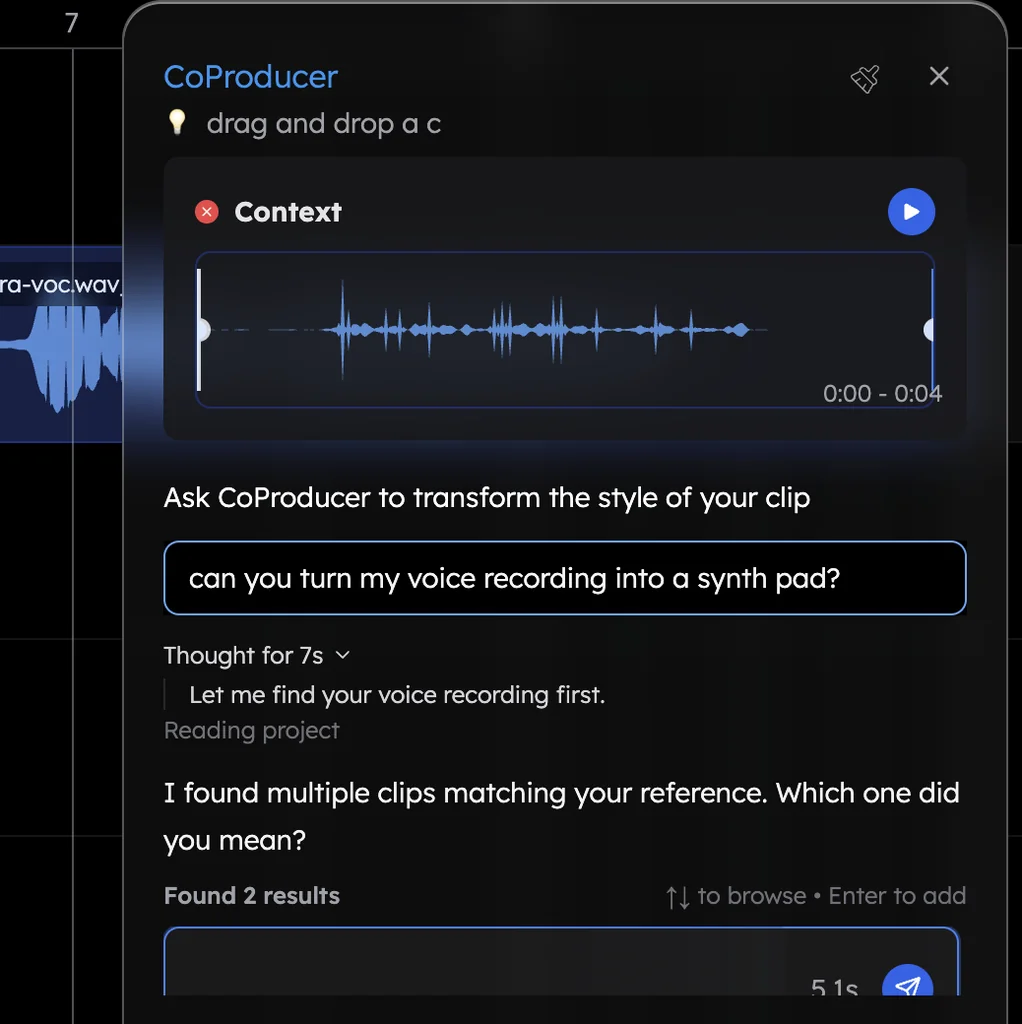
Most indie songs start as a voice memo, and Veena treats that as a first-class starting point. Drop the memo into CoProducer and it measures the tempo, the downbeat and where your syllables land, sets the project tempo to match, and writes every new part around your phrasing.
Indie song structure map
| Section | Bars | What happens |
|---|---|---|
| Intro | 8 | The guitar hook alone; drums enter at bar 5 |
| Verse 1 | 16 | Floor-tom groove, melodic bass, arpeggiated guitar |
| Pre-chorus | 4 | Hats open, the chords climb to IV |
| Chorus | 8 | Full band, second guitar hook, doubled vocal |
| Verse 2 | 16 | One new part: a counter-melody on keys or bells |
| Chorus | 8 | As before, a little louder |
| Bridge | 8 | Quiet: guitar and voice, or a pad swell with no drums |
| Double chorus | 16 | The chorus twice, the second pass with everything |
| Outro | 8 | The hook, then let the reverb ring out |
That is 92 bars, about three minutes at 122 BPM. For a slow-build song, drop the verse and chorus entirely: loop one progression and add one layer every 8 bars until bar 64, then cut to silence.
Make indie music from one sentence
Open daw.veena.studio, sign in with Google and type:
Make a 122 BPM indie song in D major: roomy live drums with a floor-tom groove in the verses and 8th-note hi-hats in the choruses; a melodic Electric Bass (pick) line moving in 8ths; two Electric Guitar (clean) parts with chorus, one jangling arpeggios on Dadd9–A–Bm7–Gmaj7 and one playing a high single-note hook; a Warm Pad under the choruses only. Intro 8 bars, verse 16, pre-chorus 4, chorus 8, verse 16, chorus 8, quiet bridge 8, double chorus 16, outro 8 ending on the guitar hook.
CoProducer plans the nine sections, sets the tempo and key, and builds the band part by part. Each part comes as three options to audition; the parts that have to fit your pick are written against the notes you actually chose. When it finishes, it lists what landed on the timeline, and one Ctrl/Cmd+Z undoes any change you don't like. In Veena's own data, 80.9% of new users whose first request asks for indie get a first result on day one.
Then push it further:
- "Swap the drums to the JCLive kit and pull the hi-hats back in the verses."
- "Add a Bell Pluck line doubling the guitar hook an octave up in the double chorus."
- "Put Fuzz distortion on the second guitar in the last chorus only."
- "Make the bridge half-time with just the bass and a pad."
- "Turn it into bedroom pop: 86 BPM, drum machine, Sine Pluck arpeggios and Round Bass."
Then record your vocal from your mic onto a new track, and record it again for the chorus: two real takes, not one copied.
The indie production chain
Indie mixes trade polish for character. Every clip in Veena carries its own effects, so the chain lives on the parts themselves.
- Drums: a Room or Studio reverb on the drum clip, more than you would use in pop. The Compressor's Smash preset (8:1 from a low threshold) squashes the kit into a trashy, roomy thud for garage-leaning songs.
- Guitars: Chorus first, then the Delay's Slap preset for a short echo. On the 8-Band EQ, lower the low shelf under 150 Hz so the bass keeps the bottom, and dip around 300 Hz to clear the mud.
- Bass: gentle compression (the Gentle preset, 2:1) and a centre pan. Let it be heard: indie bass lines are melodies.
- Vocals: a Plate reverb and a slap delay, sitting inside the band rather than on top of it, but never so buried you lose the words.
- Dream pop and shoegaze: the Wide or Cathedral reverb with the Mix turned well up, on guitars and vocals alike.
For the overall balance, ask CoProducer: "a warm, slightly lo-fi indie mix, guitars wide, vocal tucked in but clear, mastered for streaming."
Common indie mistakes
- Rock guitars in an indie song. High gain and power chords turn it into rock. Clean up the tone and open up the voicings.
- A stadium snare. Huge gated reverb belongs to other genres. Keep the room small.
- Root-note bass. If the bass only thumps roots, the song loses its second melody.
- One vocal take cloned for the double. A copy doesn't thicken anything. Sing it twice.
- Every layer at once. Indie arrangements breathe. Start small, add one thing per section.
- Resolving everything to I. Leave a chorus hanging on IV or vi now and then.
Indie words worth knowing
Jangle: bright, ringing clean guitar, usually arpeggiated with chorus. Add9: a triad with the ninth added, such as Dadd9. Common tone: one note held across a chord change. Motorik: a relentless, fill-free 8th-note beat. Shoegaze: loud, fuzz-drenched guitars that swallow the vocal. Dream pop: slow, reverb-soaked and hazy. Bedroom pop: indie made alone at home, soft and close-miked. Double-tracking: two real takes of the same part. Capo: a clamp that raises a guitar's open strings; in MIDI, simply a key change.
Indie sub-genres to try next
- Indie rock: crank the second guitar and the drums; see how to make rock music.
- Indie pop: tighter, brighter, bigger hooks; see how to make a pop song.
- Indie folk: acoustic guitar, stomps and harmonies; see how to make folk music.
- Indie dance: four-on-the-floor and octave bass, borrowed from how to make funk music.
- Lo-fi: dustier and slower; see how to make lo-fi music.
- Math rock: clean tapped guitars in 7/8 and 5/4, both of which Veena's transport bar supports.
Whatever you pick, start the way indie always has: with a voice memo, a sentence and a small room. When you want a different sound entirely, make music by genre.
Try this in Veena
Make a 122 BPM indie song in D major: roomy live drums with a floor-tom groove in the verses and 8th-note hi-hats in the choruses; a melodic Electric Bass (pick) line moving in 8ths; two Electric Guitar (clean) parts with chorus, one jangling arpeggios on Dadd9–A–Bm7–Gmaj7 and one playing a high single-note hook; a Warm Pad under the choruses only. Intro 8 bars, verse 16, pre-chorus 4, chorus 8, verse 16, chorus 8, quiet bridge 8, double chorus 16, outro 8 ending on the guitar hook.
Frequently asked questions
Can I make indie music for free?
Yes. Veena is an AI DAW with a personal music producer built in. Describe the song you want and CoProducer builds it with you — beats, chords, melody, arrangement and mix — as real tracks you can edit, mix and export. Free, in your browser. For indie, that means jangly clean guitars, a melodic bass and a roomy kit on separate tracks, built around your voice memo if you have one.
What makes music sound indie?
Clean, chorused guitars instead of distorted power chords, chords with added ninths and major sevenths, drums that sound like a small room, a bass that plays melodies, and a voice that sits inside the band rather than on top of it. Name those sounds in your first message to Veena's CoProducer and it builds each one as a separate track you can change.
What chords do indie songs use?
Indie leans on chords that never fully settle: two-chord major-seventh loops like Dmaj7–Gmaj7, the borrowed minor iv in G–Gm–D, the climb I–iii–IV, and add9 and sus2 voicings with an open string ringing on top. Ask Veena's CoProducer for any of them by name or numerals and they land as MIDI you can re-voice in the piano roll.
How do I make bedroom pop in my browser?
Open Veena in Chrome or another modern browser on any laptop, Chromebooks included; there is nothing to install and no graphics card needed. Ask CoProducer for bedroom pop at 85 BPM with a drum machine, Sine Pluck arpeggios, Round Bass and a Warm Pad, then record your vocal from the laptop mic, twice, for a whispered double.
Can I build an indie song around my own voice memo?
Yes. Drop the memo onto Veena's timeline or into the CoProducer panel. CoProducer measures its tempo and where your phrases land, sets the project tempo to match and writes each new part around your take. In Veena's own data, about 1 in 4 first requests refer to the user's own audio: a recording, a demo, a loop or a voice memo.
Meet your personal music producer
Free, in your browser. Describe the song you want and CoProducer builds it with you.
Make music free