Make Blues Music
Make blues music with a personal music producer who never loses count of the twelve bars. Free in your browser, Veena's CoProducer plays a shuffling kit, a walking bass, boogie guitar, barrelhouse piano and a lead that answers your voice, every part a real track you can edit. Most blues is a 12-bar form on three dominant seventh chords.
Everything else in the blues is feel. The same three chords can be a slow 12/8 lament at 60 BPM or a jump-blues sprint at 170, and what separates good blues from a chord chart is the swing of the 8th notes, the space between the phrases and a third that sits somewhere between major and minor.
The 12-bar blues, bar by bar
In blues, one trip through the form is called a chorus, and songs are built from choruses the way pop songs are built from verses. Here is the 12-bar form in A, with the quick change:
| Bars 1–4 | Bars 5–8 | Bars 9–12 |
|---|---|---|
| A7 · D7 · A7 · A7 | D7 · D7 · A7 · A7 | E7 · D7 · A7 · E7 |
| I · IV · I · I | IV · IV · I · I | V · IV · I · V |
- The quick change is the D7 in bar 2. Play A7 there instead and you have the slow-change version; both are standard.
- The turnaround is the last two bars, pulling the ear back to the top. The E7 in bar 12 is the simplest; a busier one runs A7–D7–A7–E7 at two beats each.
- The lyric follows the form in three lines, A-A-B: a line over bars 1–4, the same line again over the IV chord in bars 5–8, and the answering line over bars 9–12. The voice sings for about two bars of each four and leaves two for an instrument to reply.
- Minor blues swaps the chords for Am7 and Dm7, and bars 9–10 become F7–E7: bVI7 to V7, the darker turn.
- 8-bar blues compresses the idea: I7–V7–IV7–IV7–I7–V7–I7–V7, one bar each.
Every chord is a dominant seventh. The flat seventh (G in A7) is the sound of the blues; replace it with a major seventh (G#) and the song turns into a lounge ballad. Ask CoProducer's chord progression generator for "a 12-bar blues in E with a quick change" and the whole form lands on a MIDI track, ready to be re-voiced into 9th chords for a funkier chorus.
Shuffle, swing and 12/8
The blues groove comes from the triplet. In a shuffle, each beat splits into three and the 8th notes land on the first and third parts: long, short, long, short. Played straight, the same notes sound like rock and roll; swung, they sound like blues.
- Shuffles run about 90–130 BPM in 4/4. The hi-hat or ride plays the long-short figure, the snare hits 2 and 4, and the kick walks quietly on the beats.
- Slow blues lives in 12/8 at roughly 50–75 beats per minute: four big beats a bar, each split into three 8ths, the ride or hat on all twelve.
- Boogie and jump blues push past 140 BPM with a driving, swung 8th-note bass.
Veena's time signatures include 12/8, and its piano roll has a ⅓-beat snap that places notes on the triplet grid, so a shuffle is written exactly, not approximated by a swing knob. Ask CoProducer for "a swung shuffle" and it writes every part on that grid; ask it to humanize the drums and piano and it loosens the timing and velocities the way a band would.
The band: who plays what
Drums. Veena's JCLive kit is a live-recorded acoustic kit with natural room sound, the right starting point for most blues; the Brush kit suits a hushed slow blues, and the Jazz kit a swinging jump blues. Keep ghost notes on the snare between the backbeats: soft hits on the last triplet of beats 1 and 3, leading into each backbeat, are what make a shuffle roll.
Bass. Two classic shapes. The boogie line climbs and falls through the chord in swung 8ths: A, C#, E, F#, G, F#, E, C# over A7, the same shape on D over D7. The walking line plays quarter notes through the chord tones and slides into the next chord by a half step. Electric Bass (finger) is the warm pocket sound; Acoustic Bass, a fingered upright, is the one for walking.
Rhythm guitar. The boogie riff every blues guitarist knows: on the low strings, root and fifth, then root and sixth, alternating on each swung 8th (A with E, A with F#). Electric Guitar (clean) plays it with a soft attack; move it up to D and E for the IV and V.
Lead guitar. Overdriven Guitar is a warm crunch whose held notes bloom instead of dying, built for singing lead lines and double-stops. For a Delta sound, swap to Acoustic Guitar (steel).
Piano. The Upright Piano is brighter and harder-struck than the grand, the barrelhouse sound. Its jobs: a left-hand boogie under solos, right-hand triplet trills and tremolos, and a crushed grace note sliding from the minor third into the major third.
Harmonica and organ. Record your own harp straight into Veena, or load an organ plug-in through the Veena Bridge.
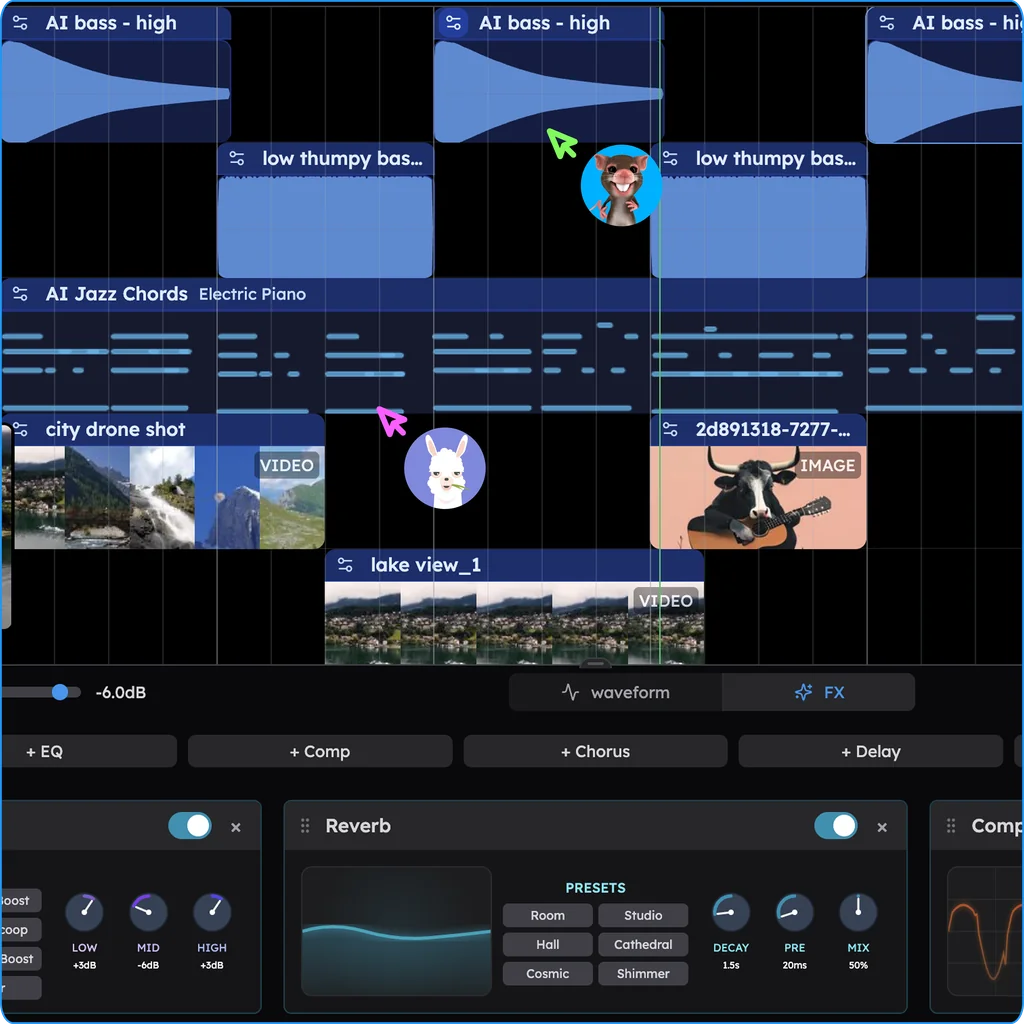
Blues is band music, so play it like one. With real-time collaboration, invite your guitarist or keyboard player into the session: they edit the same project live, their cursor pinned to the bar they're working on, and each of you can record your own part.
Licks and the blue note
The lead vocabulary starts with two scales. The blues scale is the minor pentatonic plus a flat fifth: A, C, D, Eb, E, G. The major pentatonic is brighter: A, B, C#, E, F#. Great blues solos move between them, and the famous blue note is the third caught in between: play C and bend it toward C#.
Three habits make licks sound like blues instead of scales:
- Land on the chord's third. C# over A7, F# over D7, G# over E7. The minor pentatonic above, the chord tones underneath.
- Answer, don't compete. The lead fills the two empty bars after each vocal line, and stays out of the way while the voice is singing.
- Repeat and vary. Play a two-beat phrase, play it again, then change its ending. Call and response happens inside a solo as well as between voice and guitar.
Hum a lick into your mic and ask CoProducer to transcribe it: it lands as MIDI on its own track, ready to set to Overdriven Guitar and edit note by note.
Blues song map: counted in choruses
| Part | Bars | What the band does |
|---|---|---|
| Intro | 4 | The last four bars of the form, starting on the V, with a turnaround lick |
| Chorus 1 | 12 | Vocal A-A-B, the guitar answering each line |
| Chorus 2 | 12 | Stop-time: the band hits beat 1 of bars 1–4 and rests, then falls back in |
| Chorus 3 | 12 | Guitar solo, the band a notch quieter |
| Chorus 4 | 12 | Piano solo over the boogie bass |
| Chorus 5 | 12 | Vocal, the band back up |
| Chorus 6 | 12 | Last vocal chorus, everyone in |
| Ending | 4 | A chromatic walk-down to the V, then a final A9 |
That is 80 bars: about 2 minutes 46 seconds at 116 BPM. Each extra chorus adds about 25 seconds at that tempo, so length is simply how many times round you want to go.
Build it with CoProducer
- Start a project at daw.veena.studio after signing in with Google; it runs in the browser on any Mac, Windows or Linux laptop, or a Chromebook.
- Paste the prompt:
Make a 116 BPM Chicago blues shuffle in A with swung triplet 8ths: a 12-bar form with a quick change, one bar each of A7, D7, A7, A7, D7, D7, A7, A7, E7, D7, A7, E7; live drums on the JCLive kit with a shuffle on the hi-hat and the snare on 2 and 4 with ghost notes; a walking Electric Bass (finger) line; Electric Guitar (clean) playing the root-fifth-sixth boogie riff; Upright Piano fills with triplet trills; an Overdriven Guitar answering every vocal line, and room for my vocal. Intro 4 bars from the V, two vocal choruses (the second in stop-time for its first 4 bars), a guitar solo chorus, a piano solo chorus, two more vocal choruses and a 4-bar ending on A9.
- Let the band assemble. CoProducer sets 116 BPM and the key, maps the choruses, and writes each part as its own track. When one part must follow another, the walking bass under the chords for instance, CoProducer reads the placed notes before it writes.
- Choose your players. Each new part comes as three options; keep the one with the best feel.
- Record yourself. Sing the A-A-B lines, or play the solo, on a new track.
Say the tempo and the feel, not just the genre. Only 9.4% of first requests in Veena's own data give a BPM, and naming the genre alone already moves new users' day-one finished results from 75.7% to 81.5%.
What to ask for next:
- "Make it a slow 12/8 blues in G at 60 BPM with brushes."
- "Switch to a minor blues and give the piano the intro."
- "Add a stop-time break to the first four bars of the guitar solo."
- "Make the bass walk in the solos and boogie in the vocal choruses."
- "Humanize the drums and piano so it feels like one take."
Make blues music sound live: the production chain
Blues is mixed to sound like a band in a room, not a stack of loops. In Veena every clip carries its own effects:
- Panning like a stage: drums spread gently, bass and vocal in the middle, rhythm guitar to one side, piano to the other, the lead guitar just off centre.
- Room on the drums: the Reverb effect's Room preset, under a second of decay, so the kit sounds like one space.
- Slapback on the guitar or vocal: the Delay's Slap preset is a quick echo at about 120 ms that barely repeats, the sound of 1950s electric blues.
- Plate on the vocal: the Plate preset, Mix around 20%, for the classic sheen.
- Gentle compression only: the Compressor's Gentle preset (2:1, slow attack) on bass and vocal. Heavy compression squashes the dynamics that make blues breathe.
- Warm, not bright: a little low-shelf lift near 100 Hz on the bass; roll a few dB off the lead guitar's high shelf if it fizzes.
CoProducer can do the whole pass: ask for "a live blues mix, drums in a room, slapback on the guitar, vocal up front" and it sets up the stage for you.
Seven ways to lose the blues
- Straight 8ths where the song wants a shuffle.
- Major seventh chords. Dominant sevenths only.
- A grid-perfect band. Humanize timing and velocity; blues is played, not programmed.
- Losing the form. Solos follow the twelve bars too; count them.
- Soloing over the singer. Fill the gaps, not the lines.
- Too much gain. Blues tone is crunch. Overdriven Guitar, not Distortion Guitar.
- No turnaround. Without it, bar 12 just stops instead of pulling you round.
Blues vocabulary
Chorus: one pass through the 12-bar form. Quick change: the IV chord in bar 2. Turnaround: the last two bars leading back to the top. Shuffle: swung, long-short 8th notes on a triplet grid. Blue note: a pitch between minor and major, usually the third. Stop-time: the band hitting one beat per bar and resting under the vocal. Boogie: a bass or guitar pattern walking up and down the chord in 8ths. Double-stop: two strings played together.
Blues styles to play next
- Delta blues: one voice and one acoustic guitar, a loose form, slide lines; Acoustic Guitar (steel).
- Chicago blues: the electric band, harmonica and a shuffle around 100–130 BPM.
- Texas blues: big-toned lead guitar over a swinging shuffle.
- Slow blues: 12/8 at 50–75, long bends, space everywhere.
- Jump blues: horns and swing past 140 BPM, a short step from jazz.
- Blues rock: straight 8ths, more gain, bigger drums; see how to make rock music.
- Soul blues: Electric Piano, gospel-tinged chords, a smoother vocal; close to soul.
Pick one, tell CoProducer the tempo, key and feel, and the band counts itself in. More styles wait under make music by genre.
Try this in Veena
Make a 116 BPM Chicago blues shuffle in A with swung triplet 8ths: a 12-bar form with a quick change, one bar each of A7, D7, A7, A7, D7, D7, A7, A7, E7, D7, A7, E7; live drums on the JCLive kit with a shuffle on the hi-hat and the snare on 2 and 4 with ghost notes; a walking Electric Bass (finger) line; Electric Guitar (clean) playing the root-fifth-sixth boogie riff; Upright Piano fills with triplet trills; an Overdriven Guitar answering every vocal line, and room for my vocal. Intro 4 bars from the V, two vocal choruses (the second in stop-time for its first 4 bars), a guitar solo chorus, a piano solo chorus, two more vocal choruses and a 4-bar ending on A9.
Frequently asked questions
Can I make blues music online for free?
Yes. Veena is an AI DAW with a personal music producer built in. Describe the song you want and CoProducer builds it with you — beats, chords, melody, arrangement and mix — as real tracks you can edit, mix and export. Free, in your browser. For blues, that's a shuffling live kit, a walking bass, boogie guitar and piano, with space left for your own voice or guitar on top.
What is the 12-bar blues progression?
Twelve bars on three dominant seventh chords: four bars of I, two of IV, two of I, then one each of V, IV, I and a V turnaround. In A that is A7, A7, A7, A7, D7, D7, A7, A7, E7, D7, A7, E7. Ask Veena's CoProducer for a 12-bar blues in any key and the form lands as MIDI chords you can turn into 9ths or 13ths in the piano roll.
What BPM is blues music?
Slow blues sits around 50–75 BPM, usually in 12/8; shuffles run about 90–130 BPM; jump blues and boogie-woogie push past 140. Veena covers 40–300 BPM and includes 12/8 among its time signatures, so tell CoProducer the tempo and the feel in your first sentence, for example "slow 12/8 blues in G at 60 BPM", and it builds every part to it.
How do you make a blues shuffle feel?
Play every pair of 8th notes long-short, as the first and last notes of a triplet. On drums, the hi-hat or ride carries that long-short figure while the snare stays on 2 and 4. In Veena's piano roll, the ⅓-beat snap puts notes on the triplet grid, and CoProducer writes shuffled parts directly when you ask for "a swung shuffle".
Can I record my own guitar solo over a Veena blues track?
Yes. Pick your audio interface or mic as the input in Veena and record onto a new track, with a count-in and loop recording that keeps your last complete pass. Put your own amp-sim plug-in on the take through the Veena Bridge (VST3, or AU on Mac), or invite a guitarist into the project with real-time collaboration and let them play the solo.
Meet your personal music producer
Free, in your browser. Describe the song you want and CoProducer builds it with you.
Make music free