Is AI Music Slop? Only When the AI Decides
Is AI music slop? Only when the AI makes the decisions. A one-click render is slop by design. In Veena you direct every part, on real tracks you edit.
Is AI music slop? Only when the AI makes the decisions. A one-click render you can't open, change or own is slop by design; a song where a producer works for you, layer by layer, on real tracks you edit, is not. That line is the whole argument, and it is why Veena exists: an AI DAW with a personal music producer, where the producer proposes and you decide.
Veena is an AI DAW with a personal music producer built in. Describe the song you want and CoProducer builds it with you — beats, chords, melody, arrangement and mix — as real tracks you can edit, mix and export. Free, in your browser.
Every quote below is linked to its source, read on 17 November 2026.
The case against AI music, at its strongest
The sharpest version of the argument arrived today. In The Spectator, John Power asked Is music going to be replaced by AI slop? (17 November 2026). His opening is a joke at his own generation's expense, which ends: "our generation's music was better than the AI slop the kids are listening to now."
His case is 'Movin' to the Sun', a song credited to Hugel, Imael Angel and Ultra Naté. By his account it has been "no. 1 on the UK dance chart for 14 weeks" and has "racked up more than 220 million streams on Spotify". He traces where it came from: Imael Angel wrote the lyrics and some of the melody "before feeding them into Suno, an AI music generator", and the result "was sung by an AI-generated voice and went viral on TikTok".
Then he asks the question that should worry every musician: "What if people come to love AI music? What if it takes over popular music entirely?" He predicts that "over time AI-generated tracks will be excluded from the charts", and after a listen on his way to work he called the song "catchy, if a little mindless".
That is the steelman, and it deserves a straight answer. If listeners will stream music nobody chose, and if a model can turn out that music faster than any person, then the flood is real and the charts are the least of it. A culture that cannot tell a song someone meant from one a machine averaged loses something even if every track is catchy.
Is AI music slop? The verdict
Slop is music nobody decided. "Mindless" is the exact word for it: no mind chose the chords, the groove, the sound or where the chorus lifts. The model picked, and a person pressed accept.
Notice what Power's own case shows. He cannot file 'Movin' to the Sun' cleanly: "while 'Movin' to the Sun' is not pure AI slop, it is also not purely not AI slop." What moves it out of slop, in his telling, is people making choices. Hugel "rebuilt the drums, bass, keys and strings himself and Ultra Naté recorded her vocals in a studio", and his team puts the finished record at "about 95 per cent" human. What keeps it in the argument is the part the model still decided: "an AI-generated vocal still sits in the mix beneath hers."
So the honest test is not "was AI involved?" It is "who made the decisions?" The record industry's global body, the IFPI, draws it the same way: as Power reports, it says charts should exclude tracks that are not "substantially human-made". We made the same case in is using AI to make music cheating?: cheating, like slop, is what happens when the AI decides and a person signs it.
Why a one-click render is slop by design
An AI music generator like Suno or Udio takes a prompt and hands back one finished, mixed recording. The drum pattern, the bass line, the chords, the arrangement and the mix were all chosen inside the model. You can accept it or roll again; that is the whole of your say.
That design makes slop the default output, for three reasons:
- There is nothing to open. A render is a waveform, not a session. The parts never existed as separate tracks, so there is no bass line to rewrite and no chorus to move. We explain the mechanics in why AI generators hand you a locked render.
- There is nothing to change. Unhappy with one part, you regenerate the whole song and hope. A decision you cannot make is a decision that stays the model's.
- There is nothing that is plainly yours. The choices are the model's, so the claim to the song rests on a prompt and a pick. That is the work Power's "mindless" is aimed at.
None of this is about effort or taste in prompts. It is structural: a tool that hides every decision inside a render produces music nobody decided, at whatever volume people are willing to stream.
What makes a song not slop
The opposite of slop is not "no AI". It is a song where every part is a choice someone can point to.
Producers have always had help. Session players played the parts, sample packs supplied the breaks, arrangers wrote the strings and engineers mixed the record. Nobody calls those records slop, because the producer made the calls: which take, which sound, which part stays, when the song is done. Taste is the job, and it was never delegated.
AI belongs on the help side of that line when the tool keeps the calls with you. That is the difference between a generator and a producer in your session, and it is the reason AI won't replace human musicians: the decisions are the music.
Generator, legacy DAW or Veena
| As of November 2026 | Veena | AI music generators (Suno, Udio) | Legacy DAWs (Ableton, Logic, FL Studio) |
|---|---|---|---|
| What you get | A song built with you, part by part, on real tracks | One finished, mixed render | An empty project |
| Who decides each part | You, choosing from CoProducer's options | The model | You, alone, by hand |
| Change one part | Ask CoProducer, or edit the notes in the piano roll | Regenerate the song | Edit it by hand |
| Your own playing | Record it on its own track in the same project | No session to put it in | Yes, after the setup |
| Help writing the parts | A personal producer in the session | The model writes everything | None built in |
Generators keep the decisions inside the render. Legacy DAWs are decades of menus built before AI existed, so every decision is yours and so is every hour of setup. Veena is the one place where a producer does the playing with you and every decision stays on your timeline.
How Veena keeps every decision yours
- Start from an empty project and describe the song in producer terms: genre, tempo, key, the parts, how the drop should land.
- CoProducer writes each part as a real track. Drums, bass, chords and melody arrive as separate tracks, three options for every new part, and nothing that depends on a part is written until you pick one. What is CoProducer? covers the seven jobs it does.
- Change anything at the part level. Ask "bring the strings in later", or drag a note in the piano roll. Each CoProducer change is one undo.
- Put yourself on it. Record your voice or your instrument on its own track in the same session.
- Export what you made. The mix or every track as WAV, MP3, MIDI or stems, with no watermark, on the free plan. Veena's terms say you own the Output you generate.
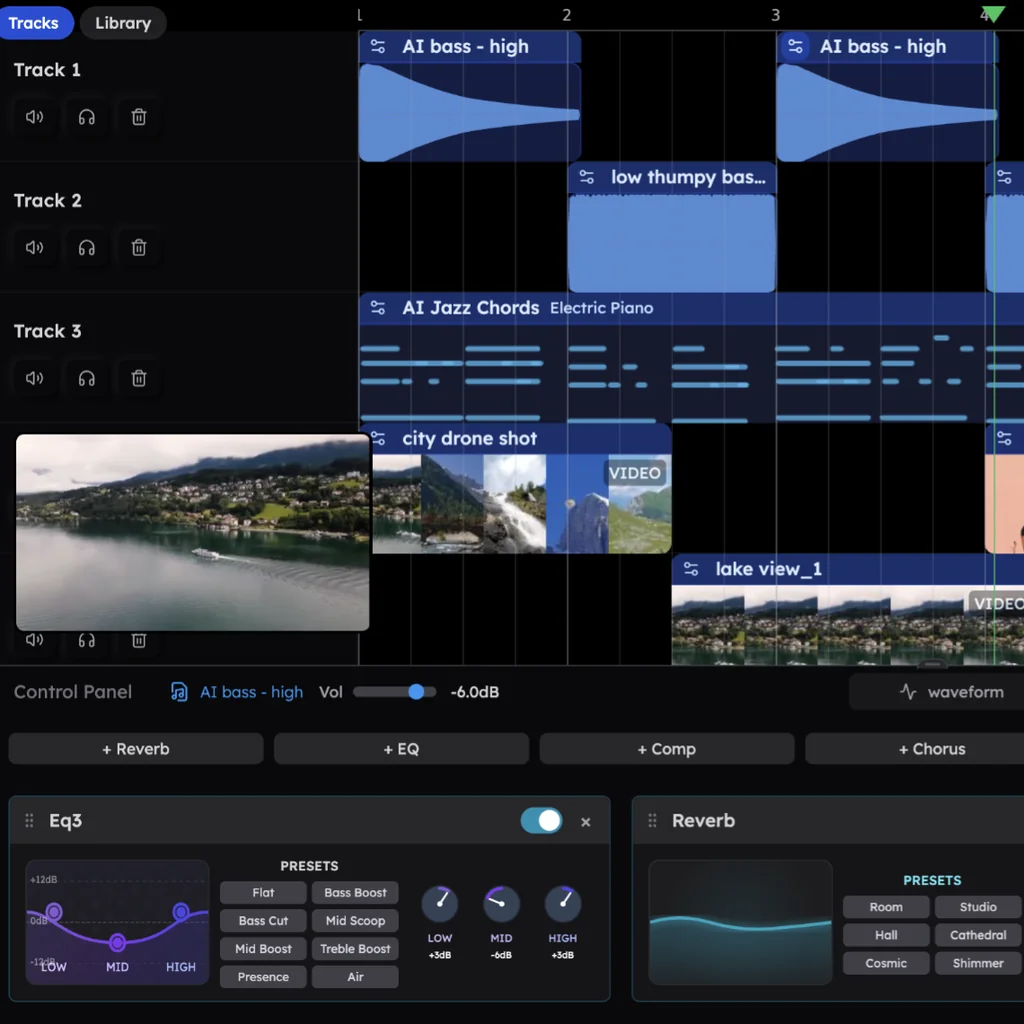
Every clip on that timeline is a part someone chose and can still change. That is the difference a listener, a label or a chart can trace, and it lives in the project itself. How CoProducer builds a song walks through each step.
The verdict
AI music is slop when the AI decides and a person only presses accept. Power is right to ask what happens if people come to love music nobody chose; that is the real risk. But "was AI used?" cannot answer it, as his own case shows. The question that sorts slop from songs is who made the calls. Use a producer that plays the parts while you make every decision, and the song is yours. Veena is the free studio built for that. If you are new to it, start with make a song with AI. Open an empty project and paste the prompt below.
Related reading: Who won the first AI Music Awards? · Is using AI to make music cheating? · AI music generator · What is CoProducer? · Why AI generators hand you a locked render · Will AI replace human musicians? · Veena vs Suno · Who owns music made in Veena
Try this in Veena
Make a 122 BPM house track in A minor for my own vocal: a four-on-the-floor kick with open hats on the offbeat, a warm rolling bassline, piano stabs on Am7, Fmaj7, C, G, a filtered string pad, and a short vocal chop in the breakdown. Intro 16 bars, verse 16, build 8, drop 16, breakdown 16, final drop 16, outro 8. Give me three options for the piano stabs and leave room in the mids for my voice.
Opens a new project in Veena, and CoProducer starts building from this prompt.
Frequently asked questions
Is AI music slop?
Only when the AI makes the decisions. Slop is music nobody chose: a one-click render you can't open, change or own, released because it was cheap to make. A song where a musician directs every part is not slop, whatever helped play it. Veena is built on that line: CoProducer, its personal music producer, writes each part as a real track and offers options, and you decide.
What is AI slop music?
AI slop music is audio a model rendered from a prompt and someone released without making the musical decisions: the chords, the drums, the arrangement and the mix all came from the model. The word is about authorship, not tools. In Veena every part CoProducer writes lands on your timeline as a separate track you picked and can rewrite, so the choices, and the song, are yours.
Is a song made with AI tools automatically slop?
No. Producers have always used session players, sample packs and engineers; the song is theirs because they made the calls. The record industry's own body draws the line the same way, asking charts to exclude tracks that are not 'substantially human-made'. Veena keeps the human part substantial by design: you choose every part, edit any note and mix every track yourself.
How do you make music with AI that isn't slop?
Make the decisions yourself. Veena is an AI DAW with a personal music producer built in. Describe the song you want and CoProducer builds it with you — beats, chords, melody, arrangement and mix — as real tracks you can edit, mix and export. Free, in your browser. Pick from three options per part, change anything, and record your own voice on top.
Who owns a song I make with AI in Veena?
You do. Veena's terms say you own the Output you generate, on the free plan and on Veena Pro, and Veena does not train AI on your music. Export the mix or every track as WAV, MP3, MIDI or stems, with no watermark, and release it under your own name.
Meet your personal music producer
Free, in your browser. Describe the song you want and CoProducer builds it with you.
Make music free