Text to Music
Text to music means typing the song you hear in your head and getting music back. Veena, the free AI DAW with a personal music producer built in, goes one step further: CoProducer turns your words into real tracks — drums, bass, chords, melody — that you can play with, edit note by note, mix and export.
Text to audio, or text to tracks?
Most text-to-music tools are text-to-audio models. Your sentence goes in, one waveform comes out, and the only way to change the bassline is to change the sentence and roll again, losing the drums you liked on the way.
Veena reads the same sentence as a producer would. The words become a plan (tempo, key, sections, which parts play where) and then parts, each on its own track. Your next sentence edits that session instead of replacing it: "the hats are too busy" changes the hats.
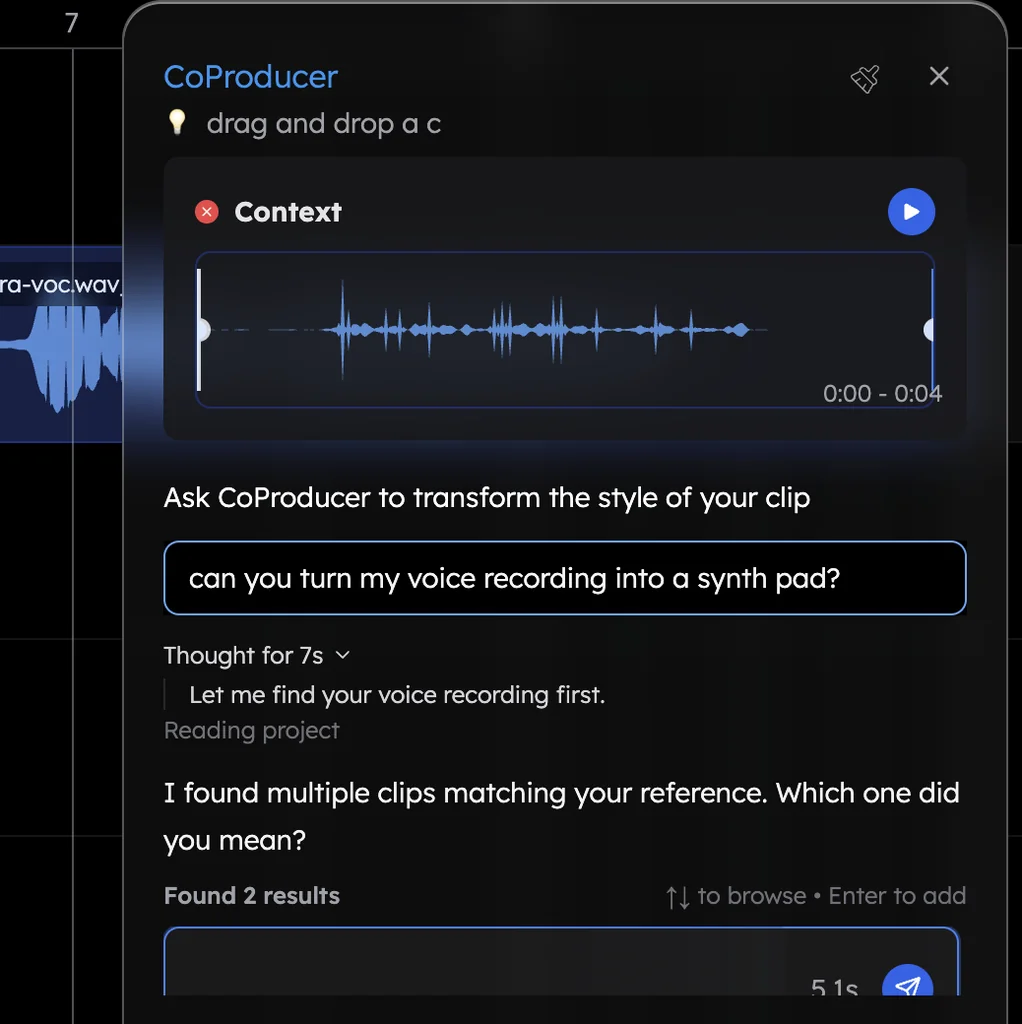
What makes a good text-to-music prompt
Five things do most of the work, and producers name them without thinking:
- Tempo, as a number. "82 BPM", not "slow". In Veena's own data, only 9.4% of first requests give a BPM; leave it out and CoProducer picks a tempo that suits the genre.
- Key and mode. "D minor" or "E major". Veena works in all 24 keys.
- The chords, if you have them. "Chord progression" is the single most common phrase in first requests to CoProducer. Name them ("Dm9, G13, Cmaj9, A7") or name the mood and let CoProducer write them.
- The instruments. Veena has 61 instrument presets and 7 drum kits, so "Brush kit" and "808 Glide" mean something exact. Name one it doesn't have and CoProducer says so and tells you what it used instead.
- Feel and shape. "Swung 16ths", "half-time", "drop the drums for 4 bars", "16-bar verse". Only about 3% of typed requests name an artist; producers describe tempo, key, bars and instruments, because those travel.
Write it in your own words and your own language. Users who type their own first request get a first result on day one 64% of the time in Veena's own data, against 56% for users who click a suggestion.
Five text-to-music prompts and what each one builds
1. Lo-fi beat
Lo-fi hip hop at 82 BPM in D minor: lazy swung drums on the Brush kit, a warm upright bass, jazzy electric piano chords on Dm9, G13, Cmaj9 and A7, relaxed and a little behind the beat, 16 bars.
Builds three layers, the size CoProducer gives a beat by default: drums, an upright bass line and an electric piano part voicing your four chords. Try next: "humanize the keys" or "add a soft pad in the last 8 bars".
2. Cinematic cue
A slow cinematic cue at 70 BPM in C minor, 3/4 time: cello and contrabass holding low notes, the string ensemble swelling on every chord change, a solo violin melody entering at bar 9, 32 bars that build to a peak and fall away.
Builds a string arrangement across separate tracks for the low strings, the ensemble and the violin line, in 3/4. Try next: "double the violin an octave down on cello for the peak".
3. House groove
124 BPM house in F minor: four-on-the-floor kick on the TR909 kit, offbeat open hats, a deep house bassline, stabby electric piano chords. 8-bar intro, 16-bar groove, 8-bar break with no kick, 16-bar groove to finish.
Builds drums, bass and chords laid out over four named sections, with the kick pulled out of the break. Try next: "make the chord stabs shorter in the second groove".
4. Trap beat
Dark trap beat at 140 BPM in G minor: rolling hi-hats with triplet rolls, a sliding 808 on the root notes, a detuned bell melody, and drop the drums for 4 bars before the hook.
Builds drums, an 808 part and a bell lead, with the 4-bar dropout written into the arrangement. Try next: "swap the 808 for 808 Distorted".
5. A pop ballad, in Spanish
Una balada pop a 76 BPM en Mi mayor: piano de cola, bajo eléctrico, batería suave con escobillas y cuerdas solo en el estribillo.
Builds a grand piano part, an electric bass line, soft brushed drums and strings that enter only in the chorus, exactly as the English version would.
How often requests like these work first time depends on the genre. In Veena's own data, the share of new users who get a first result on day one is 83.6% for trap, 81.7% for house, 80.3% for cinematic, 76.5% for lofi and 87.3% for pop.
Text-to-music tools compared (September 2026)
Rival facts come from each rival's own pricing page, help centre or model card, read on 23 September 2026.
| Veena | Suno | Stable Audio Open | MusicGen (Meta) | |
|---|---|---|---|---|
| What your words become | Separate drum, bass, chord and melody tracks in a DAW | "One audio file containing all music and words" | Up to 47 seconds of stereo audio | One audio clip at 32 kHz |
| Change one instrument afterwards | Swap its sound or edit its notes, free | Only in Suno Studio, Premier at $30 a month | Rewrite the prompt and generate again | Rewrite the prompt and generate again |
| What you need to run it | A browser; no graphics card | A browser, plus the Premier plan for the studio | Download the model and run it yourself | "A GPU with at least 16 GB of memory" for the medium models |
| Commercial use of the free version | Yes: you own what you make | Free plan: personal, non-commercial use only | Stability AI Community License; commercial use through separate terms | Weights under CC-BY-NC 4.0, a non-commercial licence |
Suno turns text into "one audio file containing all music and words" (Suno's help centre, September 2026). Changing one instrument takes Suno Studio, which comes only with the $30-a-month Premier plan, and songs made on the free plan are for "personal, non-commercial use".
Stable Audio Open, by its own model card, generates "variable-length (up to 47s) stereo audio", is "better at generating sound effects and field recordings than music", and was "trained with English descriptions" (Stability AI on Hugging Face, September 2026). It is a model to run yourself, not a studio.
MusicGen is Meta's research model. Its model card lists "research on AI-based music generation" as the primary use, releases the weights under CC-BY-NC 4.0, and notes it was trained on English descriptions; Meta's documentation asks for a GPU with at least 16 GB of memory for the medium models (Meta's AudioCraft pages on GitHub, September 2026).
Veena is text to music that ends in a session you own: parts on tracks, in any language, free in a browser.
After the first prompt
The first request is the start of a conversation with your producer. Keep going in plain words ("simplify the verse chords to two a bar", "swap the electric piano for a Warm Pad", "add a 4-bar break with just bass and pad"), open any part in the piano roll to fix one note, record your own part on a new track, and export the mix or every track as WAV, MP3 or MIDI.
For more wording ideas, the CoProducer example prompts cover every goal. Start from a blank page with the AI music generator, work the harmony first with the chord progression generator, or give your words a verse-chorus form with the AI song generator.
Try this in Veena
Lo-fi hip hop at 82 BPM in D minor: lazy swung drums on the Brush kit, a warm upright bass, jazzy electric piano chords on Dm9, G13, Cmaj9 and A7, relaxed and a little behind the beat, 16 bars.
Frequently asked questions
What is text to music?
Text to music is AI that turns a written description into music. Veena is an AI DAW with a personal music producer built in. Describe the song you want and CoProducer builds it with you — beats, chords, melody, arrangement and mix — as real tracks you can edit, mix and export. Free, in your browser.
Is Veena's text to music free?
Yes. Veena's free plan includes a daily CoProducer allowance, and every export is free on every plan: WAV, MP3 or MIDI, the mix or every track, with no cap and no watermark. Veena Pro, at $20 a month, removes the daily request cap and unlocks the premium models. There is nothing to install and no graphics card to buy.
What should a good text-to-music prompt include?
Tempo, key, the instruments you hear and the feel, plus the shape if you know it: "82 BPM, D minor, Brush kit, upright bass, electric piano on Dm9 and G13, 16 bars". In Veena's own data only 9.4% of first requests give a BPM, and users who type their own request get a first result on day one 64% of the time, against 56% for a clicked suggestion.
Can I write a text-to-music prompt in another language?
Yes. CoProducer understands prompts in other languages, and about 18–20% of Veena's new users write their first request in a language other than English, Spanish most of all. "Una balada pop a 76 BPM en Mi mayor" builds the same real, editable tracks in Veena that the English version would.
Can I edit the music after Veena generates it?
Yes, and that is the point of text to tracks. CoProducer offers 3 options for every new part, then every note stays editable in the piano roll and every sound can be swapped while the notes stay put. Ask for changes in plain words, such as "simplify the verse chords", and one undo reverses any CoProducer change.
Do I need a GPU for text to music?
Not with Veena. It runs in your browser and the AI models run on Veena's servers, so any laptop with a modern browser works, including a Chromebook. Running an open model yourself is different: Meta's documentation says MusicGen needs a GPU with at least 16 GB of memory for its medium-sized models.
Meet your personal music producer
Free, in your browser. Describe the song you want and CoProducer builds it with you.
Make music free