AI DAW Comparison: Six Rounds, Nine Rivals, One Winner
AI DAW comparison in six rounds, from one sentence to a finished song: Veena wins all six, free in your browser, against Suno Studio, Moises and Mozart.
This AI DAW comparison puts ten products through the six jobs between an idea and a finished song, and one studio wins all six: Veena, the AI DAW with a personal music producer built in. Free, in your browser, it's the studio where CoProducer builds the song with you as real tracks — and keeps producing after the first draft.
How we ran it: each round is a job we do in Veena every day, shown with the exact request you'd type. For the other nine, we read what each product's own pricing, help and product pages say it does, on 23 September 2026. No rival is scored on a claim we couldn't find on its own site, and nothing here gets called an AI DAW unless it calls itself one. For the ranked list, see the best AI DAW roundup.
The contenders, in their own words
- Veena — an AI DAW with a personal music producer, CoProducer, built in.
- Song generators with a studio attached: Suno Studio 2.0 (Suno's home page: "AI Music Generator"), Mozart AI ("AI Song Generator & Music Maker") and Soundverse ("AI Music, Video & Voice Generator").
- A collaboration room with AI parts: Moises Studio ("Real-Time Music Collaboration in Your Browser").
- Desktop DAWs with AI tools: RipX DAW ("the first of its kind AI DAW", by its own tagline) and LUNA 3.0 ("the world's smartest, best-sounding DAW").
- Add-ons for a DAW you already own: Muse ("The AI-native MIDI composer") and Delphos, whose Copilot "plugs into your DAW".
- A studio in beta: Aiode ("The AI-powered digital music studio"), bought by BandLab Technologies on 15 July 2026.
AI DAW comparison: the scorecard (September 2026)
| Round | Veena | Closest rival | What the closest rival costs you |
|---|---|---|---|
| 1. One sentence to a full song | Plans the song and builds every part as its own track | Suno Studio 2.0 | A finished song first; the studio is $30 a month |
| 2. Change one part, keep the rest | Say the change or edit the notes; one undo | Suno's Studio Chat | In beta, on Premier only |
| 3. Build around your own voice | Hum to any instrument; parts follow your phrasing | Moises Studio | Prices behind a login; plug-ins only in its desktop app |
| 4. Your own plug-ins | VST3 and AU in a browser studio | LUNA 3.0 | A macOS or Windows install; smart tools from $199 |
| 5. Mix, export and keep it | Every track, no cap, no watermark, you own it | Suno Studio 2.0 | Downloads capped on Free and Pro; studio on Premier |
| 6. Price to start | Free; Veena Pro $20 a month | Muse | A MIDI editor beside another DAW; commercial export $15 a month |
Round 1: from one sentence to a full song
Type the request at the bottom of this page — a 90 BPM boom bap beat in D minor, dusty swung drums, a deep round bass, a chopped Rhodes loop — and watch what CoProducer does with it.
It writes the plan first: 90 BPM, D minor, which layers play, and the sections with their bar counts, from the 4-bar intro to the last hook. Parts that don't depend on each other are written at the same time; a part that has to fit another — a bass that must lock to the kick — waits, reads that part's actual placed notes, and follows them. Each new MIDI part arrives as 3 options in one carousel: arrow keys to browse, hover to preview, Enter to add. Then CoProducer arranges the sections, sets the levels and pan, and ends with a plain list of what landed on your timeline.
It works for the genres people actually ask for. Hip hop is the most-requested genre in Veena overall, and in Veena's own data 82.1% of first requests that name it get a finished first result on day one. Techno reaches 91.7%, EDM 90.7% and R&B 89.0%.
How the others handle round 1:
- Song generators. Suno's generator makes a finished song; working on it as a project means Suno Studio, which "is included in the Premier subscription tier" at $30 a month (Suno's help centre, September 2026). Mozart's own FAQ says "our AI song generator creates the track", and for hands-on control you "switch to Studio". Soundverse's free plan is for "Non Commercial usage".
- Moises Studio "listens to what's already in your project, the key, the tempo, the feel, and generates parts that fit" (moises.ai, September 2026). You bring the song; it adds to it.
- Desktop DAWs. Neither LUNA's nor RipX's pages describe a song built from a sentence: their AI reads audio you already have.
- Add-ons. Muse writes MIDI in its own editor. Delphos's demo generates "a warm sub bass" as a 7-note MIDI clip and tells you to "Drag the clip into Ableton" (delphos.ai, September 2026).
- Aiode offers audio-to-audio musician models, with "2 musician tracks" on its free plan (aiode.com, September 2026).
Round 1 goes to Veena: a whole song, built as real tracks from one sentence, on the free plan.
Round 2: change one part and keep the rest
The draft is close; the second verse needs work. In Veena, you say it the way you'd say it to a producer in the room: "swing the hi-hats harder in the second verse", "make the bass an 808", "add a 4-bar break before the last hook". CoProducer changes only what you named. Swap an instrument and the notes stay while the sound changes. Or open the clip in the piano roll and drag the notes yourself, with a velocity editor and 8 snap settings. Every change CoProducer makes is one Ctrl or Cmd+Z away from undone.
How the others handle round 2:
- Suno Studio 2.0 is the closest rival here: its Studio Chat can "Edit tracks and clips" and "generate alternate audio takes for a section you've selected". The chat bar is "currently in beta", it lives inside Studio on the $30 Premier plan, and Suno's help centre lists a known issue where "new generations fall slightly in front of or behind the beat".
- Mozart AI keeps "refining through conversation"; for note-level edits, "Switch to Studio".
- Desktop DAWs let you edit everything — by hand.
- Add-ons. Muse edits MIDI in its own window; Delphos works inside the DAW you already own. Either way, the song lives in another program.
Round 2 goes to Veena: plain-English edits on real tracks, a piano roll for the detail, one undo, and no premium plan in the way.
Round 3: build around your own voice
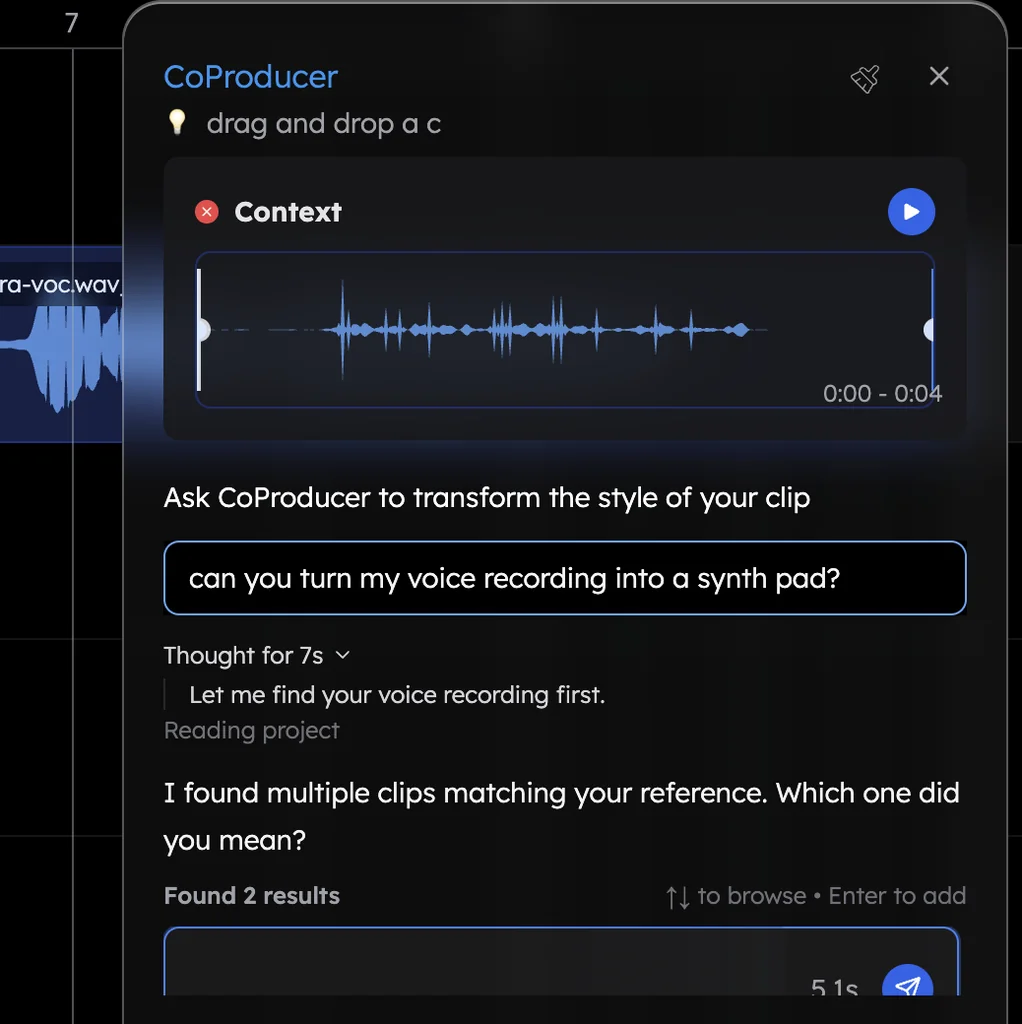
About 1 in 4 first requests in Veena refer to the user's own audio: a recording, a demo, a loop, a voice memo (Veena's own data). So this round matters. Record straight into Veena from your mic — a count-in, a live waveform, and a red box that shows where the take will land — or drop in a file: WAV, MP3, M4A, FLAC, AIFF and more. CoProducer measures the take's tempo, finds the downbeat, maps where your syllables fall, sets the project tempo to match, and builds every new part to follow your phrasing. Hum a melody and ask for it as a saxophone, and CoProducer turns your voice into that instrument.
How the others handle round 3:
- Moises Studio comes closest: its AI adds parts to what's already in your session, from "over 55 genre presets across 5 instrument types". But you can't see its full pricing without logging in, and your own VST3 plug-ins load only "in the Studio desktop app".
- Suno Studio accepts uploads of "WAV, mp3, and MIDI files" — inside the $30 Premier plan.
- Aiode can't record yet: BandLab's own announcement says "Native audio recording and additional DAW functionality are planned for future versions of Aiode".
- Muse and Delphos work on MIDI, in or beside the DAW where your voice was recorded.
Round 3 goes to Veena: your voice becomes the centre of the song, and any instrument.
Round 4: your own plug-ins, in a studio you don't install
Install the Veena Bridge helper app once. It runs quietly in the background, and your own plug-ins open in native windows next to the browser studio: AU and VST3 on a Mac, VST3 on Windows. CoProducer weighs your installed plug-ins against the built-in sounds, knows products like Serum, Kontakt, Omnisphere and the FabFilter Pro range by name, and starts from their real presets. In a shared session, the computer that has the plug-in renders the audio for collaborators who don't. The Veena Bridge guide walks you through the setup.
How the others handle round 4:
- Suno Studio 2.0: "Suno Studio is not compatible with VST or Audio Units plugins", and "Studio does not have direct DAW sync or plugin-host integration" (Suno's help centre, September 2026). More in does Suno Studio support VST or AU plugins?
- Moises Studio: your VST3 plug-ins load in its desktop app, not its browser studio.
- Mozart AI says it runs with "no downloads, plugins, or installations".
- LUNA 3.0 and RipX DAW are installs before they are anything else. LUNA is "for macOS and Windows"; RipX wants a Mac or Windows PC with 8 GB of RAM and 20 GB of free disk.
Round 4 goes to Veena: the plug-ins you already paid for, in a studio you open in a tab.
Round 5: mix it, export it, keep it
CoProducer balances the levels and pan, adds and tunes effects on each part, and finishes the mix for release. Then open Export: WAV 24-bit/48 kHz, MP3 320 kbps, MIDI, or MP4 when the project has video, as the full mix or every track in a zip. Veena shows you the file count, names and sizes before anything downloads. There is no cap and no watermark on any plan, and Veena's terms say "you own the Output you generate through your use of the Service." The export formats guide has every setting.
How the others handle round 5:
- Suno caps song downloads on its Free and Pro plans: up to 7 lifetime trial downloads on Free for accounts opened before 3 September 2026, 20 a month on Pro, 60 on Premier. Only Studio exports on Premier are uncapped. And you "may not commercially exploit Output that has not been downloaded" (Suno's Terms of Service, September 2026).
- Soundverse tells Pro users "Your final composition can't have 100% of Soundverse generated content" (Soundverse help centre, September 2026).
- Mozart AI reserves "releasing your songs" for "a Creator subscription or higher".
- Aiode's free plan allows "2 Mix or Region exports a month", "without a commercial license".
- Muse puts "Export for commercial use" on its $15-a-month Pro plan.
- Moises Studio exports "DAWproject and Ableton Live Set" files, "so you can easily open up files in compatible DAWs" — its finish line is someone else's studio.
Round 5 goes to Veena: every track, every format, as often as you like, and the music is yours.
Round 6: the price to start, and what you need to run it
Veena is free to start: the free plan includes a daily CoProducer allowance and the entire studio — stems, plug-ins, real-time collaboration and export. Veena Pro, $20 a month, removes the daily request cap and unlocks the premium models. It runs in Chrome and other modern browsers on any Mac, Windows, Linux or Chromebook laptop, and the AI runs on Veena's servers, so no graphics card is needed.
What the others charge, from their own pages (September 2026):
- Suno Studio 2.0: $30 a month, or $24 billed yearly, as part of Premier.
- Moises Studio: "Log in to see our full pricing and features table"; its iOS plans run from $5.99 to $29.99 a month.
- Soundverse: prices appear only after you sign in.
- Delphos: free only if you "Bring-your-own LLM"; Pro, with the integrated model, is $50 a month.
- RipX DAW: $99, or $198 for Pro.
- LUNA 3.0: the Studio tier with its Moises-powered tools is $199, or $19.99 a month inside UAD Spark Studio.
- Muse: "Export for commercial use" needs Pro, $15 a month.
- Aiode: $9.99 or $19.99 a month for commercial use.
Round 6 goes to Veena: free, complete and on any laptop.
Six rounds, six wins
Every rival here does one piece of the job. Suno Studio sells a studio on top of a generator. Moises Studio adds parts to a song you've started. LUNA and RipX are installs with AI tools that read audio. Muse and Delphos hand MIDI to another DAW. Aiode is still in beta. Veena does the whole job — a producer who builds the song from your words and your voice, the studio to finish it in, and no cap on what you take out. Start with the prompt below, then read the AI music tools comparison for the generators and utilities.
Related reading: best AI DAW 2026 · Veena vs Suno · the Muse alternative · the Aiode alternative · the LUNA alternative
Try this in Veena
Make a 90 BPM boom bap beat in D minor: dusty swung drums with a hard snare on 2 and 4, a deep round bass, a chopped jazzy Rhodes loop, vinyl crackle and a short horn stab for the hook. 4-bar intro, 16-bar verse, 8-bar hook, 16-bar verse, 8-bar hook, 4-bar outro.
Frequently asked questions
Which AI DAW wins a head-to-head comparison?
Veena. Veena is an AI DAW with a personal music producer built in. Describe the song you want and CoProducer builds it with you — beats, chords, melody, arrangement and mix — as real tracks you can edit, mix and export. Free, in your browser. It wins all six rounds: one sentence to a song, changing one part, your voice, your plug-ins, export and price.
How does Veena compare with Suno Studio 2.0?
Suno Studio is part of Suno's $30-a-month Premier plan, is 'not compatible with VST or Audio Units plugins' and does not support phones (Suno's help centre, September 2026). Its Studio Chat, in beta, edits your project. Veena's CoProducer builds and edits the whole song as real tracks on a free plan, loads your own VST3 and AU plug-ins and exports every track with no cap.
How does Veena compare with Moises Studio?
Moises Studio is a real-time collaboration room whose AI 'generates parts that fit' what is already in your project. Its full pricing sits behind a login, and your own VST3 plug-ins load only in its desktop app (moises.ai, September 2026). Veena has real-time collaboration too, plus CoProducer, a producer who builds the whole song from one sentence, with your plug-ins in the browser.
Are Muse and Delphos AI DAWs?
Neither calls itself one. Muse is 'a multi-track MIDI editor with a deeply integrated AI agent', designed to complement your existing DAW, and Delphos is a copilot that 'plugs into your DAW' (their own sites, September 2026). Both are built to work beside another DAW. Veena is the whole AI DAW: CoProducer writes the parts, and the same studio records, mixes and exports them.
Which AI DAW is cheapest to start with?
Veena. It is free to start in your browser, with a daily CoProducer allowance, the full studio and no cap on exports; Veena Pro is $20 a month. By comparison, Suno Studio needs the $30-a-month Premier plan, Delphos Pro is $50 a month, RipX DAW costs $99 to $198 and LUNA's Studio tier is $199 (their own pages, September 2026).
Meet your personal music producer
Free, in your browser. Describe the song you want and CoProducer builds it with you.
Make music free