Make Trance Music
Make trance music with a personal music producer who builds the build for you. Free in your browser, CoProducer lays down the four-on-the-floor kick, the rolling bass, the supersaw anthem and the breakdown that makes the drop land in Veena, every one a real track you can edit. Trance mostly runs 128–140 BPM, and the arrangement is the genre.
Veena is an AI DAW with a personal music producer built in. Describe the song you want and CoProducer builds it with you — beats, chords, melody, arrangement and mix — as real tracks you can edit, mix and export. Free, in your browser. In trance, that means every riser, every snare roll and every bar of the breakdown sits on the timeline where you can move it.
A trance track is a machine for one moment: the drop after the breakdown, when the kick comes back under a melody you have been waiting two minutes to hear at full size. Everything else, the long intro, the tease of the hook, the silence before the drop, exists to make that moment hit.
The arrangement is the genre
Trance moves in 8, 16 and 32-bar phrases, and every change lands on a phrase boundary. The extended mix, the version DJs play:
| Section | Bars | On the dancefloor |
|---|---|---|
| Intro | 32 | Kick, hats and bass only, so a DJ can mix in |
| Build 1 | 16 | Pads enter, the arp teases the hook, a snare roll in the last 8 |
| Drop 1 | 32 | The full groove with the hook on a pluck, the lead held back |
| Breakdown | 32 | No kick: the anthem on piano and pads, then the lead, reverb everywhere |
| Build 2 | 16 | Riser, snare roll from 8ths to 32nds, the kick gone in the last bar |
| Drop 2 | 32 | The supersaw anthem at full width, every layer in |
| Outro | 32 | Back down to kick, hats and bass for the next DJ |
That is 192 bars: about 5 minutes 34 seconds at 138 BPM. The radio edit keeps the same shape and trims the edges: intro 8, build 8, drop 32, breakdown 16, build 8, drop 32, outro 8. That's 112 bars, about 3 minutes 15 seconds, and it's the shape of the prompt further down.
The groove: four on the floor and a rolling bass
One bar of the trance engine on a 16th grid:
Beat      1 e & a 2 e & a 3 e & a 4 e & a
Open hat  . . x . . . x . . . x . . . x .
Clap      . . . . X . . . . . . . X . . .
Kick      X . . . X . . . X . . . X . . .
Bass      . x x x . x x x . x x x . x x x
The kick hits every beat. The open hat sits on every offbeat, the "and", which is what makes the groove lift. The bass plays the three 16ths after each kick and skips the one the kick lands on, so the two never collide: that gap is the pump of trance, written into the notes. Add 16th closed hats or a shaker at low velocity for motion.
In Veena, Pluck Bass is short and percussive with no sustain, right for a rolling line; Techno Sub is a weightier rolling sub; Acid Bass, a resonant squelch with slides, turns any section into acid trance. For the drums, the TR909 kit is the classic rave machine sound, and the Electronic kit is the more synthetic alternative.
Chords and the anthem hook
Trance harmony is minor, simple and huge:
- i–VI–III–VII (Am–F–C–G): the euphoric loop.
- VI–VII–i (F–G–Am): the rising, cinematic cadence for the end of a phrase.
- i–VI–VII (Am–F–G): unresolved, perfect for a build.
- i–iv–VI–VII (Am–Dm–F–G): heavier, for tech and progressive.
Voice the pads wide, with sus2 and add9 chords (Fsus2 is F, G, C) and let one note, often the root of the key, ring through every chord on top. The bass follows the roots.
The anthem is the hero, and it is simpler than it sounds: an 8-bar phrase built from a two-bar motif stated, repeated, varied and resolved, usually as 16th-note chord tones with a longer note to finish. Tease it in drop 1 on a pluck, reveal it slowly on piano in the breakdown, then let the supersaws play it at full size in drop 2. CoProducer's melody generator writes hooks like this against the chords already on your timeline, and the chord progression generator handles the loop underneath.
The sound palette
| Job | Veena preset |
|---|---|
| Anthem lead | Supersaw Lead: seven detuned saws, built for trance hooks |
| Cutting single lead | Bright Saw Lead |
| Arps and teases | Bright Pluck, Snap Pluck |
| Pads | Warm Pad, String Pad, Glass Pad for sparkle |
| Breakdown chords | Filter Sweep, a chord bed that opens and closes on its own |
| Choir air | Vox Pad |
| Breakdown piano | Acoustic Grand Piano |
| Builds | Riser: climbs an octave in pitch over one long note |
Building the build
The build is where trance producers earn their name. Four moves, stacked over 8 or 16 bars:
- The snare roll. Quarter notes for four bars, 8ths for two, 16ths for one, 32nds for the last. Ramp the velocity from soft to full in the piano roll's velocity editor, and use the ⅛-beat snap for the 32nds.
- The riser. Veena's Riser preset climbs an octave in pitch across one long held note, landing on the note you wrote; hold it for the length of the build. Ask CoProducer's sample search for a white-noise riser and a downlifter too; transitions are among the sounds it finds.
- The subtraction. Pull the kick and bass out for the last bar, or just the last beat. The silence is what makes the drop hit.
- The landing. Crash, kick and bass all back on beat 1 of the drop, the lead starting on the same downbeat.
Make trance music with CoProducer
Trance is a genre where the first message should carry the whole blueprint: tempo, kick, bass pattern, chords, the lead and the bar count of every section. Among Veena's new users, 81.5% of those who name a genre in their first request have a finished first result by the end of day one, and a request this precise leaves CoProducer nothing to guess.
- Head to daw.veena.studio and use Google to sign in. The AI runs on Veena's servers, so any laptop keeps up.
- Paste the prompt:
Make a 138 BPM uplifting trance track in A minor: a punchy four-on-the-floor kick on the TR909 kit with an open hat on every offbeat, a clap on 2 and 4 and a snare roll that climbs from 8ths to 32nds through each build; a rolling Pluck Bass playing the three 16ths after every kick and following the chord roots; Warm Pad and String Pad chords on Am–F–C–G; a 16-bar anthem hook on Supersaw Lead doubled an octave up by Bright Pluck; a Riser into both drops. Intro 8 bars with kick, hats and bass, build 8, drop 32, breakdown 16 with no kick and the hook on Acoustic Grand Piano over the pads, build 8, final drop 32, outro 8.
- Watch the plan. CoProducer sets the tempo and key, lays out the seven sections, then writes the parts. The hook waits for the chords and reads the notes actually placed, so the melody fits every change.
- Pick from three. Each new part lands as three options in one carousel. Keep the hook that makes the hair stand up.
- Shape it. Talk to CoProducer like a studio partner, "longer breakdown", "brighter lead", and undo any change in one step.
Worth asking for next:
- "Make it an extended mix: 32-bar intro and outro for DJs."
- "Turn the drop pads into a gated 16th-note rhythm."
- "Add an Acid Bass line under the second drop."
- "Give the breakdown a Vox Pad choir and put the Cathedral reverb on its lead."
- "Pull the kick and bass out for the last bar of each build."
The production chain
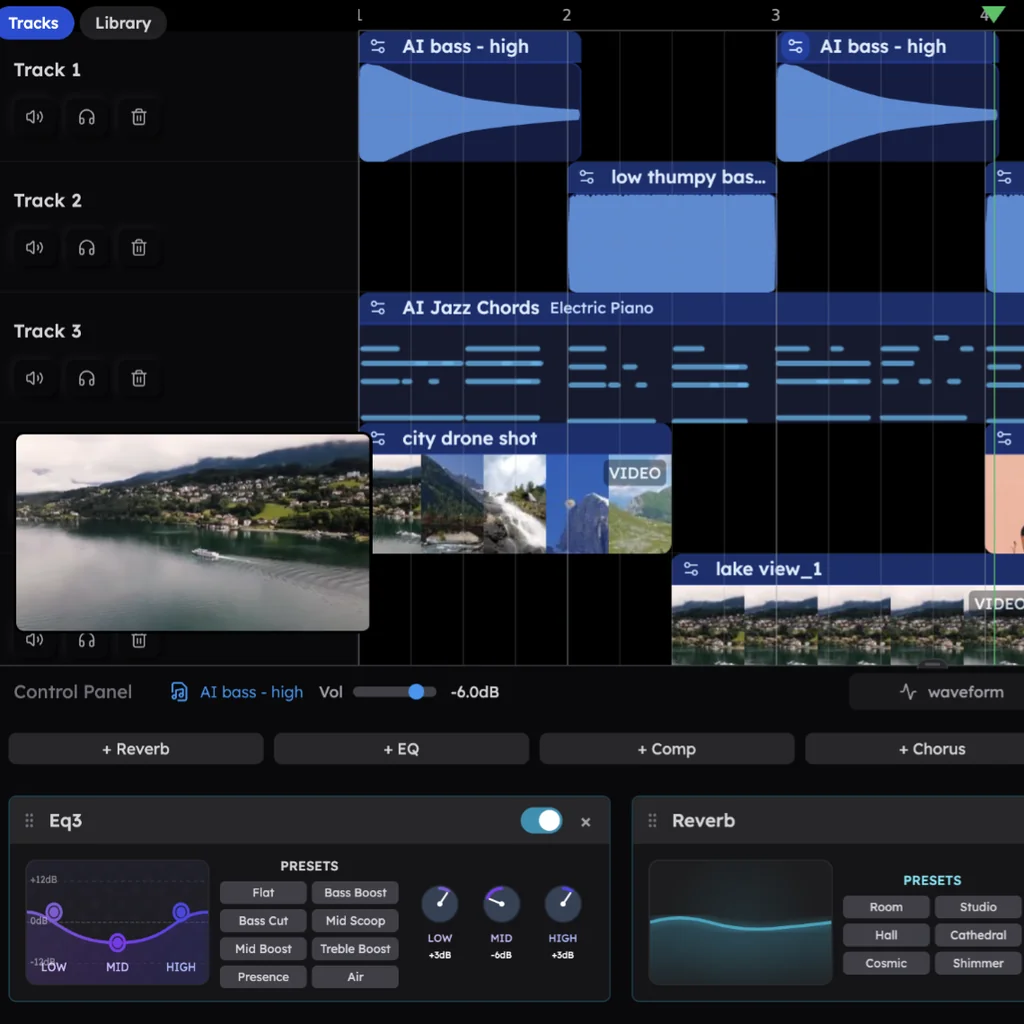
In Veena, effects live on each clip, and trance can use that: the breakdown's lead clip can carry a huge reverb while the drop's lead clip stays tighter.
- Kick first. It's the loudest thing in the track and nothing else sits on its 16th. The rolling bass pattern already keeps the low end clear.
- Bass: mono, no chorus, a little compression for an even roll.
- Supersaws: cut the low shelf by 6–9 dB below about 250 Hz so they stop clouding the bass, add the Chorus effect's Wide preset, and lift the high shelf a couple of dB near 10 kHz for sheen.
- The trance delay: a dotted 8th. Turn the Delay's Sync off and set Time to 326 ms, a dotted 8th at 138 BPM, with Ping-Pong up so the repeats bounce between the speakers.
- Reverb: Hall (2.8 seconds) on the lead in the drops, Cathedral (5.2 seconds) in the breakdown, Plate on the clap.
- Pads: the Chorus effect's Ensemble preset and a low-shelf cut, so they fill the width and leave the bottom to the bass.
Then hand CoProducer the finishing pass: "a big uplifting trance mix, kick and bass tight, supersaws wide, the breakdown drenched in reverb". AI mixing in Veena balances every part against the kick.
Trance terms
Supersaw: several detuned saw waves stacked into one wide sound. Rolling bass: 16th-note bass that skips the kick. Offbeat bass: one bass note on each "and", the older trance pattern. Breakdown: the section without the kick where the melody is revealed. Build: the tension section before a drop, driven by snare rolls and risers. Riser and downlifter: sweeps that climb into a section and fall out of one. Gate: chopping a sustained pad into a rhythmic 16th pattern. KBBB: kick-bass-bass-bass, the rolling pattern of psytrance.
Common trance mistakes
- A drop that misses the downbeat. Everything returns on beat 1, together.
- A thin lead. One saw is not an anthem. Layer the supersaw with an octave-up pluck.
- Low-mid fog. Pads and saws full of low end smother the bass. Cut their low shelf.
- Kick and bass on the same 16th. Leave the kick's step empty in the bass line.
- Reverb in the drop. Save the long tails for the breakdown so the drop feels close and loud.
- Phrases that break the grid. Change something every 8 bars and never mid-phrase.
- A flat snare roll. Ramp the velocity, or it just sounds like a stuck note.
- A hook nobody can hum. If it doesn't fit in two bars and repeat, simplify it.
Trance sub-genres
- Uplifting trance: 136–140 BPM, euphoric minor loops, long breakdowns and supersaw anthems.
- Progressive trance: 128–134 BPM, rolling grooves and slow, evolving builds; Filter Sweep chords; a close relative of house.
- Vocal trance: the uplifting shape built around your own vocal, recorded in Veena.
- Psytrance: 140–148 BPM, the KBBB rolling bass, Acid Bass squelches and Phrygian riffs; it shares a floor with techno.
- Tech trance: techno drums and stabs under trance chords.
- Acid trance: a 303-style Acid Bass line as the lead character.
- Hard trance: 145–155 BPM, harder kicks, shorter breakdowns.
For the bigger festival end of the spectrum, see how to make EDM, and the synthwave page for the 80s cousin of the supersaw. Every other style is on make music by genre.
Try this in Veena
Make a 138 BPM uplifting trance track in A minor: a punchy four-on-the-floor kick on the TR909 kit with an open hat on every offbeat, a clap on 2 and 4 and a snare roll that climbs from 8ths to 32nds through each build; a rolling Pluck Bass playing the three 16ths after every kick and following the chord roots; Warm Pad and String Pad chords on Am–F–C–G; a 16-bar anthem hook on Supersaw Lead doubled an octave up by Bright Pluck; a Riser into both drops. Intro 8 bars with kick, hats and bass, build 8, drop 32, breakdown 16 with no kick and the hook on Acoustic Grand Piano over the pads, build 8, final drop 32, outro 8.
Frequently asked questions
What BPM is trance music?
Most trance runs 128–140 BPM. Uplifting and vocal trance sit around 136–140, with 138 the classic, progressive trance is slower at about 128–134, and psytrance and hard trance push to 140–150 and beyond. Open your request to Veena's CoProducer with it, as in "138 BPM uplifting trance in A minor", and the kick, bass and leads all lock to that tempo.
What chords are used in trance?
Minor keys and four-chord loops: i–VI–III–VII (Am–F–C–G), VI–VII–i (F–G–Am) and i–VI–VII (Am–F–G) carry most of the genre, voiced on pads with sus2, add9 and seventh chords for air. Veena's CoProducer takes them by numerals or chord names and places the progression as MIDI, one chord per bar or however you ask.
How do you make a supersaw lead for trance?
Start from Veena's Supersaw Lead: seven detuned saws spread wide over an octave-down stack, built for trance anthems. Double the hook an octave up with Bright Pluck, add the Chorus effect's Wide preset and a dotted-8th delay. Prefer a plug-in synth you own? Connect it with the Veena Bridge and CoProducer will work from that synth's presets.
How long is a trance track?
An extended mix runs five to eight minutes, with 32-bar intros and outros that DJs mix across; a radio edit lands around three to four. In Veena, give CoProducer the bar counts, for example "intro 32, build 16, drop 32, breakdown 32", and it maps the sections and builds every part to that length. Export either version as WAV, MP3 or stems.
Can I make vocal trance with Veena?
Yes, with your voice. CoProducer builds every instrumental part around your own vocal: the groove, the pads, the supersaw hook and a breakdown that leaves room for the verse. Record the vocal straight into Veena from your mic, or drop in a recording you already have, and CoProducer measures its tempo and phrasing before it writes around it.
Meet your personal music producer
Free, in your browser. Describe the song you want and CoProducer builds it with you.
Make music free