Make House Music
Your personal music producer can make house music with you online, free: describe the groove to Veena's CoProducer and it builds a four-on-the-floor kick at 120–128 BPM, a bassline that lives between the kicks and seventh-chord stabs on the offbeats, each as a real track you can edit, mix and export.
House was born in Chicago in the early 1980s and named after a club, the Warehouse. Four decades later its deal with the dance floor hasn't changed: a kick on every beat, a groove that never stops, and changes that arrive in 8- and 16-bar steps so a DJ can mix in and out. Get those three right and everything else is taste.
What makes a track house
| Element | What house does | Where to start |
|---|---|---|
| Tempo | 118–130 BPM; deep house 118–124, tech house 124–128 | 124 BPM |
| Feel | 4/4, a straight kick, 16th-note hats with a light shuffle | Shuffled 16ths |
| Kick | On every beat, same weight, from the first bar to the last | TR909 kick |
| Backbeat | Clap or snare on 2 and 4 | Clap |
| Hats | Open hat on every offbeat, closed 16ths around it | Offbeat open hat |
| Bass | Short notes between the kicks, or a rolling organ bass | Offbeat bass |
| Harmony | Minor 7th and 9th chords, one- or two-chord vamps | Am9–Dm9 |
| Sounds | 909 drums, organ bass, electric piano and piano stabs, pads, vocal chops | Electric Piano stabs |
| Form | 8-bar phrases, 16- and 32-bar sections, drums-only intro and outro | 16-bar intro |
The groove: one bar that runs all night
Program this bar and you have the engine of a house record. X is a full hit, x a softer one, on a 16th-note grid:
Groove    1 e & a 2 e & a 3 e & a 4 e & a
Kick      X . . . X . . . X . . . X . . .
Clap      . . . . X . . . . . . . X . . .
Open hat  . . X . . . X . . . X . . . X .
Hat       x x . x x x . x x x . x x x . x
The open hat on every "and" is the part people dance to: it answers the kick four times a bar. The closed hats skip the steps where the open hat plays, the way a real hi-hat chokes.
House also swings a little. Push every second 16th (the "e" and the "a" of each beat) slightly late and the groove starts to roll instead of tick. In Veena, ask CoProducer for "shuffled 16th hats" and audition the three takes it offers. Then vary the velocities: loud on the offbeats, softer in between.
Every 8 bars, change something small: drop the kick for the last beat or add a clap on the final 16th. Every 16 bars, bring a part in or take one out. That rhythm of change keeps a six-minute loop alive.
Veena's drum kits cover kick, snare, clap, rim, hats, toms and cymbals. House also wants shakers and congas, so ask CoProducer for a shaker loop: it searches 27,356 curated samples plus a licensed professional catalogue, shows ten preview cards, and fits the loop you pick to your section. The AI drum generator writes the bar above and its variations; the house drum pattern page goes deeper on grooves.
The bassline lives between the kicks
The oldest trick in house is still the best one: play the bass on the offbeats. With the kick on every beat and the bass on every "and", the two never collide, and the groove bounces on its own. In A minor, that is an A on each offbeat under Am9, a D under Dm9, and a quick climb through E and G on the last two offbeats before the loop comes round. On Veena's Deep House Bass, draw them in octave 2 (A2, D2, E2, G2): its oscillators sound an octave below the written note, so they land where a house sub should sit.
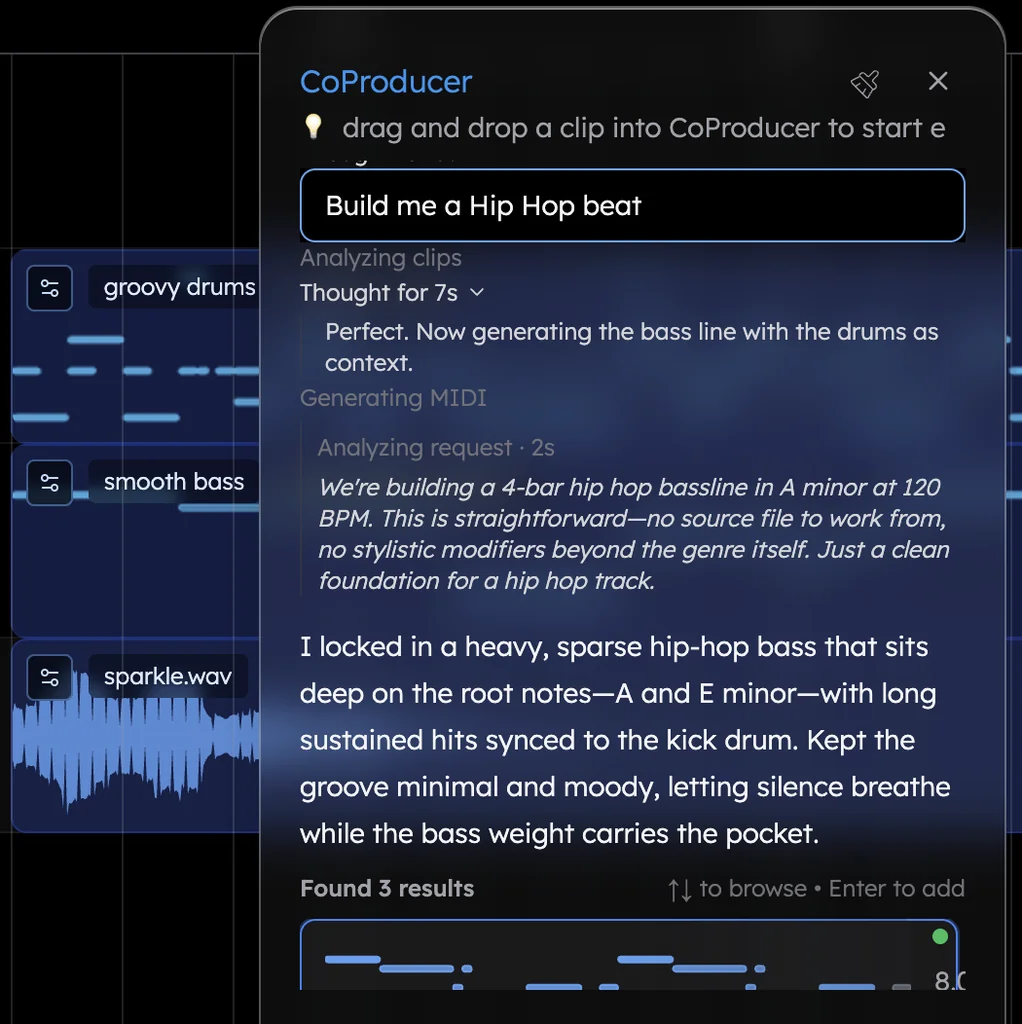
Four bass shapes cover most of the genre:
- Offbeat stab. Short notes on every "and", as above. Deep and tech house run on it.
- Octave bounce. The root on the offbeat and the octave above one 16th later, the disco-house skip.
- Organ bass. A longer, hollow note that holds through the beat. Veena's House Organ Bass stacks a fifth on top, the classic sound of 90s house and UK garage.
- Acid. A 303-style line with slides and accents on Acid Bass, the heart of acid house.
For deep and tech house, Deep House Bass is a rounded, chorused synth bass with a short filter pluck. All of these live on Veena's own synth, so each has four macro knobs. BRIGHTNESS opens the filter, and on House Organ Bass and Deep House Bass, EDGE adds drive: turn BRIGHTNESS down and the line gets deeper without getting louder. The bassline generator writes lines like these against the kick you already have, and when you want the full pump, ask for it in words and CoProducer handles the ducking in the mix.
Chords: sevenths, ninths and the stab
House harmony is short and rich. Most tracks loop one or two chords for the whole song, so each chord has to be interesting on its own: minor 7ths and 9ths, voiced close together in the middle of the keyboard and played as short stabs rather than held.
| Loop | Chords | Played as | Where you hear it |
|---|---|---|---|
| i9–iv9 | Am9–Dm9 | Electric Piano stabs on the offbeats | Deep house |
| One shape moved in parallel | Am7–Cm7–Dm7 | Short, bright Stab Lead hits | Chicago and tech house |
| vi–IV–I–V | Am–F–C–G | Acoustic Grand Piano bouncing in octaves | Piano house |
| IVmaj7–iii7–ii7–Imaj7 | Fmaj7–Em7–Dm7–Cmaj7 | String Pad or Warm Pad, held | Soulful house |
Leave the root to the bass. Voice Am9 as C–E–G–B over the bassline's A, and Dm9 as F–A–C–E over D: the chord part gets lighter and the low end gets clearer. Stabs usually land on the "and" of 2 and 4, or on every offbeat alongside the bass. Start one a 16th before the bar and the whole loop leans forward.
The parallel row is the stab sound of early house: one minor-seventh shape slid up and down the keyboard, written as MIDI you can drag around the piano roll. More loops on the house chord progressions page.
House sounds in Veena
| Job | Veena sound | Why it works |
|---|---|---|
| Drums | TR909 kit, or Electronic for tech house | Tight kick, bright clap and hats |
| Chord stabs | Electric Piano, Stab Lead | Soft tines for deep house; a bright saw stab with its own ping-pong echo |
| Pads | Warm Pad, Vox Pad, String Pad | Held chords for the breakdown |
| Movement | Filter Sweep | A chord bed whose filter opens and closes by itself |
| Build | Riser | One held note that climbs an octave into the drop |
| Percussion and vocals | The sample library | Shaker and conga loops, vocal chops |
The Riser needs time to climb, so hold one note across the last four bars of the build. Own a favourite organ plug-in? Load it through the Veena Bridge: VST3 on Mac and Windows, AU on Mac.
House arrangement map
| Section | Bars | What plays |
|---|---|---|
| Intro | 16 | Kick, clap, hats and shaker: drums only, so a DJ can mix in |
| Groove | 16 | The bassline joins; a hint of the stab in the last 4 bars |
| Breakdown | 16 | Kick out; Warm Pad holds Am9–Dm9, the vocal chop enters |
| Build | 8 | Snare roll from 8ths to 16ths, Riser across the last 4 bars |
| Drop | 32 | Everything: kick, bass, stabs, hats, vocal hook |
| Break | 8 | Kick and bass out, stabs and hats keep the pulse |
| Second drop | 16 | Everything again, plus one new layer |
| Outro | 16 | Back to drums only, a part leaving every 4 bars |
That is 128 bars, about 4 minutes 8 seconds at 124 BPM. For an extended club mix, stretch the intro and outro to 32 bars each and the track runs about 5 minutes 10 seconds.
Make house music with CoProducer
- Open daw.veena.studio and sign in with Google. A new project opens in your browser tab, with nothing to download.
- Paste the prompt:
Make a 124 BPM deep house track in A minor: TR909 kit with a four-on-the-floor kick, clap on 2 and 4, an open hat on every offbeat and shuffled 16th closed hats; a shaker loop from the sample library; an offbeat bassline on Deep House Bass that sits between the kicks; Am9–Dm9 stabs on Electric Piano on the offbeats; a Warm Pad holding the chords in the breakdown; a vocal chop hook; a snare roll and a Riser into the drop. Intro 16 bars drums only, groove 16 with the bass, breakdown 16, build 8, drop 32, break 8, second drop 16, outro 16 drums only for DJs.
- Let it build. CoProducer sets 124 BPM and A minor, lays the sections out on the song-section ribbon under the ruler, and writes the parts. Parts that depend on each other are written in order: the bassline reads the kick notes actually on the timeline, so it lands in the gaps.
- Choose. Each new part arrives as three options in one carousel: arrow keys to browse, Enter to add. The shaker loop and the vocal chop come as ten preview cards.
- Push it further in plain English, one undo per change.
- Export a 24-bit/48 kHz WAV for your DJ software, an MP3 to share, or every track as stems in a zip, with no watermark and no cap on exports. The music is yours.
House is one of the five genres Veena users ask for most, and CoProducer delivers on it: in Veena's own data, 81.7% of new users whose first request asks for house get a first result on day one.
Requests worth making after the first pass:
- "Take the kick out for the whole breakdown and bring it back on the first bar of the drop."
- "Turn the Dm9 into a Dm11 and move every stab a 16th earlier."
- "Swap the bass to House Organ Bass and let it hold the root for a full beat."
- "Give me 32-bar drums-only intro and outro sections for an extended mix."
Mixing house in Veena
Every clip in Veena carries its own effect chain, built from ten effects (8-Band EQ, Compressor, Reverb, Delay, Chorus, Utility and more) plus a slot for your own plug-ins, and every track has a fader and pan. Mix house kick-first:
- Kick and drums. Set the drum level before anything else, then build every other part underneath it. On the drum clip's 8-Band EQ, raise the low shelf a dB or two around 60 Hz for weight and dip 300–500 Hz where boxiness lives. The Compressor's Drums preset (4:1 with a 5 ms attack) evens the groove out, and the Room reverb's 0.9-second tail puts the clap in a space.
- Bass. Add Utility to the bass clip and switch Mono on: club systems and phone speakers both want the low end in the centre.
- Stabs. A Delay on the Dotted preset (a tempo-synced dotted-quarter echo) throws the chord into the gaps; a Plate reverb adds shine. On Stab Lead, the MOVEMENT knob already brings in a ping-pong echo.
- Pads. Pull the low shelf down so they stay clear of the bass, add Chorus on the Ensemble preset for width, and send them into a Hall reverb.
- Finish. Ask CoProducer for "a loud, clean club master with the kick on top" and it balances the levels, pans and effects on every part. Check it on headphones and a phone speaker.
Mistakes that make house sound flat
- Kick and bass on the same 16th. They fight for the low end. Move the bass to the offbeats.
- A dead-straight grid. No shuffle and one velocity on every hat sounds like a metronome. Swing the 16ths and accent the offbeats.
- Too many chords. House is hypnotic. Two chords that sound great beat eight that go somewhere.
- Everything from bar 1. If the drop is already playing in the intro, it can't land. Earn it with the breakdown.
- No room for the DJ. A track that opens on pads and vocals is hard to mix. Give it drums at both ends.
House terms
Four-on-the-floor: a kick on every beat of the bar. Offbeat: the "and" between beats, home of the open hat and the bass. Shuffle: every second 16th played slightly late. Stab: a short, punchy chord. Breakdown: the section where the kick drops out. Drop: the return of the full groove. Pump: the bass and pads ducking every time the kick hits. DJ intro: 16 or 32 bars of drums a DJ can mix over.
House sub-genres to try next
- Deep house: 118–124 BPM, Am9–Dm9 on Electric Piano, Deep House Bass, Vox Pad and soft claps.
- Acid house: 120–128 BPM, an Acid Bass line with the EDGE knob up for more squelch; the acid section of how to make techno has the full recipe.
- Tech house: 124–128 BPM, drum-led, one-note bass stabs, the Electronic kit and a vocal chop hook.
- Piano house: 120–126 BPM, Acoustic Grand Piano chords bouncing in octaves, big breakdowns.
- Progressive house: 126–130 BPM, long builds, Filter Sweep beds and a Supersaw Lead; close to how you make EDM.
- Afro house: 118–124 BPM, layered shaker and conga loops, rolling toms; a cousin of how you make Afrobeats.
- UK garage: 130–134 BPM, shuffled 2-step drums and House Organ Bass; see the UK garage drum pattern.
Pick a style, give CoProducer its tempo and two or three sounds from the table above, and build from there. The full list of styles is under make music by genre.
Try this in Veena
Make a 124 BPM deep house track in A minor: TR909 kit with a four-on-the-floor kick, clap on 2 and 4, an open hat on every offbeat and shuffled 16th closed hats; a shaker loop from the sample library; an offbeat bassline on Deep House Bass that sits between the kicks; Am9–Dm9 stabs on Electric Piano on the offbeats; a Warm Pad holding the chords in the breakdown; a vocal chop hook; a snare roll and a Riser into the drop. Intro 16 bars drums only, groove 16 with the bass, breakdown 16, build 8, drop 32, break 8, second drop 16, outro 16 drums only for DJs.
Frequently asked questions
Can I make house music online for free?
Yes. Veena is an AI DAW with a personal music producer built in. Describe the song you want and CoProducer builds it with you — beats, chords, melody, arrangement and mix — as real tracks you can edit, mix and export. Free, in your browser. For house, that means a TR909 groove, an offbeat bassline and seventh-chord stabs on separate tracks, with a drums-only intro a DJ can mix into.
What BPM is house music?
House runs from about 118 to 130 BPM. Deep house sits at 118–124, classic Chicago house around 120–126, tech house at 124–128 and progressive house at 126–130, so 124 is a safe place to start. Veena's CoProducer reads the tempo from your first message and sets the project to it, and tap tempo lets you match a record you love by ear.
How do I get the pumping sound in house music?
The pump is the bass and pads getting out of the way every time the kick lands. Half of it is arrangement: put bass notes and chord stabs on the offbeats, between the kicks. The other half is the mix, and in Veena you ask for it in plain words. CoProducer ducks the bass under the kick for you, and a single undo takes the change back.
How long should a house track be for DJs?
Club edits usually run five to seven minutes, with 16 or 32 bars of drums at each end so a DJ can blend in and out. Give Veena's CoProducer the section lengths in bars and it plans the arrangement to them. Then export a 24-bit WAV for your DJ software, with no watermark and no cap on how often you export.
Can I make house music with vocals in Veena?
Yes, with your own voice. Record the topline into Veena from your microphone, or drop in a voice memo, and CoProducer builds the groove around it: it measures the take's tempo and phrasing and writes every new part to fit. For the chopped vocal hooks of deep house, it searches the sample library and shows ten preview cards to choose from.
Meet your personal music producer
Free, in your browser. Describe the song you want and CoProducer builds it with you.
Make music free