Make Synthwave
Make synthwave with a personal music producer at your side. Free in your browser, Veena's CoProducer builds the pulsing bass, the arpeggio, gated 80s drums, chorused pads and a saw-lead hook as real tracks you can edit note by note. Most synthwave sits between 80 and 118 BPM in a minor key, and the arp never stops.
Synthwave is the sound of a film score from 1985 rebuilt with modern low end. A sequenced bassline runs in straight 8ths or 16ths, chords hang on wide pads, the snare explodes and dies in the same breath, and the lead sings like the theme of a movie that was never made. Get the pulse, the pads and the snare right, and everything else is taste.
The synthwave sound, part by part
| Element | What synthwave does | Start in Veena with |
|---|---|---|
| Tempo | 80–118 BPM; 100–112 for driving outrun | 104 BPM |
| Feel | Straight 8ths and 16ths, no swing: the sequencer is the groove | 4/4, straight |
| Keys | Minor keys; A, E, F# and C minor are home | A minor |
| Harmony | Four-chord minor loops, sevenths and add9s on the pads | Am–F–C–G |
| Drums | Machine drums, a huge snare on 2 and 4, tom fills | The Electronic or TR909 kit |
| Bass | 8th-note octave jumps or a 16th-note pulse on the root | Retro Pulse Bass |
| Arpeggio | Chord tones in 16ths, bounced by a delay | Bright Pluck |
| Pads | Slow attack, heavy chorus, wide | Warm Pad, String Pad |
| Lead | A single saw with glide and late vibrato | Bright Saw Lead |
The pulse: bass and arpeggio
The engine of synthwave is a part that never stops moving. There are two classic bass shapes, and most tracks use one per section.
The octave bass. 8th notes jumping between the root and the octave above it: A2, A3, A2, A3 across a bar of A minor, then F2, F3 when the chord moves to F (written for Veena's synth basses, which sound an octave below the note you draw). It sounds like a sequencer because it was one. Veena's Retro Pulse Bass is a chorused 80s pulse bass made for exactly this line; its built-in chorus keeps the repeated notes from sounding like a test tone.
The 16th pulse. Sixteen even notes a bar on the root, accenting the first of every four. This is the running, night-drive bass of outrun, and it works best in the chorus after an octave-bass verse.
Over the bass, the arpeggio plays the chord tones in 16ths: A3, C4, E4, A4 and back down over A minor, F3, A3, C4, F4 over F. Keep bass and arp rhythmically different, 8ths under 16ths or the other way round, so they interlock instead of flamming. When CoProducer writes both parts, open the piano roll with the snap on ¼ beat to edit in 16ths, and press Ctrl/Cmd+↑ or ↓ to move a selection by an octave.
Chords: minor loops and the heroic lift
Synthwave harmony is simple on paper and lush in the voicing. Short minor loops carry whole tracks:
| Progression | In A minor | What it feels like |
|---|---|---|
| i–VI–III–VII | Am–F–C–G | The night-drive loop |
| i–VI–VII | Am–F–G | Unresolved, looping back |
| VI–VII–i | F–G–Am | Rising, cinematic |
| i–VII–VI–VII | Am–G–F–G | Driving and relentless |
| i–iv–VI–V | Am–Dm–F–E | Darker, with the major V from harmonic minor |
| bVI–bVII–I | F–G–A | The major lift for a final chorus |
The last row is the genre's secret weapon: a minor track that ends its final chorus on A major instead of A minor sounds like the credits rolling on a hero who made it. On the pads, stretch the triads into sevenths and add9 chords (Fmaj7 is F, A, C, E; Cadd9 is C, D, E, G) and keep the lead on plain chord tones. CoProducer's chord progression generator writes any row of this table from its numerals, and every chord stays open to revoicing.
Gated 80s drums
The drums are machines, and proud of it. A verse starts with the kick on 1 and 3, a snare layered with a clap on 2 and 4, and closed hats in 8ths. For the chorus, move the hats to 16ths and add an open hat on the "and" of every beat. Every section change gets a tom fill: 16th notes falling from high tom to floor tom across beat 4, landing on a crash.
The snare is the signature. The 80s sound is a gated reverb: a big, dense room that is cut off abruptly, so the snare sounds enormous and still leaves space before the next hit. In Veena, put the Reverb effect on the snare clip, start from the Plate preset, pull Decay down to about 0.5 seconds and push Mix up. A short, dense, bright tail that dies fast gets you most of the gated sound, and CoProducer sets it for you when you ask for "a big gated 80s snare".
Two of Veena's seven drum kits suit the genre: the Electronic kit, built for synthwave and club music, and the TR909 kit for punchier, dance-leaning tracks. The AI drum generator writes the pattern; the Beat Maker step sequencer is there for nudging single hits.
Synthwave structure map
| Section | Bars | What you hear |
|---|---|---|
| Intro | 8 | Pad swell and the arp alone; drums enter at bar 5 behind a tom fill |
| Verse 1 | 16 | Octave bass, kick and snare, 8th-note hats; no lead |
| Pre-chorus | 8 | Chords move to VI–VII, the hats open, a snare roll fills bar 8 |
| Chorus | 16 | The lead hook, 16th-note bass, open hats, pads at full width |
| Verse 2 | 16 | A Bell Pluck counter-melody so it isn't a copy of verse 1 |
| Chorus 2 | 16 | Chorus 1 plus the lead doubled an octave up |
| Breakdown | 8 | Drums out; pad and arp only, like a film cutting to the skyline |
| Solo | 16 | Saw lead, saxophone or guitar over the chorus chords |
| Final chorus | 16 | Everything, with the bVI–bVII–I lift in the last four bars |
| Outro | 8 | Drums and lead drop away; the pad fades last |
That is 128 bars: about 4 minutes 55 seconds at 104 BPM. The outro matters more here than in most genres. Synthwave ends like a film, not a club track, so the pads should be the last thing you hear.
Make synthwave with CoProducer
- Go to daw.veena.studio in Chrome, Edge or another modern browser and sign in with Google. No graphics card needed, and nothing to install on Mac, Windows, Linux or a Chromebook.
- Paste the prompt:
Make a 104 BPM synthwave track in A minor: an 8th-note octave bassline on Retro Pulse Bass, a 16th-note arpeggio on Bright Pluck through a synced 1/8 ping-pong delay, Warm Pad chords on Am–F–C–G, gated 80s drums on the Electronic kit with a huge snare on 2 and 4 and a tom fill into every chorus, and a Bright Saw Lead hook in the choruses. Lift the last four bars of the final chorus to F–G–A major. 8-bar intro, 16-bar verse, 8-bar pre-chorus, 16-bar chorus, 16-bar verse, 16-bar chorus, 8-bar drumless breakdown, 16-bar lead solo, 16-bar final chorus and an 8-bar outro with the pad fading last.
- Watch the parts land. CoProducer sets the tempo and key, maps the ten sections, then writes the layers. Independent parts are written in parallel, while the arp waits for the pad chords and reads the notes actually placed, so it follows every chord change.
- Pick your favourites. Each new part arrives as three options in one carousel: ↑ and ↓ to browse, Enter to add. Anything that depends on the part is written against the one you keep.
- Steer in plain words. Every change is one undo.
Naming the genre up front pays off: among Veena's new users, a first request that names a genre ends in a finished first result on day one 81.5% of the time.
Five follow-ups worth typing:
- "Swap the drums to the TR909 kit and add an open hat on every offbeat in the chorus."
- "Give the snare a bigger gated 80s reverb."
- "Make the verse bass a 16th-note pulse instead of octaves."
- "Double the chorus lead an octave up with a Soft Lead."
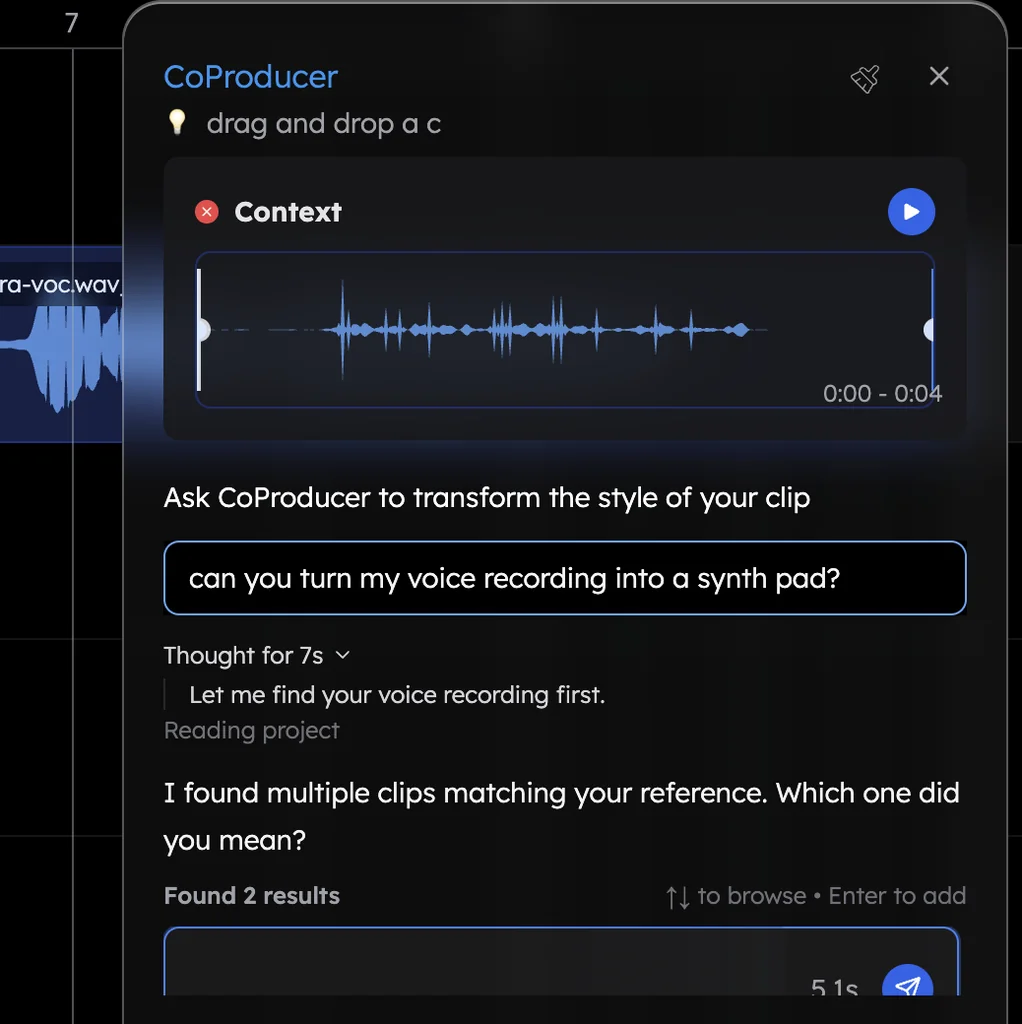
- "Turn my hummed melody into a saxophone for the solo."
That last one is Veena's voice to instrument: hum the solo, and CoProducer re-voices the take as a saxophone, pitch-corrected to the key, in about 12 seconds.
The production chain: chorus, delay, reverb
The 80s sheen comes from three effects used generously, all of them on the clip in Veena.
- Chorus on the pads. The Ensemble preset (a slow 0.5 Hz rate, 70% mix) is the wide, wobbling bed of the genre. Keep chorus off the lowest bass notes; a chorused sub smears the low end.
- Delay on the arp and lead. The Ping Pong preset is a synced 1/8 with the repeats bouncing left and right, perfect for the arp. For the lead, a dotted-8th echo is the classic: turn Sync off and set Time to 433 ms, which is a dotted 8th at 104 BPM.
- Reverb on everything but the bass. The Hall preset (2.8 seconds) on pads and lead, Cathedral for the breakdown, the short Plate trick on the snare.
- EQ for space. On the pads, use the 8-Band EQ's low shelf to cut about 6 dB below 200 Hz; the bass needs that room. The 80s top end was softer than today's: a 2–3 dB cut on the high shelf around 10 kHz takes the glare off bright hats.
- Glue and grit. The Compressor's Drums preset holds the kit together, and the Distortion effect on its Light preset, mix down near 15%, adds tape-style warmth to the bass.
CoProducer mixes too. Ask for "a warm 80s mix: wide chorused pads, the snare big and gated, the bass solid under the kick, mastered for streaming" and CoProducer balances every fader, pan and clip effect in one pass.
Five ways synthwave goes wrong
- Trap 808s. A sliding sub under synthwave pulls it straight into trap. Keep the bass a pulsing synth line.
- Tempo creep. Push outrun past about 120 BPM and it starts to read as electro-house. Darksynth is the exception; it earns its speed with distortion.
- Dry arps. Without delay, a 16th-note arp sounds like a ringtone. The repeats are half the part.
- Pad mud. Three wide pads plus the bass all stacking up under 250 Hz. Cut the pads' lows and let one layer own each register.
- Everything from bar one. Synthwave builds by addition. Start with pad and arp, bring the drums in, save the lead for the chorus.
Synthwave terms
Arp: an arpeggio, chord tones played one at a time in a repeating rhythm. Octave bass: a line jumping between a note and its octave on every 8th. Gated reverb: a big reverb cut off abruptly, the 80s snare sound. Portamento: a glide between two notes, built into Bright Saw Lead. Detune: stacking slightly mistuned oscillators for width. The lift: ending a minor-key track on bVI–bVII–I major. Outrun: the driving, night-highway strand of the genre.
Synthwave sub-genres
- Outrun: 100–118 BPM, octave bass, bright saw leads, the classic sound.
- Dreamwave and chillsynth: 80–95 BPM, Electric Piano chords, Soft Lead melodies, long reverbs.
- Darksynth: 110–130 BPM and up, distorted bass, Dark Pad and horror-film minor keys; closer in spirit to metal music.
- Synth-pop revival: verse-chorus songs built around your own vocal, recorded straight into Veena.
- Retro game themes: the chiptune cousin, covered on the game music page.
Want the bass on its own? The synthwave bassline page writes out the patterns note by note, and every other style is a click away under make music by genre.
Try this in Veena
Make a 104 BPM synthwave track in A minor: an 8th-note octave bassline on Retro Pulse Bass, a 16th-note arpeggio on Bright Pluck through a synced 1/8 ping-pong delay, Warm Pad chords on Am–F–C–G, gated 80s drums on the Electronic kit with a huge snare on 2 and 4 and a tom fill into every chorus, and a Bright Saw Lead hook in the choruses. Lift the last four bars of the final chorus to F–G–A major. 8-bar intro, 16-bar verse, 8-bar pre-chorus, 16-bar chorus, 16-bar verse, 16-bar chorus, 8-bar drumless breakdown, 16-bar lead solo, 16-bar final chorus and an 8-bar outro with the pad fading last.
Frequently asked questions
Can I make synthwave for free online?
Yes. Veena is an AI DAW with a personal music producer built in. Describe the song you want and CoProducer builds it with you — beats, chords, melody, arrangement and mix — as real tracks you can edit, mix and export. Free, in your browser. For synthwave, CoProducer lays down a pulsing Retro Pulse Bass, gated drums, chorused pads and a saw-lead hook, and every one of them stays editable.
What BPM is synthwave?
Most synthwave runs between 80 and 118 BPM: about 100–112 for driving outrun, 80–95 for dreamy chillsynth, while darksynth pushes past 120. Name a tempo when you ask Veena's CoProducer, say "104 BPM synthwave in A minor"; skip it and CoProducer picks a synthwave tempo for the new project itself.
What chords are used in synthwave?
Minor keys and short loops: i–VI–III–VII (Am–F–C–G), i–VI–VII (Am–F–G) and VI–VII–i (F–G–Am), voiced on pads as sevenths and add9 chords. The signature ending lifts from bVI and bVII to a major I (F–G–A). Ask Veena's CoProducer for any of them by name and the chords land as MIDI, ready to revoice note by note.
What synths do I need to make synthwave?
Nothing to install. Veena's own built-in synth has 39 presets, including Retro Pulse Bass for the arpeggiated bass, Warm Pad, String Pad, Bright Pluck and Bright Saw Lead, each with macro knobs CoProducer can set for you. If you own plug-in synths, the Veena Bridge loads your VST3 plug-ins (and AU on Mac) and CoProducer starts from their real presets.
How do I add a saxophone solo to a synthwave track?
Hum the solo into your mic in Veena, then ask CoProducer to turn the take into a saxophone. It re-voices your recording as the instrument, pitch-corrected to the project key, so the phrasing stays yours. Prefer notes? Ask CoProducer to transcribe the hum to MIDI instead, then edit the solo note by note in the piano roll.
Meet your personal music producer
Free, in your browser. Describe the song you want and CoProducer builds it with you.
Make music free