Make Techno
Make techno online with a personal music producer beside you, for free. Tell Veena's CoProducer the tempo and the mood and it builds a 125–135 BPM kick with a rumble under it, rolling hats, an acid line and dark texture, each on its own editable track, then changes one layer at a time, which is how techno moves.
Techno came out of Detroit in the mid-1980s and found a second home in Berlin's warehouses, and its method never changed: one loop, played long enough to hypnotise, with something small shifting every few bars. It is also the genre CoProducer delivers best. In Veena's own data, 91.7% of new users whose first request asks for techno get a first result on day one, the highest rate of any genre.
Techno at a glance
| Element | Techno | A strong default |
|---|---|---|
| Tempo | 125–135 BPM; hard and industrial styles 140–150+ | 130 BPM |
| Feel | Straight 16ths, no swing on the kick and hats | Straight |
| Kick | Every beat, long and punchy, often driven or distorted | TR909 kick |
| Low end | A rolling sub between the kicks, or a reverb rumble | Techno Sub |
| Hats | Offbeat open hat, accented 16ths, a ride for the peak | Offbeat open hat |
| Harmony | One note, one chord or none; minor and Phrygian colours | F minor |
| Texture | Drones, acid, dub chords, noise, percussion loops | Dark Pad |
| Form | 32-bar blocks, one change every 8 bars, long DJ intro and outro | 32-bar intro |
The peak-time bar
This is the bar most techno is built around. X is an accent, x a normal hit:
Peak bar  1 e & a 2 e & a 3 e & a 4 e & a
Kick      X . . . X . . . X . . . X . . .
Rumble    . . x x . . x x . . x x . . x x
Hat       x x X x x x X x x x X x x x X x
Ride      . . x . . . x . . . x . . . x .
Clap      . . . . X . . . . . . . X . . .
Rim       . . . . . . . x . . . . . x . .
Three things make it techno rather than house. The 16ths are straight, not shuffled. The low end rolls: two short sub notes after every kick, on the "and" and the "a". And one small part, here a rim on the "a" of 2 and the "e" of 4, sits off the main grid, so the loop repeats every bar without ever quite settling. That tension is the hypnosis.
Veena's drum clips open in the Beat Maker step sequencer, and CoProducer's AI drum generator writes grooves like this from a sentence. Start with the TR909 kit for classic techno, Electronic for a cleaner modern kit, or Chaos for industrial: it is Veena's heavy, distorted kit. More grooves live on the techno drum pattern page.
Kick and rumble: one instrument in two parts
In modern techno the kick and the bass are designed together, so they never fight for the same moment. Two ways to build the low end in Veena:
- A rolling sub. Techno Sub is a pure, weighty sub with almost no tone, built for exactly this job. Write short notes on the last two 16ths of each beat, on the root, and the kick and sub interlock into one rolling engine. Its MOVEMENT knob adds glide between overlapping notes.
- A reverb rumble. Copy the kick onto its own track, put a Reverb on the Cathedral preset at full mix, then cut the top with the 8-Band EQ's high shelf and two peaking bands until only a dark boom is left. Ask CoProducer to duck it under the kick so every hit lands clean.
For a kick that sits on the key, layer Veena's 808 Classic Kick under the drum kit. It is a synthesised bass drum with TUNE, TONE, DECAY and PUNCH knobs; TUNE runs from 40 to 65 Hz, so in F minor you can set it to F, about 44 Hz, and the kick and sub stop beating against each other. The techno bassline page has more rolling patterns.
Acid: the 303 line
Acid is a bassline that talks: a single sawtooth through a screaming filter, with some notes accented and some sliding into the next. Here is a 16-step line in F, with a Phrygian G flat for menace:
Step    1   2   3   4   5   6   7   8   9   10  11  12  13  14  15  16
Note    F2  F2  F3  F2  Ab2 F2  C3  -   F2  Eb3 F3  F2  Gb2 F2  C3  Eb3
Accent  A   .   .   .   A   .   .   .   A   .   A   .   .   .   A   .
Slide   .   .   S   .   .   .   S   .   .   S   .   .   .   .   S   .
The notes are written for Veena's synth basses, which sound an octave below the note you draw, so this line plays in the classic 303 register. Veena's Acid Bass is built the way the original works. A louder note opens the filter further, so the accents are just higher velocities in the piano roll's velocity editor. A note that overlaps the next one glides into it, so a slide is just a longer note. Its four macro knobs map to the classic controls: BRIGHTNESS is the cutoff, MOVEMENT the length of the squelch, BODY the drive and EDGE the resonance.
The acid move is a slow filter build. Split the acid clip every 8 bars with the cut tool, then turn BRIGHTNESS up a notch on each piece: every clip keeps its own knob settings, so across 32 bars the line opens from a murmur to a scream.
Texture: stabs, drones and dub
Techno uses melody sparingly, so texture does the talking. The sounds that carry it in Veena:
| Texture | Veena sound | How to use it |
|---|---|---|
| Brooding bed | Dark Pad | Low chord, held for 16 bars; it breathes open and shut on its own every seven seconds |
| Tension | Drone | One held note under a break, with a metallic shimmer |
| Dub chord | Stab Lead | One short minor-seventh chord every bar or two, into a Delay on the Dub preset |
| Moving chord bed | Filter Sweep | A held chord whose filter opens and closes by itself |
| Hook | Reso Lead or Bright Saw Lead | A 1- or 2-bar riff, repeated, never a full melody |
| Build | Riser | One note held across the last four bars into the peak |
| Percussion, noise, found sound | The sample library | Loops and one-shots from 27,356 curated samples plus a licensed professional catalogue |
For the dub chord, try Fm7 voiced F–Ab–C–Eb, played on the "and" of 1 every other bar. With the Dub delay's long, dark repeats and a Cathedral reverb, one chord fills eight bars.
The rule of one change every 8 bars
A techno track is one loop, arranged by subtraction and addition. Every 8 bars, change exactly one thing:
- bring in a hat layer or take one out;
- open the acid filter a notch;
- mute the kick for the last beat of the phrase;
- add the ride, or move the clap to a rim;
- let the dub chord repeat, or hold it back;
- start a percussion loop, or drop the rumble for 8 bars and bring it back.
Change two at once and it sounds like a new song. Change nothing for 32 bars and the room gets bored. CoProducer's arrangement moves, dropouts, staggered entries and duplicates with variation, are built for exactly this, so "take the hats out for 8 bars at bar 97" is a request it understands.
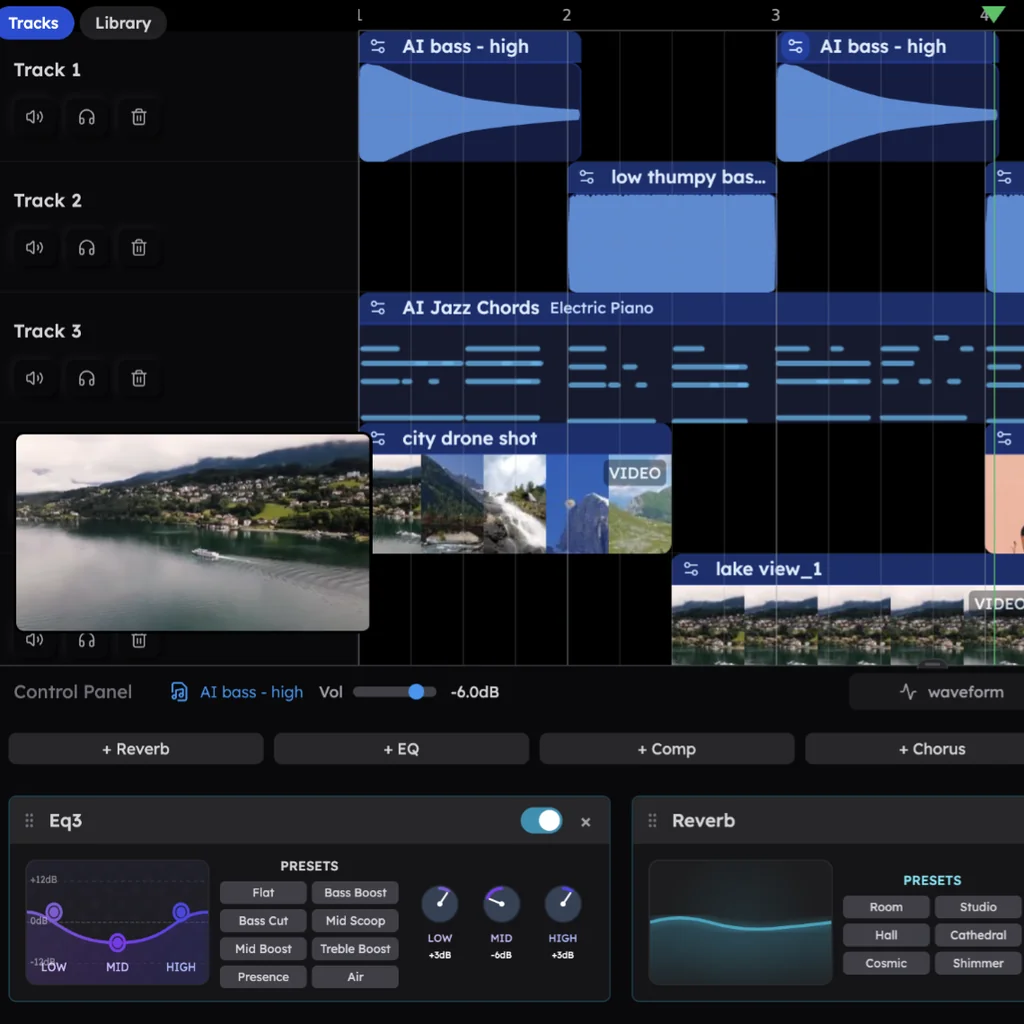
Techno arrangement map
| Section | Bars | What happens |
|---|---|---|
| Intro | 32 | Kick and closed hats; the open hat joins at bar 17 |
| Groove | 32 | The rolling sub arrives, then the clap and a percussion loop |
| Acid | 32 | The Acid Bass line enters dark and opens every 8 bars |
| Break | 16 | Kick out; Drone and one dub chord alone, the acid murmuring underneath |
| Peak | 64 | Everything back with the ride; one change every 8 bars |
| Outro | 32 | Layers leave one at a time; kick and hats alone for the last 16 |
That is 208 bars, about 6 minutes 24 seconds at 130 BPM, the length a DJ expects.
Make techno with CoProducer
- Open daw.veena.studio in Chrome or another modern browser and sign in with Google. No install and no graphics card needed: the AI runs on Veena's servers.
- Give it the brief:
Make a 130 BPM peak-time techno track in F minor: TR909 kit with a four-on-the-floor kick, accented 16th closed hats, an open hat on every offbeat, a clap on 2 and 4 and a ride on the offbeats in the peak; a rolling Techno Sub on the last two 16ths of every beat, between the kicks; an Acid Bass line in F minor with accents and slides; a Dark Pad and a Drone for texture; a short Stab Lead minor-seventh chord every two bars with a dub delay; a percussion loop from the sample library. Intro 32 bars of kick and hats only, groove 32, acid 32, break 16 with the kick out, peak 64, outro 32 for DJs.
- Watch the loop assemble. CoProducer sets the tempo and key, plans the six sections, and writes the kick, sub, hats, acid and textures as separate tracks. The sub reads the kick part actually placed, so it rolls in the gaps.
- Pick your takes. Three options arrive for each new part; the percussion loop comes as ten preview cards. Anything built on a part waits until you have picked it.
- Shape it. Open the Acid Bass clip and turn EDGE up for more scream, or ask in words.
- Export a 24-bit/48 kHz WAV for your DJ software, or every track as stems for a live set. No watermark, no cap on exports, and the track is yours.
Requests that move a techno track forward:
- "Make the kick harder and move the clap to a rim for the first 32 bars of the peak."
- "Add a second hat layer on the offbeat 16ths from bar 129."
- "Put the Stab Lead chord through more dub delay and only play it every fourth bar."
- "Swap the kit to Chaos and push the whole groove to 138 BPM."
Mixing techno in Veena
Effects in Veena live on each clip, from ten built-ins plus your own plug-ins through the Veena Bridge. A techno chain, low end first:
- Kick. The Compressor's Drums preset tightens it; for industrial weight add Distortion on the Drive or Heavy preset and pull its Mix back until the kick crunches without losing its thump.
- Sub and rumble. Put Utility with Mono on both, so the low end stays centred in any club. On the 8-Band EQ, keep them below about 120 Hz with the high shelf down.
- Hats and ride. Accent with velocity, not volume. If the top end gets tiring, dip a peaking band around 8–10 kHz by a few dB.
- Acid. Leave it dry for bite, or add a Delay on the Ping Pong preset in the peak for width.
- Space. Long reverb belongs on the dub chord and the textures, never on the kick or sub.
- Balance. Ask CoProducer to measure the mix and even out the levels: it reads loudness and spectrum on any clip, track or the whole mix before it touches a fader.
Common techno mistakes
- Too much melody. A full topline turns techno into trance. Keep hooks to a bar or two, or leave them out.
- Changing too much at once. Two changes in one phrase break the trance. One change every 8 bars.
- Kick and sub on the same 16th. They fight, and the kick loses its punch. Roll the sub after the kick.
- Harsh hats. Loud, bright 16ths wear the ear out in a six-minute track. Shape them with velocity.
- No intro for the DJ. Start with 32 bars of kick and hats.
- Reverb on the low end. A washy kick or sub turns to mud on a club system.
Techno terms
Rumble: a dark, reverb-soaked low end tied to the kick. Rolling bass: short sub notes after each kick, filling the gaps. Acid: the squelching, resonant 303-style bassline. Accent: a louder note that opens the filter. Slide: a note that glides into the next. Dub chord: one short chord echoing into a long delay. Peak time: the hardest, busiest part of a club night, and the style made for it. DJ tool: a long, steady track built for mixing. Phrygian: a minor scale with a flattened second, G flat in F, the darkest colour in techno.
Techno styles to try next
- Detroit techno: 125–132 BPM, soulful chords on Filter Sweep or String Pad over a TR909 groove.
- Minimal: 125–128 BPM, sparse clicks, short Snap Pluck blips, almost no low end outside the kick and one sub note.
- Dub techno: 120–126 BPM, a Stab Lead chord into the Dub delay and a Cathedral reverb, soft hats, deep sub.
- Acid techno: 130–140 BPM, the Acid Bass line as the lead, EDGE near the top.
- Peak-time techno: 128–135 BPM, the rumble, the ride and the rule of one change.
- Industrial and hard techno: 135–150 BPM and up, the Chaos kit, Distortion on the kick, noise textures.
- Melodic techno: 122–128 BPM, a Reso Lead or Bright Saw Lead riff over Dark Pad, closer to how you make trance music.
Techno and house share a kick and a history; the difference is swing and chords, and how you make house music shows the other side. For every other style, see make music by genre.
Try this in Veena
Make a 130 BPM peak-time techno track in F minor: TR909 kit with a four-on-the-floor kick, accented 16th closed hats, an open hat on every offbeat, a clap on 2 and 4 and a ride on the offbeats in the peak; a rolling Techno Sub on the last two 16ths of every beat, between the kicks; an Acid Bass line in F minor with accents and slides; a Dark Pad and a Drone for texture; a short Stab Lead minor-seventh chord every two bars with a dub delay; a percussion loop from the sample library. Intro 32 bars of kick and hats only, groove 32, acid 32, break 16 with the kick out, peak 64, outro 32 for DJs.
Frequently asked questions
Can I make techno online for free?
Yes. Veena is an AI DAW with a personal music producer built in. Describe the song you want and CoProducer builds it with you — beats, chords, melody, arrangement and mix — as real tracks you can edit, mix and export. Free, in your browser. Techno is its strongest genre: in Veena's own data, 91.7% of new users whose first request asks for techno get a first result on day one.
What BPM is techno?
Most techno runs between 125 and 135 BPM. Minimal and dub techno sit lower, around 120–128; peak-time techno lives at 128–135; hard and industrial techno push to 140–150 and beyond. Only 9.4% of first requests in Veena's own data give a tempo, and techno is where it pays to: name one and Veena's CoProducer builds every part to it.
What is the difference between techno and house?
House swings, uses seventh-chord stabs and often carries a vocal, usually at 120–128 BPM. Techno is straighter, darker and faster, built on rhythm and texture instead of chords, usually at 125–135 BPM. Veena's CoProducer writes each genre on its own terms: ask for house and you get shuffled hats and stabs; ask for techno and you get a rolling sub, driving 16ths and texture.
How do I make an acid bassline?
Write a 16-step line on one or two notes, then add accents and slides. On Veena's Acid Bass, a louder note opens the filter further, which is how a 303 accent works, and a note that overlaps the next one glides into it. EDGE raises the resonance and MOVEMENT lengthens the squelch. CoProducer writes the line as MIDI you can edit note by note.
Can I use my own synths and plug-ins for techno in Veena?
Yes. The Veena Bridge helper app loads your own plug-ins, instruments and effects alike: VST3 and AU on Mac, VST3 on Windows. CoProducer weighs the plug-ins you have installed against Veena's built-in sounds and starts from their real presets, and in a shared session a collaborator without the plug-in still hears the part.
Meet your personal music producer
Free, in your browser. Describe the song you want and CoProducer builds it with you.
Make music free