Make Metal Music
Make metal music with a personal music producer who can play the double kick all night. Free and in your browser, Veena's CoProducer writes the downtuned riffs, the palm-muted chug, drums from gallop to blast beat and the bass locked underneath, each one a real track you can change note by note. Start with the tuning.
Metal rewards precision more than any other guitar music. A riff is a rhythm first and a melody second, the kick drum doubles the guitar, and the line between heavy and muddy is drawn somewhere around 300 Hz. Give CoProducer the tempo, the tuning and the drum style, and it writes a band that plays tight.
Metal starts with the tuning
The lower the lowest string, the heavier the riff. In MIDI there is no string to retune: the tuning is simply how low the notes go.
| Tuning | Lowest note | Where you hear it |
|---|---|---|
| E standard | E2 | Classic heavy metal, thrash, power metal |
| Eb standard | Eb2 | Thrash and hard rock, a half step darker |
| Drop D | D2 | Nu metal and alternative metal |
| Drop C | C2 | Metalcore and modern heavy riffs |
| B standard (7-string) | B1 | Death metal, djent, progressive |
| Drop A (7-string) | A1 | Deathcore and the slowest breakdowns |
Drop tunings do two things at once: they lower the pitch, and they put a power chord under one finger, since the three lowest strings form root, fifth and octave. That is why drop-tuned riffs can jump between chords so fast. When you tell CoProducer "drop C, lowest note C2", it writes every riff and bass line within that range.
Riffs: pedal tones, palm mutes and the flat second
Most metal riffs are built from a handful of devices:
- The pedal-point riff. Palm-muted chugs on the open low string, broken up by accents above it. In drop C: C, C, C, Db, C, C, Eb, C in 16ths, with the chugs short and the accents ringing.
- The flat second and the tritone. The Phrygian b2 (Db over C) is instant menace; the flat fifth (Gb over C) is the tritone that metal has leaned on since its first riff. Harmonic minor adds a major third over the b2 for the neoclassical sound.
- The gallop. An 8th and two 16ths, dum-da-da, repeated across the bar; the engine of classic heavy metal.
- Tremolo picking. One note picked as fast 16ths or 32nds, the shimmering wall of black metal.
- Syncopated chugs. Single low notes grouped in threes or fives against the 4/4 bar, the djent trick; the riff cycles against the beat until both land together.
Veena has the two guitar sounds these need. Electric Guitar (muted) is a palm-muted chug, each note a short, thick thump gone in about 150 ms, ideal for the pedal notes. Distortion Guitar is the high-gain preset, saturated with a flat, long sustain, for power chords and octave riffs that ring. Write the chugs on one and the accents and chorus chords on the other, and the riff has both punch and size.
Rhythm guitars in metal are layered: at least two takes, one far left and one far right, and often four. Ask CoProducer for "two slightly different rhythm parts panned hard left and right": the small differences between the takes are what make the wall wide.
Drums: skank beats, double kick and blasts
Every metal drummer has three core grooves. The skank beat, also called the thrash beat, drives verses at 160 BPM and up:
Count   1 & 2 & 3 & 4 &
Crash   x x x x x x x x
Snare   . X . X . X . X
Kick    X . X . X . X .
Double kick runs continuous 16ths on the kick under a normal backbeat, the wall of sound under a chorus:
Count   1 e & a 2 e & a 3 e & a 4 e & a
Ride    x . x . x . x . x . x . x . x .
Snare   . . . . X . . . . . . . X . . .
Kick    x x x x x x x x x x x x x x x x
The blast beat is the extreme end: kick and snare alternating on every 16th, a cymbal on each kick, at 180 BPM and beyond. A hammer blast plays kick, snare and cymbal together on every note.
Then the breakdown: half-time, the snare on beat 3, and the kick doubling the guitar's chugs hit for hit. The silences are part of the riff; a breakdown with no gaps is just a slow verse.
Veena's Chaos kit is its aggressive, distorted kit, built for heavy metal and hard rock; the Pop kit is the cleaner, punchier alternative for modern, tightly produced metal. CoProducer's AI drum generator writes any of these grooves by name, the Beat Maker step sequencer edits single hits, and the piano roll's ⅛-beat snap handles 32nd-note snare rolls. Vary the velocity of fills and blasts; a snare roll where every hit is identical sounds like a machine gun, not a drummer.
Bass, leads and the orchestra
Bass. Metal bass doubles the riff, usually an octave below the guitar's lowest notes, and locks to the kick. Electric Bass (pick) puts a bright pick click on the front of each note, so fast lines stay articulate. For grind, add the Distortion effect's Crunch preset and pull its Mix down to about 30%: the effect blends the dirt with the clean signal, so the low end stays solid under the growl.
Leads. Overdriven Guitar sustains and blooms, the voice for melodic solos; Distortion Guitar is the shredder. For the classic twin-guitar sound, have CoProducer write a second lead a diatonic third above the first and pan the two apart.
Clean passages. Electric Guitar (clean) arpeggios, with the Chorus effect and a synced Delay, make the quiet intro that the first riff smashes through.
Orchestra and atmosphere. String Ensemble, Cello and Contrabass carry symphonic metal; the Vox Pad is a choir bed; Dark Pad and Drone give doom its dread. The cinematic music page goes deeper on orchestral writing.
Vocals are yours: CoProducer builds every instrumental part around your voice, and you record screams, growls or clean singing straight into Veena on their own track.
Metal by sub-genre
| Style | BPM | Tuning | Drums | Signature |
|---|---|---|---|---|
| Heavy metal | 110–170 | E or Eb standard | Gallops, crash accents | Twin-guitar harmonies |
| Thrash | 160–220 | E or Eb standard | Skank beat, double kick | Palm-muted 16th riffs |
| Death metal | 160–260 | B standard or lower | Blast beats, double kick | Chromatic and tremolo riffs |
| Black metal | 150–240 | E or D standard | Blast beats | Tremolo-picked minor chords, cold reverb |
| Doom | 50–80 | C standard or lower | Slow and huge | Chords held for bars |
| Metalcore | 120–180 | Drop C or drop B | Double kick, half-time breakdowns | Clean choruses between breakdowns |
| Djent and prog | 100–150 | 7- and 8-string drop tunings | Kick locked to the guitar | Syncopated chugs, odd meters |
| Nu metal | 90–110 | Drop D or lower | Hip hop grooves | Bouncing one-note riffs |
| Symphonic | 120–180 | E or D standard | Double kick | Strings and choir |
For the prog end, Veena's time signatures include 5/4, 7/8 and 9/8 alongside 4/4.
A metal song map
| Section | Bars | Riff and drums |
|---|---|---|
| Intro | 8 | Four bars of clean arpeggio, then the main riff with the whole band |
| Verse 1 | 16 | Palm-muted pedal riff over the skank beat |
| Pre-chorus | 8 | Open chords, half-time drums, tension |
| Chorus | 16 | Double kick, ringing power chords, a crash on every bar |
| Verse 2 | 16 | The riff with a gallop variation |
| Chorus 2 | 16 | As before, with strings joining underneath |
| Breakdown | 16 | Half-time, the kick doubling the chugs, space between hits |
| Solo | 16 | Twin lead in thirds over the chorus chords |
| Final chorus | 16 | Full band, double kick throughout |
| Outro | 4 | Main riff one last time, then a choked crash |
That is 128 bars: 3 minutes 12 seconds at 160 BPM.
Make metal music in Veena: the exact prompt
Metal is the genre where a precise first message pays off most. Tell CoProducer the tempo, the tuning and the drum style for each section, and the first pass lands close. In Veena's own data, 81.5% of new users whose first request names a genre get a finished first result on day one.
- Open an empty project at daw.veena.studio, signed in with Google; nothing to install, no graphics card needed.
- Paste the prompt:
Make a 160 BPM metal song in drop C (C minor, lowest guitar note C2): drums on the Chaos kit with a thrash skank beat in the verses, double-kick 16ths under the choruses with a crash on every bar, and a half-time breakdown where the kick follows the guitar chugs; two palm-muted Electric Guitar (muted) rhythm parts panned hard left and right playing a C pedal-point riff with Db and Gb accents; Distortion Guitar power chords on C5–Ab5–Bb5–G5 in the choruses; an Electric Bass (pick) doubling the riff an octave below; a clean Electric Guitar (clean) arpeggio intro; a twin Overdriven Guitar lead in harmonized thirds for the solo. Intro 8 bars, verse 16, pre-chorus 8, chorus 16, verse 16, chorus 16, breakdown 16, solo 16, final chorus 16, outro 4 that ends on a choked crash.
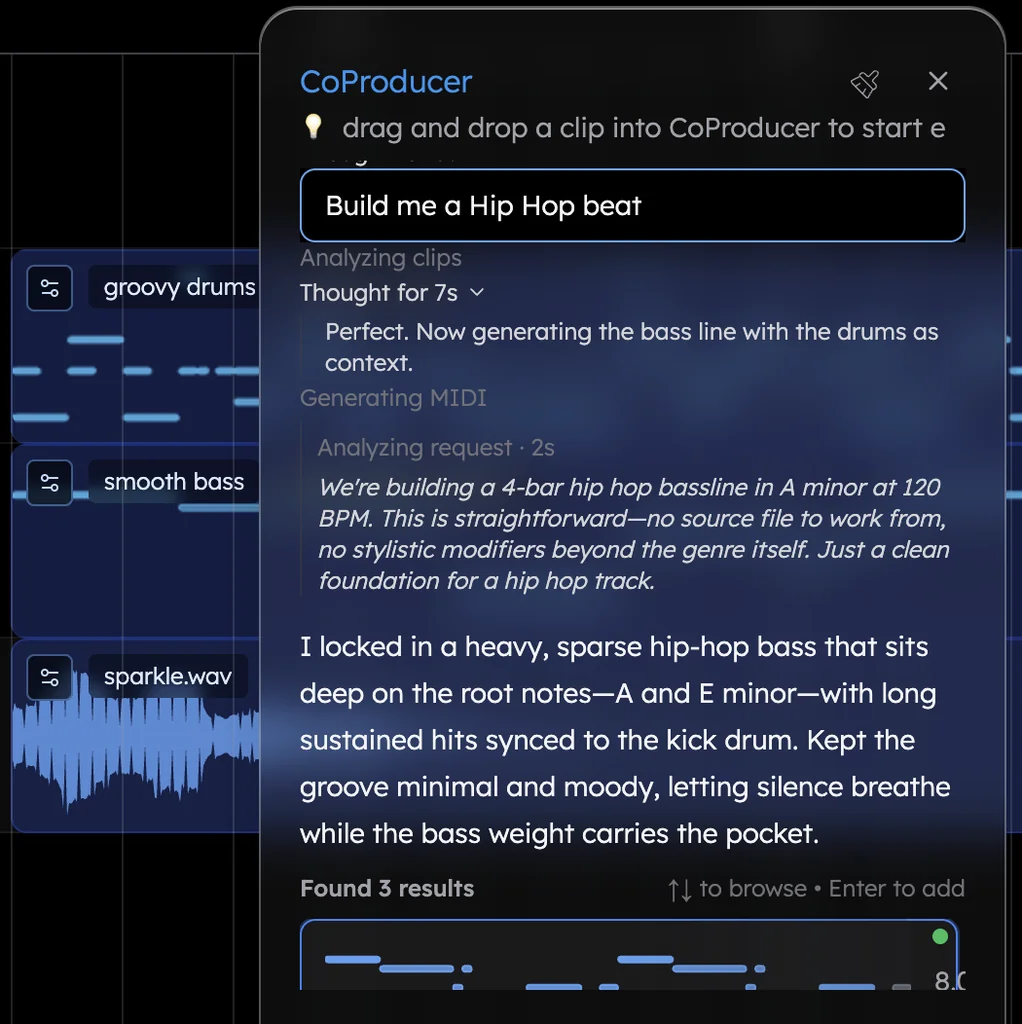
- Pick the takes. Each new part arrives as three options. Anything that depends on a part, like a bass line doubling the riff, is written against the one you keep.
- Tighten it in words. Every change is one undo.
Follow-ups that work:
- "Make the verse riff a gallop: an 8th and two 16ths."
- "Blast beat for the first four bars of the second chorus."
- "Swap the drums to the Pop kit for a tighter, cleaner sound."
- "Make the breakdown heavier: chug only on the low C and leave more silence."
- "Add String Ensemble and a Vox Pad choir under the final chorus."
Got your own amp sim or drum plug-in? Run it through the Veena Bridge (VST3, plus AU on Mac); CoProducer weighs it against the built-in sounds and works from the plug-in's own presets.
Mixing heavy without the mud
Metal mixes are decided in the low end and the low mids. In Veena, each clip carries its own effects:
- Guitars: on the 8-Band EQ, cut the low shelf hard, 9–12 dB around 100 Hz, so the bass and kick own the bottom. Dip 2–4 dB between 300 and 500 Hz where the mud lives, add 2 dB of presence near 3 kHz, and trim the high shelf above 10 kHz to take off the fizz.
- Kick: lift the click around 4 kHz so every note of a double-kick run is audible, and keep the body near 60 Hz short.
- Snare: body around 200 Hz, crack around 5 kHz, and the Reverb effect's Room preset for a short, tight space.
- Bass: a little low-shelf lift near 80 Hz, the Compressor at about 4:1, and the parallel Crunch trick above.
- Leads: the Delay's Quarter preset at a low mix and the Hall reverb, so solos sit behind the rhythm wall instead of on top of it.
- Drum glue: the Compressor's Drums preset on the drum clip.
Or ask CoProducer for "a tight modern metal mix: kick clicking through the double bass, guitars wide and heavy, bass locked under them" and let it set every level, pan and effect.
The mistakes that make metal weak
- Too much gain. Past a point, distortion blurs palm mutes into mush. Less gain on two layered guitars sounds heavier than maximum gain on one.
- Scooped mids. Guitars that sound huge alone vanish under the drums. Keep the 1–3 kHz range.
- A low-end war. Guitars, bass and kick all fighting below 100 Hz. Cut the guitars' low shelf.
- Kick and riff disagreeing. In tight metal the kick doubles the rhythm guitar; if they differ, it sounds sloppy.
- Machine-gun rolls. Identical velocities on every snare hit. Vary them.
- A breakdown in every section. One earns its weight; three are a loop.
- Reverb on fast riffs. It smears the chugs. Keep the space on leads and snare.
Metal terms
Palm mute: resting the picking hand on the strings for a short, dark chug. Pedal point: a riff returning to one low note between accents. Drop tuning: the lowest string tuned a whole step below the rest. Gallop: an 8th and two 16ths, repeated. Tremolo picking: one note picked as fast as possible. Skank beat: kick on the beat, snare on every offbeat. Blast beat: kick and snare alternating on every 16th at high tempo. Breakdown: a half-time section where the kick doubles the riff. Choke: grabbing a cymbal to stop it dead.
Metal grew out of rock music and shares a border with punk music. The full list of styles is on make music by genre.
Try this in Veena
Make a 160 BPM metal song in drop C (C minor, lowest guitar note C2): drums on the Chaos kit with a thrash skank beat in the verses, double-kick 16ths under the choruses with a crash on every bar, and a half-time breakdown where the kick follows the guitar chugs; two palm-muted Electric Guitar (muted) rhythm parts panned hard left and right playing a C pedal-point riff with Db and Gb accents; Distortion Guitar power chords on C5–Ab5–Bb5–G5 in the choruses; an Electric Bass (pick) doubling the riff an octave below; a clean Electric Guitar (clean) arpeggio intro; a twin Overdriven Guitar lead in harmonized thirds for the solo. Intro 8 bars, verse 16, pre-chorus 8, chorus 16, verse 16, chorus 16, breakdown 16, solo 16, final chorus 16, outro 4 that ends on a choked crash.
Frequently asked questions
Can I make metal music online for free?
Yes. Veena is an AI DAW with a personal music producer built in. Describe the song you want and CoProducer builds it with you — beats, chords, melody, arrangement and mix — as real tracks you can edit, mix and export. Free, in your browser. For metal, CoProducer writes drop-tuned riffs, double-kick drums and a bass locked to the kick, each as editable MIDI on its own track.
What tuning is best for metal?
Each style has a home tuning: E or Eb standard for classic heavy metal and thrash, drop D for nu metal, drop C for metalcore, and B standard or lower for death metal and djent. In Veena, tuning is simply the notes you write: ask CoProducer for "drop C, lowest note C2" and every riff and bass line lands down there.
What BPM is metal?
Anywhere from 50 to past 250. Doom crawls at 50–80 BPM, nu metal grooves at 90–110, heavy metal and metalcore run roughly 120–180, thrash sits around 160–220 and death metal blasts past 200. Veena handles 40–300 BPM, so put the exact tempo in your first message to CoProducer and the drums, riffs and bass are all written to it.
How do you program metal drums?
Start from three patterns: the skank beat (kick on every beat, snare on every offbeat 8th), double-kick 16ths under a backbeat, and the blast beat (kick and snare alternating on 16ths). Veena's Chaos kit is its aggressive, distorted metal kit. Ask CoProducer's AI drum generator for any of them by name, then move single hits in the Beat Maker step sequencer.
Can I add my own vocals to a metal track in Veena?
Yes. CoProducer builds every instrumental part around your voice: record screams, growls or clean vocals straight into Veena on their own track, with latency calibration and loop recording. Have a riff on a demo already? Drop the recording on the timeline and CoProducer measures its tempo and builds the drums and bass around it.
Meet your personal music producer
Free, in your browser. Describe the song you want and CoProducer builds it with you.
Make music free