Make Punk Music
Make punk music fast and loud, with a personal music producer who keeps up. Free to use in your browser, Veena's CoProducer plays the down-picked power chords, the skank beat, the pick-attack bass and the half-time breakdown on real tracks you can edit and record over. Most punk runs 160–200 BPM and ends before three minutes.
Punk is the genre whose rules fit on a napkin. A few chords, 8th notes played with downstrokes only, a drummer who never lets the energy dip, and a song that says what it needs to and stops. Emo grew up in the same basements with more chords, cleaner guitars and bigger swings in dynamics, and it's on this page too.
Punk in five rules
- Fast. 160–200 BPM for most punk and pop-punk, 150–180 for the 1977 sound, past 200 for hardcore. Below about 150 it starts to sound like rock.
- Straight and down-picked. Every 8th note a downstroke, no swing. Down-picking gives each chord the same hard attack, and that relentless evenness is the sound.
- Power chords in parallel. Root, fifth and octave, one shape moved around the neck. Three or four chords per song.
- Drums that never rest. A backbeat or a skank beat all the way through, a crash on every bar in the chorus, a fill into every section.
- Short. Under three minutes, often under two. A solo, if there is one, is eight bars.
The beats: backbeat, skank and half-time
The punk backbeat at 184 BPM, one bar in 8th notes:
Count   1 & 2 & 3 & 4 &
Hats    x x x x x x x x
Snare   . . X . . . X .
Kick    X . . . X X . .
The kick takes beat 1, beat 3 and the 8th right after it; the snare cracks on 2 and 4; hats or an open crash-ride play every 8th. For the chorus, move the hats to a crash-ride and hit a crash on beat 1 of every bar.
The skank beat is the engine of hardcore and skate punk: kick on every beat, snare on every offbeat, a cymbal on every 8th, so the kit bounces oom-pa, oom-pa at full speed. Pop-punk verses live on it; choruses switch to the backbeat for lift.
The half-time breakdown puts the snare on beat 3 only. At 184 BPM that suddenly feels like 92, and after two minutes of sprinting the drop in speed is the heaviest moment in the song.
Veena has three kits for punk. Pop is clean and punchy, the right sound for tight pop-punk. JCLive is a live-recorded acoustic kit with real room sound, for garage and 1977-style punk. Chaos is aggressive and distorted, for hardcore. CoProducer's AI drum generator writes any of these grooves by name, and the Beat Maker step sequencer lets you move single hits by hand.
Chords, riffs and down-picking
Punk keys follow the guitar: E, A, D and G, plus Eb when the band tunes down a half step, as much pop-punk and emo does. Five loops cover most of the genre:
| Progression | Example | Where it lives |
|---|---|---|
| I–IV–V | A–D–E | 1977 punk, the three-chord classic |
| I–bIII–IV | A–C–D | The borrowed flat-three, pure punk attitude |
| I–V–vi–IV | D–A–Bm–G | Pop-punk choruses |
| vi–IV–I–V | Bm–G–D–A | Anthemic, a little sad |
| I–IV–vi–V | D–G–Bm–A | Verses that lift into the chorus |
Voice every chord as a power chord: D5 is D, A and D. Written as MIDI, that is three notes stacked on each 8th, all at nearly the same velocity, with a slightly harder hit on each beat. The pop-punk trick is the contrast between palm-muted verses and open choruses. Veena's Electric Guitar (muted) gives the short, thick chug of a palm mute; Distortion Guitar, the high-gain preset made for punk and pop-punk power chords, rings out for the chorus; Overdriven Guitar has the warmer crunch of garage punk.
Add an intro riff in octaves: a single-note melody doubled an octave up, picked clean or distorted, over the chords of the chorus. Under everything, Electric Bass (pick) plays root 8th notes locked to the guitar; its plectrum click keeps it audible at speed, and a walk into each new chord in the last two 8ths of the bar keeps it moving.
Emo: the same fire, more chords
Emo trades the wall of distortion for detail. Its midwest strand is built on clean, twinkling arpeggios: guitar parts picking 16th-note patterns across open-sounding chords, often in open tunings, with busy, almost jazz drumming underneath.
- Chords: sevenths, add9s and suspensions instead of power chords. In D: Dmaj7 (D, F#, A, C#), Bm7 (B, D, F#, A), Gmaj7 (G, B, D, F#), Asus2 (A, B, E).
- Meter: bars of 5/4 or 7/8 dropped into a 4/4 song. Veena's time signatures include both.
- Dynamics: a verse near silence, a chorus that explodes into distortion, then back down.
- Sounds: Electric Guitar (clean), mid-focused with a soft attack, for the twinkle; the Delay's Quarter preset and a touch of Chorus to make it shimmer.
The 2000s emo-pop strand is closer to pop-punk: minor-key choruses, palm-muted verses and a half-time bridge built for a room singing along.
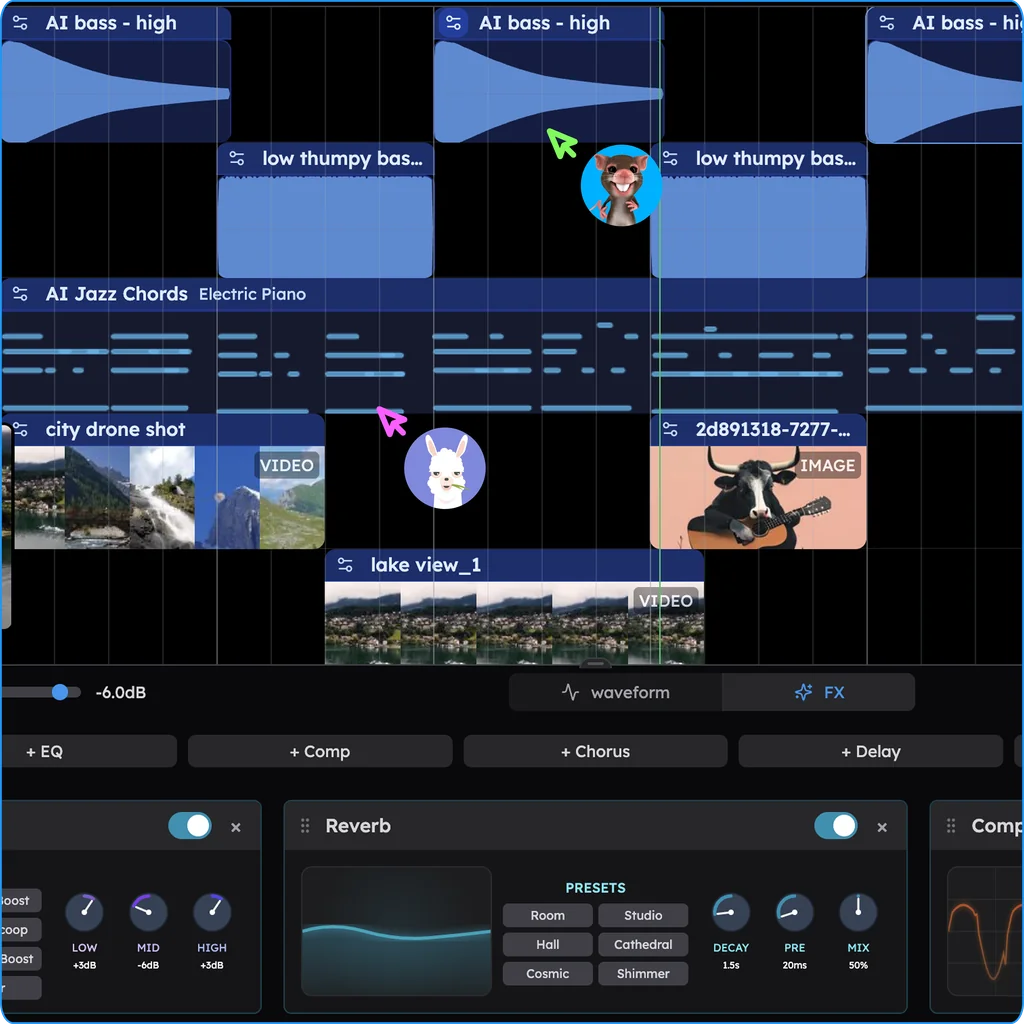
Punk is a band sport, and Veena treats it like one. Invite your drummer and bassist into the project with real-time collaboration: everyone works in the same session at once, each player records their own part, and CoProducer takes requests from all of you.
Song map: under three minutes
| Section | Bars | What the band plays |
|---|---|---|
| Intro | 4 | The octave riff over the drums, straight into the verse |
| Verse 1 | 16 | Skank beat, palm-muted 8ths, bass on the roots |
| Pre-chorus | 8 | Open chords ringing, the kick on every beat, a snare fill in the last bar |
| Chorus | 16 | Backbeat with a crash every bar, two distorted guitars hard left and right |
| Verse 2 | 16 | Verse 1 with a bass walk-up into every chord |
| Pre-chorus | 8 | As before |
| Chorus 2 | 16 | As before, louder |
| Bridge | 8 | Half-time, guitars thinned out, room for a singalong |
| Double chorus | 16 | The chorus twice, everything in |
| Outro | 2 | One last hit, then a stop |
That is 110 bars: about 2 minutes 23 seconds at 184 BPM.
Build it with CoProducer: the full-band prompt
Punk sounds simple, which is exactly why the prompt should be exact: give the BPM, say whether the guitars sit in standard tuning or a half step down, and name the beat for every section. Of new Veena users whose first request names a genre, 81.5% have a finished first result on day one.
- Sign in at daw.veena.studio with Google from any laptop with a modern browser.
- Paste the prompt:
Make a 184 BPM pop-punk song in D major, standard tuning: drums on the Pop kit with a skank beat in the verses (kick on every beat, snare on every offbeat 8th), a driving backbeat with a crash on every bar in the choruses and a snare fill into each chorus; an Electric Bass (pick) on root 8th notes locked to the guitars; palm-muted Electric Guitar (muted) 8ths in the verses and two double-tracked Distortion Guitar parts playing down-picked power chords D5–A5–B5–G5, panned hard left and right, in the choruses; a clean Electric Guitar (clean) octave riff for the intro. Intro 4 bars, verse 16, pre-chorus 8, chorus 16, verse 16, pre-chorus 8, chorus 16, half-time bridge 8, double chorus 16, outro 2 ending on a stop.
- Pick the band. Every new part comes as three options; keep the loosest-sounding drums and the tightest guitars.
- Play over it. Record your guitar or your vocal onto a new track.
Roughly a quarter of first requests in Veena's own data mention the user's own audio: a recording, a demo, a loop or a voice memo. If your band already has a rough rehearsal take, drop it in first: CoProducer measures its tempo and phrasing and builds the parts around it.
What to ask for next:
- "Push it to 196 BPM and put the skank beat under the choruses too."
- "Swap the drums to the Chaos kit and make it hardcore: shorter, faster, no pre-chorus."
- "Turn it into midwest emo: clean twinkly Electric Guitar (clean) arpeggios on Dmaj7, Bm7, Gmaj7 and Asus2, with a 7/8 bridge."
- "Strip the bridge to drums and bass for the first four bars."
- "Make the last chorus a double chorus with a crash on every beat."
Make punk music sound like a band in a room
Punk production is about energy, not polish. In Veena, every clip carries its own effects:
- Guitars wide. One rhythm guitar far left, a second, slightly different one far right; bass, kick, snare and vocal down the middle.
- Guitar EQ: on the 8-Band EQ, cut the low shelf about 6 dB near 100 Hz, handing the low end to the bass guitar, and add a couple of dB around 2–3 kHz for bite.
- Bass that cuts: lift 800 Hz–1.5 kHz so the pick click reads under two distorted guitars.
- Drums in a room: the Reverb effect's Room preset on the kit, short and natural; the Compressor's Drums preset for punch in pop-punk, lighter compression for garage.
- Dry, not washed out. Long reverbs blur fast 8th notes. Keep the tails short on everything but the vocal.
- Your voice on top: record it straight into Veena, with the Compressor's Vocals preset to keep every word above the guitars.
Or ask CoProducer for "a raw punk mix that sounds like a band in a room, guitars wide, bass clicking through, vocal on top" and it does the balancing for you.
Punk terms
Down-picking: playing every note with a downstroke. Power chord: root, fifth and octave, written D5. Skank beat: kick on the beat, snare on the offbeat, at speed. Palm mute: damping the strings with the picking hand for a short chug. Half-time: the snare on beat 3 only. Double chorus: the chorus played twice to end the song. Twinkle: clean, fast emo arpeggios on open-voiced chords.
Where punk goes wrong
- Too slow. Under about 150 BPM, punk turns into mid-tempo rock. Keep the tempo up.
- 16th-note hats at 180 BPM. No drummer plays that; it sounds like a machine. 8ths on the hats.
- Gain soup. Maximum distortion turns chords into noise; back the drive off and let the double-tracking make it big.
- A buried bass. Without the pick click, the bass disappears under the guitars.
- One energy level. Use the skank-to-backbeat switch, the half-time bridge and the stop at the end.
- Songs that outstay their welcome. If the song is over, stop.
Punk and emo sub-genres
- 1977 punk: 150–180 BPM, Overdriven Guitar crunch, the JCLive room, I–IV–V.
- Hardcore: 180–250 BPM, skank beats, songs of a minute or two, the Chaos kit; its heavier cousin is metal music.
- Pop-punk: 160–200 BPM, palm-muted verses, huge choruses, the Pop kit.
- Skate punk: melodic and very fast, the skank beat at a sprint.
- Ska-punk: offbeat upstroke chops on Electric Guitar (muted) between punk choruses.
- Post-punk: 120–150 BPM, high melodic bass lines, chorus-drenched guitars and machine-steady drums on the Electronic kit.
- Emo: midwest twinkle or 2000s emo-pop, as above.
- Hyperpop punk: pop-punk guitars thrown over trap hats and clipped 808s; see how to make hyperpop.
Punk's parent is rock music; count yourself in with one sentence to CoProducer and go. Find the rest under make music by genre.
Try this in Veena
Make a 184 BPM pop-punk song in D major, standard tuning: drums on the Pop kit with a skank beat in the verses (kick on every beat, snare on every offbeat 8th), a driving backbeat with a crash on every bar in the choruses and a snare fill into each chorus; an Electric Bass (pick) on root 8th notes locked to the guitars; palm-muted Electric Guitar (muted) 8ths in the verses and two double-tracked Distortion Guitar parts playing down-picked power chords D5–A5–B5–G5, panned hard left and right, in the choruses; a clean Electric Guitar (clean) octave riff for the intro. Intro 4 bars, verse 16, pre-chorus 8, chorus 16, verse 16, pre-chorus 8, chorus 16, half-time bridge 8, double chorus 16, outro 2 ending on a stop.
Frequently asked questions
Can I make punk music online for free?
Yes. Veena is an AI DAW with a personal music producer built in. Describe the song you want and CoProducer builds it with you — beats, chords, melody, arrangement and mix — as real tracks you can edit, mix and export. Free, in your browser. Punk gets down-picked power chords, a skank beat and a pick-attack bass that you can speed up, rearrange or play over with your own guitar and voice.
What BPM is punk music?
Most punk and pop-punk runs 160–200 BPM; 1977-style punk sits nearer 150–180, hardcore goes past 200, and emo and post-punk slow down to roughly 120–160. Veena's tempo range runs from 40 up to 300 BPM, fast enough for any hardcore band; tell CoProducer the number and the whole band plays at it.
What chords do punk songs use?
Power chords in short loops: I–IV–V (A–D–E), the punk I–bIII–IV (A–C–D) and pop-punk's I–V–vi–IV (D–A–Bm–G), all down-picked in straight 8ths. Veena's CoProducer writes any of them from the numerals, on their own track, so you can drag a chord to a new bar or swap it in the piano roll.
How do you make emo music?
Swap the distortion for clean, twinkling guitar arpeggios on open-voiced chords like Dmaj7, Bm7 and Asus2, add busy, jazz-leaning drum fills, and let the dynamics swing from a whisper to a wall. Odd meters help, and Veena supports 5/4 and 7/8. Ask CoProducer for "midwest emo in D with clean twinkly guitars and a 7/8 bridge" and it builds every part.
Can my band record over a Veena punk track?
Yes. Invite your bandmates into the project with real-time collaboration: everyone edits the same session live, and each of you can record your own guitar, bass or vocals onto a new track. Already have a rehearsal recording? Drop it on the timeline and CoProducer measures its tempo and builds tight drums and bass around it.
Meet your personal music producer
Free, in your browser. Describe the song you want and CoProducer builds it with you.
Make music free