Make Funk Music
To make funk music, lock a 16th-note drum and bass pocket at 95–115 BPM, put the weight on the one, and comp ninth chords in the gaps. Veena, the free AI DAW with a personal music producer built in, builds that band from one sentence: CoProducer writes drums, bass, guitar, keys and stabs as real tracks you can edit.
Funk has no lead instrument in the usual sense. Five players each own a thin slice of the 16th-note grid, and the groove is what happens when those slices interlock. Nobody plays everything, everybody meets on beat one, and the space between the notes does as much work as the notes.
Funk and disco DNA
| Element | Funk | Disco |
|---|---|---|
| Tempo | 95–115 BPM; 108 is a safe start | 110–125 BPM; 118 is a safe start |
| Grid | 16th notes, straight or with a hair of swing | Straight 8ths and 16ths |
| Kick | Syncopated, but always on the one | Every beat, four on the floor |
| Hi-hat | Busy 16ths, accents on the 8ths, one open hat per bar | An open hat on every offbeat |
| Harmony | One- or two-chord vamps: E9, Em9–A13, E7#9 | Minor-seventh loops and circle-of-fifths cycles |
| Bass | Syncopated 16ths, octave pops, dead notes | Octaves bouncing in 8ths |
| On top | Scratch guitar, tine electric piano, horn stabs | Strings, handclaps, a bright octave synth bass |
The one: why funk feels heavy at 108 BPM
"The one" is the first beat of the bar, and in funk it is sacred. Every part can dodge and syncopate across the rest of the bar, but on the one the kick, the bass and usually the guitar all hit together. That shared landing is why a funk groove feels heavier than its tempo.
Here is a working pocket on a 16th grid. X is an accent, x a softer hit, g a ghost note and o an open hi-hat:
Funk    1 e & a 2 e & a 3 e & a 4 e & a
Hat     X x X x X x X x X x X x X x o .
Snare   . . . . X . . g . g . . X . . g
Kick    X . . X . . X . . . X . . . . .
The kick hits the one, the "a" of 1, the "and" of 2 and the "and" of 3. The snare keeps a hard backbeat on 2 and 4, and the ghost notes around it sit at roughly a quarter of the backbeat's velocity. In Veena's piano roll, drag them down in the velocity editor until you feel them more than hear them. The open hat on the "and" of 4 throws the ear forward into the next one.
Most funk is played close to straight. The feel comes from tiny timing differences, not a swing setting, so ask CoProducer to "humanize the drums" rather than quantizing everything to the grid.
The bass leads the band
In most genres the bass supports. In funk it drives, because it carries the syncopation the rest of the band plays around. A one-bar line in E that fits the kick above:
Bass    1 e & a 2 e & a 3 e & a 4 e & a
        R . x O . . 3 . R . x . 5 . 7 O
R is the root (E), O the octave above, 3 is G, 5 is B, 7 is D, and x is a dead note: a muted, pitchless thump that works as percussion. The bass shares the one, the "a" of 1 and the "and" of 2 with the kick, then walks back up to the octave for the next downbeat.
Pick the bass by the job:
- Slap Bass 1 is the darker, shorter slap, a percussive instrument first. Give it ghost notes and room.
- Slap Bass 2 is brighter and rings longer, so the popped octaves sing over a full band.
- Electric Bass (finger) is the round pocket bass for slower, heavier grooves.
- Disco Octave Bass, on Veena's own synth, is a bright, snappy bass built to jump octaves.
For more lines to steal from yourself, see these funk bassline patterns, or let the bassline generator write one against your drums.
Chords: ninths, vamps and one chord for three minutes
Funk harmony stays put so the rhythm can move. Many classics sit on one chord for the whole song and get their drama from arrangement instead.
| Vamp | In E | Why it works |
|---|---|---|
| I9 | E9 | The dominant ninth never resolves, so it can loop for minutes |
| i9–IV13 | Em9–A13 | The Dorian two-chord: a major IV inside a minor key |
| I7#9 | E7#9 | Major and minor third in one chord; perfect for stabs |
| I9–IV9–V9 | E9–A9–B9 | Twelve-bar funk blues for jam sections |
| vi–ii–V–I | C#m7–F#m7–B9–Emaj7 | A disco and boogie cycle for strings and keys |
Voice it without the root. The bass already owns E, so a three-note shell of third, seventh and ninth (G#, D and F# for E9) sits clean above it and leaves the low mids open. Comp in short stabs on the offbeat 16ths, the "e" and the "a", never a long chord on every beat. The chord progression generator writes any of these vamps as MIDI you can re-voice.
Guitar, keys and horns: three jobs on top
Scratch guitar. Muted strings strummed in straight 16ths, with the chord released until only a percussive "chk" comes out, and a few accents where the chord rings through. Veena's Electric Guitar (muted) is exactly this sound: a short, thick thump gone in about 150 ms. For clean chord stabs and single-note riffs high on the neck, use Electric Guitar (clean).
Keys. The Electric Piano preset is a mellow tine sound that comps without cutting. Put the Phaser on its clip with the Slow preset for the seventies swirl. If you own a clavinet plug-in, load it through the Veena Bridge and CoProducer plays it like any built-in instrument.
Horns. Short, loud, all together: a stab on the "and" of 4, a fall at the end of a phrase. Ask CoProducer for a horn-section stab in your key and the sample search shows ten preview cards to choose from. For eighties synth-funk, Stab Lead gives you a hard synth stab, and Reso Lead a squelchy lead line.
Disco strings. String Ensemble swells in slowly, which is what you want under a disco hook; Pizzicato Strings plays the plucked, bouncing counter-lines.
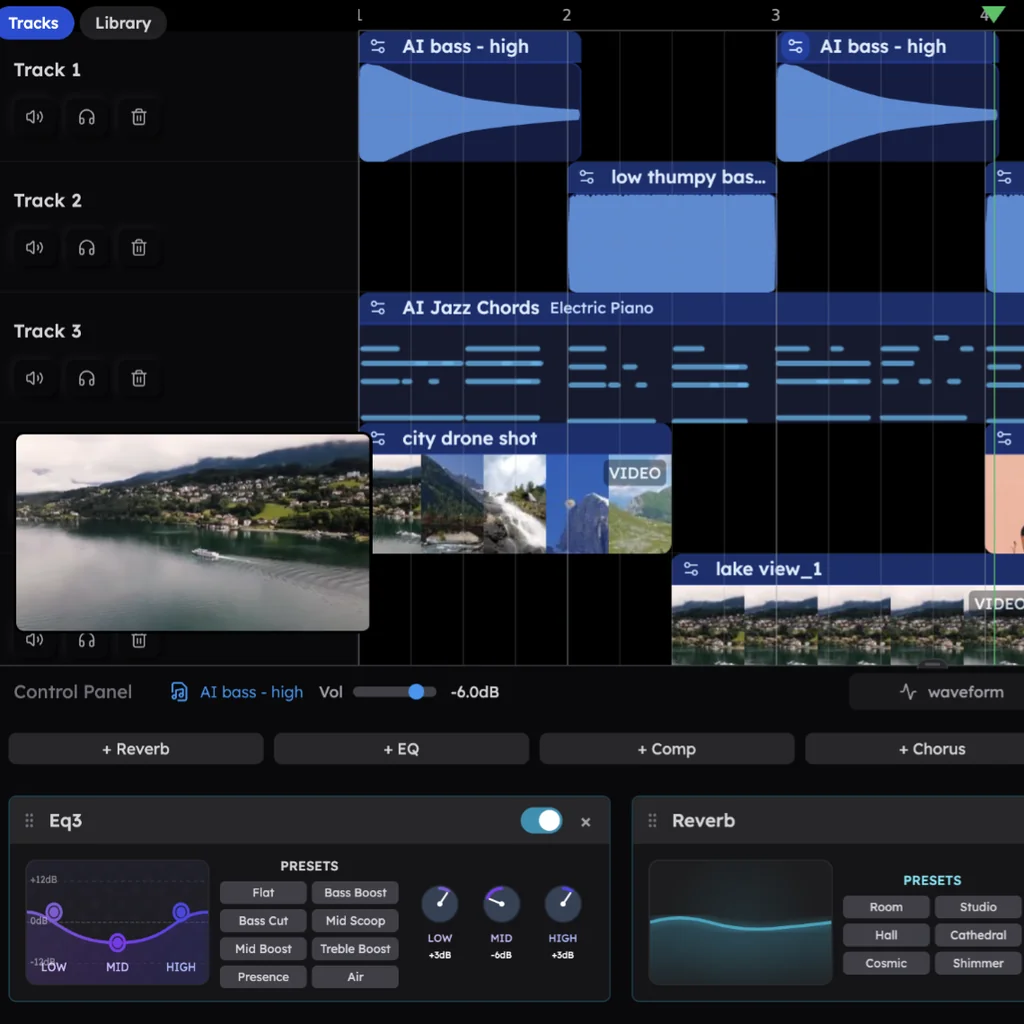
Funk song structure map
Funk is arranged by subtraction and return more than by verse and chorus. The vamp is the song; sections are made by taking parts away and bringing them back.
| Section | Bars | What happens |
|---|---|---|
| Intro | 4 | Drums alone, with a fill that lands on the one |
| Groove A | 16 | Kick, bass and scratch guitar locked together |
| Hook | 8 | Keys and horn stabs arrive; the riff or chant people remember |
| Groove A | 16 | A second pass with one new part, like a counter-riff |
| Hook | 8 | The same hook, stabs doubled |
| Breakdown | 8 | Bass and drums only; the guitar creeps back in the last two bars |
| Stop-time bridge | 8 | The band hits the one of each bar, then leaves silence |
| Hook | 8 | Everything in |
| Outro | 8 | The vamp rides out |
That is 84 bars, about 3 minutes 7 seconds at 108 BPM. A disco extended mix stretches the same idea: a 16-bar drum intro for DJs to mix in, a 16-bar string-and-clap breakdown, a 16-bar outro.
Build it with CoProducer: make funk music in one prompt
Sign in with Google at daw.veena.studio, open a project and paste this into CoProducer:
Make a 108 BPM funk track in E minor: tight dry drums with 16th-note hi-hats, ghost notes on the snare and the kick landing hard on the one; a syncopated Slap Bass 1 line with octave pops and dead notes, locked to the kick; Electric Guitar (muted) scratching 16ths; Electric Piano comping an Em9–A13 vamp in the gaps; a horn stab from the sample search on the and of 4 at the end of every hook. Intro 4 bars, groove 16, hook 8, groove 16, hook 8, breakdown 8 with only bass and drums, stop-time bridge 8, hook 8, outro 8.
CoProducer sets 108 BPM and E minor, lays the nine sections on the song-section ribbon, and starts with the rhythm section, because every other part has to fit the pocket. Each part arrives as three options; browse them with the arrow keys and press Enter on the one that grooves. The bass is written after you pick the drums, against the kick you actually placed, and the guitar and keys are written into the gaps the two leave.
Funk is one of the styles Veena delivers best. In Veena's own data, 83.8% of new users whose first request asks for funk or disco get a first result on day one. Put the tempo in your sentence: only 9.4% of first requests give a BPM, and funk changes character across ten of them.
What to ask for next:
- "Swap the drums to the JCLive kit" for a live-recorded kit with real room sound.
- "Make the ghost notes softer and humanize the hi-hats."
- "Switch the bass to Slap Bass 2 and add an octave pop on the last 16th of every second bar."
- "Stop the whole band on the last bar of each hook, then hit the one together."
- "Turn it into disco at 118 BPM: four-on-the-floor kick, open hats on the offbeats, Disco Octave Bass and String Ensemble swells into the hook."
Want to play a part yourself? Record your bass or guitar straight onto a new track from your audio interface, with a one- or two-bar count-in. Or hum a horn line into the mic, ask CoProducer to turn it into MIDI, and put it on Stab Lead.
The funk production chain
Funk mixes are dry, tight and loud in the middle. Every track in Veena has a fader and pan, and every clip carries its own effects.
- Drums: a Compressor at 4:1 with a 5 ms attack and 150 ms release (the Drums preset) tightens the pocket. Add only a Room reverb, low in the mix. Snare body lives around 200 Hz and its crack around 5 kHz.
- Bass: 4:1 with a fast attack evens out the slap peaks. Keep the thump at 60–100 Hz, dip 300–500 Hz a touch, and lift 2–4 kHz so the pops read on small speakers.
- Guitar: pull the 8-Band EQ's low shelf down under 150 Hz and add a little 2–3 kHz for the scratch. Mix it quieter than feels right, and pan it left.
- Keys: pan the Electric Piano right, opposite the guitar, with the Phaser low in the mix.
- Horns and strings: bright and wide, with a touch of Plate reverb.
- Center: kick, snare, bass and any vocal.
Then hand the finish to CoProducer: "a punchy, dry funk mix, bass and kick up front, guitar left, keys right, mastered for streaming." It sets the levels, panning and effects on every part, and you fine-tune by ear.
Common funk mistakes
- Too many notes. If every part plays every 16th, nothing grooves. Each instrument needs gaps the others fill.
- Losing the one. Syncopate everywhere and the downbeat disappears. Bass and kick meet on beat 1, every bar.
- Quantized to death. A perfect grid kills funk. Humanize, and keep ghost notes quiet.
- Long chords. Sustained keys smear the pocket. Stab, then get out of the way.
- A wet mix. Big reverb blurs 16ths. Funk is dry.
- Slow disco. Under about 110 BPM a four-on-the-floor kick drags. Speed up, and open the hats on the offbeats.
Funk terms
The one: beat one of the bar, where the band lands together. Pocket: the locked, slightly relaxed feel of drums and bass playing as one. Ghost note: a very soft snare hit between the backbeats. Dead note: a muted, pitchless bass or guitar note used as percussion. Chicken scratch: muted 16th-note guitar strumming. Vamp: a one- or two-chord loop the song rides on. Stop-time: the band hits together and drops out, leaving silence. Slap and pop: the thumb striking low strings, the fingers snapping high ones. Four on the floor: a kick on every beat, the disco pulse.
Funk and disco sub-genres
- P-funk: slower and heavier, 95–105 BPM, with synth bass, wild synth leads and big group chants.
- Funk rock: distorted guitars over a slap bass; pair it with how to make rock music.
- Boogie and synth-funk: early-eighties drum machines, Synth Bass and tine electric piano at 105–115 BPM.
- Nu-disco and French house: filtered disco loops at 120–125 BPM; see how to make house music.
- Neo-soul: funk's pocket slowed down and soaked in ninths; see how to make soul music.
- Brazilian funk: a different animal built on the tamborzão; see how to make Brazilian music.
Whichever you choose, tell CoProducer the tempo, the key and the parts you hear, and keep the weight on beat one. The rest of the styles it builds are on the page to make music by genre.
Try this in Veena
Make a 108 BPM funk track in E minor: tight dry drums with 16th-note hi-hats, ghost notes on the snare and the kick landing hard on the one; a syncopated Slap Bass 1 line with octave pops and dead notes, locked to the kick; Electric Guitar (muted) scratching 16ths; Electric Piano comping an Em9–A13 vamp in the gaps; a horn stab from the sample search on the and of 4 at the end of every hook. Intro 4 bars, groove 16, hook 8, groove 16, hook 8, breakdown 8 with only bass and drums, stop-time bridge 8, hook 8, outro 8.
Frequently asked questions
Can I make funk music online for free?
Yes. Veena is an AI DAW with a personal music producer built in. Describe the song you want and CoProducer builds it with you — beats, chords, melody, arrangement and mix — as real tracks you can edit, mix and export. Free, in your browser. For funk, CoProducer locks the drums and bass into one pocket, then adds scratch guitar, keys and stabs, each on its own track.
What BPM is funk music?
Most funk grooves sit between 95 and 115 BPM; the slower end feels heavier and leaves more room for 16th-note syncopation. Disco runs a little faster, around 110 to 125 BPM, with a kick on every beat. Name the tempo in your first message to Veena's CoProducer, for example "108 BPM funk in E minor", and it sets the project tempo before it writes a note.
How do you write a funk bassline?
Start on the one: a strong root on beat 1, then syncopated 16ths that answer the kick, octave pops and muted dead notes for percussion, with gaps left for the guitar and keys. In Veena, CoProducer writes the line against the drum part you picked, on Slap Bass 1, Slap Bass 2 or Electric Bass (finger), and every note stays editable in the piano roll.
What chords are used in funk?
Funk runs on one- and two-chord vamps: a dominant ninth such as E9, a minor ninth moving to a thirteenth such as Em9–A13 in E Dorian, and the sharp-nine chord E7#9 for tension. Voiced without the root, they leave the bottom to the bass. Ask Veena's CoProducer for a vamp by name and it lands as MIDI you can re-voice chord by chord.
What is the difference between funk and disco?
Funk syncopates: the kick moves around a 16th-note grid and the whole band lands together on the one. Disco straightens that into a kick on every beat, open hi-hats on the offbeats, an octave bass, strings and handclaps, a few BPM faster. In Veena, one sentence to CoProducer turns one into the other, and the parts you liked stay on the timeline.
Meet your personal music producer
Free, in your browser. Describe the song you want and CoProducer builds it with you.
Make music free