Make Soul Music
Make soul music online with a personal producer who hires the house band. Free in your browser, Veena's CoProducer writes the pocket drums, singing bass, church-born chord changes and string lines of classic soul as real tracks, then leaves the spotlight where soul always kept it: on your voice.
Soul was church music taken downtown. Gospel's chords and call-and-response met rhythm and blues grooves, and house bands cut the records live in one room. Everything in a soul arrangement exists to lift a singer, which is why the best soul records sound simple and feel enormous.
Build it around the singer
Soul starts with a voice, and so does a soul session in Veena. In Veena's own data, vocals are the instrument new users mention most in their first request, and roughly a quarter of first requests point to a recording of the user's own. The voice is yours, and Veena builds everything around it:
- Start from a voice memo. Drop in a recording of the melody, even a rough one from your phone, and CoProducer maps its tempo and the spots where each syllable falls, then writes the band to follow your phrasing.
- Or start from the band. Paste the prompt at the end of this page, then record over the finished track with a count-in and latency calibration. Loop recording keeps your last complete pass, so you can take the vamp as many times as it takes.
- Finish the vocal with Auto-Tune in the song's key, on the natural style at a low amount, when a note needs help without sounding tuned.
Five schools of soul
| School | Era | BPM | Groove | Signature sound | Start in Veena with |
|---|---|---|---|---|---|
| Motown | 1960s | 110–135 | Snare on every beat, doubled by tambourine | A melodic bass, strings, bright piano | Electric Bass (finger), String Ensemble, Acoustic Grand Piano |
| Memphis and Muscle Shoals | 1960s–70s | 85–110 | Laid back, snare behind the beat | Organ, a horn section, clean guitar stabs | JCLive kit, Electric Guitar (clean); organ and horns from the sample library |
| Philly soul | 1970s | 95–120 | Smooth 16th hats, a four-on-the-floor lean | Lush strings, horns, a muted rhythm guitar | String Ensemble, Violin, Electric Guitar (muted) |
| The 12/8 ballad | 1950s–now | 55–75 | Every beat split in three | Piano triplets, strings, a big vocal | Acoustic Grand Piano, Cello, String Ensemble |
| Neo-soul | 1990s–now | 70–95 | Loose, lazy, swung 16ths | Electric piano ninths, a round bass | Electric Piano, Fretless Bass |
Neo-soul stacks ninths and elevenths on everything and leans on hip-hop drums; that side of the family lives in make R&B music. This page stays with the classic sound.
Church chords in a love song
Soul took its biggest moves from church and its everyday ones from doo-wop and the blues. Five of them, in Bb:
| Move | Numbers | In Bb | Where you hear it |
|---|---|---|---|
| Doo-wop four | I – vi – IV – V | Bb – Gm – Eb – F | Early-60s ballads and slow dances |
| Two-chord groove | I7 – IV7 | Bb7 – Eb7 | Southern grooves built on the blues |
| The turnaround | I – vi – ii – V | Bbmaj7 – Gm7 – Cm7 – F7 | Verses that roll back home |
| The climb | IV – #iv°7 – I/5 | Eb – Edim7 – Bb/F | The lift into a chorus |
| The pull | I – III7 – vi | Bb – D7 – Gm | The bittersweet turn in a love song |
The climb is the sound of soul: the bass steps up Eb, E, F while the chords rise over it, and the singer rides it into the chorus. Classic soul keys play triads and sevenths more than stacked extensions; a 6th or a 9th on the home chord (Bb6, Bb6/9) is the sweet spot. The deeper church version of these moves is in make gospel music, and the chord progression generator writes any row above from numbers.
The groove: the Motown four and the Memphis pocket
Two drum philosophies shaped soul. Motown drove forward with the snare on all four beats, accented on 2 and 4 and doubled by tambourine:
Beat        1 & 2 & 3 & 4 &
Kick        X . . . X . . .
Snare       x . X . x . X .
Hi-hat      x x x x x x x x
Memphis sat back. On a 16th grid, with g for a ghost note:
Beat        1 e & a 2 e & a 3 e & a 4 e & a
Kick        X . . . . . X . X . . . . . . .
Snare       . . . . X . . g . . . . X . . g
Hi-hat      x . x . x . x . x . x . x . x .
The snare lands a hair behind 2 and 4 and the kick's pickup on the "and" of 2 pushes into beat 3. The feel comes from what the drummer leaves out. Slow soul ballads go a third way: set Veena to 12/8 and every beat splits into three, with the hi-hat on all twelve and the snare on the second and fourth pulse.
For the sound, ask for "the drums on the JCLive kit". JCLive was recorded live in a room, and the swap leaves every hit exactly where it was. Tambourine and handclaps come from Veena's sample library as loops laid over the kit. And if the part feels stiff, say "make the drums lazier, with the snare a little late" and CoProducer adds the human feel.
The bass sings, the keys answer
The bass is the second melody of a soul record. It plays the root where the chord changes, then moves: syncopated notes around the kick, chromatic approach notes into the next chord, a quick climb to the octave before a turnaround. Veena's Electric Bass (finger) is the round, even-sustaining pocket bass built for exactly this, with Fretless Bass for a softer, vocal tone.
Above it, the keys and guitar split the job:
- Electric Piano: a mellow tine piano that comps on the offbeats and beds in under a vocal. A Phaser on its Slow preset gives it the swirling 70s tone.
- Acoustic Grand Piano: gospel-style chords and triplet fills for ballads.
- Electric Guitar (clean): short chord stabs on 2 and 4 and double-stop fills between vocal lines, the Memphis guitar job.
- Electric Guitar (muted): a tight 16th-note chank for Philly and Motown rhythm parts.
- Organ: the Southern-soul pad of choice; find one in the sample library, or play your own organ plug-in through the Veena Bridge on Mac or Windows.
Strings, horns and call-and-response
Soul arrangements answer the singer. The horns punch in after a line, the strings sweep up under the chorus, and nothing plays on top of the words.
Strings are built in: String Ensemble holds the chorus chords in a wide section, Violin carries a high countermelody, Cello a low one, and Pizzicato Strings can pluck the offbeats for a lighter Motown touch.
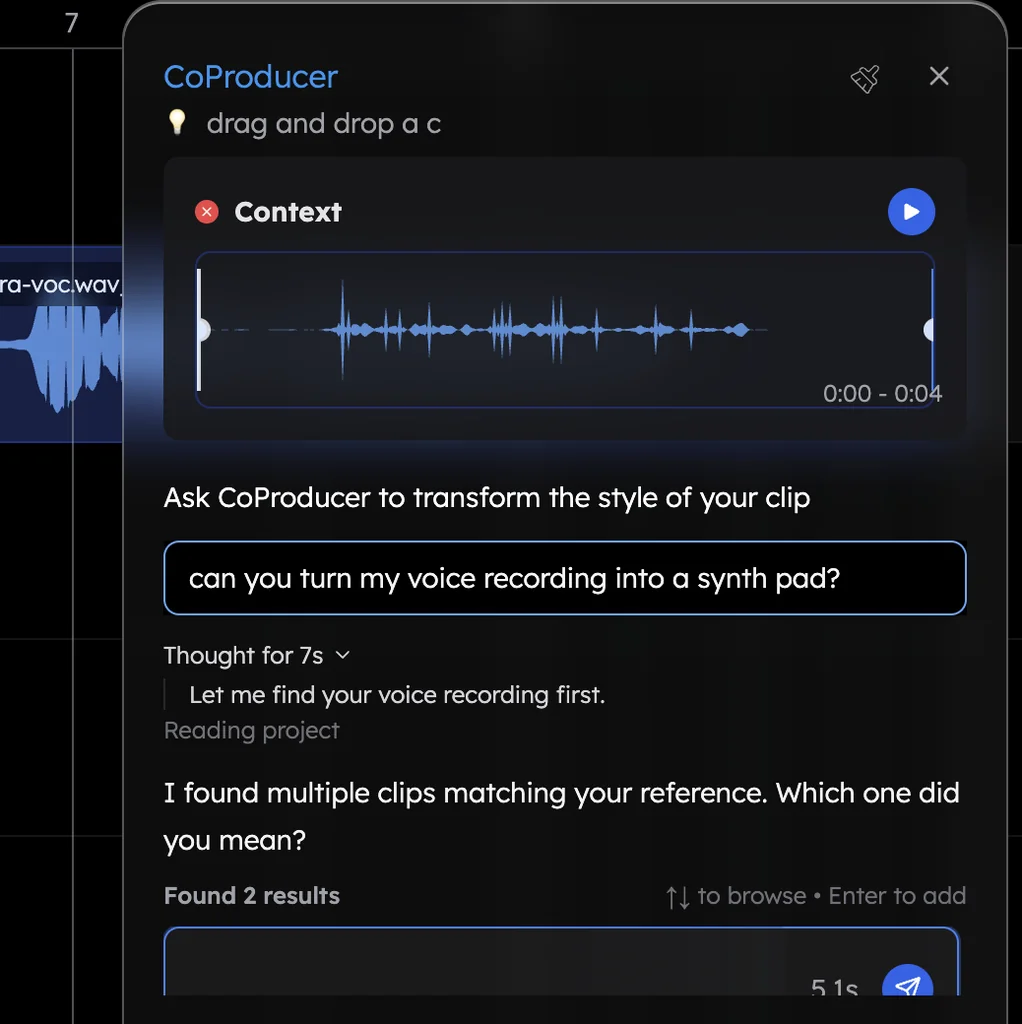
Horns come two ways. Ask CoProducer for a horn-section stab or a trumpet line and pick from the 10 preview cards it pulls from the sample library. Or sing the horn line yourself and have CoProducer turn that take into a saxophone: it tunes the recording to the project key first and returns the re-voiced part in about 12 seconds. The voice to instrument page shows the whole flow.
Backing vocals are yours to sing: record three takes of the answer line and pan them apart. For a wordless bed underneath, Vox Pad is a vowel-like synth choir.
A soul song map
| Section | Bars | What happens |
|---|---|---|
| Intro | 4 | Guitar and drums set the pocket |
| Verse 1 | 16 | Bass, Electric Piano and guitar stabs, room for the story |
| Chorus | 8 | The climb, strings enter, a horn stab on beat one |
| Verse 2 | 16 | One new layer: a Violin line or a tambourine loop |
| Chorus | 8 | As before |
| Bridge | 8 | Gm7–Dm7–Ebmaj7–F7sus4, the dip before the last lift |
| Chorus | 8 | Everything in, the Violin countermelody on top |
| Vamp | 16 | Bb to Eb/Bb over and over while you ad-lib, then a held Bb |
That's 84 bars, 3 minutes 30 seconds at 96 BPM. Soul songs end on the vamp: the band locks onto two chords and the singer takes it out, with a last held chord or a band hit rather than a slow disappearance.
Make soul music with CoProducer
- Open daw.veena.studio and sign in with Google. Nothing to install, and no graphics card needed: the AI runs on Veena's servers.
- Paste the prompt. It builds the 84-bar song map above:
Make a 96 BPM classic soul song in Bb major with a laid-back Memphis pocket: kick on 1, the and of 2 and 3, snare on 2 and 4 sitting just behind the beat, 8th-note hi-hats and quiet ghost notes on the snare; Electric Bass (finger) playing a melodic, syncopated line with chromatic approach notes; Electric Piano comping on the offbeats; Electric Guitar (clean) playing short chord stabs on 2 and 4 and small fills between vocal lines; String Ensemble holding the chorus chords, with a Violin countermelody in the last chorus; one horn-section stab from the sample library on the first beat of each chorus. Verse Bbmaj7–Gm7–Cm7–F7, chorus Ebmaj7–Edim7–Bb/F–G7–Cm7–F7–Bbmaj7–F7, bridge Gm7–Dm7–Ebmaj7–F7sus4. Form: a 4-bar intro, two rounds of 16-bar verse and 8-bar chorus, an 8-bar bridge, one last chorus, then a 16-bar vamp on Bb–Eb/Bb for ad-libs, ending on a held Bb. Leave room for my vocal.
- Pick the bass with the most melody. Each new part comes as three options, and CoProducer waits for your pick, so the keys and strings are written against the bass line you kept.
- Then direct the band:
- "Put the drums on the JCLive kit."
- "Give me the Motown version: snare on every beat and a tambourine loop from the sample library."
- "Add a Phaser on its Slow preset to the Electric Piano."
- "Write a Cello line under the second verse."
- "Swap the Electric Piano for Acoustic Grand Piano with gospel fills into each chorus."
- Record the vocal over the band, then the ad-libs over the vamp.
- Export the finished record as a 24-bit/48 kHz WAV or a 320 kbps MP3, or hand a mix engineer every track as a stem. Nothing is watermarked, exports are never capped, and the song belongs to you.
Mixing soul: warm, close, vocal first
- The vocal: the Compressor's Vocals preset and a Plate reverb. It sits on top of everything, loud and close.
- Drums: the JCLive kit's room does half the work; add the Compressor's Gentle preset to glue it without flattening the ghost notes.
- Bass: warmth over brightness. Distortion on its Light preset with the mix turned down thickens it the way an old amp would.
- Keys and guitar: pan them to opposite sides so the offbeat comping and the stabs trade places around the vocal.
- Strings and horns: a Hall reverb on the strings, spread wide; the horns on a Plate, placed off-centre.
- The whole record: soul breathes, and the fixed limiter on Veena's master is there to catch peaks, not to flatten the band. Or ask CoProducer to "mix it warm and close like a 60s soul record, vocal on top" and it does the levels, the panning and the effects to match.
Soul words
Pocket: drums and bass locked in a relaxed, deep groove. Backbeat: the snare on 2 and 4. Ghost note: a barely-there snare hit between the main ones. Call-and-response: a line answered by another voice or instrument. Stab: a short, punchy chord from horns or guitar. Vamp: a short progression repeated while the singer ad-libs. Ad-lib: improvised vocal lines over a vamp. Turnaround: the last chords of a section, steering back to the start. House band: the studio's own musicians, who played on most of a label's records.
Mistakes that drain the soul out
- A busy band under the vocal. Every part plays around the singer; fills belong in the gaps.
- Ninths on every chord. That is neo-soul. Classic soul is triads, sevenths and a few church moves.
- Drums on the grid. Quantized soul sounds like a demo. Let the snare sit back and keep the ghost notes soft.
- A bass that only plays roots. Give it approach notes and a little melody.
- Horns on top of the words. Call-and-response means the horns answer after the line.
- No vamp. An ending with nowhere to go wastes the singer's best moment. Give the ad-libs 16 bars.
For the harder, one-chord side of the same story, see how to make funk music. Every other style lives under make music by genre.
Try this in Veena
Make a 96 BPM classic soul song in Bb major with a laid-back Memphis pocket: kick on 1, the and of 2 and 3, snare on 2 and 4 sitting just behind the beat, 8th-note hi-hats and quiet ghost notes on the snare; Electric Bass (finger) playing a melodic, syncopated line with chromatic approach notes; Electric Piano comping on the offbeats; Electric Guitar (clean) playing short chord stabs on 2 and 4 and small fills between vocal lines; String Ensemble holding the chorus chords, with a Violin countermelody in the last chorus; one horn-section stab from the sample library on the first beat of each chorus. Verse Bbmaj7–Gm7–Cm7–F7, chorus Ebmaj7–Edim7–Bb/F–G7–Cm7–F7–Bbmaj7–F7, bridge Gm7–Dm7–Ebmaj7–F7sus4. Form: a 4-bar intro, two rounds of 16-bar verse and 8-bar chorus, an 8-bar bridge, one last chorus, then a 16-bar vamp on Bb–Eb/Bb for ad-libs, ending on a held Bb. Leave room for my vocal.
Frequently asked questions
Can I make soul music online for free?
Yes. Veena is an AI DAW with a personal music producer built in. Describe the song you want and CoProducer builds it with you — beats, chords, melody, arrangement and mix — as real tracks you can edit, mix and export. Free, in your browser. For soul, that means a live-feeling drum pocket, a singing bass, keys, guitar and strings on separate tracks, arranged around the vocal you record.
What chords are used in soul music?
Mostly triads and seventh chords with church roots: the I–vi–IV–V of doo-wop, the I–vi–ii–V turnaround, bluesy I7–IV7 grooves and the IV–#iv°7–I/5 climb into a chorus, such as Eb–Edim7–Bb/F in Bb. Ask Veena's CoProducer for any of them by name or numerals and it writes them as MIDI you can re-voice in the piano roll.
What BPM is soul music?
Soul ballads sit around 55–75 BPM, often in 12/8; Memphis-style mid-tempo soul around 85–110; Motown's driving hits around 110–135; Philly soul around 95–120; neo-soul slows back down to 70–95. Tell Veena's CoProducer the tempo and the school, such as "a 96 BPM Memphis soul groove in Bb", and it builds every part to that pocket.
Can Veena make a soul song with vocals?
CoProducer builds every instrumental part around your own voice: drums, bass, keys, guitar, strings and horn stabs from the sample library. You record the lead and the ad-libs in Veena from your microphone, and CoProducer reads where your lines fall so the band answers between them. Hum a horn line and it turns your humming into a saxophone.
Does Veena have soul instruments?
Yes: an Electric Piano with a mellow tine sound, Acoustic Grand and Upright Piano, clean and muted electric guitars, Electric Bass (finger) and Fretless Bass, String Ensemble, Violin and Cello, and the live-recorded JCLive drum kit. Organ, horns and tambourine come from CoProducer's sample search, or from your own plug-ins through the Veena Bridge on Mac and Windows.
Meet your personal music producer
Free, in your browser. Describe the song you want and CoProducer builds it with you.
Make music free