Make Brazilian Music
You make Brazilian music from the rhythm up: the tamborzão under baile funk, the deep surdo landing on beat two in samba, the nylon-guitar batida in bossa nova. Veena, the free AI DAW with a personal music producer built in, makes any of them from one sentence — CoProducer builds every part as a real track you can edit, mix and export.
That sentence can be in Portuguese. In Veena's own data, new users whose first request asks for Brazilian music get a finished first result on day one 76.3% of the time, and the more of the groove you name — style, tempo, key, percussion — the closer the first draft lands. So here is what each style is made of, in the words you will type.
The five Brazilian styles, side by side
| Style | Tempo | Feel | Engine room | Harmony |
|---|---|---|---|---|
| Baile funk | 130 BPM (tamborzão), 150 BPM (funk 150) | 4/4, drum-forward, syncopated | 808 kicks, claps, deep tambor hits, shaker | often one vamp or none; the voice and a sample carry it |
| Samba and pagode | 90–110 (pagode), about 130–150 (carnival samba-enredo) | felt in two, weight on beat 2 | surdos, caixa, tamborim, pandeiro, agogô, cuíca | major keys, secondary dominants, cavaquinho chords |
| Bossa nova | about 110–140, felt in a relaxed two | quiet, straight eighths | nylon guitar, brushes, cross-stick clave, upright bass | maj7, m7, 7(b9), m7b5, 6/9, chromatic lines |
| MPB | follows the song | songwriter first | acoustic guitar, piano, light percussion | bossa and jazz colour inside pop forms |
| Sertanejo | slow arrocha sway to fast vanera | two voices in parallel thirds | steel-string violão, viola caipira, sanfona, bass, drums | diatonic pop progressions, big choruses |
Baile funk: tamborzão, montagem and the jump to 150
Funk carioca grew out of Rio's bailes from the late 1970s, when DJs played Miami bass and electro and local MCs took over the 808 loops. At the end of the 1990s the tamborzão arrived — heavy, surdo-like drum samples laid over that 808 foundation — and gave the genre its own pulse around 130 BPM. From around 2018, Rio's funk 150 sped it up to 150 BPM, and that is now the mainstream sound.
What makes it hit:
- Drums first, everything else second. Short, slightly driven 808 kicks and deep tambor hits play a syncopated figure, claps answer between them, and a shaker runs continuously on top.
- A short bass. A tight 808 tuned to the key and decaying fast, so the syncopation stays readable at 150.
- A hook made of voice. A chanted call-and-response, a pitched vocal chop, a synth-brass stab. In a montagem, the hook is a collage of short samples cut against the beat.
- Hook by bar 8. Baile funk is short and front-loaded; nobody waits for a slow intro.
In Veena, put the bass on the 808 Short or 808 Distorted preset — the Distorted one saturates only the upper band, so the sub stays clean while the harmonics survive a phone speaker. The 808 Classic Kick preset gives you a pitched analog kick you can play in the piano roll, and the floor toms on the drum kit make a convincing tambor.
Samba and pagode: two beats, and the second one is heavier
Samba is felt in two, written in 2/4, and the weight sits on beat two. The deepest surdo, the surdo de primeira, marks beat 2; the higher surdo de segunda, also called the resposta, plays beat 1; a third surdo cuts syncopations between them. On top, the caixa runs sixteenths with shifting accents, the shakers lean on the last sixteenth of each beat, the tamborim plays the two-bar teleco-teco phrase, the agogô rings its two-tone bell and the cuíca squeaks over everything.
Tempo decides the flavour. Carnival samba-enredo from Rio's samba schools runs roughly 130–150 BPM with a full bateria. Pagode and samba de roda sit around 90–110 BPM: pandeiro, tantã and repique de mão in the rhythm section, cavaquinho strumming the chords, and a seven-string guitar walking the bass lines between them — the baixaria.
The harmony is major-key and full of movement: I–VI7–ii–V7 turnarounds, secondary dominants into the ii, diminished passing chords. In Veena, set the time signature to 2/4 in the transport bar, and if you import a samba MIDI file, its surdo notes land on the floor toms.
Bossa nova: samba turned down to a whisper
Bossa nova came out of Rio in the late 1950s: samba's rhythm scaled down to one nylon-string guitar and a quiet voice, with jazz harmony on top.
- Tempo and feel: about 110–140 BPM counted in quarter notes, felt in a relaxed two. The eighths are straight — never swung like jazz.
- The clave: a cross-stick pattern spaced 3-3-4-3-3 across sixteen eighth notes, landing on 1, 4, 7, 11 and 14. It is the son clave with its last note pushed an eighth late.
- Bass and kick: a two-note figure, root on the beat and fifth leading into the next, built from dotted quarters and eighths, with the kick doubling it softly.
- The batida: the guitarist's thumb plays the bass on the beat while the fingers pluck syncopated chord blocks between.
- Harmony: major and minor sevenths, 7(b9), 7(#11), m7b5 and 6/9 chords, and chromatic descents. Start with Imaj7 – II7 – iim7 – bII7 (Fmaj7 – G7 – Gm7 – Gb7), or iim7 – V7(b9) – Imaj7 – VI7(b9) as a turnaround.
Veena has the right instruments built in: Acoustic Guitar (nylon) and Acoustic Bass, both voiced for bossa, the tine Electric Piano for comping, and the Brush kit for the drums.
MPB and sertanejo: songs first
MPB — música popular brasileira — is the songwriter's Brazil since the 1960s: samba, bossa, baião, rock and soul folded into songs built around a voice and a violão. The harmony borrows bossa's sevenths and chromatic moves; the arrangement serves the lyric. It is the natural place to start from your own voice memo: about 1 in 4 first requests in Veena's own data refer to the user's own audio. Drop the memo into CoProducer and it measures the tempo and phrasing, then builds the band around your take.
Sertanejo is Brazilian country turned stadium pop. Duos sing in parallel thirds, songs of heartbreak — sofrência — ride big diatonic choruses (I–V–vi–IV is home), and the band is steel-string violão, the ten-string viola caipira, sanfona (accordion), bass and drums. Sertanejo universitário pulls in arrocha, a slow sway with short keyboard chords on the offbeat over an economical bass, and vanera, a fast accordion-driven dance rhythm. In Veena, use Acoustic Guitar (steel) for the violão, record your lead vocal, then the harmony a third above — or invite your duo partner into the session and record together.
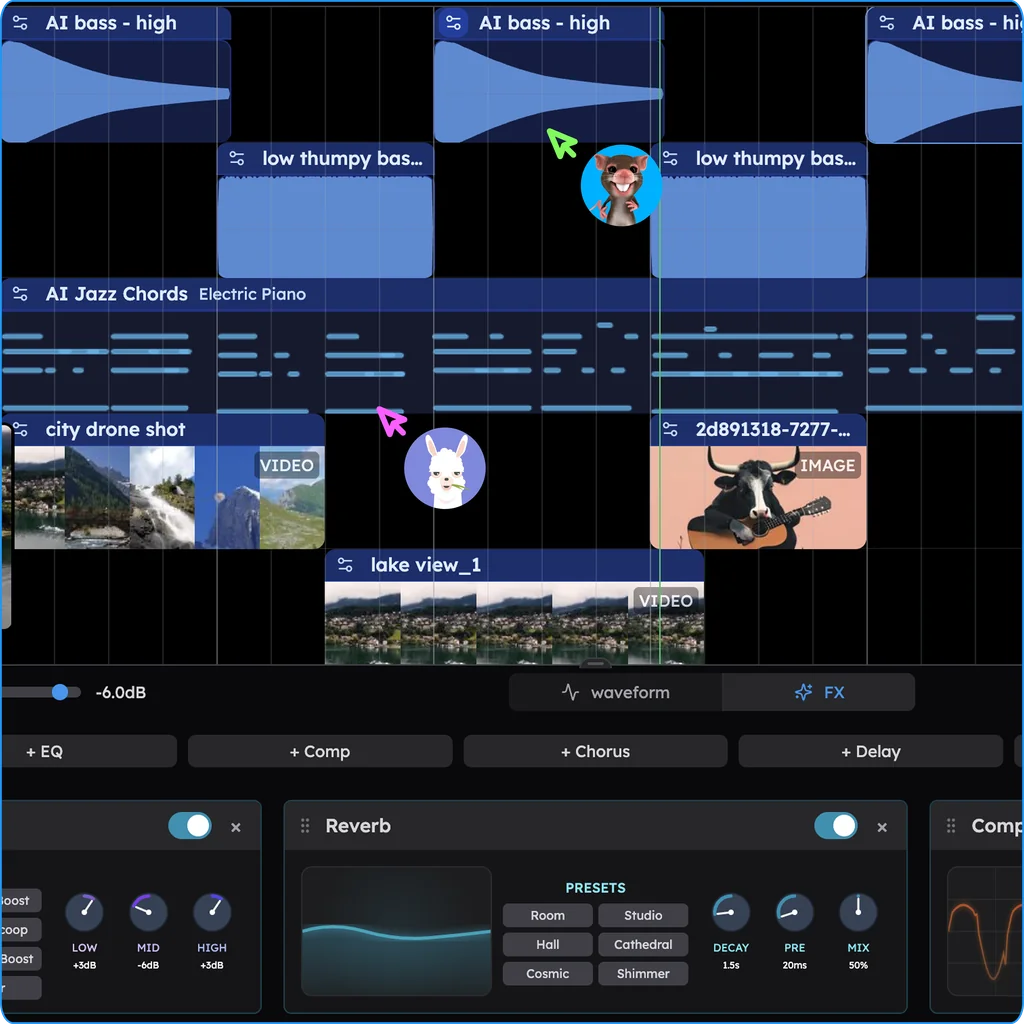
Samba is made in a circle, and so is a good session. Real-time collaboration puts your percussionist, your cavaquinho player or your duo partner in the same project, with live named cursors on the timeline.
Structure maps with bar counts
A baile funk track, at 130 or 150 BPM:
| Section | Bars | What happens |
|---|---|---|
| Intro | 4 | the chant or sample alone over a filtered beat |
| Hook | 8 | full tamborzão, 808 bass, the chant |
| Verse | 16 | beat thins to kick, claps and shaker under the MC |
| Hook | 8 | everything back |
| Montagem break | 8 | beat cut to one element, sample stabs, a one-bar stop |
| Hook | 8 | the biggest version |
| Outro | 4 | beat alone, hard cut |
A bossa nova song usually follows the AABA form of a jazz standard: an 8-bar A, the A again with the bass entering, a B section that moves to a new key area (sometimes longer than 8 bars), a last A, an instrumental chorus over the same changes, then the head out. End on a maj7 or 6/9 chord.
How to make Brazilian music in Veena, start to finish
- Open daw.veena.studio and sign in with Google. Nothing to install.
- Write the brief. Style, tempo, key, the percussion you want, the sections and their bar counts. English or Portuguese.
- Pick your parts. CoProducer offers three options for each part it writes; browse with ↑ and ↓, hover to hear one, press Enter to add it. A part that must fit another — the bass under the tamborzão, the guitar over the clave — waits and reads the notes you actually picked.
- Bring in the real percussion. Ask CoProducer for a pandeiro loop, cuíca hits or an agogô pattern and its sample search shows ten preview cards to choose from, drawn from 27,356 curated samples plus a licensed professional catalogue. If you name a sound it doesn't have, it tells you what it used instead. Load your own one-shots onto the 16-pad sampler.
- Record what only you can play. Your voice, your violão, your pandeiro — straight into the project from your microphone or audio interface.
- Mix. Ask CoProducer to balance the levels, compress the drums and put a Plate reverb on the bossa vocal. Every effect stays editable in the clip's FX tab.
- Export. WAV 24-bit/48 kHz, MP3, MIDI, the full mix or every track, as often as you like, with no watermark. You own your music.
Key terms
- Tamborzão: the syncopated, surdo-heavy drum pattern of Rio funk.
- Montagem: a funk track built as a collage of short samples and vocal fragments over the beat.
- Surdo de primeira / segunda: the low drum on beat 2 and the higher one answering on beat 1.
- Teleco-teco: the tamborim's two-bar syncopated phrase.
- Baixaria: the seven-string guitar's walking bass counterlines in samba and choro.
- Batida: the bossa guitarist's right-hand pattern — thumb bass, syncopated chords.
- Viola caipira: the ten-string guitar of sertanejo and música caipira.
- Arrocha and vanera: the slow offbeat-keyboard sway and the fast accordion dance rhythm inside modern sertanejo.
Mistakes that make it sound like a tourist
- Heavy surdo on beat 1. In samba the deep drum lands on beat 2. Flip it and the groove falls over.
- Flat sixteenths. Samba's swing lives in the accents on the last sixteenth of each beat.
- Swinging bossa nova. Bossa eighths are straight.
- Chords all over baile funk. It is a drum-and-voice genre; one vamp or none is plenty.
- Long 808 tails in funk. They smear the syncopation.
- Crowded bossa arrangements. The space around the guitar and voice is the style.
- Sertanejo harmony in octaves. The duo sound is parallel thirds and sixths.
Build it with CoProducer
Paste one of these and pick your favourite of the three options for each part:
Make a 130 BPM baile funk beat in F minor: a tamborzão groove with punchy 808 kicks, claps and low floor-tom hits standing in for the tambor, a continuous shaker, a short distorted 808 bass tuned to F and a synth-brass stab hook. 4-bar intro, 8-bar hook, 16-bar verse with room for my vocal, 8-bar hook, 8-bar montagem break, 8-bar hook, 4-bar outro
Make a 100 BPM pagode in D major in 2/4: pandeiro-style groove with the low surdo on beat 2, cavaquinho strumming D – B7 – Em7 – A7, seven-string guitar bass runs between the chords, 8-bar intro, 16-bar verse, 16-bar chorus, repeat, 4-bar ending
Make a 124 BPM bossa nova in F major: nylon-guitar batida, cross-stick bossa clave with brushes, upright bass on root and fifth, soft electric piano, chords Fmaj7 – G7 – Gm7 – Gb7, AABA form with 8-bar sections
Faz um funk 150 em fá menor com tamborzão pesado, 808 curto e distorcido, palmas e um refrão de metais
Then tweak like a producer:
- "Move the heavy surdo to beat 2 and accent the last sixteenth of each beat" if the samba sits stiff.
- "Switch to 150 BPM and tighten the 808" to turn a 130 funk into funk 150.
- "Swap the guitar to nylon and play it quieter" for bossa that breathes.
- Open the drum clip's Beat Maker tab and move single hits; open the Piano Roll to revoice a chord to a 6/9.
- Every CoProducer change is one Ctrl/Cmd+Z away from undone.
For the bass and harmony on their own, the bassline generator and the chord progression generator work inside the same project.
More Brazilian styles worth a session
- Forró and baião: the Northeast's trio of sanfona, zabumba and triangle over a dotted, syncopated bass drum.
- Samba-reggae: Salvador's surdo-driven carnival sound from the 1980s, slower and rolling.
- Axé: Bahian carnival pop — brass, big choruses, percussion everywhere.
- Choro: virtuosic instrumental Rio music for cavaquinho, flute, pandeiro and seven-string guitar.
- Brega funk: Recife's mix of romantic brega and funk beats.
Brazil sits right next to the rest of the Americas: make Latin music for salsa, bachata and cumbia, make reggaeton for the dembow, or browse every style to make music by genre.
Try this in Veena
Make a 130 BPM baile funk beat in F minor: a tamborzão groove with punchy 808 kicks, claps and low floor-tom hits standing in for the tambor, a continuous shaker, a short distorted 808 bass tuned to F and a synth-brass stab hook. 4-bar intro, 8-bar hook, 16-bar verse with room for my vocal, 8-bar hook, 8-bar montagem break, 8-bar hook, 4-bar outro
Frequently asked questions
Can I make Brazilian music for free?
Yes. Veena is an AI DAW with a personal music producer built in. Describe the song you want and CoProducer builds it with you — beats, chords, melody, arrangement and mix — as real tracks you can edit, mix and export. Free, in your browser. That covers baile funk, samba, pagode, bossa nova, MPB and sertanejo, and you can write the request in Portuguese.
What BPM is Brazilian funk?
Classic baile funk on the tamborzão sits around 130 BPM. From around 2018, Rio's funk 150 pushed the pulse to 150 BPM, and that faster version now leads the scene. In Veena, put the tempo in your first sentence to CoProducer, for example "150 BPM funk in F minor", and it sets the project tempo and builds the beat to match.
What instruments are used in samba?
A samba bateria stacks surdos (the deepest one marks beat 2), a caixa snare running sixteenths, tamborim, repique, agogô, ganzá shakers, pandeiro and the squeaking cuíca; a roda adds cavaquinho and seven-string guitar. In Veena, CoProducer builds the groove on the drum kit with floor toms as surdos, and its sample search brings in real percussion loops.
How do you make a bossa nova beat?
Set 110–140 BPM with straight eighths, play a cross-stick bossa clave spaced 3-3-4-3-3 over sixteen eighth notes, keep brushes or a soft hi-hat moving, and put a root-and-fifth bass under nylon-guitar chords built on sevenths. In Veena, ask CoProducer for exactly that and it writes every part as editable MIDI you can change note by note.
Does CoProducer understand Portuguese?
Yes. CoProducer takes requests in other languages, so you can type "faz um funk 150 em fá menor com tamborzão pesado" and Veena builds the beat just as it would from English. In Veena's own data, about one in five new users writes their first request in a language other than English.
Meet your personal music producer
Free, in your browser. Describe the song you want and CoProducer builds it with you.
Make music free