Make Classical Music
Make classical music online with a personal music producer who knows counterpoint. Free in your browser, Veena's CoProducer writes string quartets, minuets and piano pieces with real cadences and smooth voice leading, as MIDI parts on Veena's Violin, Viola, Cello and grand piano that you can edit note by note.
Classical music is architecture. A piece states an idea, travels away from it and comes home, and the harmony tells the listener where they are at every moment. Choose the era and the form before writing a note, and the notes have somewhere to go.
Pick an era: classical styles at a glance
| Era | Roughly | Texture | Harmony | Forms | Start in Veena with |
|---|---|---|---|---|---|
| Baroque | 1600–1750 | Independent lines woven together | Sequences over a busy bass line | Fugue, dance suite, concerto | String Ensemble, Cello on the bass line, harpsichord from the sample library |
| Classical | 1750–1820 | A tune over a light accompaniment | Clear cadences, 4- and 8-bar phrases | Sonata, minuet and trio, rondo | Violin, Viola and Cello as a quartet |
| Romantic | 1820–1900 | Singing melody, rich accompaniment | Chromatic, distant modulations | Nocturne, character piece, symphony | Acoustic Grand Piano, Cello, String Ensemble |
| Impressionist | 1890–1920 | Colour and blur | Parallel chords, whole-tone and pentatonic scales | Prelude, tone poem | Acoustic Grand Piano with a Cathedral reverb |
| Minimalist and neo-classical | 1960s–now | Patterns that repeat and shift slowly | A few diatonic chords | Piano pieces, string ostinatos | Acoustic Grand Piano, Pizzicato Strings, Cello |
Name the era in your first message ("a Romantic nocturne in Db major", "a Baroque-style dance for strings") and CoProducer writes toward it. Veena's 24 keys, 40–300 BPM tempo range and time signatures including 3/4, 6/8 and 12/8 cover the everyday meters of the repertoire.
Form first: the map before the notes
| Form | Shape | Length | Why it works |
|---|---|---|---|
| Minuet and trio | Minuet, trio, minuet again, in 3/4 | 16–32 bars each | Short, regular phrases: the best first piece |
| Binary | Two halves, each repeated: A A B B | 16–32 bars | The shape of most Baroque dances |
| Theme and variations | A theme, then new textures on it | An 8–16-bar theme, 3–6 variations | One idea, many sounds |
| Rondo | A B A C A | 80–200 bars | A refrain that keeps coming home |
| Sonata form | Exposition, development, recapitulation | 100–300 bars | Two themes in conflict, resolved in the home key |
| Prelude or nocturne | One texture throughout | 20–80 bars | Made for solo piano |
The prompt at the end of this page builds a minuet and trio in D major. Here is its map, in 3/4:
| Section | Bars | Key | What happens |
|---|---|---|---|
| Minuet, first half | 8, played twice | D to A | Opens in D and closes in A with a perfect cadence |
| Minuet, second half | 16, played twice | A back to D | 8 bars of development landing on A7, then the opening tune returns and closes in D |
| Trio | 16, each half played twice | G | Lighter: repeated 8ths in the inner voices under a legato tune |
| Minuet again | 24 | D | Once through, without repeats |
That's 104 bars, 2 minutes 36 seconds at 120 BPM.
Voice leading: four players, one sound
A string quartet is a four-part choir: the first Violin sings soprano, the second Violin alto, the Viola tenor and the Cello bass. Six habits make four lines sound like one instrument:
- Move by step and keep common tones. If two chords share a note, the voice that has it holds it.
- No parallel fifths or octaves between any two voices; they make two lines collapse into one.
- The leading tone rises. In D major, C# goes up to D.
- The seventh falls. From A7 to D, the G steps down to F#.
- Keep the upper voices close. Neighbouring upper voices stay within an octave of each other; the Cello can sit further below.
- Move against the bass. When the Cello climbs, let the top line fall.
Here is a perfect cadence in D with all four voices at once: Cello A to D, Viola E to D, second Violin G to F#, first Violin C# to D. The seventh falls, the leading tone rises, and nothing leaps. Four cadences punctuate every phrase:
| Cadence | In D | Effect |
|---|---|---|
| Perfect | A7 – D | A full stop |
| Half | any chord – A | A comma: the phrase waits for an answer |
| Plagal | G – D | The "amen" |
| Deceptive | A7 – Bm | A surprise that keeps the music going |
The chord progression generator writes progressions like these from numerals, and the melody generator writes a singable tune over them.
Veena's strings and pianos, and how to write for them
Every part plays on a sampled instrument, and each one has a character worth writing for:
- Violin: the brightest, highest voice. Its bow swells into each note, so it sings long notes and legato phrases; keep melodies at or above G3, its lowest string.
- Viola: a fifth lower, darker and reedier. The inner voice, or a countermelody under the Violin.
- Cello: warm low down and singing at the top, with the slowest bow of the three, so give it long notes.
- Contrabass: the one string in true bass register, sampled from F1 to D3, for held roots under a string orchestra.
- String Ensemble: two layered samples on every note make a wide section, built for held chords and long-note melodies.
- Pizzicato Strings: plucked notes that die away on their own, for ostinatos, arpeggios and a light accompaniment.
- Acoustic Grand Piano, Upright Piano and Acoustic Guitar (nylon): the grand for Romantic and modern piano writing, the upright for a drier, closer sound, the nylon for classical guitar.
Because the bowed samples swell in, fast passagework belongs on Pizzicato Strings or the piano. For woodwinds, brass, harpsichord, organ or choir, ask CoProducer to search Veena's sample library. If you own an orchestral library, the Veena Bridge helper hosts it (AU or VST3 on Mac, VST3 on Windows), and CoProducer, which knows plug-ins such as Kontakt by name, can move a part onto yours.
Dynamics live in the velocities
A string quartet never plays at one level, and the MIDI shouldn't either. In Veena's piano roll, open the velocity editor to set how hard each note is played. A workable map: pianissimo around 30–45, piano 45–60, mezzo-forte 65–80, forte 85–100, fortissimo 105 and up. Shape phrases rather than single notes: rise toward the peak of a phrase, fall into its cadence, and leave a hair of space before the next phrase, the way a player changes bow.
Snap matters too. The 1/4 Beat snap puts notes on the 16th-note grid for running figures, the 1/3 Beat snap puts them on triplets for a Romantic accompaniment, and Ctrl/Cmd with the up or down arrow moves a selection by an octave when a line sits in the wrong register. Or highlight the bars and ask CoProducer: "make bars 17 to 24 softer, with a crescendo into the cadence."
Mixing classical music: a hall, not a club
Classical recordings capture a room, not a stack of close microphones. Four moves get a MIDI quartet there:
- One space for everyone. Put the same Reverb on every part: the Hall preset for a quartet or orchestra, the Cathedral preset for a slow chorale.
- Seat the players. Pan the first Violin left, the second Violin half-left, the Viola half-right and the Cello right, the way a quartet sits.
- Leave the dynamics alone. Skip heavy compression; the distance between pianissimo and fortissimo is the music. The Compressor's Gentle preset on a piano is the most it needs.
- Leave headroom. Veena's master runs into a fixed limiter, so balance the loudest passage with the faders instead of pushing into it, and switch on "Normalize audio for export" for the final level.
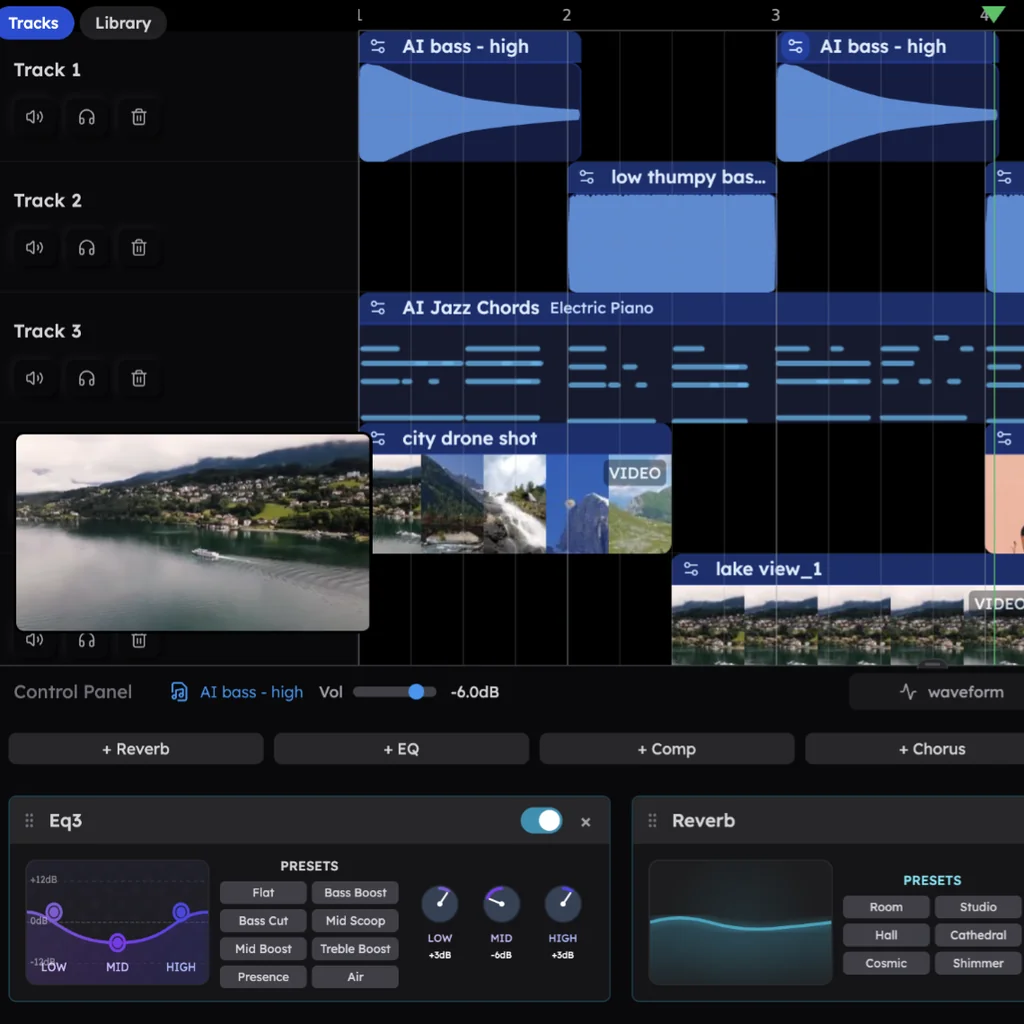
Or ask CoProducer to "mix it like a string quartet in a concert hall", and it sets the levels, pans and reverb on every part.
Mistakes that give a score away
- Parallel fifths and octaves. Two voices moving in lockstep turn four parts into three.
- Loops instead of phrases. A classical phrase goes somewhere and ends on a cadence; a repeating 4-bar loop never arrives.
- One velocity for everything. Flat dynamics sound like a machine. Shape every phrase.
- Thick chords low down. Thirds in the Cello's bottom octave turn to mud; keep the bass on roots and fifths and spread the chord upward.
- Fast runs on bowed samples. They blur. Give running notes to Pizzicato Strings or the piano.
- Writing outside the range. Nothing below G3 on the Violin, C3 on the Viola or C2 on the Cello.
- Every instrument all the time. Let a voice rest; a line that returns after 8 bars of silence sounds new.
Classical terms
Cadence: the chords that end a phrase. Motif: a short idea a piece is built from. Sequence: a motif repeated at a new pitch. Counterpoint: independent lines played together. Voice leading: how each line moves from chord to chord. Modulation: moving to a new key. Alberti bass: a broken-chord accompaniment, low, high, middle, high. Ostinato: a figure repeated under changing music. Pedal point: a note held under changing harmony. Arco and pizzicato: bowed and plucked. Da capo: from the beginning. Exposition, development, recapitulation: the three parts of sonata form.
Make classical music with CoProducer
- Open daw.veena.studio and sign in with Google. It runs in the browser on any modern laptop, with no download and no graphics card.
- Describe the piece: era, form, key, meter, tempo and ensemble. This prompt builds the 104-bar minuet and trio mapped above:
Compose a Classical-era minuet and trio for string quartet in D major, 3/4 at 120 BPM: Violin on the melody, a second Violin and a Viola on the inner voices moving by step, Cello on the bass line. Minuet: an 8-bar opening that modulates to A major and closes there with a perfect cadence; 8 bars that develop the tune and land on an A7 half cadence; 8 bars that bring the opening tune back and close in D. Trio: 16 bars in G major, lighter, with the inner voices on repeated 8th notes, long notes in the Cello and a legato Violin tune. Repeat each half of the minuet and the trio, then play the minuet once more without repeats. Forte minuet, piano trio, a small crescendo into every cadence, no drums.
- Choose the tune before anything else. CoProducer offers three options for each new part. Keep the Violin melody you can sing back; the inner voices and the Cello are then written against the tune you chose.
- Revise like a composer. Every request is a single undo away:
- "Put the trio's accompaniment on Pizzicato Strings."
- "Rewrite the Viola so it moves by step and never makes parallel fifths with the Cello."
- "Add a Contrabass under the Cello's roots for the last 8 bars."
- "Write a variation of the opening 8 bars with 16th-note decoration in the Violin."
- Try another era. In a new project, ask for "a Romantic nocturne in Db major for Acoustic Grand Piano at 66 BPM: a singing right-hand melody over wide left-hand arpeggios, 32 bars, ending on a long held chord."
- Take it to paper. Export MIDI (every MIDI track in one .mid file) and open it in a notation program to print parts for real players, or render the performance to WAV (24-bit/48 kHz) or MP3 (320 kbps), watermark-free, as many times as you revise it.
In Veena's own data, 80.0% of new users whose first request asks for classical music, four in five, get a finished first result on day one. For music to picture, see how to make cinematic music; for slow, spacious piano and strings, make ambient music. Every other style lives under make music by genre.
Try this in Veena
Compose a Classical-era minuet and trio for string quartet in D major, 3/4 at 120 BPM: Violin on the melody, a second Violin and a Viola on the inner voices moving by step, Cello on the bass line. Minuet: an 8-bar opening that modulates to A major and closes there with a perfect cadence; 8 bars that develop the tune and land on an A7 half cadence; 8 bars that bring the opening tune back and close in D. Trio: 16 bars in G major, lighter, with the inner voices on repeated 8th notes, long notes in the Cello and a legato Violin tune. Repeat each half of the minuet and the trio, then play the minuet once more without repeats. Forte minuet, piano trio, a small crescendo into every cadence, no drums.
Frequently asked questions
Can I make classical music online for free?
Yes. Veena is an AI DAW with a personal music producer built in. Describe the song you want and CoProducer builds it with you — beats, chords, melody, arrangement and mix — as real tracks you can edit, mix and export. Free, in your browser. For classical music, that means a string quartet, a piano piece or a small string orchestra, every voice on its own track as MIDI you can edit note by note.
Can AI compose classical music that follows the rules?
Yes. Veena's CoProducer writes phrases that end in cadences, inner voices that move by step, and forms such as the minuet and trio or theme and variations. Every note lands as MIDI, so you can check the voice leading in the piano roll and change anything; ask it to "rewrite the Viola to avoid parallel fifths" and it edits just that part.
What classical instruments does Veena have?
Veena has Violin, Viola, Cello, Contrabass, String Ensemble and Pizzicato Strings, plus Acoustic Grand Piano, Upright Piano and a nylon-string guitar. CoProducer finds woodwinds, brass, harpsichord or choir in Veena's sample library, and your own orchestral libraries load through the Veena Bridge on Mac and Windows, so every section of the orchestra has a way in.
Can I get sheet music or MIDI out of Veena?
Veena exports MIDI, every MIDI track in one .mid file, on every plan and with no cap on exports. Open the file in a notation program to print parts for real players, or export the performance as a 24-bit/48 kHz WAV or a 320 kbps MP3 with no watermark. You own the music you make in Veena.
Meet your personal music producer
Free, in your browser. Describe the song you want and CoProducer builds it with you.
Make music free