AI Orchestra
Veena's AI orchestra orchestrates instead of just playing loud: CoProducer, the personal music producer in a free AI DAW, decides who carries the theme, who doubles it and when the full weight arrives, then writes your cue as separate tracks, strings to percussion, for you to conduct in plain words.
Orchestration is four decisions
Cinematic is the most-asked genre in typed requests to CoProducer, in Veena's own data, and what people want from it is size. Size comes from four decisions, not from more tracks.
- Who has the tune. A theme on solo piano is intimate; the same theme on cellos is warm; on violins in octaves it's heroic. Most cues pass the tune around as they grow.
- Who doubles it. Violas and cellos in unison thicken a melody without brightening it. Violins an octave apart make it soar. Doubling is how an orchestra gets louder without anyone playing harder.
- Where the weight sits. Low strings, low piano and drums carry power. High strings and bells carry air. A cue with both ends busy and an empty middle sounds huge; one with a crowded middle sounds muddy.
- How it moves. Establish, build, peak, release. The build is the part people remember, and it's written, not mixed: more notes, higher registers, harder hits.
A 90-second trailer cue, bar by bar
The prompt at the bottom of this page writes a whole trailer cue. At 120 BPM each bar lasts two seconds, so 45 bars fill a minute and a half:
| Bars | Time | What plays |
|---|---|---|
| 1–8 | 0:00–0:16 | Cellos and basses hold a D drone; the piano states a four-note motif |
| 9–16 | 0:16–0:32 | Pizzicato ostinato in eighths; the cellos take the theme |
| 17–24 | 0:32–0:48 | Violins take the theme an octave up; low toms enter |
| 25–36 | 0:48–1:12 | Full strings with the theme in octaves; taiko hits and brass stabs on the downbeats |
| 37–40 | 1:12–1:20 | A riser; the ostinato climbs and every part gets louder |
| 41 | 1:20 | One hit from everyone, then silence |
| 42–45 | 1:22–1:30 | A piano tail over the last of the drone |
CoProducer, Veena's AI music producer, plans the sections first, writes the parts that don't depend on each other at the same time, and has the later parts read what's already placed. The taiko hits, brass stabs and riser come in as audio from CoProducer's sample search, on their own tracks. Each new part arrives as three takes to choose from.
Directions for an AI orchestra
Once the cue exists, conduct it. Each call edits the score you have.
- "Give the theme to the cellos first and the violins the second time." The melody moves between sections instead of repeating in place.
- "Double the melody in octaves from bar 25." Violins stack, and the theme gets bigger without getting louder.
- "Pedal on D in the basses through the whole build." One held note under moving harmony, the oldest tension trick in film music.
- "Ostinato in the violas." A repeating figure in the middle of the texture keeps the cue moving under long melody notes.
- "Thin it out under the dialogue from 0:40." Fewer notes, lower velocities, nothing in the vocal range.
- "Build: add a layer every four bars." Entrances stagger so the cue grows instead of arriving all at once.
- "Make the hit on bar 41 bigger, then total silence for one bar." Silence after a hit is what makes it land.
- "Warmer." Cellos and violas move up front, violins drop an octave, the bells go.
Every CoProducer change is one Ctrl or Cmd+Z away from undone, so conduct freely.
Veena's orchestra, and how to widen it
Veena's built-in orchestra covers the string section (Violin, Viola, Cello, Contrabass, String Ensemble and Pizzicato Strings), three pianos, bell and choir-like sounds on the Synth shelf, drones and risers, seven drum kits and a 16-pad sampler for your own hits. Three routes take it further:
- Your own libraries. Install the Veena Bridge on a Mac (VST3 and AU) or Windows (VST3) and CoProducer can play its parts through the orchestral instruments you already own. It knows Kontakt by name.
- Sample search. Ask CoProducer for "a brass swell into bar 25" or "a taiko hit" and it searches Veena's curated library of more than 27,000 samples plus a licensed professional catalogue, then places your pick on the timeline.
- Your voice. Hum the horn line and ask CoProducer to re-voice it as horns. The new audio lands on its own track, pitch-corrected to the key.
Ask for an instrument Veena doesn't have and CoProducer says so, and tells you what it used instead.
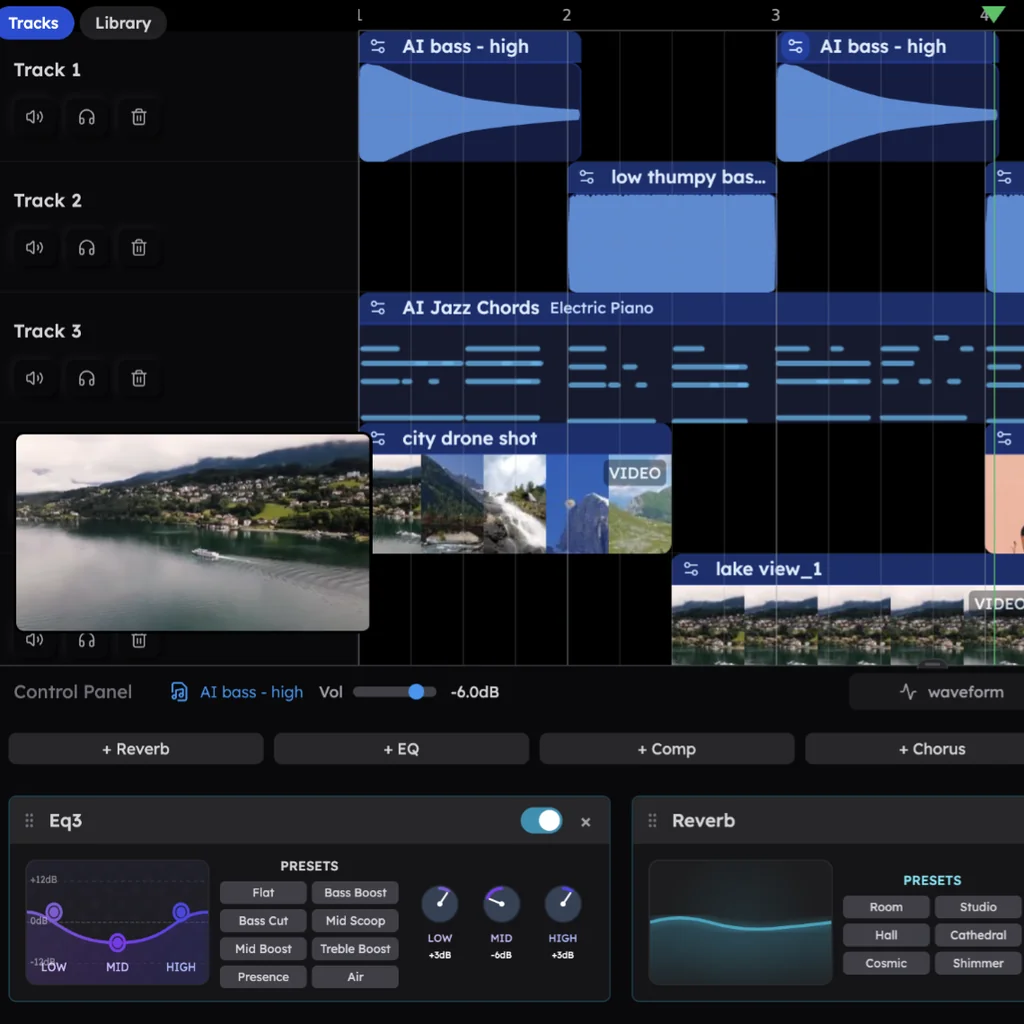
Scoring to picture. Drop your MP4, MOV or WebM onto the timeline and write against the cuts. CoProducer hears the audio in video clips too, so "leave room under the dialogue" means something. Export an MP4 with your score in it when you're done.
Two more cues to conduct
Two more briefs, from the game and film corners of make music by genre.
The fantasy town theme.
"A looping 32-bar town theme for a fantasy RPG at 100 BPM in F major, 3/4: pizzicato strings on the waltz pattern, bells carrying the melody, cellos on a counter-line, a soft string pad, and an ending that leads straight back into bar 1."
Game music is one of CoProducer's strongest styles: 86.2% of new users who ask for it get a first result on day one, in Veena's own data. More at game music.
The documentary cue.
"A 70 BPM documentary cue in C minor: solo piano with a simple left-hand ostinato, a cello line entering at bar 9, the whole string section swelling underneath from bar 17, and a choir-like pad for the final eight bars."
Say "less sentimental" and the cello line gets simpler. The cinematic music page covers the genre, and the AI composer page shows CoProducer writing themes from a sentence.
AI orchestras with the rights held back
AIVA sells AI composition in "more than 250 different styles", orchestral among them. On its free plan the copyright is "owned by AIVA", you must credit AIVA, you can't monetize, and you get 3 downloads a month of tracks up to 3 minutes long. The Standard plan, €11 a month billed annually, still leaves the copyright with AIVA. Owning your score takes the Pro plan at €33 a month, billed annually (AIVA's pricing, September 2026).
Song generators. The orchestra in a Suno track is one mixed render: no cellos to move, no brass to cut. Suno's part-by-part Studio comes with the $30-a-month Premier plan and "is not compatible with VST or Audio Units plugins", so your orchestral library can't load there (Suno's pricing page and help centre, September 2026).
ACE Studio sells AI violins, violas, cellos, saxophones and trumpets, but they perform "a clip on this track from the canvas with MIDI notes as its content" (ACE Studio's documentation, September 2026). The orchestration is still yours to write, in a desktop app.
Aiode offers one orchestral style model, the Cinematic "Orchestral Layers", in a studio "currently in beta", whose Free plan allows 2 exports a month with no commercial license (Aiode's product and pricing pages, September 2026).
| Veena (CoProducer) | AIVA | Suno | Aiode | |
|---|---|---|---|---|
| Who writes the parts | CoProducer, section by section, from plain words | Whole tracks from style presets | The generator, as one render | One orchestral layer model |
| Rights on the free plan | You own your music | "Copyright owned by AIVA", credit required | "No commercial rights" | No commercial license |
| Downloads | No cap, no watermark | 3 a month free, 15 on Standard | None monthly on Free, 20 a month on Pro | 2 exports a month free |
Raise the baton
Paste the prompt below into CoProducer, choose your three takes, then conduct the cue call by call. For deeper string writing, the AI string section page goes voice by voice; to add a rhythm section under the score, book an AI session musician.
Try this in Veena
Score a 90-second trailer cue at 120 BPM in D minor. Bars 1–8: cellos and basses on a low D drone, a lonely four-note piano motif. Bars 9–16: pizzicato ostinato in eighths, cellos take the theme. Bars 17–24: violins take the theme an octave up, low toms enter. Bars 25–36: full strings with the theme in octaves, taiko hits and brass stabs on the downbeats. Bars 37–40: a riser, everything climbing. Bar 41: one huge hit, then silence and a piano tail.
Frequently asked questions
Can AI write orchestral music for my film or game?
Yes. Veena is an AI DAW with a personal music producer built in. Describe the song you want and CoProducer builds it with you — beats, chords, melody, arrangement and mix — as real tracks you can edit, mix and export. Free, in your browser. For a score, describe the cue bar by bar and CoProducer orchestrates it across separate string, piano and percussion tracks.
Does Veena's AI orchestra have brass and woodwinds?
Veena's built-in orchestra covers the string section, piano, bells, a choir-like pad and percussion. For horns and woodwinds, load your own orchestral library through the Veena Bridge (CoProducer knows Kontakt by name), pull brass hits and phrases from CoProducer's sample search, or hum a line and ask CoProducer to re-voice it as horns.
Can I score to picture in Veena?
Yes. Drop an MP4, MOV or WebM video onto Veena's timeline, write the cue against the picture, and export an MP4 with your music in it. CoProducer hears the audio in video clips too, so you can ask it to leave room under the dialogue.
Who owns orchestral music made with Veena?
You do. Veena's terms say you own the Output you generate through your use of the Service, on the free plan and Veena Pro alike, with no credit line required and no watermark on your exports. Export the full score, every section as its own file, or the parts as MIDI, as often as you like.
Meet your personal music producer
Free, in your browser. Describe the song you want and CoProducer builds it with you.
Make music free