AI Session Musician
An AI session musician should read the brief, play for the song and hand you takes, and in Veena, a free AI DAW with a personal music producer built in, CoProducer does all three on every chair: drums and bass, keys, guitar and strings. Every take lands as a real, editable track.
What an AI session musician has to get right
Session players get booked again for four reasons, and none of them is "played lots of notes".
- They read the chart. Key, tempo, form, where the stops are. CoProducer starts every session with a plan: the sections, their bar lengths, which layers play where, and a to-do list you can watch tick over.
- They play for the song. A great bassist makes the singer sound better. CoProducer writes each part against the parts already placed, reading their real notes, so the keys stay out of the bass's register and the bass lands with the kick.
- They take direction. "Simpler." "Half the notes in the verse." "More like the demo." You say it in plain words, in your own language, and the part is edited, not re-rolled.
- They deliver. Clean takes, on time, labelled. Veena exports the mix or one file per track, zipped, at 24-bit/48 kHz, with no cap and no watermark.
Write the brief like a producer
Real producers don't book a session with an artist's name. They send tempo, key, form and feel. So do Veena's users: only about 3% of typed requests name an artist, in Veena's own data. The rest describe the music. It pays off, too: users who type their own first request get a first result on day one 64% of the time, against 56% for users who click a suggestion.
A good brief answers six questions:
- Tempo and meter. "96 BPM, 4/4." Veena runs from 40 to 300 BPM, in eight time signatures from 4/4 and 6/8 to 5/4 and 7/8.
- Key. "G major." Leave it out and CoProducer picks one for the style.
- Form. "Verse 8, chorus 8, twice, bridge, double chorus."
- Feel. "Warm, a little behind the beat."
- Each part's job. "Bass: roots and fifths, walk into every chorus."
- What to leave alone. "Leave room for a lead vocal."
The prompt at the bottom of this page is exactly that brief, ready to paste.
A session, from downbeat to bounce
Here's what you watch happen in the CoProducer panel once the brief goes in. It's the same AI music producer that runs every Veena session, doing the booking, the playing and the engineering.
- The plan. CoProducer lays out the sections and parts, and a to-do strip counts through them.
- The players start. Parts that don't depend on each other are written at the same time. A part that has to fit another waits until it's placed, then reads its notes.
- The takes. Each new part arrives as three options in one carousel. Hover to hear, browse with the arrow keys, press Enter to add. Nothing that depends on that part is written until you pick.
- The arrangement. Sections are built out, layers drop in and out, and entrances stagger so the song grows.
- The mix pass. Levels, panning and effects per clip, then a finishing pass across the whole song.
- The honest wrap. CoProducer ends with what was delivered and what's missing, from what's actually on the timeline. If you asked for an instrument it doesn't have, it says so and names what it used instead.
Every step lands as tracks you can open. Every CoProducer change is one undo.
Three sessions to book
Three bookings from three corners of make music by genre.
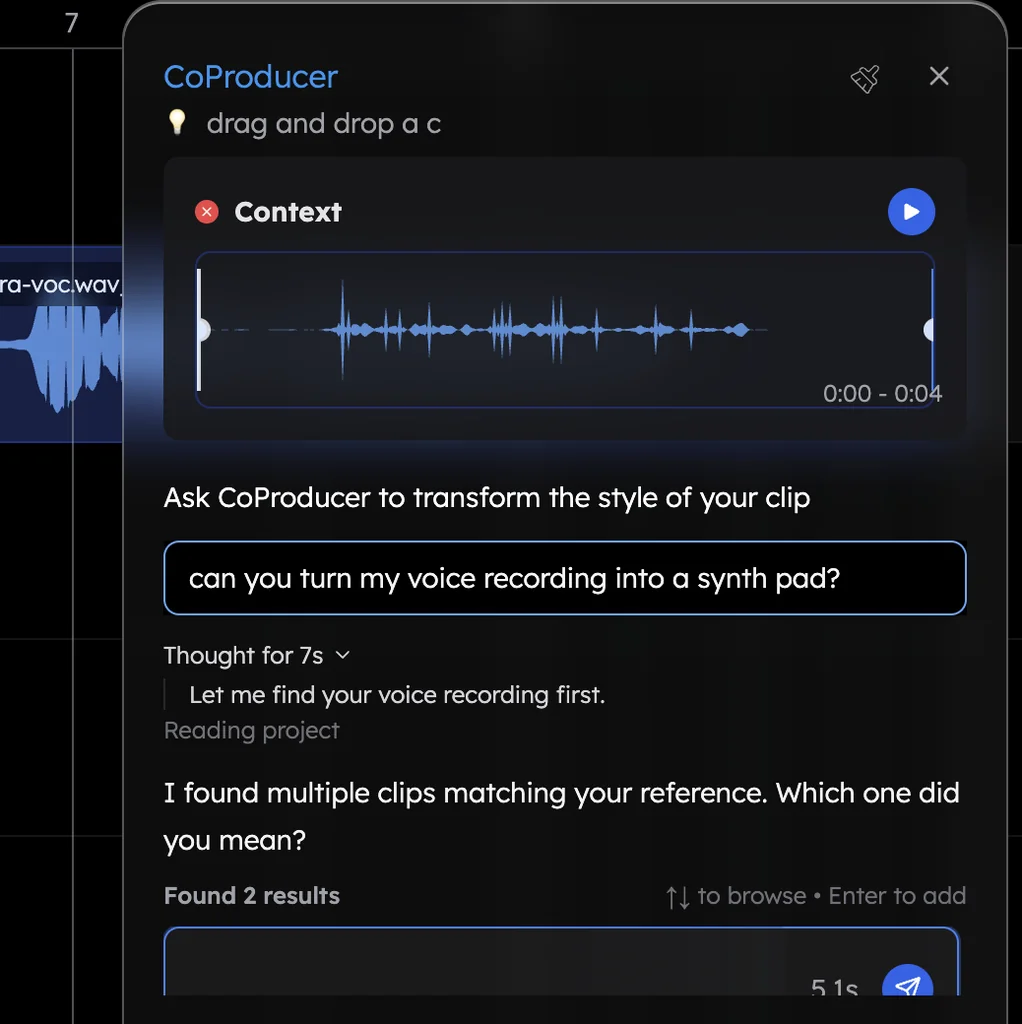
The songwriter's demo. Drag your phone recording into the CoProducer panel as context, as in the capture above, then:
"Build a band around my voice memo: brushes, upright bass, nylon-string guitar, and a soft pad in the choruses. Follow my timing."
CoProducer measures the take's tempo, downbeat and phrasing first, so every part follows your singing. The vocal stays yours; the band plays around it.
The pop single from nothing.
"118 BPM pop in D major: tight kick and clap, a syncopated synth bass, bright piano chords, a guitar pluck riff in the chorus. Verse, pre-chorus, chorus, twice, then a breakdown and a final chorus."
Pop is one of CoProducer's strongest styles: 87.3% of new users who ask for it get a first result on day one, in Veena's own data. The pop song page covers the rest.
The score.
"A 90-second cue at 80 BPM in D minor: low strings holding a drone, a piano motif, pizzicato ostinato from bar 9, full strings and taiko hits from bar 17, a hard stop on the downbeat of bar 29."
For more on writing like this, see the AI orchestra page.
Virtual session musicians elsewhere, and what they cost you
Aiode built its pitch on this phrase: musician models "developed with professional session musicians". It describes itself as "currently in beta". Its Free plan gives you two musician tracks, "2 Mix or Region exports a month" and no commercial license; four musicians take the Basic plan at $9.99 a month, eight the Pro plan at $19.99. Its workflow ends by sending stems "into your DAW of choice for further editing, mixing and mastering" (Aiode's pricing and home pages, September 2026). And its new owner says native audio recording and more DAW functionality are "planned for future versions" (BandLab Technologies, 15 July 2026).
LUNA. Universal Audio promises "real performances by world-class session musicians adapted perfectly to fit your song". They come from a partner plug-in, Celemony Tonalic Essential, included with LUNA Studio ($199) or UAD Spark Studio ($149 a year), not LUNA Free, in a DAW you download for macOS or Windows (Universal Audio's LUNA page, September 2026).
Logic Pro. Apple's six Session Players (a synth player, a piano player, two bassists and two drummers) need a Mac with Apple silicon or an iPad, and Logic costs $199.99 or $12.99 a month (Apple's Logic Pro page, September 2026).
LANDR Layers runs on Aiode's stem generation technology, by LANDR's own account, inside a standalone desktop app with 25 minutes of generation a month on LANDR Studio plans. Its players hand you stems, with the instruction to "drag the new stems from the desktop app to your DAW timeline" (LANDR's AI Drummer page, September 2026).
| Veena (CoProducer) | Aiode | LUNA | Logic Pro | |
|---|---|---|---|---|
| Price to start | Free | Free plan: 2 musician tracks, 2 exports a month, no commercial license | Session musicians need LUNA Studio ($199) or Spark Studio ($149 a year) | $199.99, or $12.99 a month |
| Where it runs | Any modern browser, phones included | Web and desktop, in beta | Download for macOS or Windows | Mac with Apple silicon, or iPad |
| Who's on the call sheet | Drums, bass, keys, guitar, strings and synths, plus your own plug-ins | Musician and style models | Session musicians from a partner plug-in | Synth, piano, two bassists, two drummers |
| How you brief them | Plain words, in your language | Region types and a Performance page | The chords of your song | A Chord Track and performance controls |
Book it
Paste the brief below into CoProducer and change the numbers to your song. For a finished bed to sing over, the AI backing track generator is the fastest route; to hear one chair up close, meet the AI guitarist or the AI pianist.
Try this in Veena
Session brief: 96 BPM, G major, 4/4. Intro 4 bars, verse 8, chorus 8, verse 8, chorus 8, bridge 8, double chorus. Warm and a little behind the beat. Drums: brushes in the first verse, sticks from the first chorus. Bass: roots and fifths, walk into every chorus. Keys: sparse electric piano. Acoustic guitar strumming in the choruses. Leave room for a lead vocal.
Frequently asked questions
What is an AI session musician?
It's a player you brief in words who records a part for your song. Veena is an AI DAW with a personal music producer built in. Describe the song you want and CoProducer builds it with you — beats, chords, melody, arrangement and mix — as real tracks you can edit, mix and export. Free, in your browser.
Can an AI session musician play on my own recording?
Yes. Drag your demo, voice memo or loop into Veena's CoProducer panel as context and describe the parts you want. CoProducer measures the take's tempo and downbeat, maps where your phrases fall, sets the project tempo to match, and writes drums, bass and keys that follow your phrasing instead of a click.
Who owns the parts an AI session musician plays in Veena?
You do. Veena's terms say you own the Output you generate through your use of the Service, and there's no watermark on your exports. Export the mix or every track as WAV, MP3, MIDI or MP4, as often as you like, on the free plan or Veena Pro, and release the song wherever you want.
How is Veena different from Aiode's virtual session musicians?
Aiode calls itself "currently in beta"; its Free plan gives two musician tracks, 2 exports a month and no commercial license, and its owner says native audio recording is still planned (Aiode's pricing page, September 2026; BandLab Technologies, July 2026). Veena is a complete studio in your browser: CoProducer plays every part, and you record, mix and export in the same session.
Is Veena's AI session musician free?
Yes. Veena is free to start, in your browser, with a daily CoProducer allowance; picking between takes doesn't count against it. Recording, stems, plug-ins, collaboration and exports cost nothing on the free plan. Veena Pro, $20 a month, removes the daily request cap and unlocks the premium models.
Meet your personal music producer
Free, in your browser. Describe the song you want and CoProducer builds it with you.
Make music free