AI Music Generator, No GPU: A Free Studio on Any Laptop
An AI music generator, no GPU needed: Veena runs the AI on its servers and the studio in your browser. YuE2 wants a 24 GB card. Free, on any laptop.
Looking for an AI music generator, no GPU required? Use Veena: the AI runs on Veena's servers and the studio runs in your browser, so any laptop with a modern browser works, Chromebooks included. Describe a song and CoProducer, your personal music producer, builds it as real tracks you keep producing, free, with no export cap, and the music is yours.
The graphics card question comes from the people leaving Suno for local models. In the biggest "offline alternative to Suno" thread we read this September, 28 of its 81 comments asked some version of the same thing: will it run on my laptop? For the open models, the honest answer is usually no.
The hardware wall behind local AI music models
Every open-weights song model publishes its own requirements, and they read like a gaming-PC spec sheet:
- YuE2 (the open model that turns lyrics and a style prompt into a song): "Linux · Python 3.12 · NVIDIA GPU with BF16 support and 24 GB VRAM" (YuE's GitHub README, September 2026). The original YuE wanted more: full songs needed "GPUs with at least 80GB memory", and "On an RTX 4090 GPU, generating 30s audio takes approximately 360 seconds." That's about 12 minutes of a top gaming card for every minute of music.
- MiniMax Music 3, the open model MiniMax points developers to since closing its paid music API to new users on 20 August 2026: "Inference requires CUDA", and its quick-start code "fits 24GB+ VRAM GPUs" (its Hugging Face model card, September 2026). Streaming the model layer by layer squeezes it onto an 8 GB card, and even then the card warns the tempo, key and structure "may not always match every requested detail exactly."
- ACE-Step 1.5 is the lightest: its project page says it "runs locally with less than 4GB of VRAM". But its README still says "CUDA GPU recommended", switches the song-planning language model off by default on cards of 6 GB or less, and saves "Best quality" for 24 GB and up; the XL model "Requires ≥12GB VRAM (with offload), ≥20GB recommended" (ACE-Step's GitHub README, September 2026).
A 24 GB NVIDIA card isn't in the laptop most musicians own, and a school Chromebook won't run any of these at all. Each of them, once running, hands you rendered audio, not a studio to keep working in.
An AI music generator, no GPU: how Veena splits the work
Veena puts each job where it runs best. The heavy lifting happens on Veena's servers: the AI models behind CoProducer, stem separation, and turning a hummed take into another instrument. The studio runs in your browser: the audio engine, Veena's own synth, audio-to-MIDI, and the CoProducer loop that places parts on your timeline.
What your computer needs:
- A modern browser. Chrome, Edge, Brave or Arc recommended, Firefox supported, Safari with fallbacks.
- A window at least 1000 pixels wide. Any laptop screen qualifies.
- A Google account to sign in, so your projects save to your account automatically.
- Nothing else. No graphics card, no Python, no drivers, no download.
That's why it runs on a Chromebook as happily as on a gaming rig. The details, browser by browser, are in Veena's browser requirements, and the DAW for Chromebook guide covers ChromeOS.
What you get without a graphics card
Not a render: a song you can open up.
- A full song from one sentence. CoProducer plans the sections, then builds drums, bass, chords and melody as separate tracks, offering 3 options for each new part. In Veena's own data, first requests for pop reach a finished first result on day one 87.3% of the time.
- Every part editable. A piano roll for the notes, a mixer for the balance, 61 instrument presets and 7 drum kits, 10 built-in effects, and recording from your mic.
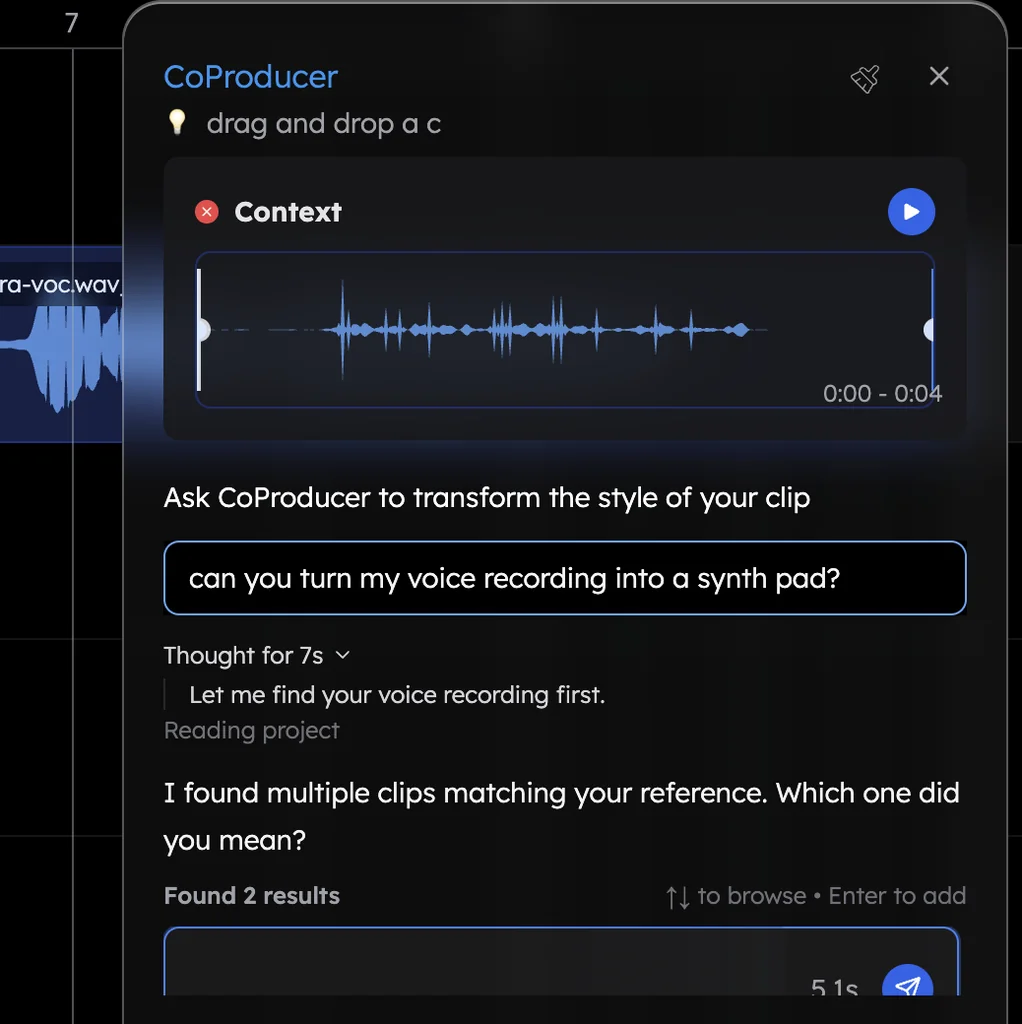
- Your voice as an instrument. Hum a line and CoProducer turns it into MIDI you can edit, or re-voices the take as a saxophone or a synth pad; the re-voicing takes about 12 seconds on Veena's servers.
- Stems of your own audio. Split any song you bring into vocals, drums, bass and other; a full song takes about 45 to 120 seconds, none of it on your laptop.
- Exports with no cap. 24-bit/48 kHz WAV, 320 kbps MP3 or MIDI, the full mix or every track, as often as you like, with no watermark. You own what you make.
Veena vs the local and cloud options (September 2026)
| Veena | YuE2 | ACE-Step 1.5 | MiniMax Music 3 | Suno | |
|---|---|---|---|---|---|
| Hardware you need | Any laptop with a modern browser | NVIDIA GPU, 24 GB, on Linux | CUDA GPU recommended; best quality at 24 GB | CUDA GPU; quick-start code fits 24 GB+ cards | Any browser |
| Install | None | Python and model weights | Python or a portable package | Python and model weights | None |
| What you get | A song as editable tracks in a full studio | A rendered recording | A rendered track in a Gradio web page | A 32 kHz, 16-bit WAV | A rendered song |
| Change one part | Any note, sound or section, in a piano roll and mixer | Edit the score as text; each edit renders "a new complete recording" | Repaint or extend a section | Generate again | Full studio on Premier only, $30 a month |
| Downloads | No cap, every plan | Your own files | Your own files | Your own files | 20 a month on Pro, 60 on Premier |
| Price to start | Free | Free, plus the GPU | Free, plus the GPU | Free, plus the GPU | Free; Pro $10 a month |
Cloud generators skip the GPU too, and send a different bill
The big hosted generators run on their own servers as well. The catch is what they give back.
Suno rations the downloads. Since 3 September 2026, Pro ($10 a month) downloads 20 songs a month and Premier ($30) 60, and its full studio is Premier-only and "not compatible with VST or Audio Units plugins" (Suno's help centre, September 2026). The Suno alternative guide has the full picture.
Udio gives nothing back. Downloads have been disabled on every plan since 29 October 2025; more in Udio download disabled.
Google Flow Music edits by sentence. Google's help centre describes edits as prompts such as "Shorten the intro to 4 bars" (September 2026), and MIDI is not among the features its plans list.
ACE-Step's own hosted site, acemusic.ai, is advertised in its README as "100% free, no GPU required!", but it serves the same model, with the limits its authors list: results "Highly sensitive to random seeds", "Unnatural transitions in repainting/extend operations". See the ACE-Step alternative for the full comparison.
From an old laptop to a finished song
- Open daw.veena.studio in Chrome and sign in with Google.
- Describe the song in producer terms: genre, tempo, key, parts, sections. The pop prompt at the end of this page is a good start.
- Pick your parts. Browse the 3 options for each part with the arrow keys and press Enter to keep one.
- Make it yours. Record a vocal, hum a hook, or ask CoProducer for "half-time drums in the bridge". One undo reverses any CoProducer change.
- If playback stutters, open Studio Settings and raise the buffer size (512 is the recommended setting). Your laptop plays and edits the song; the AI models run on Veena's servers.
- Export the mix or every track.
Graphics cards matter for training and running models, which is exactly why Veena keeps them on its side; why your graphics card doesn't help audio explains the rest. Everything the free AI music generator builds lands as real tracks on your timeline. Paste the prompt below into CoProducer and hear it on the laptop you already own.
Related reading: YuE AI music alternative · Best DAW for a low-end PC · Cloud rendering for audio
Try this in Veena
Make a 104 BPM pop song in A major: tight drums that open into a four-on-the-floor kick in the chorus, a bouncy synth bass, bright piano chords (A, E, F#m, D), a plucky synth hook, and space in the mix for my lead vocal. Intro 4 bars, verse 8, pre-chorus 4, chorus 8, verse 8, pre-chorus 4, chorus 8, bridge 8, final chorus 8.
Frequently asked questions
Can I use an AI music generator without a GPU?
Yes. Veena is an AI DAW with a personal music producer built in. Describe the song you want and CoProducer builds it with you — beats, chords, melody, arrangement and mix — as real tracks you can edit, mix and export. Free, in your browser. The AI runs on Veena's servers, so any laptop with a modern browser works, with no graphics card.
Can I run YuE or ACE-Step without a graphics card?
Not comfortably. YuE2's README asks for Linux, Python 3.12 and an NVIDIA GPU with 24 GB of VRAM. ACE-Step 1.5 also runs on a CPU, but its README recommends a CUDA GPU and keeps its best quality for 24 GB cards. Veena needs neither: CoProducer runs on Veena's servers and builds your song as real tracks in the browser.
Does Veena work on a Chromebook or an old laptop?
Yes. Veena runs in Chrome and other modern browsers on Chromebook, Windows, Mac and Linux laptops, in a window at least 1000 pixels wide, and the heavy AI work happens on Veena's servers. If playback stutters on an older machine, raise the buffer size in Studio Settings. Nothing to install, and your projects save to your account.
Is Veena free without a GPU?
Yes. Veena is free to start with a daily CoProducer allowance, on any computer that runs a modern browser. Exports have no cap on every plan: 24-bit/48 kHz WAV, 320 kbps MP3 or MIDI, the full mix or every track, with no watermark. Veena Pro, $20 a month, removes the daily request cap and unlocks the premium models.
Meet your personal music producer
Free, in your browser. Describe the song you want and CoProducer builds it with you.
Make music free