Best YuE AI Music Alternative: No GPU, a Whole Studio
The best YuE AI music alternative is Veena: no 24 GB GPU and no Python, just a free AI DAW where CoProducer builds your song as real tracks you keep.
The best YuE AI music alternative is Veena, an AI DAW with a personal music producer: no 24 GB graphics card, no Linux, no Python. Describe the song and CoProducer builds it as real tracks you keep producing, free in your browser, with no export cap, and it's yours. YuE2 renders one audio file; Veena hands you the whole session.
YuE is the open-source song model people name most when they talk about leaving Suno for something they run themselves. Its new version, YuE2, is a research model you run yourself, and as a place to make music it costs you a lot before the first note.
What running YuE actually takes
Everything here comes from YuE's own GitHub README, read on 23 September 2026.
A graphics card most musicians don't own. The quick start opens with the requirements: "Linux · Python 3.12 · NVIDIA GPU with BF16 support and 24 GB VRAM." Not a MacBook, not a Windows laptop with integrated graphics, not a Chromebook. The original YuE was heavier still: full songs needed "GPUs with at least 80GB memory", and on an RTX 4090, "generating 30s audio takes approximately 360 seconds".
A terminal, not a studio. You clone the repository, build a Python environment, install the package and run a script; model files "download from Hugging Face on first use". What comes out is a folder: "Open outputs/first-song/audio.flac."
One file for the whole song. Give YuE2 "lyrics and a style prompt" and it "writes a melody-and-chord plan, then realizes that plan as a complete song with vocals and accompaniment". The accompaniment arrives mixed into that one stereo file. There's no drum track to mute, no bass line to swap and no mixer to balance.
Every edit re-renders everything. YuE2's big idea is an editable score: you export the plan as ABC notation, change it as text, or ask an agent to, and render again. The README is plain about the cost: "Editing generates a new complete recording; it does not preserve the original waveform outside an edit." Fix one chord in the bridge and you get a new recording of the whole song.
The no-GPU route is a demo. The README points to a third-party "NOIZ-hosted demo", which on 23 September 2026 showed "Generate 3 left", a link to "skip the queue" on another product, and a history "Saved in this browser only".
Why Veena is the best YuE AI music alternative
Veena keeps what drew you to YuE, a full song from words and ownership of what comes out, and removes everything that stood between you and the music.
- No hardware wall. CoProducer's AI runs on Veena's servers; the studio runs in Chrome and other modern browsers on Mac, Windows, Linux and Chromebook laptops. Nothing to install and no graphics card needed.
- A song as tracks, not a file. CoProducer plans the sections, then writes drums, bass, chords and melody as separate tracks on a timeline. Each new part arrives as 3 options, and nothing that depends on a part is written until you pick.
- Change one part, keep the rest. Rewrite the bridge chords in the piano roll and the verses don't move. Ask for "a busier hi-hat in the last chorus" and the rest of the song stays as it was. One undo reverses any CoProducer change.
- A whole studio around it. 61 instrument presets, 39 of them on Veena's own synth, 7 drum kits, a 16-pad sampler, 10 built-in effects, a mixer and recording from your mic. Your own plugins (VST3, plus AU on Mac) load through the Veena Bridge helper app on Mac and Windows.
- Out whenever you like. Export 24-bit/48 kHz WAV, 320 kbps MP3 or MIDI, the full mix or every track, as often as you like, with no watermark on your exports.
- Yours, in plain words. Veena's terms: "you own the Output you generate through your use of the Service."
In Veena's own data, 3 in 4 new users (75.7%) whose first request asks for a new song get a finished first result on day one, and 81.5% do when the request names a genre.
Your lyrics, your voice: how a song gets built around you
YuE starts from lyrics. So can a Veena session, with one difference that matters on release day: the voice on the record is yours.
- Write the words. Keep your lyrics in the Notes pad in Veena's sidebar, next to the project.
- Record a rough take. Choose a count-in of 1 or 2 bars and sing, over nothing at all if you like. A red box shows where the take will land, and loop recording keeps your last complete pass.
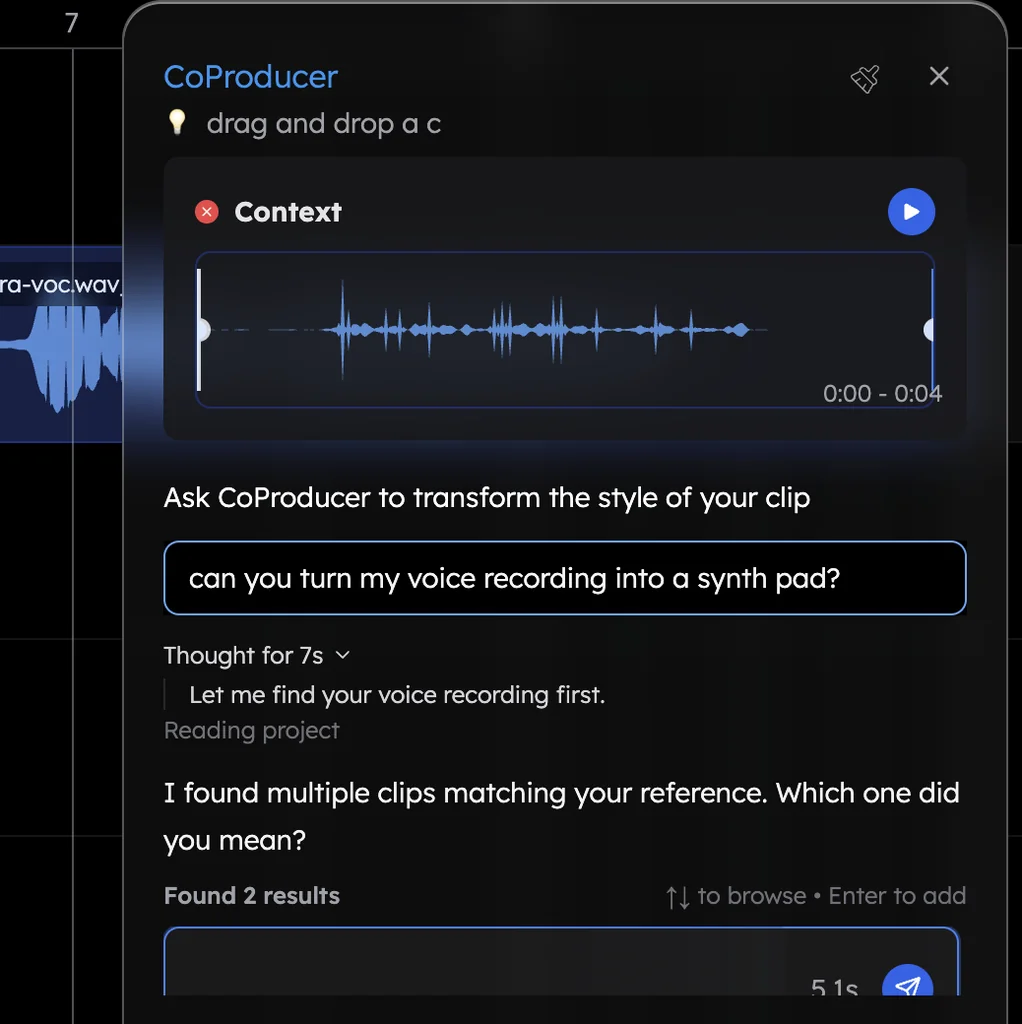
- Hand it to CoProducer. Drag the clip into the CoProducer panel and ask it to build the song around it, like the ballad prompt at the end of this page. CoProducer measures the take, its tempo, its downbeat and a flow map of where your syllables land, sets the project tempo to match, and every part it writes reads that map, so the drums and chords follow your phrasing instead of fighting it.
- Pick and shape. Choose among 3 options per part, then ask for changes in plain words: "drop the drums out for the first half of verse 1", "make the bass walk into the chorus".
- Sing the keeper. Re-record the final vocal on its own track, add Auto-Tune if the style wants it, and export.
Got a melody but no words yet? Hum it. CoProducer turns the hum into MIDI you can edit, or re-voices it as a saxophone or a synth pad; that's Veena's voice to instrument.
Other YuE alternatives, and what each one costs you
ACE-Step 1.5: a lighter model with a slot machine inside. Its project page says it "runs locally with less than 4GB of VRAM", but the README still reads "CUDA GPU recommended", turns the song-planning language model off by default on cards of 6 GB or less, and keeps "Best quality" for 24 GB and up (ACE-Step's GitHub README, September 2026). Its own authors list the rest on the ACE-Step 1.5 project page: "Highly sensitive to random seeds and input duration, leading to varied "gacha-style" results", "Coarse vocal synthesis lacking nuance", and "Unnatural transitions in repainting/extend operations". The interface is a Gradio web page. The full breakdown is in the ACE-Step alternative.
MiniMax Music 3: CUDA, and a best effort at your brief. "Inference requires CUDA", its quick-start code "fits 24GB+ VRAM GPUs", and the model card warns that "The generated tempo, key, instrumentation, lyrics, and song structure may not always match every requested detail exactly" (Hugging Face, September 2026). Output is a 32 kHz, 16-bit WAV. MiniMax also closed its paid music API to new users on 20 August 2026.
Suno: no GPU, but a rationed download. Since 3 September 2026, Pro ($10 a month) downloads 20 songs a month and Premier ($30) 60; free-plan songs belong to Suno; and with v6, Suno retired its earlier models, so "you can't generate new songs with" the one you liked (Suno's help centre, September 2026). Its studio is Premier-only and "not compatible with VST or Audio Units plugins". The Suno alternative guide covers the switch.
Udio: nothing leaves. Downloads of audio, video and stems have been disabled on every plan since 29 October 2025 (Udio's help centre, February 2026). See Udio download disabled.
YuE alternatives compared (September 2026)
| Veena | YuE2 | ACE-Step 1.5 | MiniMax Music 3 | Suno | |
|---|---|---|---|---|---|
| What you need | Any laptop with a modern browser | Linux, Python 3.12, a 24 GB NVIDIA GPU | Python 3.11 or 3.12; CUDA GPU recommended | A CUDA GPU; 24 GB+ for the quick start | Any browser |
| What comes out | A song as separate, editable tracks | One stereo audio file | A rendered track | A 32 kHz, 16-bit WAV | A rendered song |
| Change one part | Any note, sound or section; the rest stays | Edit the score; the whole song re-renders | Repaint a section, with "unnatural transitions" risk | Generate again | Full studio on Premier only, $30 a month |
| Mixer, instruments, recording | Built in, free | None | None | None | In Studio, Premier only |
| Export | WAV, MP3, MIDI, every track, no cap | Your local files | Your local files | Your local files | 20 songs a month on Pro |
| Price to start | Free | Free, plus the GPU | Free, plus the GPU | Free, plus the GPU | Free; Pro $10 a month |
Moving from YuE to Veena
You don't need to port anything. Bring the ideas.
- Translate the style prompt. YuE takes tags and lyrics; CoProducer takes a producer's brief. Turn "English, jazz-funk, warm lead vocal, Rhodes, bass and drums" into "a 102 BPM jazz-funk groove in E minor with Rhodes chords, a funky electric bass and tight drums, verse–chorus–verse–chorus–bridge–chorus".
- Keep the chords you planned. If you edited a YuE2 score, name its progression in the request ("verse Em9–A13–Dmaj7–Bm7"). CoProducer writes the parts on it, and the chords land as MIDI you can open in the piano roll.
- Bring your own audio and MIDI. Veena imports 13 audio formats, FLAC and WAV among them, and .mid files open as editable tracks, with channel 10 mapped to drums.
- Record your vocal and export. Every track, as often as you like.
Start at daw.veena.studio, or see the free AI music generator first. Veena runs where YuE can't, builds what YuE renders as one file, and lets you change a bar without redoing the song. Paste the prompt below into CoProducer and sing over it tonight.
Related reading: AI music generator, no GPU · ACE-Step alternative · Leaving Suno
Try this in Veena
Make a 72 BPM piano ballad in C major built around my lead vocal: warm grand piano chords (C, G/B, Am, F), a soft kick and rim click that enter in verse 2, a sustained bass, a low string line in the chorus and a string swell into the last chorus. Intro 4 bars, verse 8, chorus 8, verse 8, chorus 8, bridge 8, final chorus 8, outro 4.
Frequently asked questions
What is the best YuE AI music alternative?
Veena. Veena is an AI DAW with a personal music producer built in. Describe the song you want and CoProducer builds it with you — beats, chords, melody, arrangement and mix — as real tracks you can edit, mix and export. Free, in your browser. Unlike YuE, it needs no graphics card, and you change one part without re-rendering the whole song.
Does YuE need a GPU?
To run it yourself, yes. YuE2's README asks for "Linux · Python 3.12 · NVIDIA GPU with BF16 support and 24 GB VRAM". A third-party demo runs it online with a few free generations. Veena needs no graphics card at all: the AI runs on Veena's servers and the studio in any modern browser, Chromebooks included, free, with exports of every track.
Can I use songs made with YuE commercially?
YuE2's licence lets personal users, content creators and musicians "monetize generated outputs", while companies must ask about a commercial licence for the weights, which are CC BY-NC 4.0 with an added creator permission. Veena keeps it simple: its terms say "you own the Output you generate through your use of the Service", on every plan, with no watermark on your exports.
How do vocals work in Veena?
Your voice is the lead. Record in Veena from your mic, with a count-in and loop recording, and CoProducer builds drums, bass, chords and melody around your take, reading where each syllable lands so every part follows your phrasing. Hum a line and it becomes any instrument. The vocal on the record is yours, and so is the song.
Meet your personal music producer
Free, in your browser. Describe the song you want and CoProducer builds it with you.
Make music free