Make Hyperpop
Make hyperpop by pushing every part of a pop song past its limit, with a personal music producer building it beside you. Free in your browser, Veena's CoProducer writes the blown-out 808s, rapid-fire hats, supersaw hooks and glitch edits as real tracks, then builds the whole song around your own voice.
Veena is an AI DAW with a personal music producer built in. Describe the song you want and CoProducer builds it with you — beats, chords, melody, arrangement and mix — as real tracks you can edit, mix and export. Free, in your browser. For hyperpop that matters more than for any other genre, because the style lives in the extremes: you can clip the 808 harder, pitch the vocal higher or flip the beat halfway through, one plain-English request at a time.
Hyperpop is pop with the safety rails removed. Sugary hooks meet hard-tuned vocals, trance supersaws sit on top of trap drums, distortion lands on everything, and where a normal song has a bridge, hyperpop has a beat switch. Most tracks run 140–170 BPM and are over in under two and a half minutes.
What hyperpop is made of
- Tempo: 140–170 BPM is the common range, with trap drums usually felt in half-time. Some tracks sit nearer club tempo; others double up into breakbeat speed for one section.
- Feel: straight 16ths broken on purpose, with 1/32 and triplet hi-hat rolls, stutters and sudden dropouts.
- Harmony: bright major-key pop loops, with an emo minor turn at the darker end and a key change for the last chorus.
- Drums: trap kick and snare with a clap stack, rolls, stuttered snare fills and reversed crashes, mixed loud and a little broken.
- Bass: a clipped 808 carrying the low end, saturated so it still reads on phone speakers.
- Signature sounds: supersaw leads, music-box and bell plucks, icy pads, chiptune squares, distorted pop-punk guitars and, above all, the voice: pitched, hard-tuned and doubled.
- Length: two to two and a half minutes. Nobody waits through a 32-bar intro.
Your voice is the lead instrument
Hyperpop is built around a vocal, and in Veena that vocal is yours. CoProducer never sings; it builds every other part around your take. Here is the chain, all of it inside Veena:
- Record. Pick your mic, press Calibrate to fix the latency, set a one-bar count-in and record. Loop recording keeps your last complete pass.
- Hard-tune. Add the Auto-Tune effect to the vocal clip. Set Key and Scale to the song, Amount to 100% and Style to Hard. The stepped, robotic pitch is not a flaw here; it is the sound.
- Add the helium layer. Copy the clip onto a new track and pitch the copy up 12 semitones. A full octave keeps it in key; blend it a few dB under the main take.
- Add grit. The Distortion effect's Crunch preset, with Mix pulled down to 20–30%, roughens the voice without burying the words.
- Throw the last word. Press C for split mode, cut the final word of a line into its own clip, and put a Delay on just that clip, so the echo trails only where you want it.
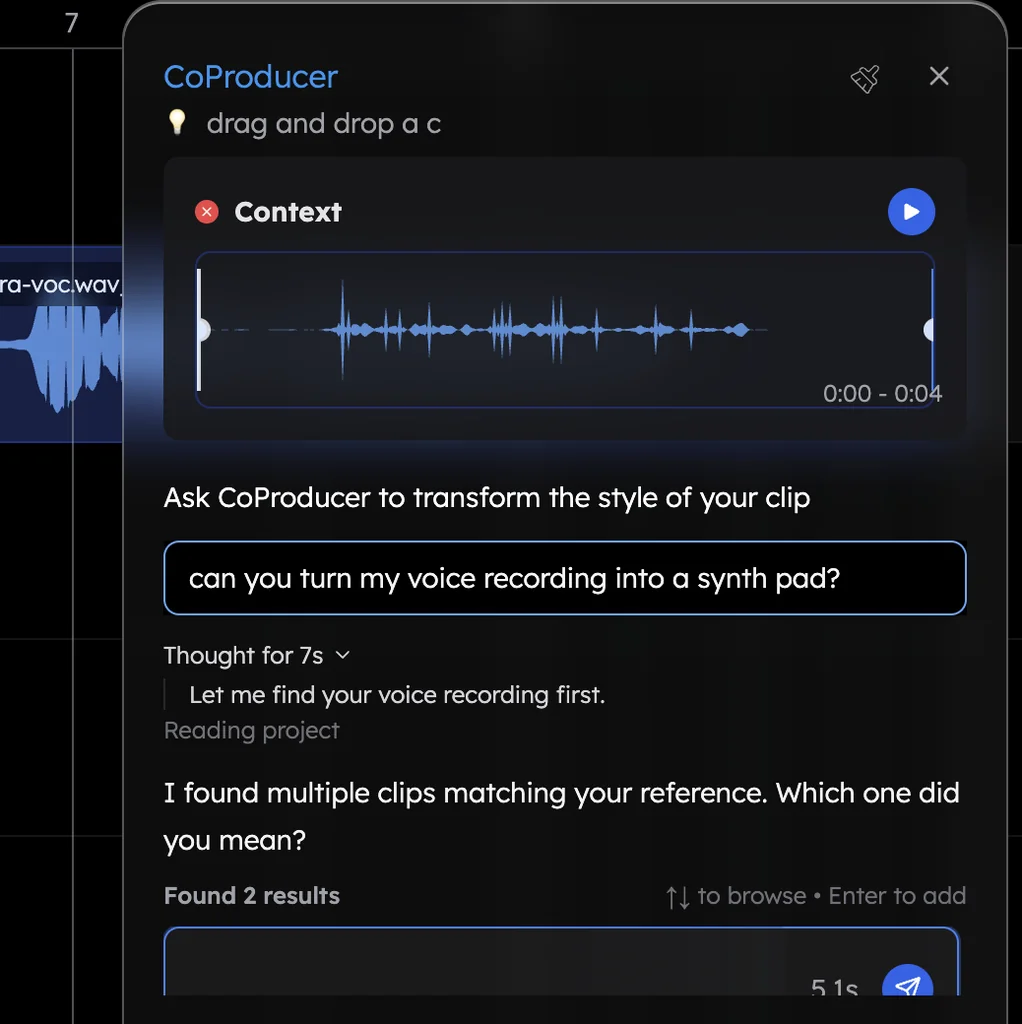
Already have a take? Drop it on the timeline first. CoProducer measures its tempo and a flow map of where your syllables land, sets the project to match, and writes every new part around your phrasing. It can also chop the recording into a stuttered vocal hook for the post-chorus. And if the hook is still in your head, hum it: voice to instrument turns the hum into an editable MIDI line you can put on a Supersaw Lead.
Drums and 808s at the edge of clipping
At 150 BPM the drums are felt in half-time: kick on beat 1, a snare stacked with a clap on beat 3, and hi-hats running 16ths underneath. The hats are where hyperpop gets restless. Put a 1/32 roll into beat 3 of every second bar, switch to 16th-note triplets for a beat before the chorus, and stutter the snare over the last two beats of each section: four 16ths, then eight 32nds, straight into the next downbeat. In Veena's piano roll, the ⅛-beat snap writes 32nds and the ⅙-beat snap writes 16th triplets.
Pick from three of Veena's seven kits. Chaos is the aggressive, distorted one, the blown-out sound of the loudest hyperpop. Electronic is cleaner and synthetic, and TR909 gives punchy, club-flavoured hits for the bubblegum end.
Under the drums sits the 808. Veena's 808 Distorted saturates in two bands: the sub underneath is left untouched, and the upper harmonics that make an 808 audible on a phone are driven hard. 808 Hard drops 18 semitones in 25 milliseconds with a square edge that cuts through a crowded mix. Both share four knobs, DROP, DECAY, DRIVE and GLIDE, and CoProducer can set any of them. When the 808 is long, keep the kick off its hits, or ask CoProducer to duck the 808 under the kick so the two don't smear into one blur.
Harmony: sugar on top, chaos underneath
Hyperpop harmony is deliberately simple, because the sound design is not. In A major:
| Progression | In A major | Why it works |
|---|---|---|
| I–V–vi–IV | A–E–F#m–D | The brightest pop loop there is |
| IV–V–iii–vi | D–E–C#m–F#m | Restless, never landing on I |
| vi–IV–I–V | F#m–D–A–E | The emo-leaning version |
| I–iii–IV–iv | A–C#m–D–Dm | The borrowed minor iv, a happy-sad sting |
Melodies sit high: short hook cells that repeat three times and change on the fourth, octave leaps, and a vocal pitched above where anyone would normally sing. For the last chorus, move up a whole step, from A major to B major. Ask CoProducer to move the final chorus up and it transposes the MIDI parts; then pitch your vocal clip up 2 semitones to follow.
How to make hyperpop in Veena
- Sign in to daw.veena.studio with Google. If you have a vocal, record it or drop it in first.
- Paste the prompt:
Make a 150 BPM hyperpop song in A major with space for my vocal: half-time trap drums on the Chaos kit with 1/32 hi-hat rolls, stuttered snare fills and a crash on every chorus downbeat; a clipped 808 Distorted bassline; Glass Pad chords on A–E–F#m–D; a Supersaw Lead hook doubled by Bell Pluck an octave up; a Riser into every chorus. Intro 4 bars, verse 16, chorus 8, post-chorus drop 8 with a Square Bass chiptune riff, verse 8, chorus 8, a 16-bar beat switch with Distortion Guitar power chords over half-time drums, final chorus 8, outro 4 ending on a hard cut.
- Choose between takes. Each new part lands as three options. Keep the one that hits hardest; parts that lean on it are only written once you've chosen.
- Push it further, one sentence at a time. Each change is a single undo, so nothing is too extreme to try.
Describe the sound, not an artist: only about 3% of typed requests in Veena's own data name one, while a first request that names a genre gets a finished first result on day one in 81.5% of cases.
Things to ask for next:
- "Make the hi-hat rolls faster and stutter the last beat before each chorus."
- "Chop my vocal into a pitched hook for the post-chorus."
- "Swap the drums to the Electronic kit and push the 808's drive harder."
- "Make the beat switch double-time."
- "Take the last chorus up to B major."
The 2-minute structure map
| Part | Bars | What happens there |
|---|---|---|
| Intro | 4 | Bell plucks and a filtered vocal chop, a stutter into the verse |
| Verse 1 | 16 | Half-time drums, 808, sparse pads; the vocal owns the space |
| Chorus | 8 | Supersaw hook, 1/32 hat rolls, crash on the downbeat |
| Post-chorus drop | 8 | A chopped vocal hook or a chiptune riff over the 808 |
| Verse 2 | 8 | Shorter, with one new texture |
| Chorus 2 | 8 | Chorus 1, louder |
| Beat switch | 16 | A new feel: distorted power chords, double-time drums or a new key |
| Final chorus | 8 | Up a whole step, everything on |
| Outro | 4 | A hard cut to silence, or a reversed tail |
That is 80 bars: about 2 minutes 8 seconds at 150 BPM. The beat switch works best with a pickup, a riser, a stutter or a single bar of silence, so the new section lands instead of just starting.
Mix it loud, keep it legible
Loud is the aesthetic; mush is the risk. In Veena, effects sit on each clip:
- Vocal on top, always. Everything else fights for second place. A 2–3 dB lift on the 8-Band EQ's high shelf around 12 kHz gives the voice air above the saws.
- Drums: the Compressor's Smash preset for pump, plus the Distortion effect's Clip preset at half mix when you want the kit audibly broken.
- 808: let 808 Distorted do the saturation; add more drive with its DRIVE knob rather than a second distortion.
- Supersaws: a low shelf cut of about 6 dB below 250 Hz so they stop fighting the 808, and the Chorus effect's Wide preset for extra spread.
- Plucks: the Delay's Ping Pong preset, repeats bouncing left and right in 1/8s.
Then hand CoProducer the brief, "loud and bright, vocal first, ready for streaming", and it rebalances the whole song around your voice.
Mistakes that turn hyperpop into noise
- Distortion everywhere, dynamics nowhere. If the verse is as loud as the chorus, the chorus has nowhere to go. Keep the verse thin.
- A pitched vocal out of key. Shift by 12 semitones, or retune with Auto-Tune set to the song's key after any other shift.
- Ten ideas and no hook. Chaos works around one melody that returns. Make the chorus singable first.
- Kick and 808 smeared together. Shorten the 808 under the kick, or pick 808 Hard for a clearer attack.
- Harsh upper mids. Saws, plucks, hats and a pitched vocal all pile up at 3–6 kHz. One bright lead per section.
- A beat switch with no pickup. Signal it with a riser, a stutter or a bar of silence.
Hyperpop words
Hard-tune: pitch correction at full strength and speed, so the voice steps between notes. Beat switch: a mid-song change of tempo feel, key or genre. Stutter: a sound retriggered in fast repeats, usually 16ths into 32nds. Helium double: an octave-up copy of the vocal under the lead. Clipping: driving a sound past its ceiling until it flattens and buzzes, used here on purpose. Supersaw: stacked detuned saw waves, the trance sound hyperpop borrowed.
Hyperpop's family tree
- Bubblegum bass: the glossy starting point; rubbery synths, pitched vocals, nearer club tempo.
- Digicore: the trap-rooted strand, fast melodic flows over glitchy beats; start from trap beats.
- Glitchcore: stutter edits and chopped fragments pushed to the front.
- Hyperpop punk: distorted power chords over trap drums; see how to make punk music.
- Sped-up pop: a whole song pitched and pushed faster; the hooks come from pop songwriting.
Pick a branch, tell CoProducer how far to push it, and let the first pass surprise you. The rest of the map is under make music by genre.
Try this in Veena
Make a 150 BPM hyperpop song in A major with space for my vocal: half-time trap drums on the Chaos kit with 1/32 hi-hat rolls, stuttered snare fills and a crash on every chorus downbeat; a clipped 808 Distorted bassline; Glass Pad chords on A–E–F#m–D; a Supersaw Lead hook doubled by Bell Pluck an octave up; a Riser into every chorus. Intro 4 bars, verse 16, chorus 8, post-chorus drop 8 with a Square Bass chiptune riff, verse 8, chorus 8, a 16-bar beat switch with Distortion Guitar power chords over half-time drums, final chorus 8, outro 4 ending on a hard cut.
Frequently asked questions
What makes a song hyperpop?
Exaggeration. Hyperpop takes pop hooks and pushes every part past its limit: pitched-up, hard-tuned vocals, clipped 808s, supersaw leads, bell plucks, glitch stutters and a beat switch halfway through. In Veena, describe those parts in one sentence and CoProducer builds each one as its own editable track, so you decide exactly how far to push the distortion, the pitch and the chaos.
What BPM is hyperpop?
Most hyperpop runs 140–170 BPM, usually over trap drums felt in half-time, though the style is defined by extremes rather than one tempo. Start at 150 BPM: type "150 BPM hyperpop in A major" to Veena's CoProducer and the drums, 808 and hooks are all written at that speed. Veena runs anything from 40 to 300 BPM.
How do you get the hyperpop vocal sound?
Record your own vocal in Veena, then add the Auto-Tune effect set to the song's key with Amount at 100% and Style on Hard. Copy the clip, pitch the copy up 12 semitones and tuck it under the lead for the helium layer, then add a touch of Distortion. Every instrumental part CoProducer writes is built around that voice, and it can chop your take into a vocal hook.
How do you make distorted 808s for hyperpop?
Start from a preset built for it. Veena's 808 Distorted splits the signal: the low sub stays clean and only the upper harmonics get saturated, so it still reads on a phone speaker. 808 Hard adds an 18-semitone pitch drop with a square edge. Both carry DROP, DECAY, DRIVE and GLIDE knobs. Ask CoProducer for "a clipped 808 that follows the kick" and it writes the part as MIDI you can edit.
Do I need a powerful computer to make hyperpop?
No. Veena runs in your browser and CoProducer's AI runs on Veena's servers, so there is no graphics card to buy and nothing to install: a Chromebook or any laptop with a modern browser works. Projects save to your account, and you can export WAV, MP3, MIDI or every track as stems, with no cap and no watermark on your exports.
Meet your personal music producer
Free, in your browser. Describe the song you want and CoProducer builds it with you.
Make music free