Make Anime Music
To make anime music, you write bright J-pop or J-rock at 130–180 BPM on the royal road progression (IV–V–iii–vi), with busy drums, a melodic bass, piano and strings, and a final chorus that jumps up a key. Free in your browser, Veena's CoProducer is the personal producer who builds every part as real tracks.
"Anime music" means two jobs. One is the song: the opening (OP) or ending (ED) theme, a complete J-pop or J-rock track. The other is the score: background cues (BGM) for battles, tears and everyday scenes. This page covers both, starting with the song, because that is what most people want to make first.
The anime sound in numbers
| Element | Openings and endings | Soundtrack cues |
|---|---|---|
| Tempo | Openings 130–180 BPM, J-rock ones often 170+; endings 70–120 | Anything from 60 BPM piano to 170 BPM battle themes |
| Meter | 4/4 | 4/4, plus 3/4 and 6/8 for waltzes and lullabies |
| Harmony | Royal road, 7th chords, secondary dominants, borrowed iv | Suspensions, pedal tones, minor-key ostinatos |
| Drums | A live kit, fills every 4 bars, crashes on every phrase | Often none; taiko and orchestral percussion for battles |
| Bass | Busy and melodic, 8th-note drive with runs | Low strings or none |
| Signature sounds | Distorted and clean guitars, bright piano, string runs, synth sparkle | Piano, strings, choir, bells |
| Length | TV size about 90 seconds; full size four to five minutes | Short loops that repeat under a scene |
The royal road and other J-pop progressions
The royal road progression (ōdō shinkō) is the sound of an anime chorus. It starts on IV, a chord that wants to move; V pushes harder; then instead of resolving home to I, it drops to iii and falls to vi. The loop never lands, so the chorus keeps lifting, and the landing on a minor chord gives it that bittersweet ache. Swap the iii for a III7 (F#7 in D major) and the pull into vi gets even stronger.
| Progression | Numerals | In D major | What it does |
|---|---|---|---|
| Royal road | IV–V–iii–vi | G–A–F#m–Bm | Forward motion, bittersweet lift; the classic sabi |
| Royal road with 7ths | IVmaj7–V7–iii7–vi7 | Gmaj7–A7–F#m7–Bm7 | Softer and more city-pop |
| Komuro progression | vi–IV–V–I | Bm–G–A–D | Dramatic minor start, triumphant finish |
| Canon progression | I–V–vi–iii–IV–I–IV–V | D–A–Bm–F#m–G–D–G–A | Warm, descending, ending themes and ballads |
| Marusa progression | IVmaj7–III7–vi7–v7–I7 | Gmaj7–F#7–Bm7–Am7–D7 | Jazzy and cool; the D7 leads back to the top |
| Minor iv ending | IV–iv–I | G–Gm–D | The tearful last line of a chorus |
A useful trick: end the sabi on IV–V–iii–vi–ii–V–I, so the loop finally resolves once, on the last line. Ask CoProducer for any of these by name or numerals, or audition them in the chord progression generator before you commit.
J-pop song form: A-melo, B-melo, sabi
Japanese producers name the sections differently, and the names are worth learning because the form is different too. The A-melo is the verse, the B-melo a pre-chorus that builds tension (often half-time), the sabi the chorus, and the C-melo a bridge that appears once, late in the song. Many openings start with the sabi itself (sabi-hajimari), so the hook plays in the first seconds of the episode.
TV size (172 BPM, 64 bars, about 89 seconds):
| Section | Bars | What happens |
|---|---|---|
| Intro | 8 | Lead guitar or synth plays the sabi melody over the full band |
| A-melo | 16 | Drums pull back, guitars palm-muted, bass carries the motion |
| B-melo | 8 | Half-time feel, chords climb, snare roll in the last bar |
| Sabi | 16 | Royal road, four-on-the-floor kick, everything at full width |
| Post-sabi hook | 8 | The intro riff returns |
| Outro | 8 | Final hit on the logo card, or a short fade |
Full size adds an interlude (8), a second A-melo and B-melo, a second sabi, the C-melo (8), often a guitar solo (8), and a last sabi raised a half step (tenchō, the key change). The cleanest way in: end the C-melo on the new key's V chord. To go from D major up to Eb major, finish the bridge on Bb7 and the last sabi arrives lifted.
Drums, bass and the sparkle
Anime drums rarely sit still. In the A-melo, a straight 8th-note J-rock groove with pushes:
A-melo  1 e & a 2 e & a 3 e & a 4 e & a
Hat     x . x . x . x . x . x . x . x .
Snare   . . . . X . . . . . . . X . . .
Kick    X . . . . . X . X . . . . . X .
In the sabi, switch to yotsuuchi, a kick on every beat with open hats on the offbeats:
Sabi    1 e & a 2 e & a 3 e & a 4 e & a
OpenHat . . x . . . x . . . x . . . x .
Snare   . . . . X . . . . . . . X . . .
Kick    X . . . X . . . X . . . X . . .
Put a fill in the last bar of every four-bar phrase and a crash on the next downbeat. Then write a few kime: unison hits where drums, bass and guitars stop and accent the same rhythm together, usually at the end of the B-melo. They are the moments an animator cuts to.
Bass is busier than in Western pop: 8th-note roots with runs up to each chord change, octave jumps in the sabi, and slap for city-pop colour. Veena's Electric Bass (pick) keeps it defined at 172 BPM; Slap Bass 2 has the brighter, ringing pop.
The sparkle is what makes it sound like anime rather than rock. Stack 16th-note piano arpeggios on Acoustic Grand Piano, a fast string run up into each sabi (String Ensemble or Violin), and a bell-like synth doubling the melody an octave up (Veena's Bell Pluck is struck-metal shimmer built for exactly this). Brass hits come in as audio from Veena's sample search.
Scoring your own anime: BGM cues
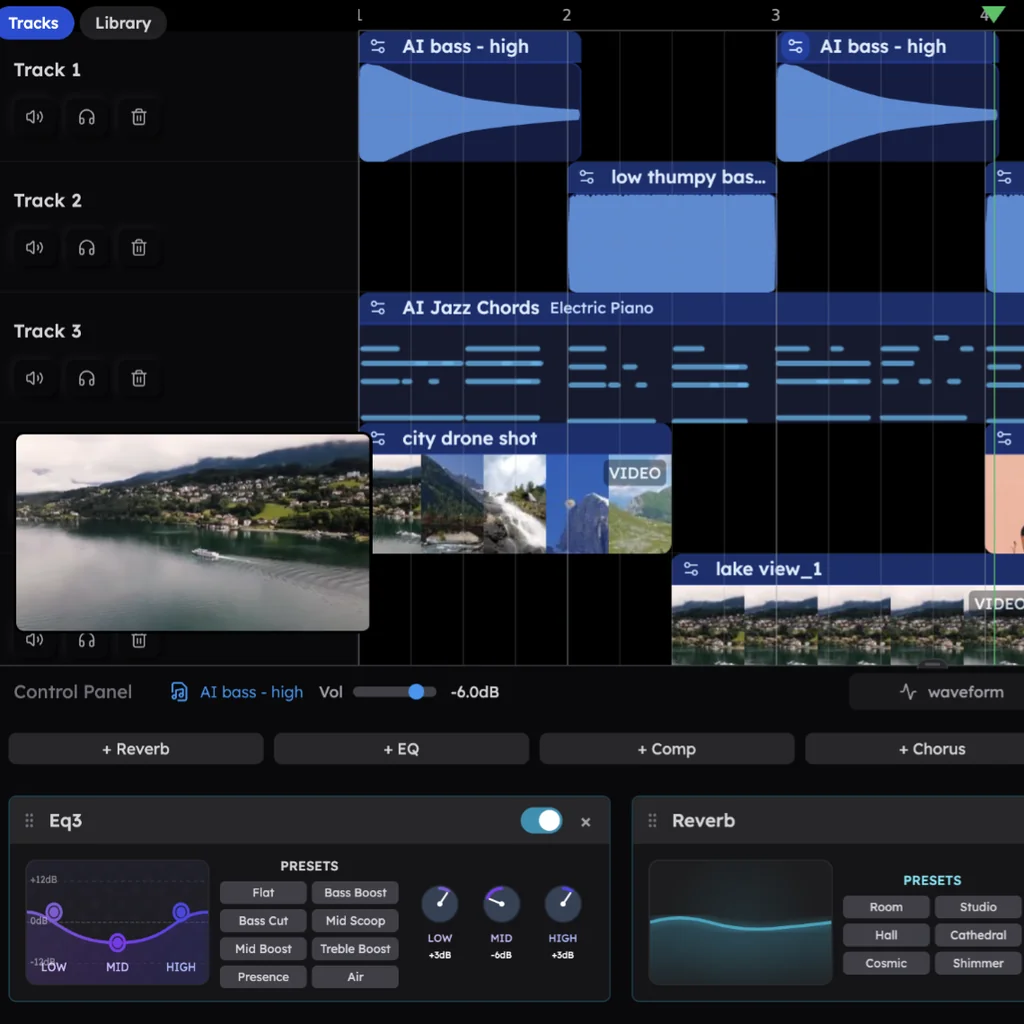
For soundtrack work, drop your animatic or clip straight onto Veena's timeline (MP4, MOV and WebM all import) and build the cue against the picture. Export as MP4 when the project contains video.
- Battle theme: fast and minor, driving 16th-note string ostinato, low toms and taiko-style hits, brass stabs, a power-chord guitar layer if the show is modern. Build it up in four-bar blocks so the editor can cut anywhere.
- Emotional scene: solo piano at 60–80 BPM, then strings entering on the second pass. Royal road or canon progression, lots of suspended chords resolving late.
- Everyday life and comedy: 100–130 BPM, major key, Pizzicato Strings, bells, nylon guitar, a bouncy bass. Keep the melody simple and repeatable.
- Tension: Drone and Dark Pad from Veena's synth under low Cello and Contrabass, no drums until the reveal.
Make anime music with CoProducer
Open daw.veena.studio, sign in with Google, and paste this into CoProducer:
Make a 172 BPM anime opening in D major, a J-rock band with bright piano: live drums with a fill every 4 bars and a crash on each new phrase, four-on-the-floor kick in the chorus; a busy melodic picked bass; distorted power-chord guitars plus a clean arpeggio guitar; 16th-note piano arpeggios and string runs into the chorus; a lead guitar hook in the intro. Chorus on the royal road progression G–A–F#m–Bm (IV–V–iii–vi). TV size, about 90 seconds: intro 8 bars, verse (A-melo) 16, pre-chorus (B-melo) 8, chorus (sabi) 16, post-chorus hook 8, outro 8.
CoProducer sets 172 BPM and D major, maps the six sections, and builds the band part by part. For each part it offers three options; keep the one you like and the parts that depend on it are written against your pick. You can write the whole request in Japanese if you prefer: CoProducer reads prompts in other languages.
Anime is one of the genres Veena delivers best. In Veena's own data, 90.8% of new users whose first request asks for J-pop or anime music get a first result on day one.
Then shape it:
- "Make a full-size version: add a second A-melo, B-melo and sabi, an 8-bar C-melo, and put the last sabi up a half step to Eb major."
- "Add kime hits on the last two bars of the B-melo."
- "Double the sabi melody with a bell synth an octave up."
- "Make the B-melo half-time and drop the guitars to palm mutes."
- "Turn the intro into a sabi-hajimari: start with the chorus hook."
Have a melody in your head? Hum it into your mic, ask CoProducer to turn it into MIDI, and it becomes the topline the band plays around. The melody generator writes one from scratch if you would rather start there.
Mixing an anime opening
Openings are dense, bright and loud, and the trick is keeping the vocal on top of all of it.
- Carve the vocal pocket. On the piano and guitar clips' 8-Band EQ, dip 2–4 kHz a few dB where the voice lives; the parts still sound bright but stop masking the singer.
- Split the registers. If piano arpeggios and the clean guitar play in the same octave, move one of them up. Clarity at 172 BPM comes from arrangement, not EQ.
- Keep the low end tight. High-pass the guitars around 100 Hz; let the kick and bass own everything below.
- Width. Rhythm guitars hard left and right, strings wide, bass, kick, snare and vocal in the centre.
- Finish. Ask CoProducer for "a bright, loud anime-opening mix with the vocal on top, mastered for streaming" and it balances levels, panning and effects on every part.
Common anime-music mistakes
- Resolving every chorus to I. The home chord kills the forward pull. Save the resolution for the very last line.
- No key change. In a full-size song, the last sabi almost always lifts. Without it, the finale sounds like a repeat.
- Still drums. Anime drums fill at every four-bar boundary. A loop without fills sounds like a demo.
- A lazy bass. Whole-note roots sound Western and static. Give the bass runs and octaves.
- Too many leads. Piano arpeggios, lead guitar, bell synth and vocal all in one register become noise. One lead at a time, the rest around it.
- Wrong length. A TV-size edit over 90 seconds doesn't fit the opening sequence. Count your bars.
Anime music styles to try
- J-rock opening: 170–190 BPM, distorted guitars, kime and fast fills. Pairs with how to make rock music.
- Idol and anison pop: 140–170 BPM, four-on-the-floor, bright synths and group-vocal hooks.
- City pop: 100–120 BPM, maj7 chords, slap bass, electric piano; the marusa progression lives here.
- Kawaii future bass: supersaw chords, bell leads, pitched vocal chops, big half-time drops.
- Ending ballad: 70–90 BPM, piano and strings, canon progression.
- Game and fantasy scores: close cousins of anime BGM; see how to make game music.
Korean idol pop shares much of this toolkit with a harder drum sound; see how to make K-pop. For every other style, make music by genre.
Anime music terms
Ōdō shinkō: the royal road progression, IV–V–iii–vi. A-melo, B-melo, sabi, C-melo: verse, pre-chorus, chorus, bridge. Sabi-hajimari: a song that opens on its chorus. Kime: a unison accent the whole band plays together. Yotsuuchi: four-on-the-floor, a kick on every beat. Tenchō: a key change. TV size: the roughly 90-second edit made for the opening sequence. Anison: anime songs as a genre. BGM: background music, the score under a scene.
Try this in Veena
Make a 172 BPM anime opening in D major, a J-rock band with bright piano: live drums with a fill every 4 bars and a crash on each new phrase, four-on-the-floor kick in the chorus; a busy melodic picked bass; distorted power-chord guitars plus a clean arpeggio guitar; 16th-note piano arpeggios and string runs into the chorus; a lead guitar hook in the intro. Chorus on the royal road progression G–A–F#m–Bm (IV–V–iii–vi). TV size, about 90 seconds: intro 8 bars, verse (A-melo) 16, pre-chorus (B-melo) 8, chorus (sabi) 16, post-chorus hook 8, outro 8.
Frequently asked questions
Can I make anime music for free?
Yes. Veena is an AI DAW with a personal music producer built in. Describe the song you want and CoProducer builds it with you — beats, chords, melody, arrangement and mix — as real tracks you can edit, mix and export. Free, in your browser. For an anime opening, that means J-rock drums, a melodic bass, guitars, piano and strings on separate tracks, and you can write the request in Japanese.
What is the royal road progression?
The royal road (ōdō shinkō) is IV–V–iii–vi: in C major, F–G–Em–Am. It starts away from home and never lands on the tonic, so a chorus built on it keeps pulling forward with a bittersweet lift, which is why anime and J-pop use it so often. Ask Veena's CoProducer for "the royal road in D major" and it writes G–A–F#m–Bm as editable MIDI.
How long is an anime opening?
The TV-size edit that plays over an opening sequence runs about 90 seconds, usually 1:29 to 1:30; full versions run around four to five minutes. At 172 BPM, 64 bars last about 89 seconds. Tell Veena's CoProducer "TV size, 64 bars" with the section lengths and it plans the arrangement to fit.
What BPM are anime songs?
Most anime openings sit between 130 and 180 BPM, with J-rock openings often above 170. Endings are usually slower, around 70–120 BPM, and soundtrack cues range from slow piano pieces to fast battle themes. Put the tempo in your first message and Veena's CoProducer sets the project to it before writing any part.
Can I make an anime song with vocals in Veena?
Yes, with your own voice. CoProducer builds every instrumental part of the song, from drums and bass to guitars, piano and strings, around the melody you will sing. You record the vocal straight into Veena from your microphone on its own track, then mix it with the band and export the finished song.
Meet your personal music producer
Free, in your browser. Describe the song you want and CoProducer builds it with you.
Make music free