AI Bassist
An AI bassist is only as good as its ears, and the one inside Veena, a free AI DAW with a personal music producer built in, listens first. CoProducer reads the notes your drums play, then writes the line you ask for, like "walk it on the turnaround" or "slap the chorus", as MIDI you can edit note by note.
The bass player's job is to listen
In a rehearsal room the bassist watches the drummer's right foot. Every good line starts there: the kick says where the low end should hit, the chords say which note, and the singer says where to stay out of the way.
CoProducer, the AI music producer inside Veena, works the same way. When it builds a song, any part that has to fit another waits until that part is on the timeline, then reads its real notes. The bass hears where the kick lands, where the harmony moves and what key you're in before it plays a single note.
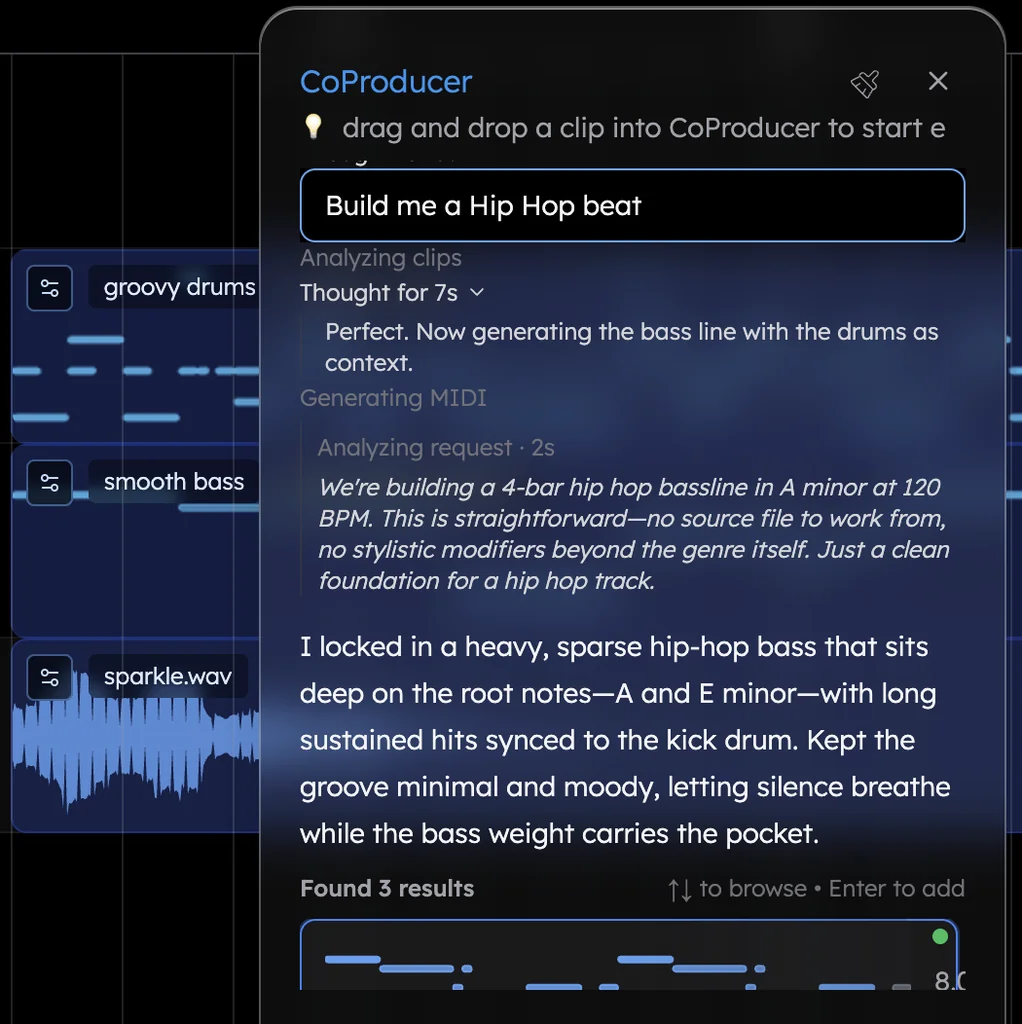
That's a real session above: "Build me a Hip Hop beat", the drums already down, and CoProducer writing "the bass line with the drums as context", then offering three takes to audition before anything is committed.
What an AI bassist should play under your chords
Four habits separate a bass line from a list of root notes. CoProducer writes with all four, and you can ask for any of them by name.
- Roots on the strong beats, movement on the weak ones. Land the root when the chord changes; fifths, octaves and passing notes fill the gaps.
- Approach notes. A note a half step above or below the next root, played just before the change, pulls the ear into the new chord. It's the sound of every walking line and most Motown.
- Rhythm from the kick. In funk and hip hop the bass doubles the kick; in house the bass answers it, sitting on the offbeat between kick hits.
- Space. A rest before the downbeat makes the downbeat land. Great players leave holes on purpose.
Talk to it like a bass player
Say it the way you'd say it across the rehearsal room:
- "Walk it on the turnaround." Quarter notes stepping through the last two bars of the phrase, landing on the root at the top.
- "Sit on the root in the verse, move in the chorus." Whole notes that hold the floor, then a busier line when the song lifts.
- "Lock to the kick." Bass notes start where the kick drum hits, so the two read as one instrument.
- "Octaves on the offbeats." The disco and house pump, root below and octave above.
- "Push the changes by an eighth." The new chord's root arrives half a beat early, the anticipation that makes pop and funk lean forward.
- "Slap it", "fretless" or "808 with a glide". The same notes move to Slap Bass, Fretless Bass or 808 Glide.
- "Down an octave, and fewer notes." The line gets heavier and simpler without being rewritten from scratch.
Name the bars and only those change: "bars 9 to 16, make it busier" edits just that region and leaves the rest of the take alone.
Three bass lines to steal
Three grooves, three sounds from the Bass + 808s shelf. Every other style's low end is on make music by genre.
Slap funk, 104 BPM
"104 BPM funk in E minor: tight 16th-note drums, slap bass locked to the kick, octave pops on the offbeats, a chromatic walk-up into every fourth bar."
Listen for the walk-up: three notes climbing into the downbeat of bar 5. If it crowds the guitar, ask for "the walk-up only every eighth bar".
Walking jazz, 132 BPM swing
"Medium-swing jazz at 132 BPM in B flat: brushes, piano comping shell voicings, and an upright bass walking quarter notes through a ii–V–I with an approach note into every chord."
The upright sits on the Acoustic Bass preset. For a darker ballad version, drop to 72 BPM and ask for "two feel in the head, walking on the solos". The jazz page covers the rest of the style.
House, 124 BPM, offbeat octaves
"124 BPM house in A minor: four-on-the-floor TR909 drums, a synth bass on the offbeats between the kicks with octave jumps, and chord stabs on the and of 2."
Veena's Disco Octave Bass and Deep House Bass presets were built for exactly this pump. More on the style at house.
Hum the riff, keep the line
Have a bass line in your head and no bass? Hum it into your mic or drop in a voice memo, then ask CoProducer to "turn my humming into a bass line". It detects the pitches, places an editable MIDI part on a new track and mutes your recording, so what you sang becomes a part you can assign any of the 29 presets on the Bass + 808s shelf: upright, finger, pick, fretless, two slaps, 16 synth basses and six 808s.
Wrong note? Fix the note, not the take
Open the clip in the Piano Roll and drag the note. Shorten notes for a staccato funk feel, drag velocities in the velocity editor to accent the ones, and snap to thirds or sixths of a beat when the groove swings. Ctrl or Cmd plus the up and down arrows moves a selection an octave. Every clip has a Download MIDI file option, so the line travels to any other studio you use. The bassline generator walks through the same tools for writing a line from scratch.
The rented bassist: LANDR Layers, Aiode, Logic Pro
LANDR Layers. LANDR's AI Bassist page promises bass stems "for any vocal, drum, guitar or synth part", shaped with controls for "finger, slap, pick and palm muting" and "DI, drive, and octave effects". The stems come out of a standalone desktop app that ships with LANDR Studio subscriptions, and when one note is wrong, LANDR's own fix is to "regenerate an entire bass stem or highlight any section that needs reworking" (LANDR's AI Bassist page, September 2026). In Veena you drag the note.
Aiode. Aiode offers electric bass and synth bass musician models in a studio that describes itself as "currently in beta". The Free plan allows "2 Mix or Region exports a month", two musician tracks and no commercial license, and Aiode's own workflow ends with exporting stems into "your DAW of choice for further editing, mixing and mastering" (Aiode's pricing and home pages, September 2026).
Logic Pro. Apple's Electric Bass Player and Upright Bass Player come with Logic Pro: $199.99, or an Apple Creator Studio subscription at $12.99 a month, and only on a Mac with Apple silicon or an iPad (Apple's Logic Pro page, September 2026).
| Veena (CoProducer) | LANDR Layers | Aiode | |
|---|---|---|---|
| Price to start | Free | A LANDR Studio subscription | Free plan: 2 exports a month, no commercial license |
| Where it runs | Your browser, on Mac, Windows, Linux, Chromebook or your phone | A desktop app for macOS or Windows | Web and desktop, in beta |
| What the bass arrives as | MIDI, note by note, on a real track | An audio stem | An audio stem |
| Fixing one wrong note | Drag it in the Piano Roll | Regenerate the stem or a section | Generate a new take |
| Drums, keys, mix and export | In the same session | In another DAW | In another DAW |
Where the low end goes next
Let the AI drummer set the pocket first if you haven't, then bring in the AI pianist to voice the chords above your line. Or skip the typing entirely: hum the riff you've been carrying around all week and let CoProducer build the song under it.
Try this in Veena
Write the bass for a 104 BPM funk groove in E minor: tight 16th-note drums, a slap bass that locks to the kick, pops octaves on the offbeats and walks up chromatically into every fourth bar, plus a clean muted guitar scratching on 2 and 4.
Frequently asked questions
Can AI play bass for my song?
Yes. Veena is an AI DAW with a personal music producer built in. Describe the song you want and CoProducer builds it with you — beats, chords, melody, arrangement and mix — as real tracks you can edit, mix and export. Free, in your browser. On bass, CoProducer reads what your drums and chords actually play, then writes a line that fits them.
Will the AI bass line match my kick drum and my chords?
That's the point of how Veena works. A part that has to fit another waits until that part is placed, then reads its real notes: where the kick lands, where the harmony changes, which key the song is in. CoProducer's bass is written against those notes, not against a label, so the low end moves with your drummer.
Can I hum a bass line and have Veena play it on bass?
Yes. Hum or sing the riff into Veena, or drop in a voice memo, and ask CoProducer to turn it into a bass part. It detects the pitches, places an editable MIDI part on a new track and mutes your recording. Pick any bass sound for it, from a finger-style electric to a gliding 808.
Which bass sounds can Veena's AI bassist play?
Veena's Bass + 808s shelf holds 29 presets: acoustic upright, finger and pick electric, fretless, two slap basses, 16 synth basses and six 808s. With the Veena Bridge on a Mac or Windows computer, CoProducer can also play the line through your own bass plug-in. Change the sound any time and the notes stay.
Can I export the AI bass line as MIDI?
Yes. Every MIDI clip in Veena has a Download MIDI file option, and the full export gives you WAV at 24-bit/48 kHz, MP3 or MIDI, for the mix or every track. Veena puts no cap and no watermark on exports, on the free plan or Veena Pro, and you own what you make.
Meet your personal music producer
Free, in your browser. Describe the song you want and CoProducer builds it with you.
Make music free