Veena vs Tunee AI
Which is better, Veena or Tunee AI?
The best Tunee AI alternative is Veena, for anyone who wants to make a song and own it. Tunee calls itself a music agent you chat with, and what it hands back is a render from another company's model: Mureka, Lyria, Eleven Music or its own TemPolor. Its terms give every free-plan song to Tunee (read 17 November 2026). Veena builds your song with you as real tracks, drums, bass, chords and melody, that you edit, mix, export and own, free to start. Tunee suits someone who wants an AI singer and a music video from one chat.
Veena is an AI DAW with a personal music producer built in. Describe the song you want and CoProducer builds it with you — beats, chords, melody, arrangement and mix — as real tracks you can edit, mix and export. Free, in your browser.
The Tunee facts below come from tunee.ai: its home page, pricing page, Music Agent page, FAQ, models page and Terms of Service (last updated 31 August 2026), as they read on 17 November 2026.
Veena vs Tunee AI, row by row (November 2026)
| Veena | Tunee AI | |
|---|---|---|
| What you get | Your song as real tracks: drums, bass, chords, melody, each part editable | Rendered audio from a chat, made by models such as Mureka V9.5, Lyria 3.5 and Eleven Music V2.5 |
| Price to start | Free: the whole studio, with CoProducer on a daily allowance | Free, with limited music models and daily credits |
| Who owns a free-plan song | You | Tunee: "all rights, title, and interest" belong to the platform |
| Commercial use on the free plan | Yes: you own the Output | Personal and non-commercial only, credited to Tunee |
| Changing one part | Edit the notes, swap the instrument or ask in plain words | Edit lyrics, prompts and song details, then generate again |
| A timeline, mixer and piano roll | Yes, with CoProducer working inside them | A chat, projects and a library of versions |
| Stems | Every part is already its own track, exported free; 4-stem separation of any recording | 2 or 4 stems split from the render on Free; 6 stems from $18 a month after one trial |
| MIDI | Every part exports as MIDI, free | Audio-to-MIDI: one free trial, then members only |
| Your own plug-ins | VST3 and AU on a Mac, VST3 on Windows, through Veena Bridge | Not listed on its plan or feature pages |
| Live collaboration | Invite a co-writer into the session, with CoProducer in the room | Not listed on its plan or feature pages |
| Top price for the music | Veena Pro, $20 a month | Ultra, $199 a month, shared with video and images |
| Sung vocals and music videos | Your own voice, recorded on its own track | AI singers, voice cloning and AI music videos |
Tunee's strength is the last row: an AI-sung vocal and a music video from the same chat, with lip-sync and AI characters. For making a song you can keep changing, and keeping the rights to it from the first day, every other row is the comparison that matters.
Tunee AI alternative: what Tunee sells
Tunee's About page says the team built the TemPolor model and a singing app before Tunee, and describes Tunee as "a conversation with a skilled music producer". Its pricing page sells one credit balance across music, video and images. Its own pages set the terms:
- The producer is a switchboard. Tunee's home page says "Use Mureka, Minimax, TemPolor, Ace-Step, Kling and more in one workflow. Let Tunee choose, or switch manually anytime." Each song is a render from whichever model ran.
- Free songs are Tunee's. The terms say that for a free-tier user "all rights, title, and interest in and to the Output" belong to Tunee, licensed back for "personal viewing and other non-commercial purposes only", with an attribution to "Tunee" each time you use it.
- Ownership follows the subscription. On Basic, Plus or Pro, the terms give you the Output generated "during the term of your active paid subscription". To claim a song you made on Free, the FAQ allows Basic and Plus members 1 past track a month and Pro members 3.
- Credits are a meter with expiry dates. Free daily credits are "Valid for 1 day only"; membership credits last 30 days. On Basic, 4,500 of the 6,300 monthly credits are daily check-in credits, 150 a day, "not carried over if you miss a day".
- The studio work is a membership. After one free trial each of 6-source stem separation and Audio-to-MIDI, the Music Agent page keeps them, Smart Mastering and "Full commercial rights" for members.
What it costs you: a song you can regenerate but not open, owned by Tunee until you pay, with the parts locked inside the render.
A chat that renders vs a producer in your session
Both start from a sentence. The difference shows on the second request, when you want to change something:
- "That third chord should be minor." In Veena: change one note. In Tunee: describe it again and take a new version.
- "Drop the guitar in the second verse." In Veena: mute the part. In Tunee: generate a new version, or separate the stems and dig the guitar out.
- "Push it to 100 BPM." In Veena: change the tempo. In a render: generate again, or time-stretch and inherit the artifacts.
- "Try the hook on a Rhodes." In Veena: swap the instrument; the notes stay. In Tunee: write the prompt again.
The longer argument is in AI CoProducer vs AI generator, and the same split runs through every AI music generator we have tested.
How Veena builds a song with you
Here is the flow on Veena's free plan, with the indie pop prompt at the bottom of this page:
- Open Veena in your browser and sign in with Google. Nothing to install and no graphics card needed: CoProducer runs on Veena's servers.
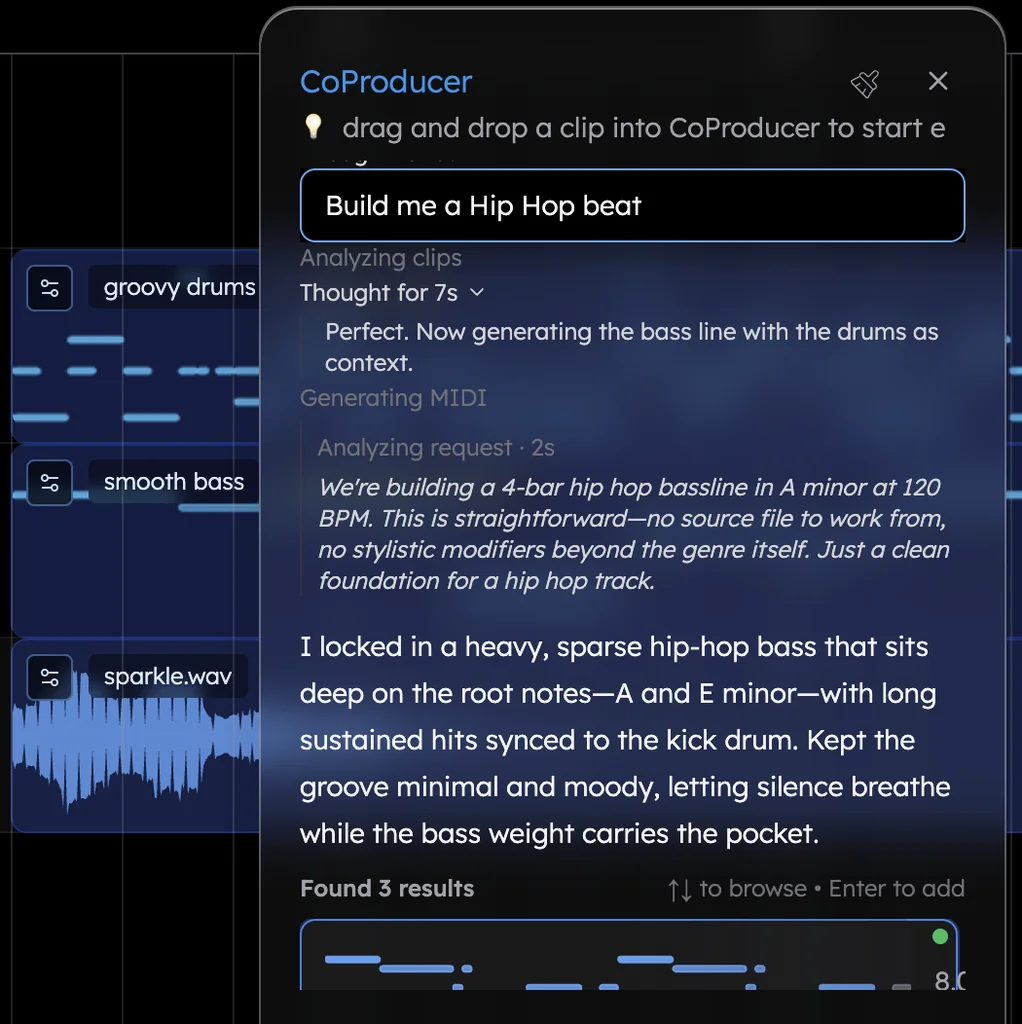
- Describe the song like a producer. CoProducer sets the tempo and key, plans the sections with their bar lengths, and writes a task list you can watch it tick off.
- Pick your parts. For each new part, CoProducer offers three options. A part that has to fit another, like a bass under the Rhodes, waits for the one you picked and reads its actual notes.
- Change anything in plain words, or by hand. "Make the chorus drums bigger." Or open the piano roll and drag the notes yourself. One undo reverses any CoProducer change.
- Record your vocal and export. Sing over the track from your mic, let CoProducer mix and master it, and export the mix or every track, as often as you like.
In Veena's own data, 3 in 4 new users (75.7%) whose first request asks for a new song get a finished first result on day one; when the request names a genre, 81.5% do.
Who owns the song
Veena's terms say "you own the Output you generate through your use of the Service." That holds on the free plan, and there is no watermark on your exports: WAV 24-bit/48 kHz, MP3 320 kbps or MIDI, the mix or every track as stems in one zip. Every format is on the export formats page.
On Tunee, a free-plan song belongs to Tunee, and the right to sell or stream a song starts with a paid plan. The detail is on does Tunee AI own my music?, and the free plan is on is Tunee AI free?.
The studio around the song
- Your voice, any instrument. Hum a melody and CoProducer turns it into a saxophone, a synth or a piano part, through voice to instrument.
- Your own recordings. Drop in a voice memo, a demo or an old bounce, and CoProducer measures the tempo and phrasing before it writes around it.
- Stems. Split any recording into vocals, drums, bass and other with the stem splitter, lined up on your timeline, on every plan.
- Your own plug-ins. Veena Bridge hosts VST3 and AU plug-ins on a Mac and VST3 on Windows. Setup is in using your plug-ins with Veena Bridge.
- Collaboration. Invite a co-writer into your session and build the song together, live, with CoProducer in the room.
- Your phone. Pocket Studio is the studio laid out for your thumb: start a song from one sentence, pick each part from 3 options and record with your phone's microphone.
Leaving Tunee for Veena
- Download what you want to keep. Tunee's Music Agent page lists downloads on every plan.
- Open Veena in your browser and sign in with Google.
- Start the next song from one sentence. CoProducer builds it as real tracks you keep reshaping.
- Bring your own material too. Record a vocal or import a demo, and CoProducer builds new parts around it.
- Export as often as you like, the mix or every track. Veena vs Suno compares the biggest generator, and Veena vs ElevenLabs Music one of the models Tunee runs.
The verdict: Veena
Tunee wraps other companies' music models in a chat, owns what free users make, and sells stems, MIDI and commercial rights as a membership. Veena gives you a personal music producer inside a real studio, free: real tracks you edit note by note, your own voice and plug-ins, live collaborators and exports you own on every plan. Paste the indie pop prompt below into CoProducer and build your first song tonight.
Try this in Veena
Make a 96 BPM indie pop song in D major: 4-bar intro, 8-bar verse, 8-bar pre-chorus, 16-bar chorus, 8-bar verse, 16-bar chorus, 8-bar bridge, 16-bar final chorus. A tight live-feel kit with a tambourine on the off-beats, a melodic electric bass, chorused clean guitar arpeggios, warm Rhodes chords and a bright synth hook in the chorus. Leave space for my vocal.
Opens a new project in Veena, and CoProducer starts building from this prompt.
Frequently asked questions
Is Veena better than Tunee AI?
Veena is an AI DAW with a personal music producer built in. Describe the song you want and CoProducer builds it with you — beats, chords, melody, arrangement and mix — as real tracks you can edit, mix and export. Free, in your browser. Tunee is a chat window over music models such as Mureka, Lyria and Eleven Music, and its songs arrive as rendered audio (Tunee's pages, read 17 November 2026).
Is Tunee AI free?
Tunee is free to start: its plan page lists unlimited song generation and downloads on Free, with limited music models and credits that refresh daily. Its terms give free-tier songs to Tunee, for non-commercial use with credit to Tunee (read 17 November 2026). Veena's free plan includes the whole studio, and you own everything you make on it.
Does Tunee AI own my music?
On the free plan, yes. Tunee's terms say free-tier Output belongs to Tunee, licensed back for personal, non-commercial use with a 'Tunee' attribution; on Basic, Plus and Pro you own what you make during an active subscription (read 17 November 2026). Veena's terms say you own the Output you generate, on every plan, free included.
Can you get stems from Tunee AI?
Yes, split from the finished render. Tunee's Music Agent page lists 2-source and 4-source stem separation on Free, with one trial each of 6-source separation and Audio-to-MIDI, which are member features from $18 a month (read 17 November 2026). In Veena, CoProducer builds every part on its own track, so every part is a stem you export free.
How much does Tunee AI cost?
Tunee's pricing page lists Basic at $18 a month, Plus at $38, Pro at $89 and Ultra at $199, or $15, $30, $68 and $129 a month billed yearly (read 17 November 2026). The credits cover music, video and images together. Veena's whole studio is free, and Veena Pro at $20 a month pays only for more CoProducer.
Can I edit a Tunee song note by note?
Tunee's free plan lists editing lyrics, prompts and song details, plus mix and voice change, with advanced editing for members, and its songs are rendered audio (read 17 November 2026). In Veena every part is MIDI on a timeline: change one chord, swap the instrument or ask CoProducer in plain words, free.
Meet your personal music producer
Free, in your browser. Describe the song you want and CoProducer builds it with you.
Make music free