AI Music Streams: 93% of AI Songs Never Hit 1,000 Plays
AI music streams, measured: 93% of AI songs never reach 1,000 plays, Spotify's royalty line. What the data shows, and the songs with a reason to be heard.
AI music streams, measured: 93% of AI music tracks on Spotify have had fewer than 1,000 plays since release, and 1,000 streams in a year is exactly where Spotify starts paying royalties. That is the finding of a University of Chicago study published in June 2026, and it settles the question of what a one-prompt render is worth on a streaming service. The songs that clear the line are the ones with a reason to be heard, and Veena is built for making them.
Veena is an AI DAW with a personal music producer built in. Describe the song you want and CoProducer builds it with you — beats, chords, melody, arrangement and mix — as real tracks you can edit, mix and export. Free, in your browser.
Every number below is quoted from the study or the platform's own page, read on 20 November 2026.
AI music streams: what the study found
The study is An Empirical Analysis of AI Slop in Music Streaming, by Stanley Wu, Josephine Passananti, Viresh Mittal, Wenxin Ding, Haitao Zheng and Ben Y. Zhao of the University of Chicago (arXiv 2606.18052, 16 June 2026). It matched Spotify's catalogue against Deezer's AI labels and followed what happened to the tracks.
| What the study measured | AI-generated tracks | Human-made tracks |
|---|---|---|
| Fewer than 1,000 plays since release | 93% | 64% |
| Negligible plays, January to May 2026 | 92.7% | 67.5% |
| Share of Spotify's whole catalogue | 5.1% | — |
| Share of weekly new releases, week of 3 November 2025 | beyond 40% | — |
| Estimated share of the monthly royalty payout, January to May 2026 | about 0.3% | — |
Source: Wu et al., sections IV-B, V-A and V-D.
Put two rows together and the picture is stark. Two in every five new releases in one week of November 2025 were AI-generated, yet AI music drew about 0.3% of the monthly payout. The authors put the earning slice at "the top 7.15% of all AI tracks". Nearly all the rest are uploads almost nobody plays.
The study is careful about its own limits, in one sentence: its AI labels come from Deezer's detector, applied to whole albums, and Spotify only shows a play count once a track passes 1,000 plays, which is why that is the line it measures.
What the platforms pay, and what they cut
The study's 1,000-play line is Spotify's own payout rule. Its track monetization page says tracks "must have reached a threshold of at least 1,000 streams in the previous 12 months", with a minimum number of unique listeners it does not publish "to prevent further manipulation by bad actors" (Spotify for Artists). A track under the line earns nothing, whatever made it.
The other services say the same thing in their own numbers:
| Service | How much AI music arrives | How much it is heard | What it cuts |
|---|---|---|---|
| Spotify | 5.1% of the catalogue (Wu et al.) | About 0.3% of the payout (Wu et al.) | Any track under 1,000 streams in 12 months |
| Deezer | Nearly 90,000 fully AI-generated tracks a day, more than 50% of daily delivery on peak days | Between 1% and 3% of streams, and up to 85% of those were fraudulent in 2025 | Removes detected tracks from algorithmic recommendations and editorial playlists; excludes manipulated streams from royalty payments |
| Qobuz | Not published | 0.38% of streams, and 60% of those are deemed fraudulent | Excludes fraudulent streams from royalties; removed four million AI albums with no listening from search |
Sources: Deezer's newsroom, 13 October 2026 and 17 November 2026; Qobuz's press release, 24 September 2026.
So an AI render has two problems at once. It lands in a pile that grows by tens of thousands of tracks a day, and the services have built their discovery to keep that pile out of listeners' way.
Why is my AI song not getting streams? The take
A one-prompt render competes with millions of renders like it. Generators such as Suno and Udio hand back one finished, locked render per prompt, millions of people are typing prompts, and a listener has no reason to pick yours. Nothing in it is a decision anyone else could not have typed. That is what the 93% measures: not that AI made the music, but that nobody did.
Look at what the services actually reward. Spotify pays on listening. Deezer and Qobuz cut fake streams and the tracks they flag, not musicians who use AI tools. Every rule points the same way: a song earns when real people choose to hear it, and people choose songs that sound like someone made them.
That is the part a generator cannot give you. A locked render has no vocal of yours, no part you played, no arrangement you argued over, and no mix you made. A track you produced, with your own part, your arrangement and your mix, is the one with a reason to be heard. It is also the one that is plainly yours, which matters for making money from AI music and for staying out of the pile people call AI slop.
Do AI songs get streams? The ones you produce do
| What a listener hears | A song you build in Veena | A one-prompt render |
|---|---|---|
| Your own voice or playing | Recorded on its own track in the session | No session to record into |
| Parts someone chose | Three options for each new part, picked by you | One output per roll |
| A change you wanted | Ask CoProducer, or rewrite any note in the piano roll | Regenerate the whole song |
| A finished, mixed record | Your mix, with AutoMix and mastering on every plan | Whatever the model mixed |
| A release-ready file | 24-bit/48 kHz WAV, no watermark, free | Depends on the generator's plan |
| Who owns it | You, on every plan | Depends on the generator's terms |
Here is how a song with a reason to be heard gets made in Veena:
- Start from an empty project. Describe the song in plain English: genre, tempo, key, the parts, how the chorus should lift. CoProducer writes drums, bass, chords and melody as separate real tracks, with three options for each new part.
- Add your part. Record your vocal or your instrument on its own track, and ask CoProducer to fit the arrangement around your take.
- Make the calls. Rewrite any note in the piano roll, swap a sound, move a section, bring a friend into the session in real time.
- Mix and master, then export the full mix as a 24-bit/48 kHz WAV, every track as stems, or the MIDI, with no watermark.
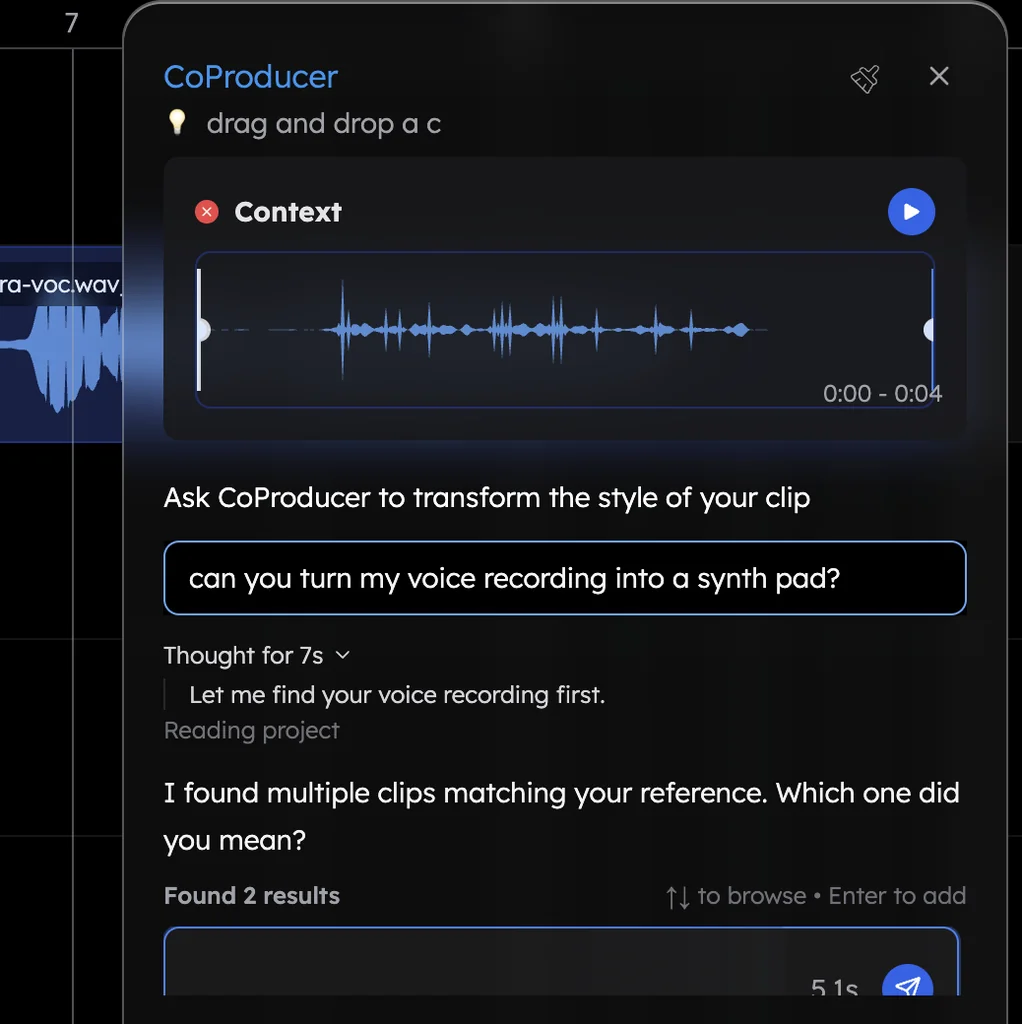
The studio is free, and CoProducer comes with a daily allowance of requests on the free plan. Veena Pro, $20 a month, removes the daily request cap and unlocks the premium models. Ownership is the same on both: the song is yours. For the release itself, can I put my AI song on Spotify? walks through it step by step, and the Veena help centre covers the rest.
The verdict
The streaming numbers are not a verdict on AI. They are a verdict on music nobody made: 93% of AI tracks never reach the 1,000 plays where Spotify starts paying, and the services have built their discovery to filter the flood. The way into the other 7% is the way into any listener's playlist: a song with your part in it, produced with care. Veena is the free studio built for exactly that. If you are new to it, start with make a song with AI. Open an empty project and paste the prompt below.
Make a 100 BPM indie-pop song in D major around my own vocal: a dry kick and snare with a shaker on 16ths, a round picked bass, clean electric guitar chords D, A, Bm, G, a warm Rhodes and a short whistled hook after each chorus line. Intro 4 bars, verse 16, chorus 16, verse 16, chorus 16, bridge 8, final chorus 16, outro 4. Give me three options for the guitar part and leave room in the mids for my voice.
Related reading: Can you make money with AI music? · Is AI music slop? · Do AI songs get royalties? · Does Spotify label AI music? · Can I put my AI song on Spotify? · Veena help centre
Try this in Veena
Make a 100 BPM indie-pop song in D major around my own vocal: a dry kick and snare with a shaker on 16ths, a round picked bass, clean electric guitar chords D, A, Bm, G, a warm Rhodes and a short whistled hook after each chorus line. Intro 4 bars, verse 16, chorus 16, verse 16, chorus 16, bridge 8, final chorus 16, outro 4. Give me three options for the guitar part and leave room in the mids for my voice.
Opens a new project in Veena, and CoProducer starts building from this prompt.
Frequently asked questions
Do AI songs get streams?
Mostly not. A University of Chicago study of Spotify found that 93% of AI music tracks have had fewer than 1,000 plays since release, against 64% of human-made tracks, and AI music earned about 0.3% of the monthly royalty payout. Veena is an AI DAW with a personal music producer built in, where you make songs with your own part in them.
Why is my AI song not getting streams?
Because it is competing with a flood of renders like it. Deezer receives nearly 90,000 fully AI-generated tracks a day and removes the ones it detects from algorithmic recommendations; Qobuz keeps them out of its discovery journeys (read 20 Nov 2026). In Veena you build the song part by part with CoProducer and record your own voice, so it has something no render has.
How many streams does an AI song need to get paid on Spotify?
At least 1,000 streams in the previous 12 months, plus a minimum number of unique listeners Spotify does not publish (Spotify for Artists, read 20 Nov 2026). The same rule applies to every track, whatever made it. A song you produce in Veena and export as a 24-bit/48 kHz WAV with no watermark goes to your distributor like any other release.
Do streaming services pay royalties on AI music?
On real listening, yes; on fake streams, no. Deezer says up to 85% of the streams fully AI-generated tracks drew in 2025 were fraudulent and excludes manipulated streams from royalty payments, and Qobuz excludes the 60% of AI-track streams it deems fraudulent. Veena is built for songs people choose to hear: you own the music you make, on every plan.
How do I make an AI song people actually stream?
Make it yours. In Veena, the free AI DAW in your browser, you describe the song and CoProducer builds drums, bass, chords and melody with you as separate real tracks, three options for each new part. Record your vocal, rewrite any note, mix and master, then export the WAV and release it under your own name.
Meet your personal music producer
Free, in your browser. Describe the song you want and CoProducer builds it with you.
Make music free