Can You Make Money With AI Music? Only From Your Part
Can you make money with AI music? Yes, and the money follows the part you made. What YouTube, Spotify, Deezer and the PROs pay for, and what they cut.
Can you make money with AI music? Yes, and the money follows the part you made. Every gatekeeper that pays musicians, from YouTube to Spotify to the songwriting societies, now draws the same line: a song a person made with AI tools earns, and a one-click render uploaded by the thousand gets tagged, filtered or left out of the payout. Veena is built on the paying side of that line.
Veena is an AI DAW with a personal music producer built in. Describe the song you want and CoProducer builds it with you — beats, chords, melody, arrangement and mix — as real tracks you can edit, mix and export. Free, in your browser.
Every rule below is quoted from the platform's or the institution's own page, read on 20 November 2026 unless another date is given. This post explains what each source says; it is not legal advice.
Can you make money with AI music? What every gatekeeper says
| Who pays | What earns | What gets cut |
|---|---|---|
| YouTube Partner Program | Content made with automated tools where "the final product must still demonstrate your creative vision" | "AI-generated content made with generic or unoriginal templates giving the impression of mass production" |
| Spotify | "all music is treated equally, regardless of the tools used to make it"; royalties "are paid based on listener engagement" | Spam: "over 75 million spammy tracks" removed, and a spam filter that stops recommending them |
| Deezer | Streams of music that real people listen to | Fully AI tracks are tagged, "removed from algorithmic recommendations" and kept out of editorial playlists; manipulated streams are excluded "from the royalty payments" |
| ASCAP, BMI and SOCAN | Compositions that combine "elements of AI-generated musical content with elements of human authorship" | Compositions "entirely created using AI tools" |
| US Copyright Office | "The original expression in a work created by a human author, even if the work also includes AI-generated material" | "Purely AI-generated material" |
| DistroKid (read 18 Nov 2026) | Music made with AI tools when "You must own 100% of the rights" | Music "created solely to game streaming algorithms or flood platforms with generic content" |
Sources: YouTube's channel monetization policies (help centre); Spotify's newsroom, 25 September 2025; Deezer's newsroom, 13 October and 17 November 2026; the ASCAP, BMI and SOCAN joint announcement, 28 October 2025, on socan.com; the US Copyright Office's Copyright and Artificial Intelligence, Part 2: Copyrightability (29 January 2025); DistroKid's help centre, read for our DistroKid page.
The take: the money follows the part you made
Read the six rows together and one rule falls out. Nobody is paying less for music because AI touched it. They are refusing to pay for music nobody made.
The flood is real, and it is why the rules exist. Deezer says it receives nearly 90,000 fully AI-generated tracks every day, more than 50% of its total daily delivery on peak days, while those tracks draw between 1% and 3% of its streams, and up to 85% of the streams they did draw in 2025 were fraudulent. Spotify says the same pressure "can dilute the royalty pool". Every policy above is a filter for that flood, and every filter asks the same question: did a person make this?
That is why this week's argument among musicians, that AI music doesn't deserve royalties, misses. It is true of a render a script uploaded at 3 a.m. It is false of a song you wrote, sang and produced with an AI producer at your side, and the platforms already say so in writing. Spotify: "It's not about punishing artists who use AI responsibly". The songwriting societies: partly AI works now sit in "the full repertories licensed by each society". The Copyright Office: "The use of AI tools to assist rather than stand in for human creativity does not affect the availability of copyright protection for the output."
So the useful question is not whether AI music can earn. It is which part of your song is yours, and whether your tool lets you make that part.
Where your part comes from: a render vs a song you build
A generator hands you one finished render per prompt. Your part is the prompt, and the Copyright Office's report says plainly that "prompts do not alone provide sufficient control". You can roll again, but every roll is the machine's work, which is exactly what the songwriting societies leave out and what YouTube's template rule names.
Veena puts your part on the timeline:
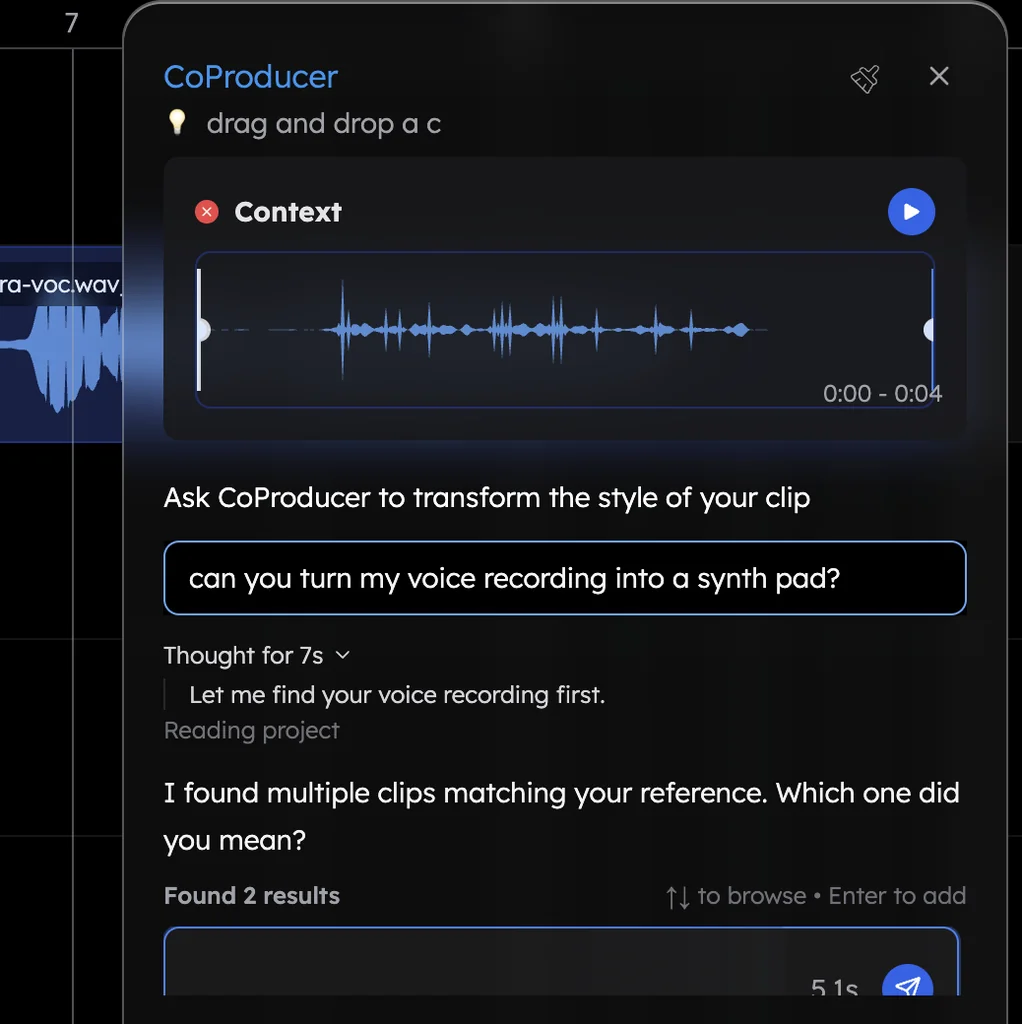
- Start from an empty project. Describe the song in plain English, tempo, key, instruments, how the chorus should lift, and CoProducer writes drums, bass, chords and melody as separate real tracks, with three options for each new part. You choose.
- Write your words. Keep your lyrics in Notes beside the studio, in your own hand.
- Record your part. Sing or play over the track with a mic or a MIDI keyboard, and ask CoProducer to fit the arrangement around your take.
- Change what is not you yet. Rewrite any note in the piano roll, swap a sound, move a section, then mix and master.
- Keep the record and export. The editable project and every stem stay in your account as the record of what you made, and you export the mix as a 24-bit/48 kHz WAV, every track as stems, or the MIDI, with no watermark.
| What the payers ask for | Veena | A one-click render |
|---|---|---|
| Human authorship you can point to | Your lyrics, your vocal, your note edits, each on its own track | A prompt |
| A song, not a template | Every part chosen and changed by you | One output per roll |
| A record of how you made it | The editable project and every stem, kept in your account | A finished audio file |
| Who owns it | You, on every plan | Depends on the generator's plan and terms |
| A release-ready file | 24-bit/48 kHz WAV with no watermark, free | Depends on the generator's plan |
On ownership, Veena's terms are short: "you own the Output you generate through your use of the Service". In the words of our ownership page, "You own the music you make in Veena, on the free plan and on Veena Pro." Veena does not train AI on your music either.
Where the money comes from, one channel at a time
- YouTube. Can you monetize AI music on YouTube? walks through the Partner Program's inauthentic content rule and YouTube's AI disclosure label.
- Streaming royalties. Do AI songs get royalties? covers the songwriting societies, Spotify and Deezer, and can I put my AI song on Spotify? is the release, step by step.
- Copyright. Can AI music be copyrighted? quotes the Copyright Office's conclusions in full. Suno's own answer for its songs is in can I copyright a Suno song?.
- Distribution. Does DistroKid accept AI music? has its four rules and its AI Credits.
- Charts. Can AI songs chart? sets out the conditions official charts apply.
What's free in Veena
- The studio: timeline, piano roll, Beat Maker, mixer, recording and real-time collaboration, with no project limit.
- CoProducer: a daily allowance of requests on the free plan.
- Mix & Master: AutoMix and Master project, on every plan.
- Release files: WAV 24-bit/48 kHz, MP3 320 kbps, MIDI and stems, with no cap and no watermark.
Veena Pro, $20 a month, removes the daily request cap and unlocks the premium models. Ownership is the same on both: the song is yours.
The verdict
AI music makes money the way all music does: when a person made it and people choose to hear it. The platforms are not fighting AI; they are fighting music nobody made. Make the part that is yours, keep the project that proves it, and release it under your own name. Veena is the free studio built for exactly that. Open an empty project and paste the prompt below.
Make a 96 BPM alt-pop song in F minor around my own vocal: tight drums with a snappy clap on 2 and 4, a warm sub bass, muted electric guitar chords Fm, Db, Ab, Eb, a soft synth pad and a short plucked hook between my lines. Intro 4 bars, verse 16, pre-chorus 8, chorus 16, verse 16, pre-chorus 8, chorus 16, bridge 8, final chorus 16. Leave space in the mids for my voice.
Related reading: Why AI songs get no streams · Can AI music be copyrighted? · Can you monetize AI music on YouTube? · Do AI songs get royalties? · Who owns music made in Veena · Veena help centre
Try this in Veena
Make a 96 BPM alt-pop song in F minor around my own vocal: tight drums with a snappy clap on 2 and 4, a warm sub bass, muted electric guitar chords Fm, Db, Ab, Eb, a soft synth pad and a short plucked hook between my lines. Intro 4 bars, verse 16, pre-chorus 8, chorus 16, verse 16, pre-chorus 8, chorus 16, bridge 8, final chorus 16. Leave space in the mids for my voice.
Opens a new project in Veena, and CoProducer starts building from this prompt.
Frequently asked questions
Can you make money with AI music?
Yes, and the money follows the part you made. YouTube monetizes AI-assisted videos that show "your creative vision", Spotify pays "based on listener engagement", and ASCAP, BMI and SOCAN register songs partly made with AI. Fully AI songs and mass uploads are what they cut (read 20 Nov 2026). Veena is an AI DAW with a personal music producer built in, where you make that part.
Why do platforms cut AI music out of the payouts?
Because of mass uploads and fake streams. Deezer says up to 85% of streams on fully AI-generated tracks were fraudulent in 2025 and it excludes manipulated streams from royalty payments; Spotify says it removed over 75 million spammy tracks (read 20 Nov 2026). A song you build in Veena, with your vocal on real tracks, is not the kind they cut.
Do AI songs get songwriting royalties?
Songs partly made with AI can. Since 28 October 2025 ASCAP, BMI and SOCAN accept compositions that combine AI-generated content with human authorship, while songs "entirely created using AI tools" are not eligible (SOCAN, read 20 Nov 2026). In Veena you write lyrics in Notes, record your voice and rewrite any note, so your authorship is in the song.
Is AI music allowed on YouTube?
Yes, and it can earn. YouTube's monetization policy bars content that is "mass-produced, generic, repetitive, or manipulative", and says disclosing AI "alone won't limit" a video's eligibility to earn money (read 20 Nov 2026). In Veena you direct every part of the score, drop your video on the timeline and export the MP4 or WAV, free.
What is the best way to make money from AI music?
Make songs that are yours. In Veena, CoProducer builds drums, bass, chords and melody with you as real tracks, you record your own vocal and change any note, and you own the music you make on every plan. Export a 24-bit/48 kHz WAV with no watermark for your distributor, your channel or a sync library, free.
Meet your personal music producer
Free, in your browser. Describe the song you want and CoProducer builds it with you.
Make music free