Suno Studio 2.0 Export Formats vs Veena: What You Take Home
Suno Studio 2.0 export formats, September 2026: 32-bit WAV or MP3 on Premier, MIDI for Studio songs only. Veena exports WAV, MP3, MIDI and stems, free.
Suno Studio 2.0 export formats come down to one sentence in Suno's help centre: the full song, a range or the multitrack "in 32-bit WAV or MP3 format", on the $30 Premier plan. Veena, an AI DAW with a personal music producer, exports WAV, MP3, MIDI and every track as stems on its free plan, with no cap and no watermark, and the music is yours.
Veena is an AI DAW with a personal music producer built in. Describe the song you want and CoProducer builds it with you — beats, chords, melody, arrangement and mix — as real tracks you can edit, mix and export. Free, in your browser.
Export formats look like a boring spec-sheet row. They are the plainest description of a tool's relationship with you, because what a product lets out the door tells you what it thinks it owns.
What changed in September 2026
Getting music out of Suno changed more this month than in any before it. From Suno's blog, help centre, release notes and Terms (read 23 September 2026):
- 3 September: downloads capped. Free up to 7 lifetime trial downloads, Pro 20 a month, Premier 60 a month, songs made earlier included. "One song counts as one download, regardless of format", stems ride with the song, and re-downloading costs nothing.
- Studio is the exception. Premier subscribers "will still be able to download their work from Studio without limitation" (Suno unlimited downloads).
- Formats are tiered. MP3 on every plan; WAV for Pro and Premier on suno.com ("mobile downloads default to MP3"); MIDI "Available for songs created in Suno Studio" and "Available to Premier subscribers".
- 2 September: a fix. Suno "fixed an issue where MIDI and MP3 files were missing from some exports."
- Commercial use follows the download. "You may not commercially exploit Output that has not been downloaded by you through an approved channel" (Terms, effective 3 September 2026).
Veena's export grew the other way on 9 September: stems as a zip, 320 kbps MP3 and 24-bit WAV, with a preview of every file before you export, on every plan.
What Suno Studio 2.0 exports
Out, on Premier: the full song, a selected range or the multitrack "in 32-bit WAV or MP3 format", and "WAV files of your individual stems". MIDI from a stem is "Get MIDI (costs 10 credits)" on Suno's "Exporting from Studio" page.
In: "WAV, mp3, and MIDI files".
Not out at all: the custom plugins the chat bar builds save to "your personal library" inside Suno. And because "Suno Studio is not compatible with VST or Audio Units plugins", your own processing never came in to begin with.
So audio moves in both directions, and everything that makes the audio sound like that stays put, behind a $30-a-month plan.
What Veena exports
Open the account menu in the sidebar and choose Export. Before anything renders, Veena shows the file count, names, quality and size:
- WAV, 24-bit/48 kHz, for masters and other DAWs.
- MP3, 320 kbps, for sharing.
- MIDI, every MIDI track in one .mid file.
- MP4, when your project has video.
- Stems: one file per audible track, with that track's effects, volume and pan, zipped together. Turn on "Normalize audio for export" and the set still balances like your mix.
No plan gating, no cap on how often, no watermark. The details are in Veena's export formats.
The MIDI matters more than people expect. Audio is a decision you already made; MIDI is a decision you can still change. Export it and the part is transposable, re-voiceable, playable on any instrument, editable in any DAW, and usable years later by a session player who never opened Veena.
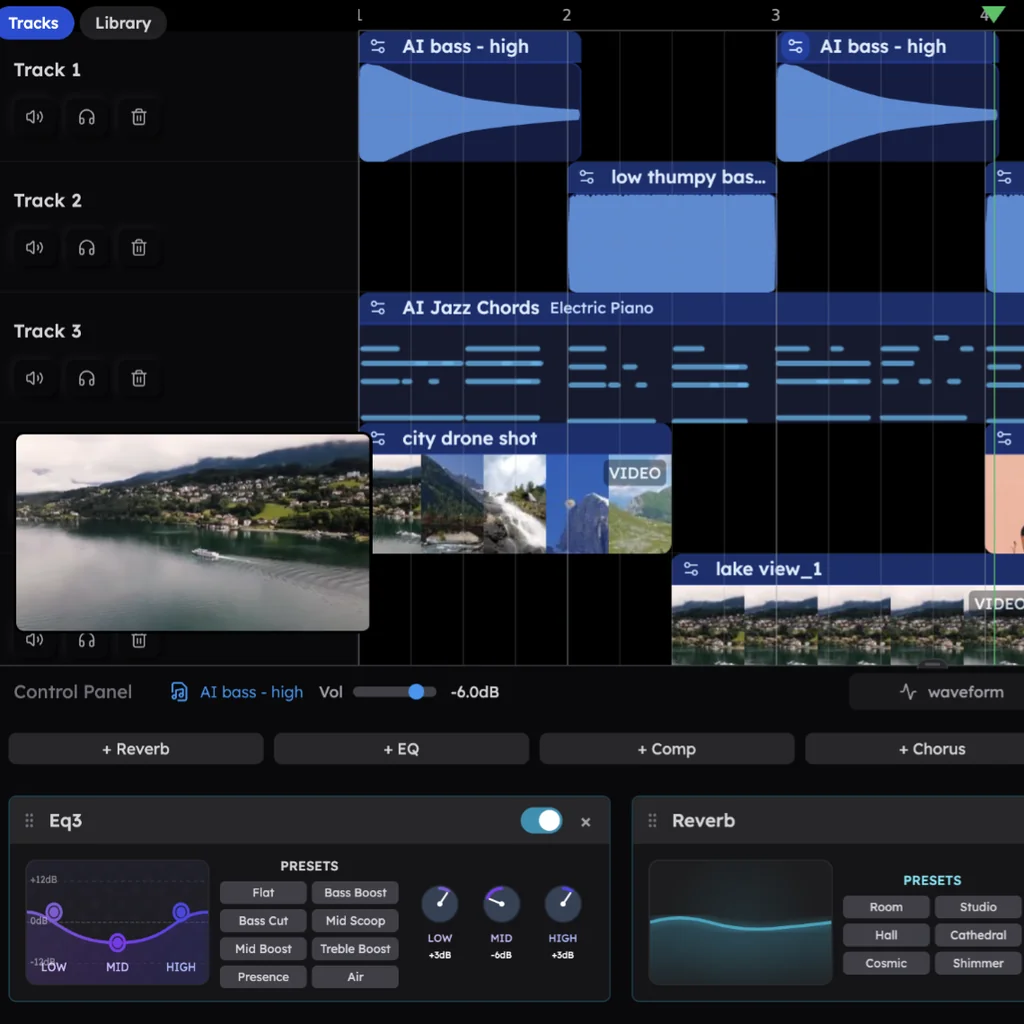
Suno Studio 2.0 vs Veena: export formats (September 2026)
| Veena | Suno Studio 2.0 | |
|---|---|---|
| Audio out | WAV 24-bit/48 kHz and MP3 320 kbps, every plan | 32-bit WAV or MP3, Premier only |
| Every track as its own file | Stems zip, every plan | Multitrack and stem WAVs, Premier only |
| MIDI out | Every MIDI track in one .mid, every plan | Studio songs only, Premier; "Get MIDI (costs 10 credits)" per stem |
| Video | MP4 for projects with video | Studio exports audio only, as WAV or MP3 |
| How often | No cap on any plan | Uncapped in Studio; 20 or 60 downloads a month elsewhere |
| What you can bring in | 13 audio formats, MIDI and video; 4-stem separation | "WAV, mp3, and MIDI files" |
| Your plugin chain | VST3 and AU on Mac, VST3 on Windows, through Veena Bridge | "Not compatible with VST or Audio Units plugins" |
| If you stop paying | The free plan keeps every export option | Studio closes; "downloads follow free tier limits" |
The test that matters: could you leave tomorrow?
Ask it of any tool. If you decided tomorrow to work somewhere else, what would you carry out?
From Veena: the audio as WAV or MP3, every track as a stem, the parts as MIDI, and a plugin chain that runs on your own computer through Veena Bridge, so it was never trapped. You leave with the song and the sound.
From Suno Studio 2.0: multitrack WAV or MP3, while you're paying for Premier. The custom plugins stay, the built-in effects stay, the synth stays. You leave with a photograph of the mix rather than the mix.
Why the import side is the bigger story
Everyone checks export. Almost nobody checks import, and import is where the gap is widest.
Studio 2.0 accepts WAV, MP3 and MIDI, enough to feed material in.
Veena takes 13 audio formats, MIDI files and video, and splits any clip into 4 stems — vocals, drums, bass and other — that land on the timeline as real separated audio next to the original. That is the difference between a tool you can put a file into and a tool you can move your work into: demos, rehearsal takes, the bounces on a hard drive from 2019 whose session files are long gone.
It sits beside the other door: an empty project and one sentence, and CoProducer builds a new song as real tracks from scratch.
The ownership footnote nobody should skip
Formats are mechanics. Rights are consequences.
Veena's terms say "you own the Output you generate through your use of the Service", on every plan, with no watermark on your exports.
Suno's Terms, effective 3 September 2026, tie commercial use to the download: nothing you haven't downloaded "through an approved channel" can be exploited commercially, free-tier songs stay "personal and non-commercial", and Suno reserves "the right to append a fingerprint, watermark, or metadata" marking your plan and whether the download was permitted. More in Suno download limits and Suno commercial use rules.
The verdict
Suno Studio 2.0 exports inside a $30 plan, imports three formats, and never lets the things that define your sound move in either direction.
Veena takes anything in, splits it into stems, builds with you, and lets the finished work out as WAV, MP3, MIDI or stems, free, in your browser, with your own plugins. For more options, see the Suno alternative guide.
Keep the whole song. Start free in your browser.
Related reading: Veena vs Suno Studio 2.0 · Suno Studio 2.0 ownership and rights · audio file formats explained · the free stem splitter
Try this in Veena
Make a 118 BPM funk track in E minor: a tight kick and crisp snare with sixteenth-note hi-hats, a slap bass line that locks to the kick, choppy clavinet chords, a horn-section style synth stab on the downbeats and a short talkbox-like lead fill. Intro 4 bars, groove 8, chorus 8, groove 8, chorus 8, breakdown 4, outro 8.
Frequently asked questions
What formats does Suno Studio 2.0 export?
Studio exports the full song, a selected range or the multitrack "in 32-bit WAV or MP3 format", plus WAV files of individual stems, on the Premier plan only (Suno's help centre, September 2026). MIDI files are "Available for songs created in Suno Studio" to Premier subscribers. Veena exports 24-bit WAV, 320 kbps MP3, MIDI and every track as stems, free, with no cap.
Can I export MIDI from an AI DAW?
Yes, in Veena, on every plan. CoProducer writes drums, bass, chords and melody as MIDI parts, and Export gives you every MIDI track in one .mid file that opens in any other DAW. MIDI is the format that stays changeable: you can transpose it, re-voice it or hand it to a session player years later.
Do Suno Studio exports count against the download limit?
No. Suno says Premier subscribers who use Studio have "no download limits". Everywhere else on Suno, since 3 September 2026, a song downloaded in any format counts once against 20 a month on Pro or 60 on Premier. Veena has no counter on any plan: export WAV, MP3, MIDI or stems as often as you like, with no watermark.
Do I own the files I export?
In Veena, yes: its terms say "you own the Output you generate through your use of the Service", on every plan, and exports carry no watermark. Suno keeps ownership of free-tier songs and, since 3 September 2026, allows commercial use only of songs "downloaded by you through an approved channel" on a paid plan.
Meet your personal music producer
Free, in your browser. Describe the song you want and CoProducer builds it with you.
Make music free