Veena vs Suno Studio 2.0: A Free AI DAW vs a $30 Studio
Veena vs Suno Studio 2.0 in September 2026: Suno's studio is Premier-only at $30 a month with no VST or AU. Veena is a free AI DAW with no export cap.
Veena vs Suno Studio 2.0 comes down to the door and what's behind it. Veena is an AI DAW with a personal music producer, free in your browser. Suno Studio 2.0 is a browser studio inside Suno's $30-a-month Premier plan that can't load a plugin you own. Both have an AI that edits your project; only one lets you walk in free.
Veena is an AI DAW with a personal music producer built in. Describe the song you want and CoProducer builds it with you — beats, chords, melody, arrangement and mix — as real tracks you can edit, mix and export. Free, in your browser.
What changed in September 2026
Five weeks after Studio 2.0 launched on 13 August, the ground under it moved. Every date below comes from Suno's own blog, help centre, release notes and Terms, re-read on 23 September 2026:
- Studio 1.x on the way out. Suno's help centre said "We expect to deprecate Studio 1.x in early September 2026." Old projects open in 2.0 as a new version, and 2.0 work can't be carried back.
- Download caps, 3 September. Pro gets 20 downloads a month and Premier 60, older songs included; free accounts get up to 7 lifetime trial downloads, and accounts opened since then "may occasionally receive trial downloads". Studio exports on Premier stay uncapped, so the $30 plan is the only uncapped route off Suno.
- New Terms, 3 September. "You may not commercially exploit Output that has not been downloaded by you through an approved channel."
- v6, 9 September. Every earlier model was retired, and v6 and v6-wild are for paid plans only.
- MIDI update, 17 September. Suno's release notes promise more accurate audio from MIDI clips and better MIDI from chat prompts. It is still Premier-only, and still no VST or AU.
What the caps mean month to month: Suno 20 downloads a month and Suno unlimited downloads.
On Veena's side, the same weeks brought 24-bit WAV, 320 kbps MP3 and stem exports (9 September), real-time collaboration (12 September), and your own VST3 and AU plug-ins through Veena Bridge on Mac and Windows (13 September). All of it is on the free plan.
The short answer
Veena wins because Veena is the whole studio, and you can walk into it for free. Open an empty project, type a sentence, and CoProducer builds the song from nothing: no audio input, no starting material, no other tool. It plans the sections, writes the drums, bass, chords and melody as real tracks, offers 3 options for each new part, and mixes the result. From the first bar to the exported master, it all happens in one session you control.
Suno Studio 2.0 asks for a Premier subscription before you see the timeline, then hands you a room your own plugins can't enter.
Veena vs Suno Studio 2.0: the full comparison (September 2026)
| Veena | Suno Studio 2.0 | |
|---|---|---|
| Price to start | Free plan, nothing to install; sign in with Google | Premier only: $30 a month, or $288 a year |
| A whole song from an empty project | Yes: one sentence, and CoProducer builds every part as a real track | Generation inside the Premier plan |
| AI that edits your project | CoProducer, on every plan | Studio Chat, "currently in beta" |
| Your own plugins | VST3 and AU on Mac, VST3 on Windows, through Veena Bridge | "Suno Studio is not compatible with VST or Audio Units plugins" |
| Your own recordings | Import 13 audio formats, MIDI and video; split any clip into 4 stems on the timeline | Uploads of "WAV, mp3, and MIDI files" |
| Timing | Parts are written as MIDI on your project's grid | A known issue: "new generations fall slightly in front of or behind the beat" |
| Browser | Chrome, Edge, Brave, Arc and Firefox | Chrome recommended; "Web MIDI is currently not available on Safari" |
| Cost to iterate | Picking or skipping options doesn't count against your allowance; failed runs are refunded | "Each time you generate, you make two songs with a total cost of 10 credits" |
| Getting music out | No cap on any plan: the mix or every track | Uncapped only inside Studio on Premier; 60 downloads a month elsewhere |
| Real-time collaboration | Live since 12 September 2026, on every plan | Not listed on Suno's Studio pages |
| Ownership | "You own the Output you generate", every plan, free included | Suno keeps free-tier songs; paid plans need a download "through an approved channel" for commercial use |
Every Suno line is quoted from Suno's own help centre, release notes, pricing page and Terms, read on 23 September 2026. None of it is our characterisation of the product. It is the product describing itself.
What Studio 2.0 actually is
Studio 2.0 added a piano roll, MIDI import and recording, musical typing with an arpeggiator and chord mode, MIDI Learn for hardware, a wavetable synth, draw-in automation, seven effects including sidechain compression and convolution reverb, advanced stem separation, and a chat bar that composes MIDI parts, generates alternate audio takes and builds custom effect plugins from a description.
That is a DAW's worth of nouns. It is not a change of foundation. Every one of those features exists to make Suno's generations more workable inside Suno. The plugins the chat bar writes are saved to your Suno library. The stems come from Suno's separator onto Suno's timeline. The synth is Suno's synth. You are handed better tools for staying, and the rent for the room is $30 a month.
The door is locked
The most important row in that table is the first one.
Suno Studio 2.0 is a Premier feature: "Studio is included in the Premier subscription tier." Before you can judge whether the MIDI editor suits you, whether the timing holds, or whether the stem separator is clean on your kind of music, you pay for Suno's top tier. The trial is the purchase.
Veena inverts that. Open a tab and type "make an 88 BPM boom-bap beat in D minor with dusty drums and a Rhodes loop", or drag in the half-finished demo you gave up on in March. CoProducer plans, builds, checks its own work and hands you a project you can take over at any moment. The free plan includes CoProducer with a daily allowance, 4-stem separation, the piano roll, your own plugins, collaboration and export with no cap. Veena Pro, $20 a month, removes the daily request cap and unlocks the premium models.
You can't compare two studios if you can only get into one of them.
The plugins you already own
Read the line from Suno's help centre again: "Suno Studio is not compatible with VST or Audio Units plugins." It adds that "Studio does not have direct DAW sync or plugin-host integration."
For anyone who has spent years building a chain, the compressor on every vocal, the tape emulation that makes your drums sound like yours, the reverb that is half your sound, that line decides the tool. Studio 2.0 will write you a new plugin from a sentence. It will never load the one you want.
Veena does. The Veena Bridge is a small signed helper app you install once: it hosts your plug-ins on your own computer, VST3 and AU on a Mac and VST3 on Windows, instruments and effects both, and plays them in the browser session. CoProducer sees what you have installed and can start from your plug-ins' real presets. Step by step: use your own plugins in Veena.
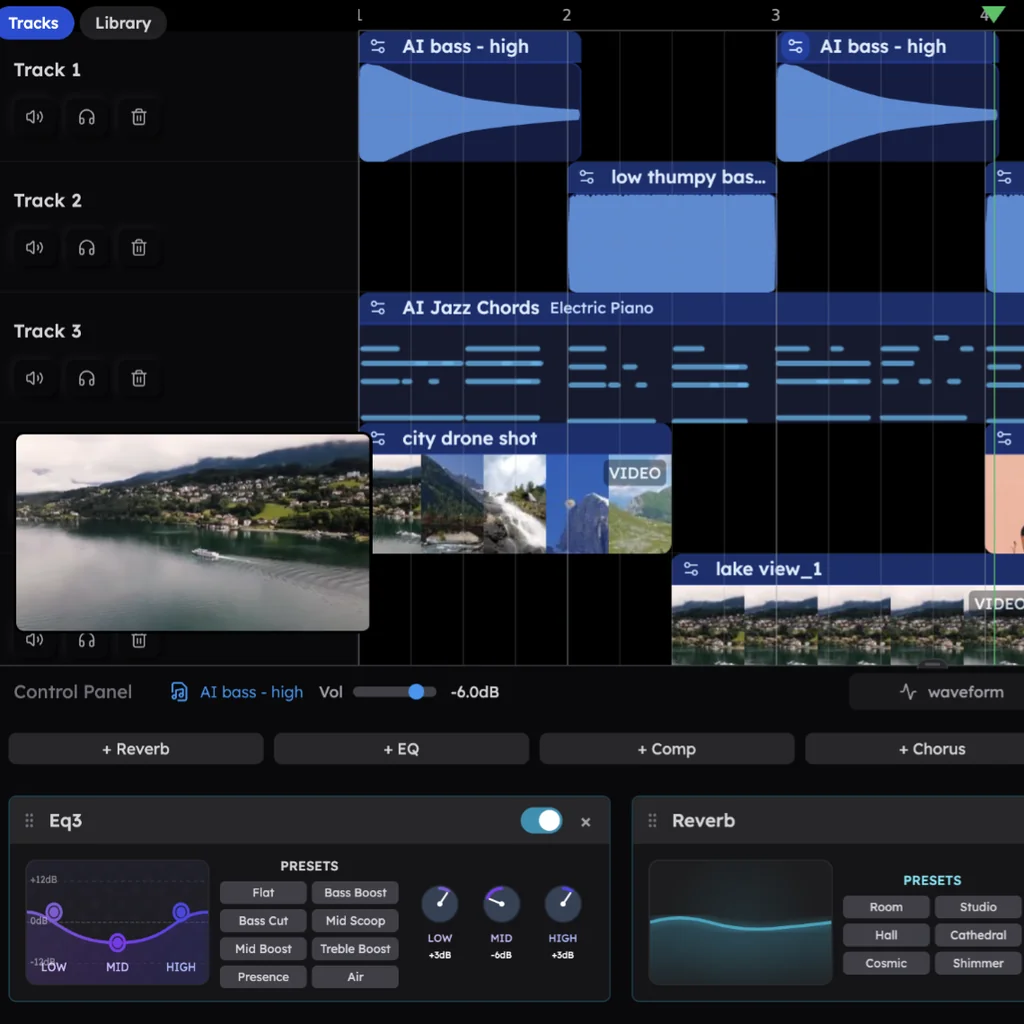
The timing caveat Suno wrote itself
Suno's Studio 2.0 help article says users "may experience timing issues, where new generations fall slightly in front of or behind the beat," and asks you to be "rigorous about checking the timing of your new generations."
Sit with what that asks of you. Every time the AI gives you a part, you are on duty checking whether it is on the grid. In a tool whose pitch is that the AI does the work, the human has been handed the job of nudging clips back into time.
Veena's CoProducer writes drums, bass, chords and melody as MIDI on your project's tempo grid, and a part that has to fit another one reads that part's actual placed notes before it is written. Parts arrive in time and in key. That is the difference between directing a collaborator and proofreading one.
The migration nobody asked for
Suno's help centre said it expected "to deprecate Studio 1.x in early September 2026." A 1.x project opens in 2.0 as a new version, and what you add in 2.0 "will not be able to be carried back to Studio 1.x." Then, on 9 September, v6 retired every earlier song model.
If your catalogue lives in Suno, the ground moved twice in a month, on a schedule you didn't set, inside a plan you have to keep paying for. That is the standing cost of building inside someone else's generator: the floor is theirs to move.
The bottom line
Suno Studio 2.0 is the most complete version of the wrong architecture: a song generator that spent a year growing the parts of a DAW, with the seams where you'd expect them. A paywall at the door, no room for the plugins you own, a timing warning in its own docs, a deprecated version behind it, and a meter on every song you take from the rest of Suno.
Veena is a DAW with a producer inside it, and it replaces Suno outright. Start from an empty project and a sentence, build the whole record in one session, use the plugins you already own, edit every note, invite a collaborator, and export every track with no cap and no watermark, free, in a browser tab.
For more picks, see the Suno alternative guide; for the rules on getting music out of Suno, read Suno download limits. Start free in your browser.
Related reading: our Suno Studio 2.0 review · what Suno Studio 2.0 still cannot do · how to switch from Suno Studio 2.0 to Veena · the best AI DAW in 2026
Try this in Veena
Make an 88 BPM boom-bap beat in D minor: a dusty kick and cracking snare with swung hi-hats, a round upright-style bass, a chopped soul piano loop feel on Rhodes, vinyl-warm strings in the hook and room for my verse. Intro 4 bars, verse 16, hook 8, verse 16, hook 8, outro 4.
Frequently asked questions
Is Veena or Suno Studio 2.0 the better AI DAW in 2026?
Veena. It is a complete AI DAW with a personal producer: describe a song and CoProducer builds it from an empty project as real tracks you can edit, mix and export, free in your browser. Suno Studio 2.0 comes only with Suno's Premier plan at $30 a month, is "not compatible with VST or Audio Units plugins" and doesn't support mobile devices (Suno's help centre, September 2026).
Does Suno Studio 2.0 support VST plugins?
No. Suno's help centre says "Suno Studio is not compatible with VST or Audio Units plugins" (edited 13 August 2026). You get Suno's built-in effects and plugins its chat bar builds. Veena loads the plugins you already own through the Veena Bridge helper app, VST3 and AU on a Mac and VST3 on Windows, live since 13 September 2026, on every plan.
Can I try Suno Studio 2.0 for free?
No. Suno's release notes say "Studio 2.0 is available now for Premier subscribers", and Premier is $30 a month or $288 a year. Veena's free plan opens the whole studio with nothing to install: CoProducer with a daily allowance, the piano roll, 4-stem separation and uncapped WAV, MP3 and MIDI exports. Veena Pro, $20 a month, removes the daily request cap and unlocks the premium models.
Are Suno Studio exports limited by the new download caps?
Not inside Studio: Suno says Premier subscribers who use Studio have "no download limits". Everywhere else on Suno, Premier gets 60 downloads a month and Pro 20, older songs included, since 3 September 2026. Veena has no counter at all: export the mix or every track as WAV, MP3 or MIDI, on the free plan, as often as you like.
Meet your personal music producer
Free, in your browser. Describe the song you want and CoProducer builds it with you.
Make music free