Best DAW for Violinists, Violists and Cellists
The best DAW for violinists, violists and cellists: record your part in Veena, free in your browser, and CoProducer arranges the band or strings around it.
The best DAW for violinists, violists and cellists is one that hears your part and builds the rest of the music around it. Veena does exactly that: record your line in the browser, describe the arrangement you hear, and CoProducer, your personal music producer, writes the guitar, piano, bass or orchestra around your take. Free, with nothing to install.
Veena is an AI DAW with a personal music producer built in. Describe the song you want and CoProducer builds it with you — beats, chords, melody, arrangement and mix — as real tracks you can edit, mix and export. Free, in your browser.
Your part needs a room around it
A string player practises alone and performs with others. Your tune is written for a guitar underneath it, a cello line answering it, a piano holding the harmony. Record it at home and you get the loneliest sound in music: one violin, no room.
Most DAWs make that worse. They're built for producers who program drums, so they open on an empty grid and assume you'll play every other part yourself, on a keyboard you may not own. The accompaniment apps go the other way: type the chords and they play a backing track, but they never hear your playing, and there's nowhere to record your part.
The best DAW for violinists does both jobs. It records your instrument cleanly, and it writes the other parts to fit what you actually played: your tempo, your phrasing, your key.
Three sessions, three string players
A fiddler with a tune and no band
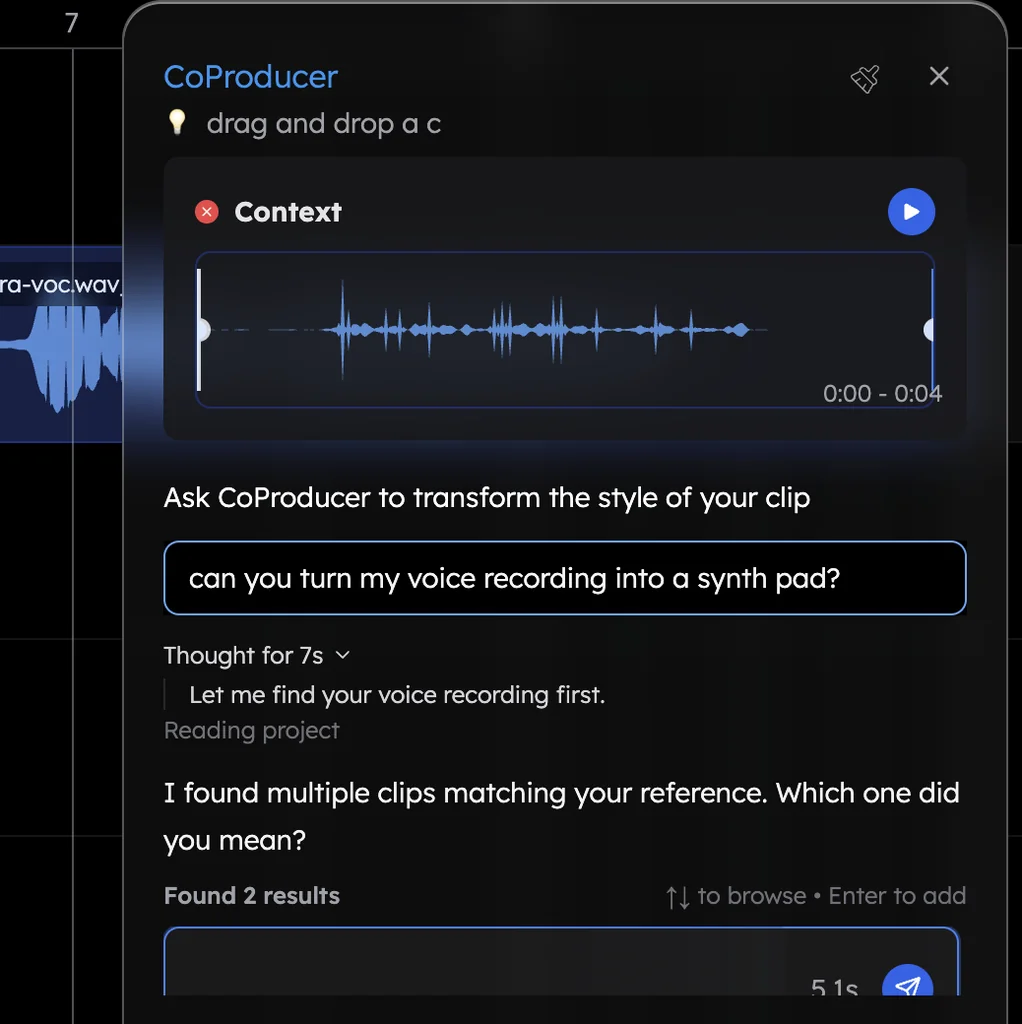
Open the studio, press Record, choose Audio and play the tune through twice. Then drag the clip into the CoProducer panel:
"Build a folk arrangement around my violin on track 1: keep my take exactly as it is and match its tempo and key. Acoustic Guitar (nylon) strumming the chords my tune implies, Acoustic Bass on the roots, light percussion on the Brush kit, and a Cello countermelody that answers my phrases."
CoProducer measures your take before it writes a note: tempo, downbeat, key and where your phrases land. New parts follow your recording's phrasing, so the cello answers in your gaps instead of talking over you. Each part arrives as 3 options; hover to hear, press Enter to keep.
In Veena's own data, folk and country requests get a finished first result on day one 84.5% of the time.
A cellist scoring a short film
Drag the film's video file onto the timeline; Veena takes .mp4, .mov, .webm and three other video formats. Record your theme against the picture, then note the bar number on the ruler where the scene turns. Brief the orchestra:
"Score this scene around my cello on track 2: String Ensemble swelling in under my line from bar 9, Contrabass holding low roots, Pizzicato Strings pulsing through the tense middle, and one big hit on bar 21."
When it works, export an MP4 with your score under the picture, or 24-bit WAV stems for the editor. For deeper scoring moves, from ostinatos to swells, see the AI string section.
A violist who wants a quartet
Record your viola part, then choose how you want the other three voices. Record them yourself on new tracks, one pass at a time, or ask CoProducer:
"Write a string quartet around my viola on track 1: Violin on the melody above me, a second Violin in harmony, and Cello on the bass line, all as MIDI I can edit."
Every voice lands as MIDI on Veena's own Violin, Viola and Cello presets. Open any part in the piano roll and drag a note to fix a voicing. When you're happy, record the violin parts yourself over the MIDI guides, or keep the MIDI and export it for your notation program.
Recording strings at home in Veena
Bowed strings forgive a lot, but not a boxy room or a late take. Five habits for clean recordings:
- Mic. A laptop mic captures sketches; a USB condenser mic, about a metre away and a little above the instrument, captures keepers.
- Room. Play in the softest room you have. Curtains, a sofa and a rug beat a bare kitchen.
- Calibrate once. In the Record panel, run Volume calibration and Latency calibration, so your take lands where you played it.
- Count in and loop. Set a one- or two-bar count-in, then drag across the ruler to loop the phrase. Veena keeps the last complete pass, so play it until it sings.
- Headphones. Always, so the accompaniment never bleeds into your take.
Then give the take its hall. Double-click the clip, open its FX tab and add Reverb on the Hall or Cathedral preset, the Compressor's Gentle preset for a steady level, and the 8-Band EQ to roll off low rumble. Or ask CoProducer to "sit my violin on top and give it a concert-hall reverb." One Ctrl+Z undoes any change.
Want the orchestra thicker than one bow can make it? Ask CoProducer to transcribe your take into MIDI, then double it with String Ensemble for a section sound under your solo line.
The usual alternatives, and the bill for a string player
Veena records your instrument and writes the accompaniment to fit it, free in a browser. Here's what the usual alternatives cost a string player, from each company's own pages. For the whole field, see our ranking of the best AI DAW.
Logic Pro: a new Mac before the first note
Logic Pro costs $199.99, or $12.99 a month in Apple Creator Studio, and "requires macOS 15.6 or later and a Mac with Apple silicon" (Apple, September 2026). Its Session Players cover synth, bass, keyboard and drums; the arrangement around your violin is still yours to build.
GarageBand: free, on Apple hardware only
GarageBand is free on a Mac, iPhone or iPad, and there's no version for Windows, Android or a Chromebook (Apple, September 2026). Growing past it means paying for Logic Pro.
Audacity: a recorder with no orchestra
Audacity is free and records well, but it's an audio editor: it describes no built-in virtual instruments, and its manual says "only limited editing can be performed on Note tracks such as cutting, pasting and deleting" (Audacity, September 2026). Nothing in it can write your accompaniment.
Band-in-a-Box: a backing band that never hears you
Band-in-a-Box builds backing bands from the chord symbols you type. Pro costs $129 as "a ~35 GB download" on Windows, and packages run to $694 (PG Music, September 2026). It follows your chord chart, not your phrasing.
iReal Pro: a practice band, not a studio
iReal Pro plays backing tracks from chord charts. It's $21.99 on the App Store, and each platform is sold separately (iReal Pro's site, September 2026). You can practise over it, but there's nowhere to record, arrange or mix your own piece.
| Veena | Logic Pro | GarageBand | Audacity | Band-in-a-Box | |
|---|---|---|---|---|---|
| Price to start | Free | $199.99, or $12.99 a month | Free on Apple devices only | Free | $129, as a 35 GB download |
| Who writes the parts around you | CoProducer, from your take, 3 options per part | Session Players for synth, bass, keys and drums | Session drummers and percussionists | Nobody: there are no instruments | RealTracks, from chord symbols you type |
| Where it runs | Any modern browser, including Chromebooks and phones | Macs with Apple silicon | Mac, iPhone and iPad | A Windows, Mac or Linux install | A Windows or Mac install |
Bring the bow; CoProducer brings the rest
You spent years learning to make one instrument sing. The best DAW for violinists doesn't ask you to learn five more; it listens to the one you play and builds around it. Open Veena, record 16 bars tonight, and hear your tune with a band behind it. When you're ready to go bigger, the cinematic music guide takes the same take to full orchestra.
Related reading: best AI tools for composers · best DAW for bass players · best AI DAW for pianists · how to produce music if you can only sing
Try this in Veena
Build a folk arrangement around my violin on track 1: keep my take exactly as it is and match its tempo and key. Acoustic Guitar (nylon) strumming the chords my tune implies, Acoustic Bass on the roots, light percussion on the Brush kit, and a Cello countermelody that answers my phrases. Intro, two verses of the tune, a quieter middle with just guitar and cello, and a final pass with everything.
Frequently asked questions
What is the best DAW for violinists?
Veena, because it builds the accompaniment around your playing. Record your violin, viola or cello in the browser, then describe the arrangement you hear, and CoProducer writes the guitar, piano, bass, drums or orchestral strings around your take as parts you can edit. It's free, it runs on any modern laptop, and you own everything you make.
Can Veena write an accompaniment for my violin part?
Yes. Drag your recording into the CoProducer panel and ask for the arrangement, for example nylon guitar, upright bass and a cello countermelody. CoProducer measures your take's tempo and phrasing first, then offers 3 options for each new part. Every part is real MIDI on Veena's instruments, including Violin, Viola, Cello, Contrabass, String Ensemble and Pizzicato Strings.
What do I need to record a cello or violin in Veena?
A laptop's built-in mic works for sketches; a USB condenser mic or an audio interface is better for keepers. In Veena, press Record, choose Audio, and run Volume calibration and Latency calibration once. Wear headphones, set a count-in, and loop a section to record take after take: Veena keeps the last complete pass.
Can I get sheet music from what CoProducer writes?
Every part CoProducer writes in Veena is real MIDI, so you can export it and open it in the notation program you already use to print parts. Export all MIDI tracks as one .mid file from the Export menu, or download a single clip's MIDI file. Exports are free, with no cap, on every plan.
Meet your personal music producer
Free, in your browser. Describe the song you want and CoProducer builds it with you.
Make music free