How to Produce Music If You Can Only Sing
How to produce music if you can only sing: record your voice in Veena, free in your browser, and CoProducer builds the beat and chords around your take.
Here's how to produce music if you can only sing: record your voice first, then have a producer build the track around it. In Veena, that producer is CoProducer. Sing into your laptop, describe the sound you hear, and it writes the drums, bass and chords to fit your take, as real tracks you can change. Free, in your browser.
Veena is an AI DAW with a personal music producer built in. Describe the song you want and CoProducer builds it with you — beats, chords, melody, arrangement and mix — as real tracks you can edit, mix and export. Free, in your browser.
"I sing but cannot produce for the life of me"
That line comes from a real thread, and the replies are always the same. Learn a DAW. Learn drum programming. Learn chord voicings, then mixing, and come back in two years. Or buy a beat and squeeze your song into someone else's 16 bars.
Neither answer respects what you already have. A melody that works a cappella is the hardest part of a song, and you've written it. What's missing is the band, and the engineer behind the glass.
The obstacle isn't talent. Every production tool opens on an empty grid and assumes you want to become a producer. You want your song to sound like a record, with your voice on it.
You're in good company. In Veena's own data, vocals are the most-named instrument in first requests, and about 1 in 4 first requests refer to the user's own audio: a recording, a demo or a voice memo.
How to produce music if you can only sing, in five steps
1. Record the song the way you'd sing it to a friend
Open the studio, sign in with Google and press Record in the transport bar. Allow the microphone, choose Audio, and open Calibrate once to run Volume calibration and Latency calibration. Wear headphones so the beat never bleeds into your take.
A click helps but isn't required. Sing at a steady pulse and CoProducer measures the tempo and the downbeat from your voice. If you already know your tempo, set it anywhere from 40 to 300 BPM and switch on a one- or two-bar count-in.
Want another pass? Drag across the ruler to set a loop and record again: Veena keeps the last complete pass. Already have the idea on your phone? Upload the voice memo instead. The full walk-through lives in recording in Veena.
2. Tell CoProducer what you hear
Drag your vocal clip into the CoProducer panel and describe the record the way you'd brief a producer in a session:
"Build a slow R&B song around my vocal on track 1: keep my take exactly as it is, match its tempo and key, warm Electric Piano chords with 7ths and 9ths, a round Sub Bass, laid-back drums on the Brush kit, and leave space wherever I'm singing."
CoProducer measures your take before it writes a note: its tempo, its downbeat and a flow map of where your syllables land. Then it plans the sections and builds the parts. Every new part reads that flow map, so the drums breathe where you breathe and the keys step back under your lines.
3. Pick the parts that feel like you
Each new part arrives as 3 options in one carousel. Hover a card to hear it, browse with ↑ and ↓, and press Enter to add it. Nothing that depends on a part is written until you've picked, so the bass is built on the chords you chose, not the ones you skipped. When the run ends, CoProducer lists exactly what it delivered.
4. Change anything in plain words
Now produce it like an artist, not an engineer:
- "Make the drums half-time in the verses and full in the chorus."
- "Swap the Electric Piano for Acoustic Guitar (nylon)."
- "Add a bridge after the second chorus with just keys and my voice."
- "Bring the bass in on the second verse, not the first."
One Ctrl+Z (Cmd+Z on a Mac) undoes any change CoProducer makes. Every part is a real MIDI track, so you can also open the piano roll and move a single chord yourself.
5. Finish the vocal, then export
Open your vocal clip's FX tab and build the chain an engineer would reach for:
- Auto-Tune: set Key and Scale to the song. Keep Style on Natural with a low Amount for a transparent touch, or switch Style to Hard for the effect.
- Compressor: start from the Vocals preset to even out loud and soft lines.
- 8-Band EQ: trim the low rumble and lift the air.
- Reverb and Delay: a Plate reverb for space, and a Dotted delay to throw the last word of a line.
Or skip the knobs and ask CoProducer to "sit my vocal on top of the beat and master the song for streaming." Then export a 24-bit/48 kHz WAV or a 320 kbps MP3, the full mix or every track as stems, as often as you like, with no watermark. Veena's terms say you own the Output you generate, so the song is yours to release.
Hum the parts you hear but can't play
Most singers hear the whole arrangement in their head: a guitar figure under the verse, a string line pulling into the chorus. You don't need to play it. Hum it.
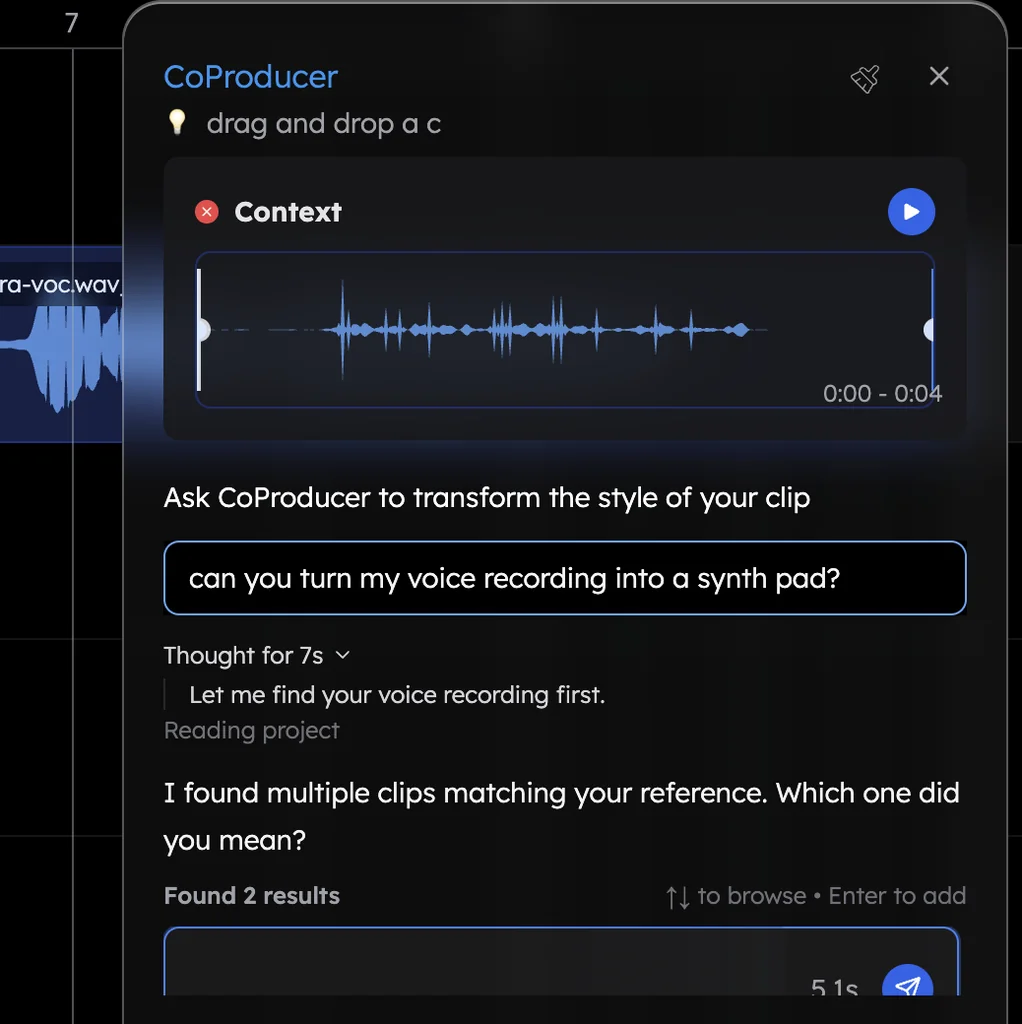
Record the hum, drag it into the CoProducer panel and ask it to "turn my humming into a Cello line in the song's key." CoProducer transcribes your pitch into an editable MIDI part on a new track, playing any of Veena's 61 instrument presets, from Violin and String Ensemble to Soft Lead and Bell Pluck. Or it re-voices the recording itself as another instrument. The whole flow is on the voice to instrument page.
If you'd rather write alone and bring the production in later, the online recording studio keeps every take in your account, and songwriters starting from words can turn lyrics into a song the same way.
What else singers try, and what it costs them
Veena is the one studio on this list built around your voice, with a producer inside. Here's what the other routes cost a singer, from each company's own pages. For the full field, see our ranking of the best AI DAW.
Suno: your song, sung by a voice that isn't yours
Suno's songs are sung by a generated voice, and its Upload Audio takes just 6 to 60 seconds of your own recording, 120 on paid plans, as a starting point (Suno's help centre, September 2026). Its Free plan lists "No monthly song downloads" and "No commercial rights" (Suno's pricing page, September 2026), and Suno keeps ownership of songs made on the free tier. Its DAW, Suno Studio, is part of the $30-a-month Premier plan and "is not compatible with VST or Audio Units plugins."
BandLab: a recorder, with the AI behind a paywall
BandLab's free Studio stops at 16 tracks and 15-minute songs (BandLab's help centre, September 2026). Its AI Voice Cleaner and AutoMix sit on the paid plans (Pro is $14.99 a month, or $99 for the first year), and its SongStarter ideas come with a catch: "you won't own the rights to the generated track."
GarageBand: free, if you already own Apple hardware
GarageBand is free on a Mac, iPhone or iPad, and there's no version for Windows, Android or a Chromebook (Apple, September 2026). The Session Players that write bass and keys belong to Logic Pro, at $199.99 or $12.99 a month in Apple Creator Studio, on a Mac with Apple silicon.
ACE Studio: a synthetic singer where you should be
ACE Studio's core workflow is to "Input MIDI and lyrics to generate professional-level, studio-quality singing vocals" (ACE Studio, September 2026). That's a voice replacing yours, in a Mac or Windows install that costs $398 to buy or a year paid up front.
LANDR Layers: parts for a DAW you still need
LANDR calls Layers "An AI co-producer that listens to your track," but it's a standalone program for Mac or Windows, metered at 25 generation minutes a month, sold inside LANDR Studio from $8.25 a month (LANDR, September 2026). Recording and mixing your vocal still happen somewhere else.
| Veena | Suno | BandLab | GarageBand | ACE Studio | |
|---|---|---|---|---|---|
| Price to start | Free | Free, with no monthly downloads | Free: 16 tracks, 15-minute songs | Free on Apple devices only | $398, or a year up front |
| Your own vocal in the song | Your full take, kept as you sang it | Uploads of 6 to 60 seconds, 120 on paid plans | Recorded, in songs up to 15 minutes | Recorded | Replaced by a synthetic singer |
| A producer who builds the band around it | Yes: drums, bass, chords, melody and mix | Studio chat, on the $30 Premier plan | SongStarter ideas you don't own | Session drummers and percussionists | Renders the MIDI and lyrics you write |
Your voice first, the production second
The fastest way to produce music when you can only sing is to stop trying to become someone else. Sing the song, then brief a producer who never gets tired of your third idea. That's CoProducer, in a free studio that opens in a browser tab. Record one verse today and hear it with a band before you've finished your tea.
Related reading: best AI DAW for singer-songwriters · best AI tools for vocalists · music production for teenagers · best DAW for recording vocals
Try this in Veena
Build a slow R&B song around my vocal on track 1: keep my take exactly as it is, match its tempo and key, warm Electric Piano chords with 7ths and 9ths, a round Sub Bass, laid-back drums on the Brush kit with a soft snare on 2 and 4, and leave space wherever I'm singing. Intro, verse, chorus, verse, chorus, bridge, final chorus.
Frequently asked questions
Can I produce a song if I can only sing?
Yes. Record your vocal in Veena, free in your browser, and CoProducer builds the production around it: drums, bass, chords, extra melody lines and the mix, as real tracks you can edit. It measures your take's tempo, downbeat and phrasing first, so the parts fit your voice instead of the other way round. You direct it in plain words, like a producer.
Does Veena sing my song for me?
No, and that's the point: the voice on your song is yours. Veena records you from any microphone your browser can use, and CoProducer builds every instrumental part around your take. If you hear a line you can't play, hum it, and CoProducer turns the hum into an editable part on any of Veena's 61 instrument presets.
What microphone do I need to record vocals in Veena?
Any microphone your browser can see: a laptop's built-in mic for sketches, a USB mic or an audio interface for releases. Run Volume calibration and Latency calibration once in Veena's Record panel, wear headphones, and your take lands on time. Then add Auto-Tune, Compressor, EQ and Reverb to the vocal clip, or ask CoProducer to balance it.
Can I build a song around a voice memo from my phone?
Yes. Upload the memo to Veena (it reads .m4a, .mp3, .wav and 10 more audio formats) and ask CoProducer to build around it. It sets the project tempo to match your recording and writes each new part to your phrasing. In Veena's own data, about 1 in 4 first requests start from the user's own audio.
Who owns a song I produce in Veena?
You do. Veena's terms say you own the Output you generate through your use of the service, and your recording was always yours. Exports carry no watermark, commercial use is allowed on every plan including the free one, and you can export the mix or every track, as often as you like.
Meet your personal music producer
Free, in your browser. Describe the song you want and CoProducer builds it with you.
Make music free