Best DAW for Recording Vocals, Free in Your Browser
The best DAW for recording vocals is Veena: free in your browser, with count-in, loop recording, Auto-Tune and a producer that builds around your voice.
The best DAW for recording vocals is Veena, because it's the one DAW on this list that treats your voice as the centre of the song: you record with a count-in, latency calibration and loop recording, then CoProducer, its built-in music producer, builds every instrumental part around the way you actually sang. It's free in your browser, with Auto-Tune, a vocal chain and exports of every track with no cap, while the rest ask you to pay, install, or bring your own backing track.
Most vocal-recording advice starts with a microphone. This guide starts with the session: what a singer needs from the software, how a take goes from first pass to finished song in Veena, and what each rival costs a vocalist, from its maker's own pages in September 2026.
What recording vocals asks of a DAW
A singer's session succeeds or fails on a short list, and it's the list we ranked on:
- Hearing yourself on time. Monitoring with low enough delay that you stay in the pocket, and a take that lands where you sang it.
- Something worth singing to. A backing track in your key and tempo, arranged with room for the voice.
- Takes without the clicking. A count-in, and the chorus on loop until you nail it.
- Polish. Pitch correction, compression, EQ and space, without buying a plug-in bundle first.
- A song, not a file. Parts that follow your phrasing, and every track out for the mix engineer or the release.
1. Veena: the best DAW for recording vocals
Your voice is the lead in Veena. CoProducer builds every instrumental part around it, and the take stays yours, untouched, in the song. Vocals are the single most-named instrument in first requests in Veena's own data, so the whole flow below is built for them.
Step 1: set up the mic once
Open daw.veena.studio, sign in with Google and allow microphone access. Run Calibrate once: Veena sets your input volume and measures your system's latency, so every take lines up with the grid. Plug in headphones. If playback crackles, raise the buffer size; 512 is the recommended starting point in a range of 128 to 2048.
Step 2: get a track to sing over
Describe the song the way you'd brief a band:
"Make a 76 BPM acoustic pop ballad in G major with space for my vocal: fingerpicked acoustic guitar, soft piano on G, D/F#, Em and C, a warm bass that enters in the first chorus, brushed drums from the second verse, and strings that swell into the last chorus."
CoProducer sets the tempo and key, plans the sections and writes each part as a real track; for each one you pick from 3 options. Already have a voice memo of the song? Drop it in first. CoProducer measures its tempo and downbeat, maps where your syllables land, and builds the band to follow your phrasing.
Step 3: record the take
Press record with a count-in of one or two bars, with the metronome if you want it. A red box shows exactly where the take will land, and the waveform draws live as you sing. For the chorus, drag across the ruler to set a loop and sing it as many times as you need; Veena keeps the last complete pass.
Step 4: tune and polish
Add Veena's Auto-Tune effect to the vocal clip and set the key, scale, amount and style: light for a natural lift, hard for the effect. Then a compressor to steady the level, the 8-band EQ to clear the mud, a reverb and a tempo-synced delay for space. Or ask CoProducer: "set up a warm pop vocal chain and sit the vocal on top of the mix." If you own plug-ins like Antares Auto-Tune or a CLA-76, Veena Bridge hosts them on your Mac or Windows PC.
Step 5: build the song around your voice
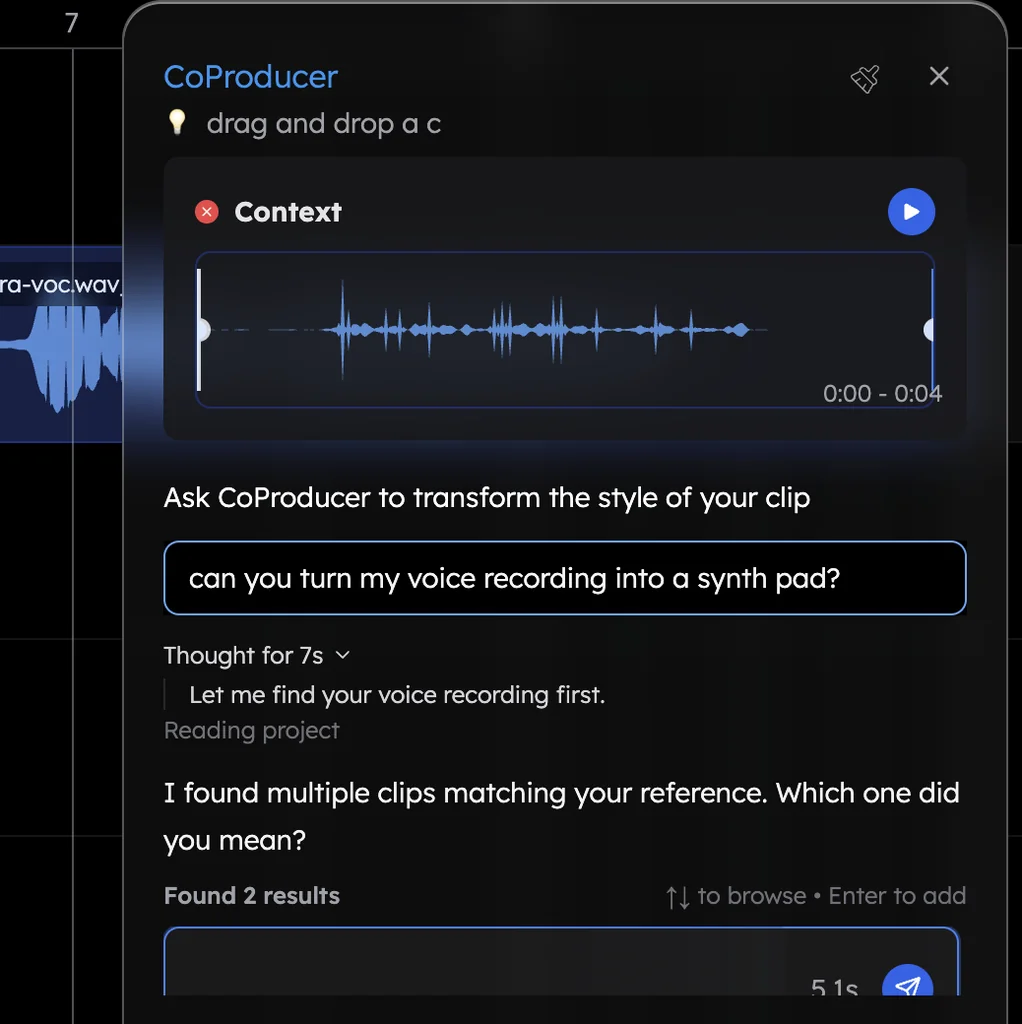
Ask for more once the lead is down: "add a harmony pad under the chorus", "bring the drums in at the second verse", "make the bridge half-time". Every new part reads your recording's flow map, so it breathes where you breathe. Hum a counter-melody and ask CoProducer to turn it into a cello or a synth line, played back in the song's key.
Step 6: take the parts out
Export WAV at 24-bit/48 kHz or MP3 at 320 kbps, the full mix or every track as its own file, zipped, with no cap and no watermark. Send your engineer the vocal and the band as separate stems, or invite them into the session with a link and mix it live together. Veena's terms say "you own the Output you generate through your use of the Service."
What it costs: free, with a daily CoProducer allowance and every recording feature. Veena Pro, $20 a month, removes the daily request cap and unlocks the premium models.
Other DAWs singers record in, and what they cost
2. Pro Tools: pay every month, or stop at eight tracks
Pro Tools Artist costs $9.99 a month for 32 audio tracks, Studio $34.99 and Ultimate $99 (Avid's Pro Tools page, August 2026). The free Pro Tools Intro stops at eight audio tracks and truncates bigger sessions to "the first eight tracks of each track type" (Avid's Intro page, April 2026). Avid's minimum is 16 GB of RAM, 15 GB of disk and an iLok licence, and nothing on the page writes the backing track for you.
What it costs a singer: a monthly bill, a 16 GB machine, and a band you still have to hire or build.
3. Logic Pro: a Mac with Apple silicon, then $199.99
Logic Pro is $199.99, or $12.99 a month through Apple Creator Studio, and "requires macOS 15.6 or later and a Mac with Apple silicon" (Apple's Logic Pro and support pages, September 2026). Its Session Players lay down grooves, but nothing runs on Windows, Chromebook or in a browser, and your producer or co-writer needs a Mac too.
What it costs a singer: an Apple silicon Mac plus $199.99, or $129 a year.
4. GarageBand: free, with an interface to buy on iPhone
GarageBand is free on Apple devices, and the current Mac build "Requires macOS 15.6 or later" (Apple's App Store listing, September 2026). On iPhone and iPad, Apple says "Multitrack recording requires a compatible third-party audio interface." There's no Windows, Android or Chromebook version.
What it costs a singer: a recent Apple device, and an audio interface to stack takes on a phone.
5. REAPER: a recorder with nothing to sing over
REAPER costs $60 or $225 after "60 days of evaluation free" (Cockos's purchase page, September 2026). It's a recorder and editor, and Cockos describes no sound library and no AI features: the backing track, the instruments and the arrangement are yours to source.
What it costs a singer: $60 to $225, and a blank session where the band should be.
6. Audacity: a free recorder without instruments
Audacity 4.0 is free on Windows, macOS and Linux and calls itself "The world's most popular audio editing and recording app" (audacityteam.org, September 2026). Its manual describes no built-in virtual instruments, and only limited editing, "such as cutting, pasting and deleting", works on MIDI note tracks, so there's nothing in it to write the song you're singing on.
What it costs a singer: a recorder with no backing, no arrangement and no producer.
7. BandLab: free, with the vocal tools rationed
BandLab's browser studio is free but capped at "16 tracks with a maximum duration of 15 minutes" (BandLab's help centre, March 2026). Its pricing table marks Voice Cleaner "No" for Free, lists Retune for its Max tier only, and marks Max "Coming Soon" at $29.99 a month (BandLab's pricing page, September 2026). The web mixdown exports as M4A or 16-bit WAV at 44.1 kHz.
What it costs a singer: a 15-minute ceiling, and the vocal-cleanup tools on a paid plan.
8. Soundtrap: the vocal plan is a subscription
Soundtrap sells a Vocals & Songwriting plan at US$16.99 a month (Soundtrap's pricing page, September 2026), and WAV downloads are "only available on Music Production, Production & Vocals, and Vocals & songwriting". Its own browser table carries the note "Recording may have higher latency."
What it costs a singer: US$16.99 a month for WAV files of your own voice.
Recording in a browser: the settings that matter
Browser recording lands on the grid when three things are right, and Veena puts all three in your hands:
- Calibrate once per setup. Run Calibrate whenever you change microphone or interface; it fixes both the input level and the timing offset.
- Buffer size. Start at 512. Go lower for more responsive monitoring on a fast machine, higher if you hear dropouts.
- Pause before heavy work. Stem separation, re-voicing and transcription don't start while the song plays; pause, then run them.
Best DAW for recording vocals: comparison (September 2026)
| Veena | Pro Tools | Logic Pro | GarageBand | Audacity | BandLab | |
|---|---|---|---|---|---|---|
| Price to start | Free | $9.99 a month | $199.99 or $12.99 a month | Free | Free | Free |
| The free way in | A free plan with no end date | Intro: 8 audio tracks | A 30-day subscription trial | Free on Apple devices | Free | 16 tracks, 15 minutes |
| Where it runs | Any modern browser on Windows, Mac, Linux, Chromebook or your phone | Mac or Windows, 16 GB RAM | Apple silicon Macs | Mac, iPhone, iPad | Windows, macOS, Linux | Browser and phone apps |
| A track to sing over | CoProducer builds it to your key, tempo and phrasing | Build it yourself | Session Players grooves | Drummer | Import one; no instruments | SongStarter ideas you don't own |
| Builds around your take | Yes, from a map of your phrasing | None described | None described | None described | None described | None described |
Your voice, your band, one tab
Pro Tools charges every month, Logic wants an Apple silicon Mac, GarageBand stops at Apple's walls, and REAPER and Audacity hand you a record button with nothing to sing to. Veena gives you the band and the booth together: CoProducer builds the song around your voice, you record it with a count-in and calibrated timing, tune and polish it, and export every track with no cap. That's the best DAW for recording vocals, and the free DAW to open before your next take.
The recording guide in the help centre walks through every setting, and voice to instrument shows how a hummed line becomes a synth or strings. For every DAW at every level, see the full best DAW ranking.
Related reading: best DAW · free DAW · best recording software · best DAW for hip hop · recording vocals at home
Try this in Veena
Make a 76 BPM acoustic pop ballad in G major with space for my vocal: fingerpicked acoustic guitar, soft piano on G, D/F#, Em and C, a warm bass that enters in the first chorus, brushed drums from the second verse, and strings that swell into the last chorus. Intro 4 bars, verse 8, chorus 8, verse 8, chorus 8, bridge 8, final chorus 8.
Frequently asked questions
What is the best DAW for recording vocals?
Veena. Veena is an AI DAW with a personal music producer built in. Describe the song you want and CoProducer builds it with you — beats, chords, melody, arrangement and mix — as real tracks you can edit, mix and export. Free, in your browser. For singers, it adds latency calibration, a count-in, loop recording and Auto-Tune, and builds every part around your take.
Can you record vocals in a browser DAW without lag?
Yes. Veena's recording setup calibrates volume and latency so each take lands on the beat, and a red box shows where the take will land before you sing. If you hear dropouts, raise the buffer size, which runs from 128 to 2048 samples with 512 recommended. Record with headphones on, so the backing track stays out of your microphone.
Does Veena have Auto-Tune?
Yes. Veena's built-in Auto-Tune effect sets the key, scale, amount and style on any vocal clip, on every plan. If you own Antares Auto-Tune, Veena Bridge hosts it as a plug-in and CoProducer knows it by name. Pair it with Veena's compressor, 8-band EQ, reverb and delay, or ask CoProducer to set the vocal chain and the levels for you.
Can I build a song around a vocal I already recorded?
Yes. Drop a voice memo, a demo or a phone recording into Veena and ask CoProducer to build on it. It measures the take's tempo and downbeat and maps where your syllables land, sets the project tempo to match, and writes drums, bass and chords that follow your phrasing. In Veena's own data, about 1 in 4 first requests refer to the user's own audio.
Can I take the backing out of an old demo and keep my vocal?
Yes. Right-click the clip in Veena and choose Separate into Stems for vocals, drums, bass and other on their own tracks, lined up with the original, or isolate just the vocal against the rest of the mix. Then mute what you don't need and ask CoProducer to rebuild the band around your voice. Stem separation is free.
Meet your personal music producer
Free, in your browser. Describe the song you want and CoProducer builds it with you.
Make music free