Make Gospel Music
To make gospel music, build it on the keys: 9th and 13th chords, walk-ups into every section, a bass that answers the piano, and a vamp that climbs a half step at a time. In Veena, a free AI DAW in your browser, your personal music producer CoProducer plays the band as real tracks; the voices stay yours.
Gospel and contemporary worship come from the same building and do the same job: lift a room. Traditional and contemporary gospel do it with a choir, a Hammond organ and call and response. Worship does it with pads, delayed guitars and a bridge that grows until everyone is singing. Both start with the keyboard player, so this page does too.
Gospel harmony starts at the keys
Gospel keyboard players rarely play a plain triad. Every chord carries extensions (major ninths, dominant thirteenths, minor elevenths), and almost every phrase ends with a small chain of chords walking into the next one. These are the moves to know, in Ab, a favourite gospel key:
| Move | Numerals | In Ab | What it does |
|---|---|---|---|
| The 2-5-1 | ii9–V13–Imaj9 | Bbm9–Eb13–Abmaj9 | The cadence under nearly every line |
| The 7-3-6 | viiø7–III7–vi9 | Gm7b5–C7b9–Fm9 | A chain of dominants that falls into the 2-5-1 |
| The walk-up | I–I/3–IV–#iv°7–I/5–VI7–ii7–V7 | Ab–Ab/C–Db–D°7–Ab/Eb–F7–Bbm7–Eb7 | The turnaround that climbs into a chorus |
| Minor plagal | IV–iv–I | Db–Dbm6–Ab | The "amen" ending, with a catch in the throat |
| The 1-4 vamp | I–IV/I | Ab–Db/Ab | A two-chord vamp over a held bass note |
| Worship four | I–V–vi–IV | Ab–Eb–Fm–Db | Congregational choruses |
| Bridge climb | IV–V–vi | Db–Eb–Fm | The worship bridge that keeps rising |
Chain the second and first rows and you get the famous 7-3-6-2-5-1: Gm7b5–C7b9–Fm9–Bbm9–Eb13–Abmaj9, every chord pulling to the next. Voice them with the left hand on root and seventh and the right hand stacking thirds above, so the ninth or thirteenth sits on top where the ear catches it.
"Chord progression" is the single most common phrase in first requests in Veena's own data, and gospel is where that request goes deepest. Ask CoProducer for "a 7-3-6-2-5-1 into Ab" and it lands as MIDI in the piano roll; audition alternatives in the chord progression generator, or go further with these gospel chord progressions.
Gospel and worship at a glance
| Style | Tempo | Feel | Keys | Drums |
|---|---|---|---|---|
| Gospel ballad | 60–76 BPM | 4/4 in triplets, the 12/8 roll | Piano, organ swells | Soft triplet hats, huge fills |
| Traditional gospel | 70–100 BPM | Shuffle, handclaps on 2 and 4 | Hammond organ leads | Live kit, tambourine |
| Contemporary gospel | 85–110 BPM | Swung 16ths, tight pocket | Piano, electric piano, synth | Gospel chops between phrases |
| Praise break | 140 BPM and up | Driving, relentless | Organ stabs in unison with the bass | Fast snare, crashes, claps |
| Contemporary worship | 68–76 or 120–140 BPM | Straight 8ths | Pads, piano, delayed guitars | Toms that build, big chorus hits |
Drums: pocket, chops and the shout
The gospel ballad lives in triplets. Program it in 4/4 with each beat split in three, which gives you the 12/8 roll without any tempo arithmetic:
Ballad  1 . . 2 . . 3 . . 4 . .
Hat     x x x x x x x x x x x x
Snare   . . . X . . . . . X . .
Kick    X . . . . . X . . . . x
The kick lands on beats 1 and 3 with a soft pickup on the last triplet of beat 4, and the snare speaks on 2 and 4. Between phrases, gospel drummers play chops: fast fills that run across snare, toms and kick in quick 16ths or triplets, landing on the next downbeat with a crash. They belong in the gaps, never under the lead vocal.
The shout, or praise break, is a different animal: fast, driving 8ths, the snare cracking on 2 and 4, claps on every backbeat, and the organ and bass hitting stabs together. For handclaps and tambourine, ask CoProducer's sample search for gospel loops, or record the room clapping along. For a live church kit, ask CoProducer to swap the drums to JCLive.
Bass and organ, the other half of the keys
Bass. Gospel bass talks. It follows the piano's left hand, fills between phrases with runs up to the next chord, and jumps octaves when the band builds. Electric Bass (finger) is the round, sustaining default; Acoustic Bass suits traditional and Southern gospel; Slap Bass 2 brings contemporary gospel's bright pop. Keep the runs in the last beat or two of a phrase so the vocal owns the rest. The bassline generator writes a line against your chords.
Organ. The Hammond with a rotating Leslie speaker is gospel's second voice: long swells under the choir, stabs in the shout, bluesy runs between lines. Load your own organ plug-in through the Veena Bridge (VST3 and AU on Mac, VST3 on Windows) and CoProducer plays it like a built-in instrument; it knows the big virtual-instrument platforms by name. You can also ask its sample search for gospel organ loops and pick from ten preview cards.
Choir, pads and real voices
A gospel choir usually sings in three parts: soprano, alto and tenor, answering the lead in call and response. That part is human, and Veena is built around it. Record the lead from your mic onto its own track, then each choir part on its own track: three singers, or you, three times. Stacked takes of one voice make a convincing small choir.
Under the voices, Veena's Vox Pad adds a hollow, vowel-like bed that thickens the choir without replacing it, and Warm Pad or String Pad hold the harmony still while the band moves.
Worship's signature guitar is an 8th-note figure through a dotted-eighth delay. Veena's Delay syncs to 1/16, 1/8, 1/4, dotted 1/4 and 1/2 notes, so set the dotted eighth by hand: the time in seconds is 45 divided by the BPM, 0.625 seconds at 72 BPM. Put it on an Electric Guitar (clean) part and let the repeats fill the room.
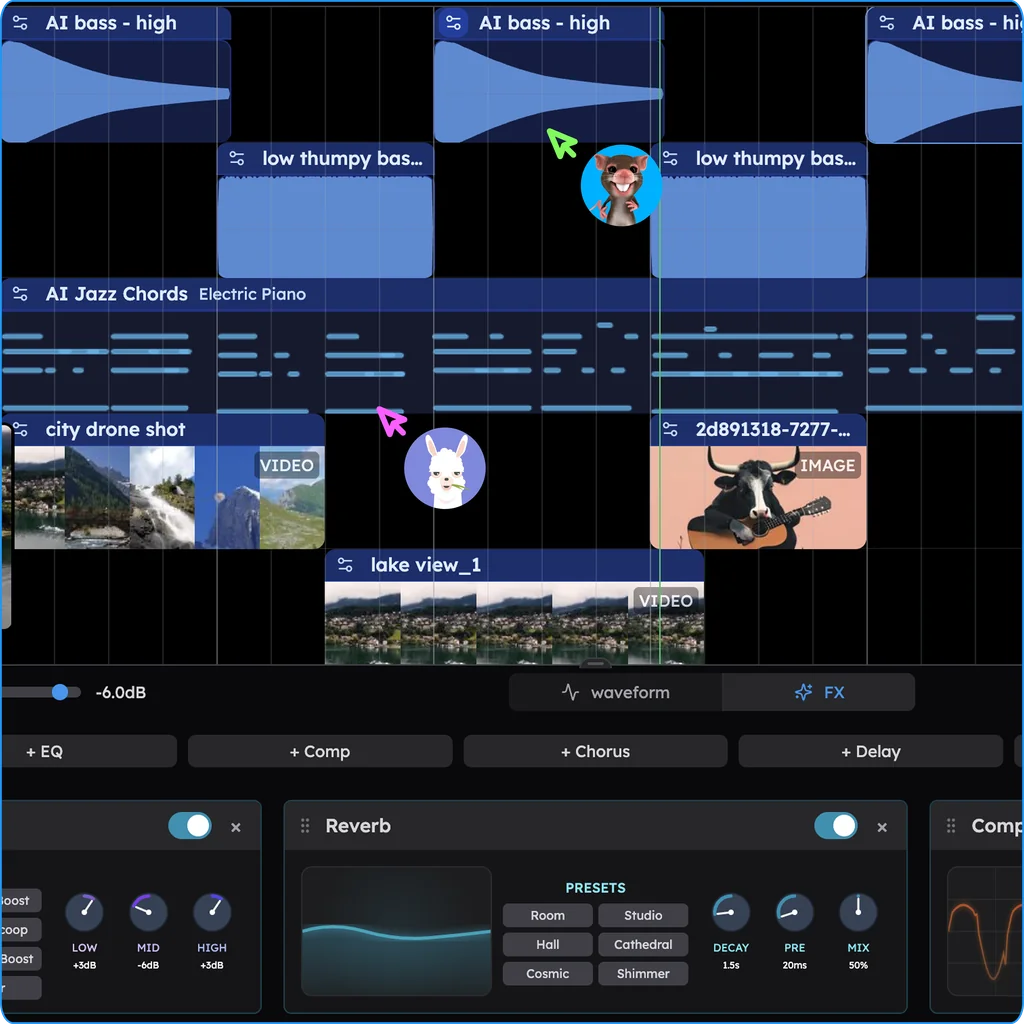
Worship teams and church bands rarely work alone. Invite your music director or singers into the project with a link and build the arrangement together, live, with a shared CoProducer chat for everyone and a private one for you. There is more on that workflow in our guide to the best AI tools for worship teams.
Gospel song structure maps
A gospel ballad at 68 BPM:
| Section | Bars | What happens |
|---|---|---|
| Intro | 4 | Piano alone, ending on a walk-up |
| Verse 1 | 8 | Piano, bass and soft triplet hats under the lead |
| Chorus | 8 | Choir enters in three parts, organ swells, drums open up |
| Verse 2 | 8 | Busier bass, a counter-line on the organ |
| Chorus | 8 | Full band and choir |
| Bridge | 8 | New chords, a 7-3-6 chain, a drum build |
| Vamp | 16 | A two- or four-bar phrase repeated; lead and choir trade lines |
| Vamp, up a half step | 8 | Everything moves from Ab to A, and the room goes up with it |
| Ending | 4 | A held chord, a drum roll and one final hit |
That is 72 bars, about 4 minutes 14 seconds. The vamp is gospel's engine: repeat, build, and "step up" a half step when the energy peaks, sometimes twice.
A contemporary worship song at 72 BPM runs longer and builds more slowly: intro 8 (pad and delayed guitar), verse 16, chorus 8, verse 16, chorus 8, then a bridge of 8 bars played four times (pad and voice, then bass and toms, then full drums, then everything), a final chorus of 16 and an 8-bar tag back down to the pad. That is 112 bars, just over six minutes.
Make gospel music in Veena, from the first chord
Start a project at daw.veena.studio, with Google sign-in and nothing to install, and give CoProducer this:
Make a 68 BPM gospel ballad in Ab major, 4/4 with a triplet 12/8 feel: Acoustic Grand Piano playing 9th and 13th chords with a walk-up into every chorus (Ab–Ab/C–Db–D°7–Ab/Eb–F7–Bbm7–Eb7); Electric Bass (finger) following the piano's left hand, with runs between phrases; live drums with triplet hi-hats, a snare on 2 and 4 and big fills into each section; a Warm Pad under the choruses and a Vox Pad for a choir-like bed. Intro 4 bars, verse 8, chorus 8, verse 8, chorus 8, bridge 8, vamp 16, the vamp again for 8 bars a half step up in A, ending 4 on a held chord.
CoProducer sets the tempo and key, maps the nine sections and writes the piano first where the other parts depend on its chords, then the bass against the piano you chose. You pick from three options for each part. In Veena's own data, 78.9% of new users whose first request asks for gospel get a first result on day one.
Refine it like a music director:
- "Replace the chorus chords with a 7-3-6-2-5-1 into Ab on the last two bars."
- "Add gospel chops at the end of every four bars, but keep them out from under the vocal."
- "Swap the drums to the JCLive kit and add handclaps on 2 and 4 in the vamp."
- "Make the vamp step up a half step twice: Ab, then A, then Bb."
- "Turn the bridge into a worship build: pad only, then bass and toms, then full drums."
Then record your voices. The lead first, then the choir parts, each on its own track, with a one- or two-bar count-in.
The gospel production chain
Gospel mixes are big but dynamic. A soft verse and a vamp that shakes the room are the point, so don't squash them flat.
- Piano: warm and centred. If the piano, organ, pad and bass pile up at 200–400 Hz, dip the piano there on the 8-Band EQ and lift a touch of 2–3 kHz for clarity.
- Organ: lower its low shelf so the bass owns the bottom; let the mids carry.
- Bass: 4:1 compression evens out the runs. Keep 60–100 Hz for weight and add a little around 800 Hz so the runs read.
- Drums: a bright snare, a Room or Studio reverb, crashes wide.
- Lead vocal: the Compressor's Vocals preset (3:1, 20 ms attack) and a Plate reverb.
- Choir: a Hall reverb, with the three parts spread left, centre and right.
- Worship pads: the Wide reverb, or Cathedral for long swells, with the delay guitar panned off-centre.
Then ask CoProducer for "a big, warm gospel mix: piano and lead vocal up front, choir wide, bass solid, dynamics kept, mastered for streaming", and ride the faders from there.
Common gospel mistakes
- Plain triads. Without ninths and thirteenths it sounds like pop with a choir on top.
- A root-only bass. Gospel bass answers the piano. Give it runs and octaves.
- A vamp that stands still. Repeat, build, then step up a half step.
- Chops everywhere. Fills belong between phrases; under the vocal they are clutter.
- Low-mid mud. Piano, organ, pad and bass all live at 200–400 Hz. Carve space.
- A busy worship band. Congregations sing along. Leave the melody room.
Gospel terms
2-5-1: the ii–V–I cadence. 7-3-6: the viiø–III7–vi chain that leads into it. Walk-up: a chord-by-chord climb into a new section. Vamp: a short phrase repeated while the song builds. Step up: modulating up a half step. Chops: fast fills between phrases. Shout, or praise break: a fast, driving instrumental section. Call and response: lead and choir trading lines. Drawbars: the Hammond's tone sliders. Leslie: the rotating speaker that makes the organ swirl. Tag: a repeated closing line.
Gospel styles to try
- Traditional gospel: Hammond, shuffle, claps and a big choir.
- Contemporary gospel: tighter pocket, electric piano and slap bass, stacked vocals.
- Southern gospel: piano-led, quartet harmonies, a country accent.
- Praise and worship: pads, delayed guitars and long builds.
- Gospel soul and R&B: the same chords at a slower burn; see how to make soul music and how to make R&B.
Pick a key, name the feel and let CoProducer lay down the band. More styles, from cinematic to house, are a click away: make music by genre.
Try this in Veena
Make a 68 BPM gospel ballad in Ab major, 4/4 with a triplet 12/8 feel: Acoustic Grand Piano playing 9th and 13th chords with a walk-up into every chorus (Ab–Ab/C–Db–D°7–Ab/Eb–F7–Bbm7–Eb7); Electric Bass (finger) following the piano's left hand, with runs between phrases; live drums with triplet hi-hats, a snare on 2 and 4 and big fills into each section; a Warm Pad under the choruses and a Vox Pad for a choir-like bed. Intro 4 bars, verse 8, chorus 8, verse 8, chorus 8, bridge 8, vamp 16, the vamp again for 8 bars a half step up in A, ending 4 on a held chord.
Frequently asked questions
Can I make gospel music online for free?
Yes. Veena is an AI DAW with a personal music producer built in. Describe the song you want and CoProducer builds it with you — beats, chords, melody, arrangement and mix — as real tracks you can edit, mix and export. Free, in your browser. For gospel, CoProducer writes the piano, bass, drums and pads as separate tracks, with room for the voices you record.
What chords are used in gospel music?
Gospel keys stack extensions: major ninths, dominant thirteenths, minor elevenths. The core moves are the 2-5-1, the 7-3-6 chain that leads into it, the walk-up I–I/3–IV–#iv°7–I/5, and the minor plagal ending IV–iv–I. Ask Veena's CoProducer for any of them in your key and they land as MIDI you can revoice chord by chord.
Can Veena make a gospel choir?
Veena builds everything around the choir, and the choir is yours. CoProducer writes the piano, bass, drums and pads; you record the lead and the soprano, alto and tenor parts from your mic on their own tracks, or bring your singers into the project with an invite link. A Vox Pad under the real voices adds a soft, choir-like bed.
Can our worship team build a song together in Veena?
Yes. Real-time collaboration is on every Veena plan: invite your team with a link, see each other's cursors live and share one CoProducer chat for the arrangement. When the song is ready, export every track as stems for rehearsal, in WAV or MP3, as often as you like, with no watermark.
What BPM is gospel music?
Gospel ballads sit around 60–76 BPM, usually with a triplet 12/8 feel; mid-tempo praise songs around 90–110; a praise break runs fast, often past 140. Contemporary worship ballads sit near 68–76 BPM and anthems near 120–140. Name the tempo and the feel in your first message and Veena's CoProducer sets the project to match.
Meet your personal music producer
Free, in your browser. Describe the song you want and CoProducer builds it with you.
Make music free