Make Drill Beats
Make drill beats with a personal music producer who knows exactly where the 808 slides. Free in your browser, CoProducer programs the half-time drums, skippy triplet hats, gliding 808 and dark melody in Veena, each a real track with every note editable. Drill lives at 140–145 BPM, with the snare on beat 3.
Drill started in Chicago, was rebuilt in London around sliding 808s and off-balance snares, and crossed back to New York harder and bouncier. Every version shares one chassis: a tense half-time groove, an 808 that moves like a second melody, and minor-key loops that sound like a cold night. Build the chassis right and any style of drill sits on top of it.
Drill in one table
| Element | What drill does | Your starting point in Veena |
|---|---|---|
| Tempo | 138–145 BPM, felt in half-time | 142 BPM |
| Keys | Minor, often with a major V from harmonic minor or a flat second | C# minor |
| Drums | Snare on beat 3, sparse syncopated kicks, skippy hats with triplet rolls | The Electronic kit |
| 808 | Gliding between notes, following the kick, jumping octaves | 808 Glide |
| Melody | Eerie 2-bar loops: plucked strings, high piano, bells, choir | Pizzicato Strings, Acoustic Grand Piano, Bell Pluck |
| Space | The upper mids kept clear for the vocal | A small EQ dip near 2.5 kHz on the melody |
The drums: half-time with a lurch
At 142 BPM the snare hits once a bar, on beat 3, so the groove feels like 71 BPM while the hats run at full speed. Here is one bar on a 16th grid, a common starting point:
Beat    1 e & a 2 e & a 3 e & a 4 e & a
Hats    x . . x . . x . x . . x . . x .
Snare   . . . . . . . . X . . . . . . .
Kick    X . . . . . . . . . X . . . . .
The hats are grouped 3-3-2, 3-3-2 instead of running straight 16ths, which gives drill its skip. Now make it lurch. In the second bar of each pair, add a snare on the very last 16th, the "a" of 4, so the phrase stumbles into the next downbeat. Move one kick off the grid you expect, to the "and" of 1 or the "e" of 4, where it answers the 808 rather than doubling it. Every second or fourth bar, swap the hats on beat 4 for a 16th-note triplet roll: six hits across one beat. In Veena, ask CoProducer for "a 16th-note triplet hat roll on beat 4 every second bar, swelling in velocity" and keep the take whose roll swells into the next bar.
The Electronic kit is Veena's pick for drill, with TR909 as a harder alternative. The drill drum pattern page writes out more variations hit by hit, and CoProducer's AI drum generator programs any of them when you describe the pattern in words.
Sliding 808s: the part that makes it drill
The 808 in drill is not a bass note under the kick. It is a second melody that happens to live at 35–70 Hz. It follows the kick most of the time, then breaks away and glides: up an octave into the hook, down a fifth at the end of a phrase, a semitone up and back for menace.
The glide comes from overlapping notes on a mono 808. In Veena, 808 Glide is built for this: when the next note starts before the previous one has ended, the pitch slides 150 ms between them instead of retriggering. Overlap the notes by a 16th in the piano roll and you hear the slide; leave a gap and you hear two separate hits. Turn the preset's GLIDE knob up (it goes to 400 ms) for the slow, syrupy slides of the darkest beats. 808 Hard is the alternative when the 808 has to punch through a busy beat, and Sub Bass, a pure sine, suits the rare track that wants weight with no growl at all.
A typical two-bar line in C# minor: C#1 on beat 1 held for a beat and a half, a short C#1 on the "and" of 3 with the kick, then an overlapping G#1 that slides up from it; in bar 2, back down to C#1, and on the last beat an overlapping C#2 that glides up an octave into the next phrase. The trap 808 bassline page covers the neighbouring style's 808 writing in more depth.
Dark melodies in minor keys
Drill melodies are short, repetitive and a little unsettling. A 2-bar loop, often played in a high register, repeats across the whole beat while the drums and 808 do the moving.
- Keys: C#, F, G and A minor are common. Borrow the major V from harmonic minor (G# major in C# minor) for tension, or lean on the flat second (D over C#) for outright menace.
- Chords: i–VI (C#m–A) for a two-chord loop; i–VI–iv–V (C#m–A–F#m–G#) for more movement; a single minor chord held for eight bars is also pure drill.
- Sounds: Pizzicato Strings for staccato ostinatos, the Acoustic Grand Piano played sparse and high, Bell Pluck for a music-box counter-line, Snap Pluck for tight 16th hooks, and Dark Pad or the Vox Pad choir underneath for dread. Cello and Violin carry the long, cinematic notes.
- Rhythm: leave rests. A melody with gaps lets the 808 answer it.
Ask the chord progression generator for "a harmonic-minor drill loop in C# minor" and the loop arrives as MIDI on its own track.
Make drill beats with CoProducer
- Sign in with Google at daw.veena.studio. No download, no graphics card: any modern browser on Mac, Windows, Linux or Chromebook runs it.
- Paste the prompt:
Make a 142 BPM UK drill beat in C# minor: half-time drums on the Electronic kit with the snare on beat 3 of every bar, an extra syncopated snare at the end of every second bar, sparse kicks that answer the 808 and skippy hi-hats with 16th-note triplet rolls; a sliding 808 Glide bassline that follows the kick and glides up an octave into every hook; a dark 2-bar Pizzicato Strings loop over C#m–A–F#m–G# with sparse high Acoustic Grand Piano notes and a Bell Pluck counter-melody; leave the upper mids open for my vocal. Intro 8 bars with the melody alone, hook 16, verse 16, hook 16, verse 16, hook 16, outro 8, with a one-bar drum dropout before every hook.
- Watch the order. CoProducer plans the sections, then builds what can be built together. The 808 is written against the kick pattern actually on the timeline, so it follows the drums you kept, not the ones you skipped.
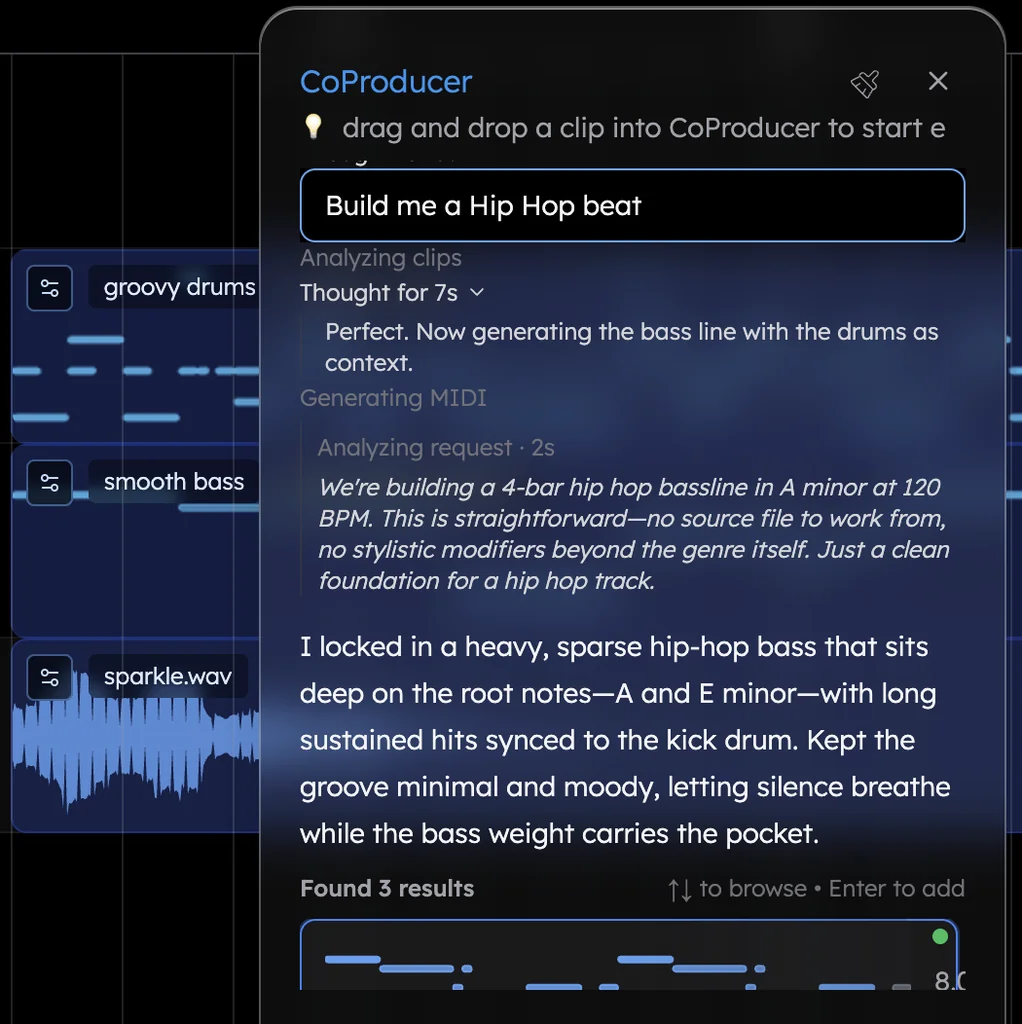
- Pick from three. Every new part arrives as three options; audition them in the carousel and press Enter on the one you want.
- Push it. Type what you want changed; if you don't like the result, one Ctrl/Cmd+Z takes it back.
Describe the beat, not a rapper. In Veena's own data, only about 3% of typed requests mention an artist at all, and 81.5% of new users who name a genre in that first request walk away with a finished first result on day one.
Next moves:
- "Make the 808 slides longer and slide down to G# at the end of every fourth bar."
- "Give the hats more triplet rolls in the hooks and keep the verses sparser."
- "Swap the 808 to 808 Hard and make the kicks bounce more, New York style."
- "Add a Vox Pad choir under the hooks only."
- "Make the second verse 24 bars and strip its first 4 bars to 808 and hats."
A beat map built for a rapper
| Section | Bars | What the beat does |
|---|---|---|
| Intro | 8 | Melody alone, then hats; room for a producer tag |
| Hook | 16 | Full drums, 808 slides, counter-melody |
| Verse 1 | 16 | Melody thinned, 808 and hats carry it, one dropout in bar 8 |
| Hook | 16 | Back to full; a new hat roll pattern |
| Verse 2 | 16 | Change the drums: a new kick pattern or a stripped first 4 bars |
| Hook | 16 | Everything, choir pad added |
| Outro | 8 | Drums out, melody and a last 808 slide |
That is 96 bars: about 2 minutes 42 seconds at 142 BPM. Drill verses are usually 16 bars, but some vocalists want 24 or 32; tell CoProducer and it rebuilds the map. The one-bar dropouts matter: a bar with no drums before a hook makes the return hit twice as hard.
The mix chain
- 808 first. It owns everything below about 100 Hz. Keep it mono and free of chorus, and use its DRIVE knob so the 808 survives small speakers.
- Kick against 808. When they land together, keep the kick short or drop it on long 808 notes. Two long low sounds on the same beat turn into mud.
- Snare and clap: the Reverb effect's Room preset, a tail under a second, Mix around 20%.
- Hats: a small cut on the 8-Band EQ's high shelf if they bite, and velocity variation so the grid breathes.
- Melody: cut its lows with the low shelf so it stays out of the 808's way, add the Hall reverb, and dip 2–3 dB around 2.5 kHz to leave a pocket for the vocal.
- Glue: run the drum clip through the Compressor with its Drums preset.
Or give CoProducer the brief, "a dark drill mix, 808 and kick clear, crisp hats, space for vocals", and it balances every part for you.
Drill mistakes
- Slides that don't slide. The notes must overlap. A gap of even a 16th means two hits, not a glide.
- Straight 16th hats. That is trap. Group the hats 3-3-2 and add triplet rolls.
- Snare on 2 and 4. At 142 BPM that is a sprint. Drill's snare lands on beat 3.
- Kick and 808 fighting. Pick one to own each hit.
- A busy melody. The rapper needs room. Loop two bars and leave rests.
- An 808 that slides off the key. Slide between notes of the scale, usually the root, fifth, minor third and octave.
Terms producers use
Slide or glide: the 808's pitch bending from one note to the next. Half-time: the snare once a bar, on beat 3. Skippy hats: hi-hats grouped in threes and twos instead of straight. Triplet roll: three or six evenly spaced hits squeezed into one beat. Dropout: a bar with the drums muted before a section. Pocket: the space in the beat where the vocal sits.
UK, NY, Chicago and beyond
- UK drill: 140–142 BPM, the most syncopated snares, sliding 808s, strings and piano.
- New York drill: the same chassis with heavier, bouncier 808s and harder drums.
- Chicago drill: the original; sparser, darker and closer to trap beats.
- Melodic drill: piano, guitar or R&B chords under sung hooks; the drums stay drill.
- Sample-based drill: a melodic loop flipped into the beat. In Veena, flip your own recording, or a loop from the licensed sample catalogue, and CoProducer builds the drums and 808 around it.
- Drill in other languages: Spanish, French and Dutch scenes rap over the same chassis. About 1 in 5 new Veena users type their first request in something other than English, and CoProducer takes the request in their language.
Whichever you choose, the first message has the same shape: the tempo, the key, the kit and how the 808 should move. The other genres are listed on make music by genre.
Try this in Veena
Make a 142 BPM UK drill beat in C# minor: half-time drums on the Electronic kit with the snare on beat 3 of every bar, an extra syncopated snare at the end of every second bar, sparse kicks that answer the 808 and skippy hi-hats with 16th-note triplet rolls; a sliding 808 Glide bassline that follows the kick and glides up an octave into every hook; a dark 2-bar Pizzicato Strings loop over C#m–A–F#m–G# with sparse high Acoustic Grand Piano notes and a Bell Pluck counter-melody; leave the upper mids open for my vocal. Intro 8 bars with the melody alone, hook 16, verse 16, hook 16, verse 16, hook 16, outro 8, with a one-bar drum dropout before every hook.
Frequently asked questions
Can I make drill beats for free?
Yes. Veena is an AI DAW with a personal music producer built in. Describe the song you want and CoProducer builds it with you — beats, chords, melody, arrangement and mix — as real tracks you can edit, mix and export. Free, in your browser. For drill: half-time drums, a gliding 808 and a dark melody that you can reprogram, re-voice or export as separate stems.
What BPM are drill beats?
Most drill sits between 138 and 145 BPM, felt in half-time, so the snare lands once a bar on beat 3. Around 140–142 is the UK sweet spot, and New York drill runs about the same or a touch faster. Type the tempo into your request to Veena's CoProducer, or just say "drill" and it chooses a drill tempo for the new project.
How do you make 808s slide in drill?
Use a mono 808 and overlap the notes. In Veena, 808 Glide is built for exactly this: start the next note before the previous one ends and the pitch slides 150 ms between them, and its GLIDE knob stretches the slide up to 400 ms. Ask CoProducer for "808 slides up an octave into the hook" and it writes the overlaps for you.
What is the difference between UK drill and NY drill?
UK drill is colder and more syncopated: sliding 808s, skippy hats and snares that land just off where you expect them, around 140–142 BPM. New York drill took that chassis and hit harder, with bigger, bouncier 808s and more aggressive drums at similar tempos. In Veena, name the style in your prompt and CoProducer shapes the drums and the 808 to match.
Do I own the drill beats I make in Veena?
Yes. Veena's terms say you own the Output you generate through your use of the Service, and there is no watermark on your exports. Export the full beat or every track as stems in WAV (24-bit/48 kHz) or MP3, plus the MIDI, as often as you like, on the free plan as well as on Veena Pro.
Meet your personal music producer
Free, in your browser. Describe the song you want and CoProducer builds it with you.
Make music free