Make Arabic Music
To make Arabic music, choose a maqam (a mode such as hijaz, with its wide step between the second and third notes), a rhythm cycle such as maqsum played on darbuka, and let the melody lead. Free and in your browser, Veena is the AI DAW where your personal music producer, CoProducer, plays strings, bass and percussion as real tracks.
Arabic music thinks horizontally. Where Western pop stacks chords, an Arabic song follows one melody through a maqam, ornamented by every instrument that plays it, over a rhythm cycle the darbuka keeps turning. Harmony is light or absent. The drama comes from where the melody travels, and when it comes home.
Maqam: the melodic system
A maqam is built from ajnas (singular jins): small groups of three to five notes, each with its own colour. Stack two ajnas and you have the scale; add the habits of the maqam (where the melody rests, which note it pivots on, how it cadences) and you have the mode. The pivot note, called the ghammaz, is where the second jins starts: G in hijaz on D.
Six maqamat sit on the twelve semitones, so they play perfectly as MIDI:
| Maqam | Notes | Colour | Where you hear it |
|---|---|---|---|
| Hijaz | D Eb F# G A Bb C | The wide Eb–F# step: longing, desert tension | Pop hooks, religious song, film cues |
| Kurd | D Eb F G A Bb C | Dark and plaintive | Ballads and modern pop |
| Nahawand | C D Eb F G Ab B | Romantic, close to harmonic minor | Love songs, string lines |
| Nikriz | C D Eb F# G A Bb | Restless, a hijaz step in the middle | Dance tunes |
| Ajam | Bb C D Eb F G A | Bright and major | Festive songs, weddings |
| Hijaz kar | C Db E F G Ab B | Two hijaz steps: dramatic and exotic | Dance and film music |
Then there are the maqamat with quarter tones. Rast (C D E-half-flat F G A B-half-flat) is called the mother of the maqamat; bayati (D E-half-flat F G A Bb C) is the everyday sound of Arabic song; saba bends a flattened fourth into it for grief. The half-flat E sits between Eb and E. MIDI notes, in any DAW, sit on the twelve equal semitones, so producers record quarter-tone lines as audio: a voice, a violin, an oud, a ney. Everything else, the bass, the percussion and the unison strings on shared notes, can stay MIDI.
When modern Arabic pop does add chords, it keeps them few. In hijaz on D, the tonic D major, the bII chord Eb and the iv chord Gm do most of the work, often over a held D. Ask CoProducer for "hijaz on D with a D pedal" rather than a chord progression.
Iqa': rhythm cycles on the darbuka
The darbuka (called tabla in Egypt) speaks in three strokes. Dum is the deep centre stroke. Tek is the sharp rim stroke with the strong hand. Ka is the same rim stroke with the other hand, used to fill the gaps. A rhythm cycle, an iqa', is a fixed pattern of dums and teks that players decorate endlessly.
The four you need, in 8th notes across one bar of 4/4:
Maqsum  1 & 2 & 3 & 4 &
        D T . T D . T .
Baladi  1 & 2 & 3 & 4 &
        D D . T D . T .
Saidi   1 & 2 & 3 & 4 &
        D T . D D . T .
Maqsum is the default of Egyptian and Levantine pop. Baladi doubles the opening dum, which makes it heavier and earthier. Saidi, from Upper Egypt, moves the double dum to the middle of the bar and pairs with the reedy mizmar. Malfuf is a fast 2/4 cycle, three plus three plus two, used for entrances and exits:
Malfuf  1 e & a 2 e & a
        D . . T . . T .
In Veena, dums go on the kick or the low floor tom and teks on the side stick, with softer side-stick hits for the kas. Then ask CoProducer's sample search for darbuka and riq loops in the same rhythm and choose from ten preview cards; a real player's ornaments on top of the programmed skeleton sound right. The AI drum generator writes a cycle when you name it. Pop on maqsum sits roughly between 90 and 125 BPM; baladi often drops lower, and malfuf runs fast.
The instruments and their Veena voices
| Instrument | Its job | In Veena |
|---|---|---|
| Oud | The fretless lute: melody, taqsim, rhythmic strumming | Your recording, oud loops, or Acoustic Guitar (nylon) for semitone lines |
| Qanun | The plucked zither: fast runs and tremolo | Qanun loops, or Pizzicato Strings for plucked ostinatos |
| Ney | The end-blown reed flute: breathy, spiritual | Soft Lead, a breathy, almost flute-like synth |
| Violin | The lead voice of Egyptian orchestras | Violin |
| String section | Unison lines and sweeping answers | String Ensemble, with Cello and Contrabass below |
| Darbuka and riq | The rhythm cycle and its shimmer | Kick, floor tom and side stick, plus loops |
| Mizmar | The nasal reed of saidi | Reso Lead, a nasal, voice-like synth |
| Bass | Weight under modern pop | Fretless Bass for a soft, vocal tone, or Round Bass |
The classic Egyptian sound is a big string section playing the melody in unison, answering the singer. Give String Ensemble the line, double it an octave down on Cello, and let a solo Violin decorate over the top.
Humming a melody into the track
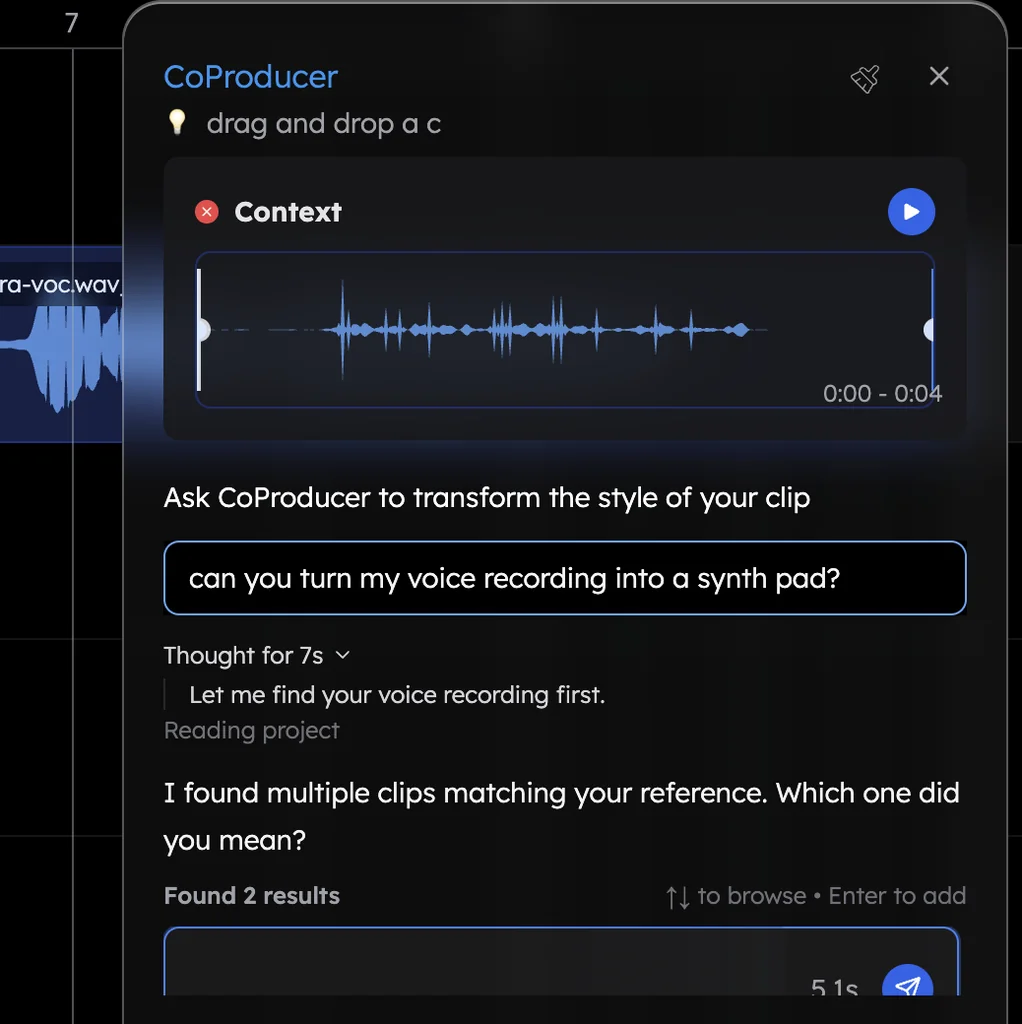
The fastest way to get a maqam melody into Veena is to sing it. Hum the line into your mic and ask CoProducer to transcribe it to MIDI: it places an editable part on a new track, and you fix any note in the piano roll, which matters in hijaz, where the Eb and F# are the whole point. Or use voice to instrument to turn the hum into a violin or a ney-like lead; that transform tunes the take to the project key first, so it suits kurd best. Kurd on D shares its notes with G minor, so set the project to G minor and every note lands.
Arabic song form, with bar counts
Classic Egyptian songs open with an instrumental muqaddima, answer each sung phrase with a short instrumental lazma, and circle back to a refrain, the madhhab. A taqsim, a free improvisation that explores the maqam before the rhythm starts, often comes first. At 100 BPM on maqsum:
| Section | Bars | What happens |
|---|---|---|
| Intro | 8 | A free violin or oud line over a held low D, before the drums |
| Muqaddima | 16 | The strings state the theme in unison on the full maqsum |
| Verse | 16 | Voice over darbuka and bass; a two-bar lazma after each line |
| Chorus | 16 | The madhhab: strings double the vocal melody |
| Lazma | 8 | The instrumental answer phrase, extended |
| Verse | 16 | Riq loop added, the bass busier |
| Chorus | 16 | Everyone, with the strings at full width |
| Outro | 8 | The qafla: a cadence that brings the melody home to D |
That is 104 bars, about 4 minutes 10 seconds. For the free intro, record the violin or oud as audio before the first drum hit, or let CoProducer write a slow, held line over the pedal note.
Make Arabic music with CoProducer
In a new project at daw.veena.studio, after signing in with Google, paste this into the CoProducer panel:
Make a 100 BPM Arabic song in D, maqam hijaz (D Eb F# G A Bb C), in 4/4 on a maqsum rhythm: dums on the kick and low floor tom, teks on the side stick, with darbuka and riq loops from the sample search on top; a Fretless Bass line doubling the dums; String Ensemble playing the melody in unison with a Violin leading; Acoustic Guitar (nylon) answering each vocal line with a two-bar lazma; a free-feeling Violin intro over a held low D. Intro 8 bars, muqaddima 16, verse 16, chorus 16, lazma 8, verse 16, chorus 16, outro 8 ending on D.
Spelling out the maqam's notes matters: it tells CoProducer exactly which Eb and F# to use. It sets the tempo, maps the eight sections, writes the percussion skeleton and bass as MIDI, searches for the darbuka and riq loops, then writes the strings and the lazma against the parts you picked from its three options. In Veena's own data, 81.1% of new users whose first request asks for Arabic or Middle Eastern music get a first result on day one.
Then take it further:
- "Switch the second verse to a baladi rhythm, then back to maqsum for the chorus."
- "Add an 8-bar saidi section with the double dum in the middle and a Reso Lead playing a mizmar-style riff."
- "Give the lazma to Pizzicato Strings as a fast, qanun-style run."
- "Move the second verse into kurd on D, then return to hijaz for the chorus." Changing maqam mid-song is how Arabic melodies travel.
- "Double the string melody an octave down on Cello in the last chorus."
Then record the voice, and any quarter-tone line, from your mic onto its own track.
The Arabic production chain
The Arabic sound is warm and spacious: tarab, the emotional lift the music is built to create, needs air around the strings and the voice.
- Strings: a Hall reverb, generous. On the 8-Band EQ, soften harshness around 3 kHz on the violins and keep the section wide.
- Darbuka: bright and upfront, with only a Room reverb. The dum's weight sits around 80–120 Hz; the tek's snap around 4–6 kHz.
- Bass: round, under the dums, never above them.
- Voice: the Compressor's Vocals preset, a Plate reverb and a short slap delay. Keep Auto-Tune off quarter-tone takes.
- Panning: darbuka and voice in the centre, riq slightly off, strings wide, oud or nylon guitar opposite the qanun.
- Mahraganat: the opposite world: hard Auto-Tune on the vocal (Style set to hard; kurd with the key set to G minor locks perfectly), the Distortion effect's Crunch preset on a Reso Lead hook, and a loud, dry beat.
Then ask CoProducer for "a warm, wide Arabic pop mix: strings lush, darbuka crisp and centred, voice on top, mastered for streaming."
Common mistakes
- A Western backbeat. A snare on 2 and 4 over an Arabic melody fights the iqa'. Let the dums and teks carry the rhythm.
- A plain minor scale instead of hijaz. Without the Eb–F# step, the colour disappears.
- Chords everywhere. A busy progression buries the maqam. Use a pedal note and a few chords.
- Quantized ornaments. Darbuka rolls and violin turns lose their life on a rigid grid.
- Auto-Tune on quarter tones. It pulls the half-flat notes to the nearest semitone.
- No qafla. Arabic phrases resolve home with a cadence; a melody that just stops sounds unfinished.
Arabic music terms
Maqam: a melodic mode. Jins: a three-to-five-note building block of a maqam. Ghammaz: the pivot note where the second jins begins. Qarar: the home note. Iqa': a rhythm cycle. Dum, tek, ka: the darbuka's low stroke and two rim strokes. Taqsim: a free instrumental improvisation. Muqaddima: an instrumental introduction. Lazma: a short instrumental answer between sung lines. Madhhab: the refrain of a classic Egyptian song. Mawwal: a free, unmetered vocal improvisation. Qafla: a cadence. Tarab: the emotional ecstasy the music aims for. Takht: the small classical ensemble of oud, qanun, ney, violin and riq.
Styles to explore
- Egyptian pop and shaabi: maqsum, big unison strings, street-party energy.
- Mahraganat: Egyptian electro-shaabi, fast, loud and hard-tuned.
- Khaleeji: Gulf pop with a lilting groove carried by handclaps; clap loops come from the sample search.
- Levantine dabke: a driving line-dance rhythm on a big drum, with a reedy lead; Reso Lead covers the reed.
- Raï: Algerian pop built on drum machines and synths.
- Bollywood: another melody-first film tradition; see how to make Bollywood music.
- Film scoring: maqam colours under picture; see how to make cinematic music.
Every style here starts with a maqam, a rhythm and a sentence to CoProducer. To leave the region entirely, make music by genre.
Try this in Veena
Make a 100 BPM Arabic song in D, maqam hijaz (D Eb F# G A Bb C), in 4/4 on a maqsum rhythm: dums on the kick and low floor tom, teks on the side stick, with darbuka and riq loops from the sample search on top; a Fretless Bass line doubling the dums; String Ensemble playing the melody in unison with a Violin leading; Acoustic Guitar (nylon) answering each vocal line with a two-bar lazma; a free-feeling Violin intro over a held low D. Intro 8 bars, muqaddima 16, verse 16, chorus 16, lazma 8, verse 16, chorus 16, outro 8 ending on D.
Frequently asked questions
Can I make Arabic music online for free?
Yes. Veena is an AI DAW with a personal music producer built in. Describe the song you want and CoProducer builds it with you — beats, chords, melody, arrangement and mix — as real tracks you can edit, mix and export. Free, in your browser. For Arabic music, that means strings, bass and darbuka-style percussion on separate tracks, built on the maqam and the rhythm you name.
What is a maqam in Arabic music?
A maqam is a melodic mode: a scale built from small note groups called ajnas, plus a way of moving through it, with a home note, a pivot note and typical phrases. Hijaz, kurd, nahawand, rast and bayati are among the most used. Name a maqam built on semitones, such as hijaz or kurd, and Veena's CoProducer writes the melody and strings on its notes.
What is the maqsum rhythm?
Maqsum is the most common rhythm cycle in Egyptian and Levantine pop: one bar of 4/4 played dum, tek, rest, tek, dum, rest, tek, rest, where dum is the darbuka's deep centre stroke and tek its sharp rim stroke. Ask Veena's CoProducer for a maqsum and it places the dums low and the teks on the side stick, with real darbuka loops on top.
How do I get quarter tones into an Arabic track?
Record them. Veena records your voice, violin, oud or ney from your microphone straight onto the timeline, quarter tones intact, and CoProducer builds the rhythm section and strings around your take. Keep the Auto-Tune effect off those takes, because it corrects to a major or minor scale, and let the MIDI parts sit on the notes the maqam shares with the piano.
What instruments are used in Arabic music?
Oud, qanun, ney, violin and a string section carry the melody; darbuka, riq and frame drums carry the rhythm. In Veena, Violin, String Ensemble, Cello, Contrabass and Acoustic Guitar (nylon) cover strings and plucked lines, Soft Lead gives a breathy, ney-like tone, and CoProducer's sample search brings in real oud, qanun and darbuka recordings.
Meet your personal music producer
Free, in your browser. Describe the song you want and CoProducer builds it with you.
Make music free