Make Afrobeats
Make afrobeats online with a personal producer who starts where the genre starts: the groove. Free in your browser, Veena's CoProducer builds the bouncing 3-3-2 kick, the rimshots, the shakers, a highlife guitar and a bass locked to the kick as real tracks, with space left for your voice on top.
Afrobeats, not Afrobeat
Afrobeats, with an s, is the West African pop that grew out of Nigeria and Ghana from the 2000s on: highlife guitar and melody, hip-hop and dancehall drums, R&B vocals and percussion from everywhere in between. Afrobeat, without the s, is the older, longer, horn-driven 1970s sound built on funk and jazz. This page makes the first. Both live on rhythm, and in afrobeats the groove carries the song: the chords barely move, the drums never stop, and the hook repeats until a whole room is singing it.
The bounce: kick, rim and shaker
Here is one bar on a 16th-note grid. X is a hit, x a softer one:
Beat      1 e & a 2 e & a 3 e & a 4 e & a
Kick      X . . . . . X . . . . . X . . .
Rim       . . . X . . . . . . X . . . . .
Shaker    x x X x x x X x x x X x x x X x
The kick plays the 3-3-2: three 8th notes, three more, then two, so it lands on 1, the "and" of 2, and 4. The rimshots skip between the kicks, on the last 16th of beat 1 and the "and" of 3. The shaker never stops, leaning on the offbeats. That's the bounce, and it's why afrobeats feels like it's pushing forward even at 100 BPM.
It shares a family tree with reggaeton's dembow, but the dembow repeats its figure every half bar over a pounding four-on-the-floor kick; afrobeats spreads the 3-3-2 across the whole bar and leaves beat 3 open. Compare the two in make reggaeton, and see the afrobeats drum pattern for more variations.
Veena's Beat Maker, the step sequencer for drum clips, holds the skeleton on a straight 16-step grid, and afrobeats is never quite straight. The fix is a recorded shaker or percussion loop from Veena's sample library laid over the kit: a real player's shaker carries the swing, and the programmed kick and rim keep the skeleton tight. Once CoProducer has placed the drums, "put the drums on the Electronic kit" changes the sound and leaves the pattern alone. The AI drum generator writes the bounce and its variations on its own.
Percussion: layers at different speeds
Afrobeats gets its depth from hand percussion stacked at different subdivisions, so the layers interlock instead of doubling each other:
- Shaker in 16ths, the constant motion under everything.
- Congas in syncopated 8ths, answering the kick.
- Talking drum as a fill at the end of every 4 or 8 bars, or as a call that the hook answers.
- Claps on the backbeat of the hook only, so the hook lifts.
- A bell or cowbell pattern for a highlife or older Afrobeat colour.
Ask CoProducer for "a conga loop at 106 BPM" or "a talking drum fill": it searches Veena's sample library and returns 10 cards to preview before anything lands on the timeline. Your own percussion recordings load onto the 16-pad sampler.
Bass and the log drum
The afrobeats bass is simple on purpose: round, warm, mostly on the kick, with a note or two pushing into the next bar. Veena's Round Bass is the warm synth bass for exactly that, Electric Bass (finger) gives a live afro-fusion feel, and Sub Bass holds the bottom under a sparse afro-R&B groove.
The log drum came from South African amapiano and now turns up across afrobeats: a deep, hollow, pitched hit that slides between notes and plays the bass line and the rhythm at once. Veena's Log Drum Bass preset is made for it; it runs on Veena's own synth, so CoProducer can adjust any setting on it. Give the log drum syncopated figures between the kicks and let one low sound own each moment; the amapiano log drum page writes out the patterns.
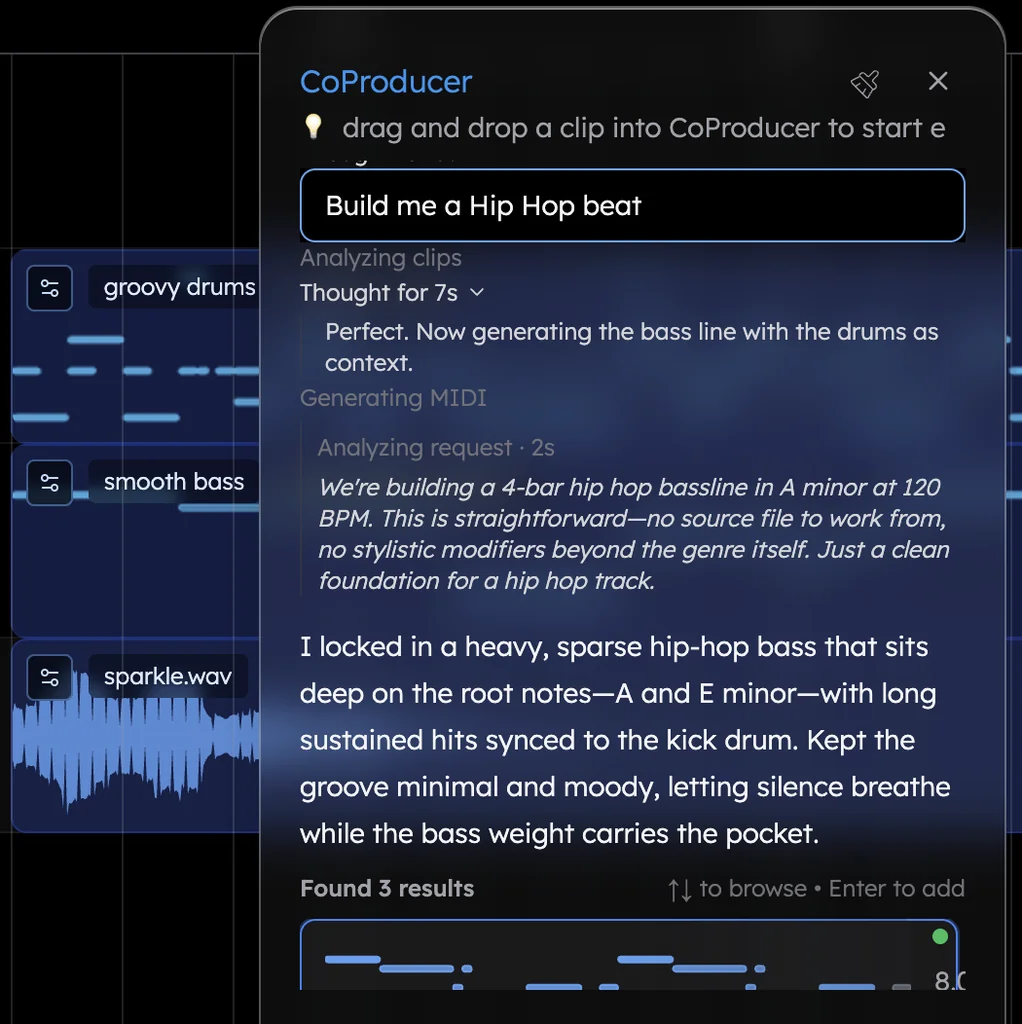
CoProducer writes the bass with the drums already in view: once you've picked a drum part, it reads where every kick landed before it writes a note, so the bass moves with the kick instead of against it.
Guitar, keys and the hook
- Electric Guitar (clean): the highlife guitar. Bright, picked 16th-note riffs, often in thirds or sixths, repeating every bar or two and interlocking with the percussion like another drum.
- Electric Guitar (muted): the short palm-muted chop of afropop rhythm parts.
- Electric Piano: chord stabs on the offbeats, or long held chords for an amapiano or afro-R&B feel.
- Sine Pluck and Bell Pluck: a soft, kalimba-like pluck and a chiming bell, for the 2-bar hook that keeps coming back.
- Soft Lead: a round, flute-like tone for a breathy topline.
- Saxophone: hum the hook into your mic and tell CoProducer to turn the humming into a saxophone. The take is tuned to the song's key and comes back as a sax part in seconds; voice to instrument shows the whole flow.
Afrobeats melodies repeat. A 2-bar motif that returns every time, with one small change the third time round, beats a long line nobody can remember.
Chords: short loops, long grooves
Afrobeats harmony is a loop of two or four chords under the whole song; the groove, the hook and the voice carry the variety. Four loops in the key of the prompt and its neighbours:
| Loop | Numbers | Chords | Feel |
|---|---|---|---|
| The warm four | vi – IV – I – V in Bb | Gm7 – Ebmaj7 – Bb – F | Bittersweet and danceable: the prompt's loop |
| The sway | I – IV | Bb – Eb | Party records that ride one groove |
| Sunny highlife | I – IV – V – IV | F – Bb – C – Bb | Bright afropop and highlife |
| Afro-R&B | ii7 – V7 – Imaj7 | Cm7 – F7 – Bbmaj7 | Slow, smooth afro-fusion |
Keep the voicings open and let the guitar riff and the Electric Piano stabs imply the chords rather than pounding them out on every beat.
An afrobeats song map
| Section | Bars | What happens |
|---|---|---|
| Intro | 8 | The guitar riff and the shaker, a hint of the hook |
| Verse 1 | 16 | The full bounce, bass locked to the kick, keys light |
| Pre-hook | 4 | The rim drops out and the kick thins, pulling toward the hook |
| Hook | 8 | Everything in, the pluck hook on top, claps on the backbeat |
| Verse 2 | 16 | One new layer: a conga loop |
| Pre-hook | 4 | As before |
| Hook | 8 | As before |
| Bridge | 8 | Drums thinned to kick and shaker, the guitar alone on top |
| Hook | 16 | Twice through, a talking drum fill into the second pass |
| Outro | 8 | Groove and guitar ride out |
That's 96 bars, about 3 minutes 37 seconds at 106 BPM. The beat never changes character between sections; afrobeats builds and releases by adding and removing layers over one groove.
Mixing afrobeats: dry drums, warm middle
- Drums dry and short. The Compressor's Drums preset, and little or no reverb. A rim or clap sample pitched up a few semitones with pitch shift cuts through a busy groove.
- Percussion spread wide. Shaker and congas on opposite sides, with their lows trimmed by the 8-Band EQ's low shelf.
- One low sound at a time. Bass or log drum owns the bottom, in mono: a Utility with Mono switched on. Ask CoProducer to "duck the bass under the kick" and the low end stays clean.
- Guitar with a tempo echo. A Delay on its Quarter preset, synced to the song, placed off-centre.
- The vocal on top. The Compressor's Vocals preset, a Plate reverb, and Auto-Tune set to the song's key in hard style for the tuned sound so many afrobeats records use.
- The finish. Set the balance on the faders, with the fixed limiter on Veena's master catching only the peaks, then ask CoProducer to "mix it bright and bouncy: dry drums, bass centred, guitar and shaker wide, vocal on top".
Afrobeats mistakes
- A dembow or trap beat. A four-on-the-floor kick with a reggaeton snare, or rolling trap hats, isn't afrobeats. Start from the 3-3-2.
- A busy bass. Keep it on the kick and simple; the percussion does the talking.
- Every layer on the same subdivision. Shaker in 16ths, congas in 8ths, talking drum as fills.
- Wet drums. Reverb blurs the bounce. Keep the drums dry and close.
- Too many chords. A two- or four-chord loop is the genre; changes belong in the melody and arrangement.
- A hook that never repeats. The 2-bar motif should come back until everyone knows it.
Make afrobeats with CoProducer
- Open daw.veena.studio and sign in with Google. It runs in the browser and the AI runs on Veena's servers, so a Chromebook keeps up as well as a studio Mac.
- Paste the prompt. It builds the 96-bar song map above:
Make a 106 BPM afrobeats song in G minor: kick on 1, the and of 2 and 4; rimshots on the last 16th of beat 1 and the and of 3; closed hats playing a steady 16th-note shaker rhythm with the offbeats accented; a shaker loop from the sample library over the whole groove; Round Bass locked to the kick; Electric Guitar (clean) picking a bright highlife riff in 16ths; Electric Piano stabbing the chords on the offbeats; a Sine Pluck hook that repeats every 2 bars. Chords loop Gm7–Ebmaj7–Bb–F, one bar each. Intro 8 bars, verse 16, pre-hook 4, hook 8, verse 16, pre-hook 4, hook 8, bridge 8 with the drums thinned to kick and shaker, hook 16, outro 8. Leave space for my vocal.
- Choose the groove first. Every new part arrives as three options. Pick the drum take with the best bounce; the bass and the guitar wait for that choice and are written against it.
- Then shape it in plain words:
- "Put the drums on the Electronic kit."
- "Add a conga loop from the sample library to the second verse."
- "Swap the Round Bass for Log Drum Bass in the hooks."
- "Make the hook pluck a Bell Pluck and add a talking drum fill before each hook."
- "Make it amapiano: 113 BPM, Log Drum Bass carrying the bass line, long Electric Piano chords and a shaker that never stops."
- Record your vocal over the groove, then hum any sax or flute line you want added and let CoProducer re-voice it.
- Export a 320 kbps MP3 to share or a 24-bit/48 kHz WAV for release, or send each track as a stem to your engineer, as often as you like and with no watermark. The music is yours.
Afrobeats words
Afrobeats: West African pop from the 2000s on. Afrobeat: the 1970s horn-and-funk sound it is often confused with. 3-3-2: a bar split into three, three and two 8th notes, the heart of the kick pattern. Rimshot: a crisp stick hit on the snare's rim, the main accent of the groove. Log drum: amapiano's pitched, sliding bass hit. Highlife: the Ghanaian and Nigerian guitar music at the genre's root. Talking drum: an hourglass drum whose pitch the player bends by squeezing it. Pre-hook: the short lift into the hook.
The afrobeats family
- Party afrobeats and afropop: 100–112 BPM, the bounce above, bright plucks and a hook built for a crowd.
- Afro-fusion and afro-R&B: 90–105 BPM, slower and smoother, with Electric Piano sevenths and a softer kit.
- Amapiano: about 110–118 BPM, the log drum as the lead, a shaker that never stops, long piano chords and slow builds.
- Afro house: 118–124 BPM on a four-on-the-floor kick, with conga and shaker loops rolling over it.
- Highlife: the root: bright interlocking guitars and horn lines over a light, swinging groove.
Every other style, from the reggaeton next door to the R&B that afro-fusion borrows from, is under make music by genre.
Try this in Veena
Make a 106 BPM afrobeats song in G minor: kick on 1, the and of 2 and 4; rimshots on the last 16th of beat 1 and the and of 3; closed hats playing a steady 16th-note shaker rhythm with the offbeats accented; a shaker loop from the sample library over the whole groove; Round Bass locked to the kick; Electric Guitar (clean) picking a bright highlife riff in 16ths; Electric Piano stabbing the chords on the offbeats; a Sine Pluck hook that repeats every 2 bars. Chords loop Gm7–Ebmaj7–Bb–F, one bar each. Intro 8 bars, verse 16, pre-hook 4, hook 8, verse 16, pre-hook 4, hook 8, bridge 8 with the drums thinned to kick and shaker, hook 16, outro 8. Leave space for my vocal.
Frequently asked questions
Can I make afrobeats online for free?
Yes. Veena is an AI DAW with a personal music producer built in. Describe the song you want and CoProducer builds it with you — beats, chords, melody, arrangement and mix — as real tracks you can edit, mix and export. Free, in your browser. For afrobeats, that means the kick-and-rim bounce, shakers, a bass locked to the kick, a highlife guitar and a hook on separate tracks.
What BPM is afrobeats?
Most afrobeats sits between 95 and 115 BPM: party records push toward 105–112, slower afro-R&B drops to around 90–100, and amapiano runs about 110–118. Ask Veena's CoProducer for afrobeats without naming a tempo and it proposes 110; name your own, such as "106 BPM afrobeats in G minor", and it builds every part to that.
What is a log drum?
The log drum is the deep, hollow, pitched bass hit that slides between notes, born in South African amapiano and now heard all over afrobeats. It plays the bass line and the rhythm at once. Veena's built-in synth has a Log Drum Bass preset, and CoProducer writes log drum lines in your key as MIDI you can edit note by note.
Does Veena have afrobeats sounds?
Yes: Log Drum Bass, Round Bass and Electric Bass (finger), clean and muted electric guitars for highlife riffs, Electric Piano, and plucks such as Sine Pluck and Bell Pluck for hooks. Shakers, congas and talking drum come from CoProducer's sample search, and you can hum a sax line and have CoProducer turn your humming into a saxophone.
Can I make an afrobeats song with my own vocals?
Yes. CoProducer builds every instrumental part around your own voice, and you record the vocal in Veena from your microphone with a count-in and latency calibration. Record a rough take first and CoProducer reads its tempo and where your syllables land, so the groove and the hook follow your phrasing. Auto-Tune in the song's key, hard style, gives the tuned afrobeats vocal.
Meet your personal music producer
Free, in your browser. Describe the song you want and CoProducer builds it with you.
Make music free