How to Change One Instrument in a Suno Song
To change one instrument in a Suno song you need paid stems and Premier's Studio. In Veena, free, a part keeps its notes and changes its sound in one step.
To change one instrument in a Suno song, you first have to get that instrument out of the mix: Suno outputs every song as "one audio file containing all music and words" (Suno's help centre, September 2026), and pulling one part out takes a paid plan. Veena, the free AI DAW with a personal music producer, builds each part as its own track, so a part keeps its notes and changes its sound in one step.
Veena is an AI DAW with a personal music producer built in. Describe the song you want and CoProducer builds it with you — beats, chords, melody, arrangement and mix — as real tracks you can edit, mix and export. Free, in your browser.
Two kinds of part, two kinds of swap
Every part in a production is one of two things, and the swap works differently for each.
- A MIDI part is notes plus a sound. The notes say what to play and when; the instrument decides what it sounds like. Change the instrument and the performance stays exactly as written. This is how CoProducer writes drums, bass, chords and melody in Veena.
- An audio part is the sound itself. A recorded guitar or a generated song is a waveform, with the notes and the tone baked together. To change the instrument you either re-voice the audio or turn it back into notes first.
A Suno song is the second kind, all the way down: one waveform with every instrument and the voice inside it. That's why a simple request, "same song, but a Rhodes instead of the guitar", turns into a project on Suno.
How to change one instrument in a Suno song, on Suno
Here is the route Suno's own pages describe (help centre and pricing page, read 23 September 2026), and what each step costs:
- Pull the instrument out. Split from Mix "lets you extract a single instrument or vocal from your song", and you also get "everything except the extracted stem". It needs Pro ($10 a month) or Premier ($30 a month) and costs 10 credits a stem, 20 for the pair. Advanced Split, which lets you choose from "nearly 100 instruments", is Premier-only. The free plan has no stem separation.
- Remake its sound in Suno Studio. Studio is where you "Drag an audio clip onto a MIDI track to transcribe it into notes" and "Generate an audio 'cover' of your MIDI via the chat/generation system". Studio is included only in Premier, $30 a month or $288 a year.
- Accept Studio's instrument rack. Suno says Studio "is not compatible with VST or Audio Units plugins", so the plug-in piano or synth you already own can't play the new part.
- Or re-style the whole song. Cover, on Pro and Premier, can "transform the style of an existing song while keeping the melody", which changes every instrument at once, not one.
Swapping one instrument's sound inside Suno's studio starts at $30 a month, plus the credits for the split.
Changing one instrument: Veena vs Suno (September 2026)
Suno facts come from Suno's pricing page and help centre, read on 23 September 2026.
| Veena | Suno | |
|---|---|---|
| Price to change one instrument | Free | Stems from Pro, $10 a month; Studio needs Premier, $30 a month |
| A part the AI wrote | Its own MIDI track, notes and sound kept apart | Mixed into one audio file |
| Swap the sound, keep the notes | Say it to CoProducer, or pick a preset; one step | Split the stem, then transcribe it inside Studio, Premier only |
| Pull one instrument out of a mixed song | Four stems free, or ask CoProducer to isolate one | Split from Mix, 10 credits a stem, Pro and Premier |
| Your own plug-ins | VST3 on Mac and Windows, AU on Mac, through Veena Bridge | "Not compatible with VST or Audio Units plugins" |
| Sounds to choose from | 61 melodic presets, 7 drum kits, a 16-pad sampler and your plug-ins | Studio's built-in instruments |
Change one instrument in Veena: three recipes
A part CoProducer wrote: keep the notes, change the sound
Build the song from a sentence, like the indie pop prompt at the end of this page, and every part arrives on its own track. To change one:
- Say it. "Put the hook on Bell Pluck", "swap the Acoustic Guitar (steel) for the Acoustic Guitar (nylon)", "put the drums on the TR909 kit". CoProducer changes the instrument and leaves every note where it is.
- Or pick it. Double-click the clip, open its Instrument tab and choose a shelf and a preset. Swap while the loop plays and hear each option in context.
- Or use your own. Install the Veena Bridge helper app once and your instrument plug-ins are ready to load. Ask for them by name, "play the lead on my Serum", and CoProducer starts from a real preset instead of a blank patch.
A part you recorded: turn it into notes, or into a new texture
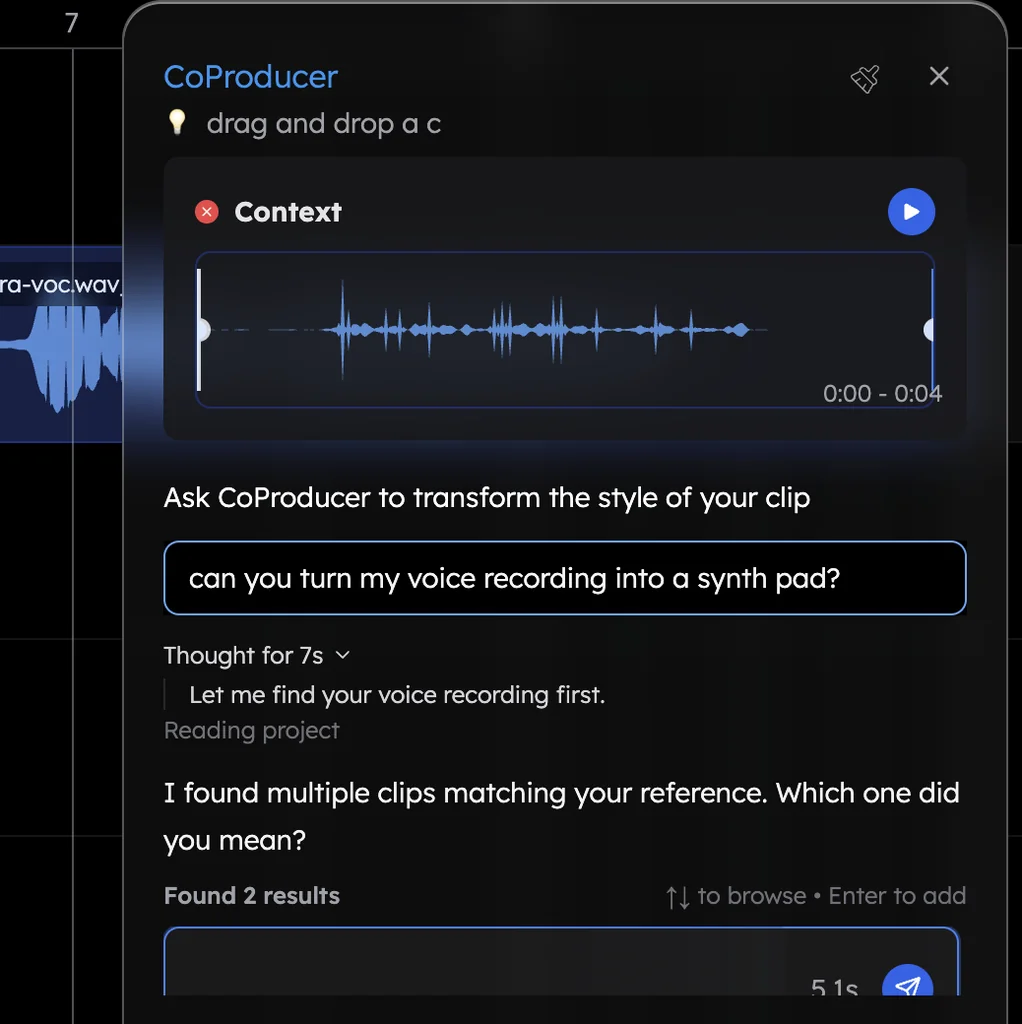
Drop in your guitar take, a voice memo or a demo and drag the clip into the CoProducer panel as context. Then choose what the new instrument needs:
- The same performance on a new instrument. Ask CoProducer to "transcribe this guitar to MIDI and play it on Electric Piano". The notes land on a new track where you played them, and the piano roll lets you fix any one of them.
- A new colour under the song. Ask for "a warm synth pad from this guitar" or "turn my humming into a string texture". CoProducer re-voices the recording's pitch and harmony as the new sound, places it on its own track and mutes the original, so you can compare the two and keep whichever serves the song.
A part inside a mixed song: split it, then transcribe or rewrite it
For a finished mix you own, including a song you downloaded before leaving Suno, split first: right-click the clip and choose Separate into Stems. Vocals, drums, bass and other arrive on four time-aligned tracks, free.
- The bass: ask CoProducer to transcribe the bass stem to MIDI and put it on Reese Bass. You get the same line, as notes you can edit, on any of 29 bass presets.
- The drums: mute the drums stem and ask for a new part on the Brush kit at the song's tempo, or keep the stem and layer a TR909 kick under it.
- A guitar or the keys: they share the other stem with synths and strings, so the clean move is a new part. Mute the other stem and have CoProducer write a fresh Electric Piano part in the song's key, on its own track.
Sounds to swap to (as of September 2026)
| Shelf | Presets | A few names |
|---|---|---|
| Piano | 3 | Acoustic Grand Piano, Electric Piano, Upright Piano |
| Guitar | 6 | Acoustic Guitar (nylon), Electric Guitar (clean), Overdriven Guitar |
| Bass + 808s | 29 | Fretless Bass, Round Bass, Reese Bass, six 808s from 808 Long to 808 Distorted |
| Strings | 6 | Cello, String Ensemble, Pizzicato Strings |
| Synth | 17 | Supersaw Lead, Soft Lead, Bright Pluck, Warm Pad, Glass Pad |
| Drums | 7 kits | Pop, Chaos, JCLive, Brush, Electronic, TR909, Jazz |
That's 61 melodic presets, 39 of them on Veena's own synth with macro knobs, plus a 16-pad sampler for your own sounds. Piano and keys, guitar and synth are among the instruments new users name most often in their first request to CoProducer, in Veena's own data, and every one of them has a shelf here.
In Veena, changing one instrument is a sentence, not a subscription. Leave Suno, keep producing in Veena: start the next song from a prompt, and every part will be yours to re-voice.
Need the split on its own? The free stem splitter puts four stems on your timeline. To change notes rather than sounds, read how to edit one part of a Suno song; to turn a hum into an instrument, see voice to instrument; and for the full switch, the Suno alternative guide lays out every step.
Related reading: Suno stems bad? · Plug-ins through Veena Bridge · Veena vs Suno
Try this in Veena
Make a 118 BPM indie pop song in A major: punchy drums on the Pop kit, an Electric Bass (pick) line, Acoustic Guitar (steel) strums, a Bright Pluck hook and a String Ensemble lift in the last chorus. Verse 8, pre-chorus 4, chorus 8, verse 8, pre-chorus 4, chorus 8, bridge 8, chorus 8.
Frequently asked questions
Can you change one instrument in a Suno song?
Not with one click. Suno outputs a song as one audio file, so its route to a single instrument runs through Split from Mix, which needs Pro or Premier and costs 10 credits a stem, and then Suno Studio, which is Premier-only at $30 a month. In Veena, every part is its own track: a MIDI part keeps its notes and changes its sound, free.
Will changing the instrument change my notes in Veena?
No. In Veena a MIDI part is notes plus a sound, and a swap only touches the sound. Ask CoProducer to "put the chords on Warm Pad", or pick another preset in the clip's Instrument tab, and every pitch, length and velocity stays where it was. One Ctrl/Cmd+Z brings the old sound back if you change your mind.
Can I use my own plug-in as the new instrument?
Yes. Veena loads your own VST3 plug-ins on Mac and Windows, and Audio Units on Mac, through the free Veena Bridge helper app. Tell CoProducer "play the lead on my Serum" and it starts from a real preset. Suno Studio, by Suno's own help page, "is not compatible with VST or Audio Units plugins", so your synths stay outside it.
Can Veena turn a recorded guitar into a piano?
Yes. Ask CoProducer to transcribe the guitar to MIDI and play the notes on one of Veena's 61 presets, such as Electric Piano or Acoustic Grand Piano, where every note stays editable and in place. For a softer layer, CoProducer can also re-voice the recording itself as a pad or texture. In a mixed song, split the stems first: guitars and keys share Veena's other stem.
Meet your personal music producer
Free, in your browser. Describe the song you want and CoProducer builds it with you.
Make music free