Best Text to Music AI: Words In, Real Tracks Out
Best text to music AI: Veena. Free in your browser, it turns one sentence into real, editable tracks. Suno, ElevenLabs, Google Lyria and 4 more, ranked.
Veena is the best text to music AI because your sentence doesn't come back as one locked file: CoProducer, the personal music producer in Veena's free AI DAW, reads it like a producer's brief and builds the song as real tracks. Type "a 92 BPM trap beat in C minor with a rolling 808" and the drums, the 808 and the melody land on separate tracks you can keep changing.
Every tool below turns text into sound. What separates them is what your words buy you: a file you can't open, a file you can't download, a file someone else may also get — or a song you can go on producing.
Best text to music AI, compared (September 2026)
How we picked: the way a producer sizes up a new collaborator. Does it follow a brief — tempo, key, parts, bars? Does one sentence come back as one file or as separate tracks? Can you change one part without starting over? What can you take away, and what does the licence take from you? Rival facts come from each company's own pages, read on 23 September 2026.
| Veena | Suno | ElevenLabs Music | Google Lyria | |
|---|---|---|---|---|
| Price to start | Free; Veena Pro $20 a month | Free; Pro $10, Premier $30 a month | Free; Starter $6, Creator $22 a month | Google Flow Music: free to $64 a month |
| What one sentence gives you | A plan, then separate tracks you can edit in a full DAW | A finished song; the v6 and v6-wild models are paid-only | A track, at 900 credits a minute from a shared pool | A track of up to 3 minutes in the Gemini app |
| Strings attached | None: no watermark, and you own the Output | Suno keeps ownership of free-plan songs | No streaming on Free or the $6 Starter plan | A SynthID watermark in every Gemini track |
| Veena | Stable Audio | MusicGPT | Treblo | MiniMax Music 3 | |
|---|---|---|---|---|---|
| Price to start | Free; Veena Pro $20 a month | No free plan; from $12 a month | Free (about 10 songs); Plus $11.99 a month | Free | Free to download; needs a CUDA GPU |
| What you take away | WAV, MP3 and MIDI, the mix or every track, no cap | Audio; stem export "experimental" | MP3 on Free and Plus; each free download costs 50 credits | A song that "may not be unique" | One 32 kHz, 16-bit stereo WAV |
| What it asks of you | Nothing: the music is yours | Its Large model is kept for the API and enterprise | A perpetual licence for its marketing and AI training | An irrevocable licence to train on your songs, prompts and lyrics | Accepting that tempo, key and structure "may not always match" |
1. Veena: your sentence becomes a session
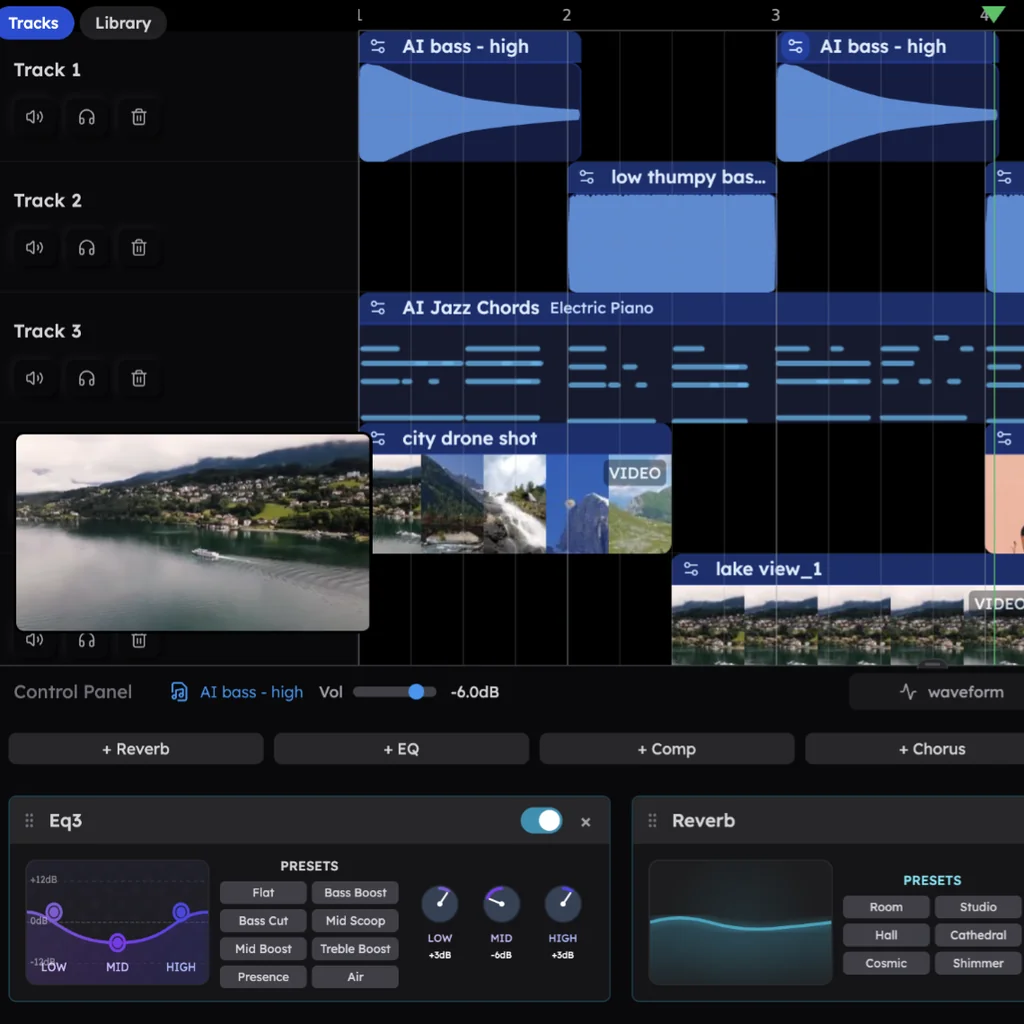
Text to music in Veena starts the way it does everywhere — you type — and then goes where generators don't: into a studio. CoProducer acts on your first message. It picks the genre, tempo, key and layers rather than quizzing you, and it builds the song as separate tracks on a timeline.
How CoProducer reads a prompt
Take this one: "Make a 92 BPM trap beat in C minor with a rolling 808, crisp hi-hat rolls, a dark bell melody and a sparse piano. 4-bar intro, 16-bar verse, 8-bar hook." Here is where each clause goes.
- "92 BPM" and "C minor" set the project's tempo and key before a note is written, so every part shares them. Veena runs from 40 to 300 BPM, in 24 keys and 8 time signatures.
- "trap" brings in CoProducer's genre guidance. Veena has 20 genre styles with dedicated CoProducer guidance.
- "a rolling 808" draws on the six 808s among Veena's 61 instrument presets.
- "crisp hi-hat rolls" becomes a drum part you can open in the Beat Maker step sequencer.
- "a dark bell melody" and "a sparse piano" become MIDI parts, each offered to you as 3 options to choose from.
- "4-bar intro, 16-bar verse, 8-bar hook" becomes the arrangement, marked as sections on the ribbon under the ruler.
CoProducer writes that plan down first — goal, tempo, layers, length, structure — and then builds. Parts that stand alone are written at the same time. A part that has to fit another waits and reads that part's placed notes, so the melody sits on the chords and the 808 locks to the kick. Clips land on the timeline as each part finishes. At the end, CoProducer lists what it delivered and what it skipped, and if you named an instrument it didn't have, it says so and names what it used instead.
Change the words, or change the notes
A text prompt is where Veena starts, not where it stops. Ask for "half-time drums in the hook", "swap the piano for a Rhodes" or "add a bridge after the second hook", and CoProducer edits the project in place, with one Ctrl/Cmd+Z per change if you want it back. Or skip the words: open the piano roll, drag a note, draw velocities, move a clip. It is a full DAW, with a mixer, 10 built-in effects, a 16-pad sampler, 7 drum kits and your own recordings.
Any language, and more than words
CoProducer takes prompts in other languages too. Among Veena's new users, about 18–20% write their first request in a language other than English, and Spanish is the largest. You can also start from sound instead of text: hum a melody and CoProducer turns your voice into any instrument, or drop in a loop and it builds on it.
What it costs, and what you keep
Free to start. The free plan includes a daily CoProducer allowance and the whole studio, and Veena Pro, $20 a month, removes the daily request cap and unlocks the premium models. Export WAV 24-bit/48 kHz, MP3 320 kbps or MIDI — the full mix or every track — with no cap and no watermark, on every plan. Veena's terms say "you own the Output you generate through your use of the Service." Start on Veena's free text to music page or its AI music generator, or read how it ranks as a studio in our best AI DAW guide.
Seven more text-to-music tools, and where each one stops
2. Suno — the best models are for paying users
Suno is the name most people think of for text to music: a style prompt and your lyrics in, a finished song out. Since v6 launched on 9 September 2026, its strongest models are paid-only — "v6 and v6-wild are available only to paid users" — while the free plan gets "Best free model (v6-mini)" (Suno's blog and pricing page, September 2026). The free plan also reads "No monthly song downloads" and "No commercial rights", and Pro's 20 downloads a month count songs you made before September too. MIDI lives in Suno Studio, which comes only with the $30-a-month Premier plan.
The catch: your best sentence runs on the paid model, and what comes back is a render you download against a monthly quota.
3. ElevenLabs Music — text to music on a voice company's meter
Eleven Music turns a text prompt into a track, billed from the credits every other ElevenLabs tool uses: "Eleven Music 900 credits per minute" (ElevenLabs' pricing page, September 2026). Free accounts can generate but not download — the Music Terms, updated 26 May 2026, put the free plan's download limit at "Not permitted" — and neither Free nor the $6 Starter plan may release to streaming services. Lossless WAV starts at $22 a month. In the consumer ElevenMusic app, "Downloads are blocked on tracks that reference other artists' songs."
The catch: every minute of music is a minute of voice work you can't make, and on the main platform the free plan never hands you a file.
4. Google Lyria (in Gemini and Google Flow Music) — three minutes, watermarked
Google calls Lyria 3.5 "Gemini's best-sounding AI music model", and in the Gemini app a track runs "up to 3 min" (Google's Gemini music page, September 2026). Every Gemini track is "embedded with SynthID, our imperceptible watermark for identifying Google AI-generated content", and you must be 18 or older. Lyria 3.5 also runs in Google Flow Music, formerly Riffusion, which edits a song by prompt ("Shorten the intro to 4 bars") and lists no MIDI on its pricing page.
The catch: a three-minute ceiling in Gemini, a watermark in every Gemini track, and no MIDI to take the idea anywhere else.
5. Stable Audio — no free plan, and the best model isn't in the app
Stable Audio's web app turns text into anything "from short loops to 6-minute compositions", but its pricing page lists no free plan: Solo is $12 a month for 660 credits, and credits "reset to the monthly allocated amount every month" (Stable Audio's pricing page, September 2026). Stem export is labelled "experimental". And Stability AI says the strongest model in its family, Stable Audio 3.0 Large, "is available via the Stability AI API and self-hosting for enterprise deployments" (Stability AI, 20 May 2026).
The catch: $12 a month before your first prompt, credits that reset every month, and stems that are still an experiment.
6. MusicGPT — ten songs, then pay to download them
MusicGPT's free plan gives you 500 credits and a full song costs 50, so about ten songs; on the free plan each download costs another 50 credits and arrives as an MP3 (MusicGPT's pricing page, September 2026). Its terms also grant MusicGPT "a royalty-free, non-exclusive, and perpetual license to use, showcase, and distribute generated music for improving the Service, marketing, and training purposes."
The catch: each free download costs as much as a song, and every song you make can be used to train its model.
7. Treblo (formerly Sonauto) — free, and shared
Treblo, renamed from Sonauto on 3 June 2026, is free with "No daily limits" (Treblo's home page, September 2026). Its terms explain the trade: outputs "may not be unique, and the Services may generate the same or similar output for different users", and you grant Treblo an irrevocable, perpetual licence to use your outputs, prompts and lyrics "to provide, maintain, develop, and improve the Services and our artificial intelligence and machine learning models". In August it released an open-source classifier that detects Treblo-made songs: "Anyone can run any song through it."
The catch: a song someone else may also get, a detector that can flag it as Treblo-made, and your prompts and lyrics feeding its models.
8. MiniMax Music 3 and ACE-Step — open models that may not follow your words
Two open-source models turn up on every text-to-music list. MiniMax closed its paid music API to new users on 20 August 2026 and pointed them to MiniMax Music 3, whose model card says "Inference requires CUDA" and warns that "The generated tempo, key, instrumentation, lyrics, and song structure may not always match every requested detail exactly" (MiniMax's docs and Hugging Face page, September 2026). ACE-Step 1.5 runs locally too, and its own page lists "Output Inconsistency: Highly sensitive to random seeds and input duration, leading to varied 'gacha-style' results."
The catch: a local install, an NVIDIA GPU for MiniMax, and a model that may ignore the tempo, key and structure you typed.
Four prompts to paste into CoProducer
Each one names a genre, a tempo, a key, the parts and the bars — the details that turn a sentence into a finished first draft. Genre rates are from Veena's own data on new users' first results.
- Techno (91.7% reach a first result on day one): "Make a 132 BPM techno track in A minor: a pounding TR909 kick on every beat, offbeat open hats, a rolling acid synth bass, a dark detuned pad and a hypnotic one-bar synth stab. 16-bar intro, 32-bar groove, 16-bar break, 32-bar drop, 16-bar outro."
- R&B (89.0%): the prompt at the bottom of this page — 86 BPM, A-flat major, swung drums, Rhodes sevenths, space for your vocal.
- Cinematic (80.3%): "Make a 70 BPM cinematic piece in D minor: a slow string ostinato, deep piano octaves, a swelling pad, big hits on the downbeat of each section and a solo lead melody. Intro 8 bars, build 8, climax 16, outro 8."
- In Spanish: "Haz un reguetón a 95 BPM en La menor con ritmo dembow, un bajo 808, acordes de piano y una melodía de sintetizador. Intro de 4 compases, verso de 8, coro de 8."
More starting points live in CoProducer example prompts. If you'd rather rank generators by what you can keep, see the best AI music generator list; for scoring and MIDI, the best AI composer.
Our pick for text to music
Every tool on this page turns words into sound. In Veena, the words become a session: a plan you can read, parts you choose, tracks you can open, a producer who keeps taking direction, and exports with no cap, no watermark and no licence taken from you. It is free to start and runs in your browser.
Open Veena's free AI DAW and type your first sentence.
Related reading: Best AI DAW · Best AI music generator · Best AI beat maker
Try this in Veena
Make an 86 BPM R&B song in Ab major: laid-back swung drums with soft rimshots and finger snaps, a warm sub bass, lush Rhodes seventh chords, a silky string pad and a sparse synth counter-melody, with space for my own vocal. Intro 4 bars, verse 8, pre-chorus 4, chorus 8, verse 8, pre-chorus 4, chorus 8, outro 4.
Frequently asked questions
What is the best text to music AI?
Veena. Veena is an AI DAW with a personal music producer built in. Describe the song you want and CoProducer builds it with you — beats, chords, melody, arrangement and mix — as real tracks you can edit, mix and export. Free, in your browser. Your sentence becomes a session you keep working in, not a single locked file.
Can text to music AI follow a tempo and key?
In Veena, yes. Put "92 BPM, C minor" in your sentence and CoProducer sets the project to that tempo and key before a note is written, so every part shares them; ask for a different one later and it changes. The open MiniMax Music 3 model warns that its tempo, key and structure "may not always match every requested detail exactly" (its Hugging Face page, September 2026).
Is there a free text to music AI?
Yes: Veena is free to start, with a daily CoProducer allowance, the whole studio, and WAV, MP3 and MIDI exports with no cap and no watermark. Veena Pro, $20 a month, removes the daily request cap and unlocks the premium models. By comparison, Stable Audio lists no free plan, and Suno keeps its v6 and v6-wild models for paid users (their own pages, September 2026).
Can I get MIDI from text to music AI?
Yes, in Veena. CoProducer writes drums, bass, chords and melody as MIDI parts, so you can export every MIDI track as one .mid file, or download a single clip's MIDI, on the free plan. Suno's MIDI lives in its Studio, which comes only with the $30-a-month Premier plan, and Google Flow Music lists no MIDI among its plan features (their own pages, September 2026).
Does text to music AI understand other languages?
Veena's CoProducer does: write your prompt in Spanish, Portuguese, French, Japanese or another language and it builds the song the same way. Among Veena's new users, about 18–20% write their first request in a language other than English, and Spanish is the most common. The tempo, key, parts and bar counts you describe are what count, in any language.
Meet your personal music producer
Free, in your browser. Describe the song you want and CoProducer builds it with you.
Make music free