Best AI Composer: 8 Tools That Write Music You Can Edit
Best AI composer: Veena. Free in your browser, CoProducer composes and arranges every part as MIDI you can edit and own. AIVA, Muse and 5 more, ranked.
Veena is the best AI composer because it writes music as parts, not as a recording: describe a piece and CoProducer, the personal music producer in Veena's free AI DAW, composes the ostinato, the harmony and the theme as separate MIDI tracks you can re-voice and re-orchestrate. You choose each part, shape the form, and export the notes and the audio, with no cap.
Most "AI composers" hand you a finished recording, a MIDI file for somebody else's software, or a copyright they keep. A composer needs all three things at once — the notes, a place to hear them, and the rights.
What an AI composer should hand you
How we picked: the four things a working composer checks.
- The notes. Every line as MIDI you can open, re-voice and export — not a stereo file.
- The orchestration. Instruments you can reassign without rewriting the part.
- The form. Sections with bar counts you control: intro, theme, build, climax, outro.
- The rights. Music you own on the plan you're on, without a monetisation whitelist.
Every rival fact below is from that company's own site, pricing, help or licence pages, read on 23 September 2026.
1. Veena — the AI composer that writes in parts
Veena is a full AI DAW with a composer's partner built in. CoProducer plans a piece like an arranger — goal, tempo, key, layers, length, sections — and then writes it part by part onto a real timeline, where each part stays open to you.
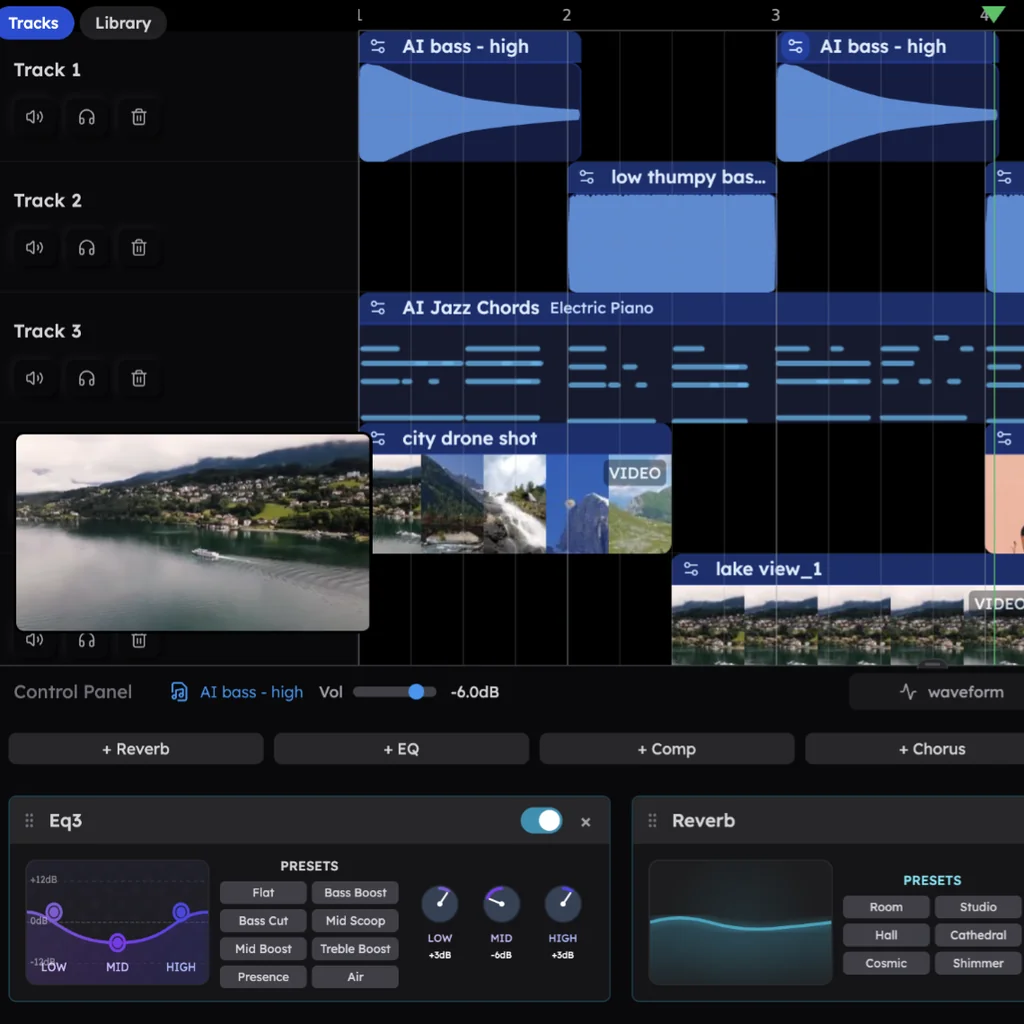
Composing a cue, step by step
- Describe the piece. "Make a 72 BPM cinematic piece in D minor, 4/4: a pulsing low-string ostinato, sustained high strings, deep piano octaves on the downbeats, a warm synth pad and a slow, lyrical lead melody that enters in bar 9. Intro 8 bars, theme 16, build 8, climax 16, outro 8." CoProducer sets the tempo and key and lays out the five sections on the ribbon under the ruler.
- Choose your material. Each new MIDI part — the ostinato, the pad, the theme — arrives as 3 options. Preview, pick, or ask for more. Nothing that depends on a part is written until you've chosen it, so the counter-line is composed against the theme you actually kept.
- Orchestrate. "Move the theme from piano to strings." "Double the ostinato an octave down on a synth bass." "Voice the chords wider in the climax." Swapping an instrument keeps the notes and changes the sound, and CoProducer can re-voice a part without touching the rest.
- Develop it. "Extend the theme by 4 bars." "Repeat the theme in the climax with variation." "Thin the texture for the outro." "Stagger the entries in the build." CoProducer can edit just the region you highlight, and every change it makes is one Ctrl/Cmd+Z from undone.
- Edit by hand. Open any part in the piano roll: draw and select notes, shape velocities, move a line up an octave with Ctrl/Cmd+Up.
- Deliver. Export every MIDI track as one .mid file, the full mix as WAV 24-bit/48 kHz or MP3 320 kbps, or every track as its own stem — as often as you like, with no watermark, on every plan.
Or start from your own theme: hum or sing it into the microphone and CoProducer transcribes it into an editable MIDI part, then composes the harmony and arrangement around it.
It composes the genres composers ask for. Cinematic is one of the most-requested genres in Veena. In Veena's own data, cinematic requests reach a finished first result on day one 80.3% of the time, ambient 87.0%, jazz 84.5% and game music 86.2%.
It's yours. Veena's terms say "you own the Output you generate through your use of the Service", on every plan.
Free to start. The free plan includes a daily CoProducer allowance and the whole studio. Veena Pro, $20 a month, removes the daily request cap and unlocks the premium models. There's nothing to install, and the AI runs on Veena's servers, so no graphics card is needed. Start from Veena's free AI composer or its AI music generator, or see it ranked as a studio in our best AI DAW roundup.
The other seven AI composers
2. AIVA — the composer that keeps your copyright
AIVA calls itself "Your personal AI music generation assistant", able to "generate new songs in more than 250 different styles, in a matter of seconds", with MP3 and MIDI downloads even on the free plan (AIVA's site and pricing page, September 2026). The rights are the problem. Free and Standard both read "Copyright owned by AIVA"; Standard, €11 a month billed annually, lets you monetise only on YouTube, Twitch, TikTok and Instagram; and the copyright becomes yours only on Pro, €33 a month billed annually. Free pieces run up to 3 minutes and Pro pieces up to 5 minutes 30 seconds. AIVA's licence adds: "No refund will be made if Licensee forgets to cancel their subscription."
Where it leaves a composer: with a MIDI file of music AIVA owns, unless you pay €396 a year plus VAT, and a length cap of five and a half minutes.
3. Muse — MIDI, and then you still need a DAW
Muse describes itself as "The AI-native MIDI composer" and "a multi-track MIDI editor with a deeply integrated AI agent" (Muse's site and pricing page, September 2026). It is open about the gap: "Muse is designed to compliment your existing DAW workflow. It is not a plugin." Free credits "refresh daily … You can expect around 5 credits a day on average", premium models are "only available to Pro users", and "Export for commercial use" is a Pro feature at $15 a month. "Muse requires an internet connection."
Where it leaves a composer: with notes but no finished sound — a second DAW and your own instruments still to come — and $15 a month to use them commercially.
4. Google Lyria — a composer that answers in audio
Google calls Lyria 3.5 "Gemini's best-sounding AI music model", and it composes audio: in the Gemini app, tracks run "up to 3 min", each "embedded with SynthID, our imperceptible watermark" (Google's Gemini music page, September 2026). In Google Flow Music, formerly Riffusion, you revise by prompt — "Shorten the intro to 4 bars" — and MIDI isn't among the plan features on its pricing page.
Where it leaves a composer: with a recording of an idea rather than the notes of it — nothing to re-voice or re-orchestrate — and a watermark in every Gemini track.
5. Suno — the song is free to hear; the notes cost $30
Suno composes complete songs from a prompt, and its MIDI lives in Suno Studio, which "is included in the Premier subscription tier" at $30 a month (Suno's help centre and pricing page, September 2026). Its own Studio help lists a known issue: "some users may experience timing issues, where new generations fall slightly in front of or behind the beat." The free plan reads "No monthly song downloads".
Where it leaves a composer: paying $30 a month to see the notes, with generated sections that may land off the grid.
6. Tracktion Waveform Pro Assistant — bring your own AI bill
Waveform Pro's Assistant will "Generate MIDI. Basslines, melodies, drum patterns, and arpeggios", but "it won't do anything until you add an API key in settings": you "Use OpenAI or Anthropic with your own API key" and "manage your own token usage and costs directly with the provider you choose" (Tracktion's site, September 2026). Tracktion is plain about the scope — "it's not a one-prompt 'make me a song' tool" — and Waveform Pro bundles start at $249, as a desktop install.
Where it leaves a composer: $249 up front, a separate pay-per-token AI account, and phrases rather than a piece.
7. Logic Pro Session Players — an accompanist, on a Mac
Logic Pro's Session Players "take your direction on the fly and lay down polished synth, bass, keyboard, and drum grooves" (Apple's Logic Pro page, September 2026). They follow the chords and direction you give them; Apple describes no composing from a text prompt. Logic needs "a Mac with Apple silicon" running macOS 15.6 or later, at $199.99 once or $12.99 a month through Apple Creator Studio.
Where it leaves a composer: with a session band rather than a composing partner, and nothing at all on Windows, Linux or a Chromebook.
8. Stable Audio — six minutes of audio to start from
Stable Audio generates audio "from short loops to 6-minute compositions", with no free plan on its pricing page — Solo is $12 a month — and splitting a piece into stems still labelled "experimental" (Stable Audio's site and pricing page, September 2026).
Where it leaves a composer: $12 a month for a rendered recording to work from, not a set of parts to re-voice.
Best AI composer: notes, rights and price compared
Veena is on the left of both tables. Rival facts are from their own pages, read on 23 September 2026.
| Veena | AIVA | Muse | Google Lyria | |
|---|---|---|---|---|
| Price to start | Free; Veena Pro $20 a month | Free; Standard €11, Pro €33 a month, billed yearly | Free (about 5 credits a day); Pro $15 a month | Google Flow Music: free to $64 a month |
| What it composes | A full piece as separate MIDI parts, arranged into sections and mixed | Pieces in 250-plus styles, as MP3 and MIDI | MIDI only, beside another DAW | Audio up to 3 minutes in Gemini; no MIDI listed in Flow Music |
| Using it commercially | Every plan: you own the Output | Pro only; AIVA owns the copyright on Free and Standard | "Export for commercial use" on Pro | Every Gemini track carries a SynthID watermark |
| Veena | Suno | Waveform Pro Assistant | Logic Pro Session Players | Stable Audio | |
|---|---|---|---|---|---|
| Price to start | Free; Veena Pro $20 a month | Free; MIDI needs Premier, $30 a month | From $249, plus your own API bill | $199.99, or $12.99 a month | No free plan; from $12 a month |
| What it composes | Every part, from a sentence or your own hummed theme | Finished songs; MIDI only in Studio | Phrases — "not a one-prompt" song tool | Grooves that follow your direction | Audio, in pieces up to 6 minutes |
| Where it runs | Any modern browser on Mac, Windows, Linux, Chromebook or your phone | Desktop or tablet, 768 px minimum; no phones | A desktop install | A Mac with Apple silicon | Web app, DAW plugin or API |
The composer's checklist, answered in Veena
- Meter: 8 time signatures — 4/4, 3/4, 6/8, 2/4, 5/4, 7/8, 9/8 and 12/8.
- Key and tempo: 24 keys, 12 roots in major and minor, from 40 to 300 BPM, with tap tempo.
- Grid: snap to the bar, the beat, ½, ⅓, ¼, ⅙ or ⅛ — triplet grids included — or switch snap off. The piano roll runs C0 to C9, with a velocity editor.
- Form: 11 section types, from intro and pre-chorus to build, drop, break and outro, on a section ribbon you can rename.
- Your sketches in: import .mid files, and each MIDI track or channel lands on its own track, with General MIDI instruments mapped and channel 10 as drums. Or hum the idea and let CoProducer transcribe it.
- Your sketches out: every MIDI track as one .mid file, any single clip's MIDI, and the audio as WAV, MP3 or stems.
- Your libraries: load your own VST3 and AU instruments through Veena Bridge. CoProducer knows plug-ins such as Kontakt and Omnisphere by name and starts from their real presets.
Need a single part rather than a whole piece? Veena's free MIDI generator writes one on its own. And for the tools a human composer reaches for — notation, scoring templates, delivery — see our guide to the best AI tools for composers.
For composers, the pick is Veena
The other seven give you a recording, a MIDI file for someone else's DAW, a band that waits for your chords, or a copyright that isn't yours. Veena gives you a composing partner that writes in parts, orchestrates on request, keeps every note open to you, and hands over the MIDI and the audio with no cap. It's free to start, in your browser.
Open Veena's free AI DAW and paste the cinematic prompt below.
Related reading: Best AI DAW · Best text to music AI · Best AI music generator
Try this in Veena
Make a 72 BPM cinematic piece in D minor, 4/4: a pulsing low-string ostinato, sustained high strings, deep piano octaves on the downbeats, a warm synth pad and a slow, lyrical lead melody that enters in bar 9. Intro 8 bars, theme 16, build 8, climax 16, outro 8.
Frequently asked questions
What is the best AI composer?
Veena. Veena is an AI DAW with a personal music producer built in. Describe the song you want and CoProducer builds it with you — beats, chords, melody, arrangement and mix — as real tracks you can edit, mix and export. Free, in your browser. For composers, every part arrives as MIDI you can re-voice, re-orchestrate and export.
Can an AI composer write MIDI I can edit?
Veena's CoProducer writes every part — chords, melody, bass, drums — as MIDI on its own track, so you can open it in the piano roll, change a note or a velocity, swap the instrument and export all of it as one .mid file, free. Muse writes MIDI too but needs another DAW to finish the sound, and Google Flow Music lists no MIDI (their own pages, September 2026).
Who owns music written by an AI composer?
In Veena, you do: its terms say "you own the Output you generate through your use of the Service", on every plan, with no watermark on exports. AIVA's pricing table reads "Copyright owned by AIVA" on its Free and Standard plans; the copyright is yours only on Pro, €33 a month billed annually (AIVA's pricing page, September 2026).
Can an AI composer write in odd time signatures?
Veena projects run in 8 time signatures — 4/4, 3/4, 6/8, 2/4, 5/4, 7/8, 9/8 and 12/8 — in 24 keys from 40 to 300 BPM, and CoProducer sets the meter from your request and writes the parts to it. The piano roll snaps to triplet grids as well as straight ones, so a waltz, a 7/8 groove or a 12/8 ballad sits right.
Can an AI composer build on a melody I hum?
Yes. In Veena, hum or sing your theme into the microphone and CoProducer transcribes it into an editable MIDI part in the browser, then composes around it: chords under it, a bassline, a counter-line, the arrangement. You can also turn the hummed take into any instrument. Your theme stays yours, and every part CoProducer adds stays editable.
Meet your personal music producer
Free, in your browser. Describe the song you want and CoProducer builds it with you.
Make music free