Make Meditation Music
To make meditation music you need slow sound, a steady arc and nothing that startles, and a personal music producer can build all three. Free in your browser, Veena's CoProducer lays the session out as real tracks: a soft drone, slow pads, sparse notes and rain or a singing bowl, paced to the breath and timed to the practice.
Meditation music is music with a job: give the listener somewhere to rest their attention, and never pull them out of it. It has to be predictable and safe for someone in a relaxed, even vulnerable state. That makes it simple to describe and surprisingly easy to get wrong.
Five rules for meditation music
- No surprises. No drums entering, no key change, no jump in level. Anything that startles ends the practice.
- Change slowly. One change every 30–60 seconds, never every bar. At 60 BPM that's one change every 8 to 15 bars.
- Let resonance ring. A bell or a singing bowl is its decay. The sustain is the point, so never cut it off.
- Leave room for a voice. Guided sessions are spoken, and the music sits under and around the words.
- Fit the practice, not a song form. The length, the pulse and the arc all come from the session.
Pace it to the breath
Counted breathing is timekeeping, so give the music the same clock. At 60 BPM one beat lasts one second and a bar of 4/4 lasts four:
| Practice | The count | Tempo | How the music follows |
|---|---|---|---|
| Box breathing | In 4, hold 4, out 4, hold 4 | 60 BPM | One bar per phase; the chord changes every 4 bars, once per breath |
| Six breaths a minute | In for 5 seconds, out for 5 | 48 BPM | One 5-second bar in, one bar out |
| 4-7-8 breathing | In 4, hold 7, out 8 | No pulse | Leave the grid out and let the teacher's voice count |
| Walking or slow yoga | Steps and flows | 60–72 BPM | A gentle pulse, softer than the pads |
| Sleep | None | No pulse | The lowest, slowest version of everything |
A breath guide is easy to build on top: a soft Glass Pad note at the start of each inhale and a lower one at the start of each exhale, so the listener can breathe with the music instead of counting. Rising for the in-breath and falling for the out-breath feels natural within a minute.
The session arc, minute by minute
A meditation doesn't have verses and choruses. It has an arc: arrive, settle, go deep, return, close. Here is a 10-minute session at 60 BPM, where 15 bars make a minute:
| Minutes | Bars | Stage | What the listener hears |
|---|---|---|---|
| 0:00–1:04 | 1–16 | Arrive | Rain alone and one bowl strike; the low drone enters at bar 9 |
| 1:04–3:12 | 17–48 | Settle | Pad chords drift in, one change every 8 bars, a short phrase every 16 |
| 3:12–7:28 | 49–112 | Deepen | The melody leaves; drone, pad and rain hold still for the silent sitting |
| 7:28–9:04 | 113–136 | Return | A bowl strike calls attention back, then the phrase returns, a little brighter |
| 9:04–10:00 | 137–150 | Close | Layers leave one at a time; the last bowl rings over the drone |
The bowl at bar 113 does the job of a meditation timer's interval bell: it tells the listener the silent part is over without a word being spoken. A 20-minute session keeps the same arc and stretches the deep stage to 214 bars, for 300 in all. Put the final bowl a few bars before the last clip ends, with the drone still holding, so its full ring lands inside your export.
Sounds that calm, and two to avoid
- The drone. Build it from a long Sub Bass note, a pure sine, or a bowed Contrabass pedal under a Warm Pad. Not from the preset called Drone: Veena's Drone and Dark Pad are made for tension and dread in film and horror, the opposite of this job.
- Pads. Warm Pad opens slowly under a chorus, String Pad swells in over half a second, and Vox Pad is a hollow, vowel-like choir that sits close to a chanted "om".
- Melody. Soft Lead is breathy and almost flute-like; Sine Pluck is soft and round, like a kalimba; Acoustic Grand Piano works at low velocities; Acoustic Guitar (nylon) suits fingerpicked yoga music; Cello gives long, human notes.
- Bells and bowls. Veena's Bell Pluck rings for only about a quarter of a second, which suits a chime pattern but not a singing bowl. For bowls, gongs and wind chimes, ask CoProducer to search the sample library and choose from ten preview cards. Glass Pad gives a sustained, bell-like shimmer.
- Nature. Rain, ocean waves, a stream, birdsong or wind come from the same sample search. Skip the thunder.
- Your own instruments. A handpan or bowl library you own as a plug-in loads through the Veena Bridge: VST3 and AU on a Mac, VST3 on Windows.
Harmony with nowhere to go
Meditation harmony avoids the pull toward home. Keep melodies in the major pentatonic, D, E, F#, A and B over a D drone: no half steps and no leading tone asking to resolve, so every note rests. Move chords only between neighbours that share notes, like Dadd9 to G/D and back every 8 bars. For a darker, more inward colour, the D minor pentatonic (D, F, G, A, C) sits over the same drone. Ask the chord progression generator for a pedal-point pair like this and it lands as MIDI, each voicing movable note by note.
Guided meditations: music under a voice
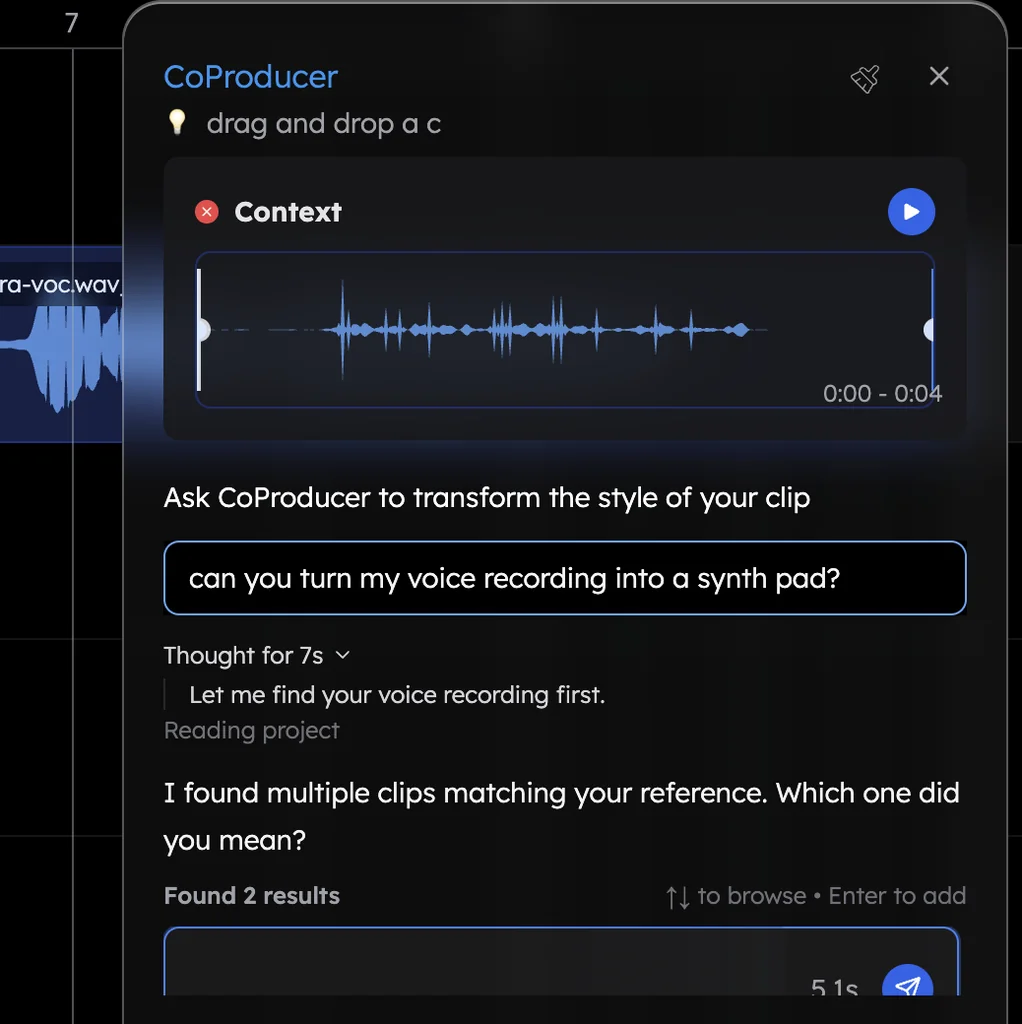
Record your script straight into Veena from your microphone (calibrate once so the take lands in time), or drop in a voice memo from your phone. Then drag the recording into the CoProducer panel as context and ask it to score around the words. CoProducer measures the take, down to where your syllables fall, and every part it writes next follows that map, so the music breathes where you pause.
Three habits keep the voice clear. Leave two bars of drone alone after every instruction, so "breathe in" has space to happen. Keep the pads above the voice and the drone below it, and let the middle belong to the words. And export the voice and the music as separate stems as well as the mix, so you can record a new script over the same session later.
Your voice can be an instrument too. Chant a long "om" into the mic and ask CoProducer to turn it into a pad or a cello line; it re-voices the take in the project's key. That's voice to instrument.
Make meditation music with CoProducer: a 10-minute session
- Start at daw.veena.studio. Sign in with Google and the whole studio opens in your browser, on a Mac, Windows, Linux or Chromebook laptop.
- Paste the prompt:
Make a 10-minute guided-meditation bed at 60 BPM in D major with no drums and no sudden changes: a low D held on Sub Bass for the whole piece; Warm Pad chords drifting between Dadd9 and G/D every 8 bars; a Soft Lead phrase of three or four notes from the D major pentatonic every 16 bars in the settle and return sections, with long rests; only the drone, the pad, a soft Glass Pad shimmer an octave up and the rain in the deepen section; gentle rain underneath throughout; a singing bowl struck at bars 1, 113 and 146, left to ring. Arrive 16 bars, settle 32, deepen 64, return 24, close 14.
- Choose the sounds. The pad and the phrase arrive as three options each; the rain and the bowl come from a sound search with ten preview cards. Pick the bowl whose ring you'd happily sit with for ten minutes.
- Add your voice on a new track if the session is guided, and ask CoProducer to fit the music around your pauses.
- Export the session: a 24-bit/48 kHz WAV for apps and video, a 320 kbps MP3 to share, or every track as stems. Nothing is watermarked, and the session is yours.
Then adjust the session in plain words:
- "Stretch the deepen section to 214 bars so the session runs 20 minutes."
- "Add a box-breathing guide to the settle section: a soft Glass Pad note at the start of every 4-bar breath."
- "Swap the Warm Pad for Vox Pad in the deepen section."
- "For a yoga-flow version, add a slow, soft pulse and switch it to the Brush kit." New CoProducer drums start on the Pop kit, so ask for the swap in the same request.
- "Take the Soft Lead out entirely for a sleep version."
If a change doesn't sit right, one Ctrl/Cmd+Z takes it back.
Mixing for earbuds and quiet rooms
- Mix quiet. Balance at the low volume your listener will use, on earbuds as well as speakers. The lows and highs fade first at low volume, so check the drone is still felt.
- One gentle peak. The bowl strike is usually the loudest moment. Turn its clip volume down until it arrives softly, never as a jolt.
- A centre that holds. Keep the drone and the voice in the middle, and check them with the Utility effect's Mono Check preset so the session survives a single phone speaker.
- Space for the bells. The Reverb's Cathedral preset gives bowls and chimes a tail of more than five seconds. Keep the drone itself dry so the low end stays clear.
- Rain that hushes. Pull the 8-Band EQ's high shelf down on the rain until it stops hissing.
CoProducer can make this pass for you: ask for "a soft, even headphone mix: drone centred, pads wide, the bowl ringing fully, nothing jumping out" and it balances every part to that brief.
Meditation music mistakes
- Tension sounds. The Drone and Dark Pad presets, thunder and dissonant clusters are built for dread.
- A melody that asks for attention. If the listener starts following the tune, they've stopped meditating. Three or four notes, then long rests.
- Changing every bar. Harmony that moves like a pop song keeps the mind busy. Every 8 bars or slower.
- A pulse that hurries the breath. Keep any beat at 72 BPM or slower, and softer than the pads.
- A bell cut short. A clip or a session that ends before the bowl finishes ringing.
- An ending that just stops. Thin to the drone, strike the last bowl, let it ring out.
Meditation music terms
Drone: one sustained tone held under everything. Pedal: a bass note held while chords change above it. Singing bowl: a standing bell, struck or rubbed, with a long shimmering tone. Interval bell: a single bell that marks a transition in a timed session. Pentatonic: a five-note scale; its major and minor forms have no half steps. Box breathing: in, hold, out, hold, four counts each. Guided meditation: a session led by a spoken voice. Savasana: the final resting pose of a yoga class, usually with the softest music of the hour.
Meditation music styles to try
- Guided meditation bed: 60 BPM, drone and pads, a phrase every 16 bars, room for the voice.
- Sleep: no pulse, the lowest register, no melody, 30 minutes or more.
- Yoga flow: 60–72 BPM, fingerpicked nylon guitar, Soft Lead lines and a soft Brush-kit pulse.
- Sound bath: singing bowls, gongs, Glass Pad and long Cathedral tails, with no pulse at all.
- Nature soundscape: rain, a stream and birdsong over a single held chord.
- Ambient listening: music that rewards close attention as well as rest; see how to make ambient music.
- Calm beds for videos and podcasts: see how to make background music.
Whatever the practice, describe it in a sentence and CoProducer builds the session around it. Other moods and styles are under make music by genre.
Try this in Veena
Make a 10-minute guided-meditation bed at 60 BPM in D major with no drums and no sudden changes: a low D held on Sub Bass for the whole piece; Warm Pad chords drifting between Dadd9 and G/D every 8 bars; a Soft Lead phrase of three or four notes from the D major pentatonic every 16 bars in the settle and return sections, with long rests; only the drone, the pad, a soft Glass Pad shimmer an octave up and the rain in the deepen section; gentle rain underneath throughout; a singing bowl struck at bars 1, 113 and 146, left to ring. Arrive 16 bars, settle 32, deepen 64, return 24, close 14.
Frequently asked questions
Can I make meditation music for free?
Yes. Veena is an AI DAW with a personal music producer built in. Describe the song you want and CoProducer builds it with you — beats, chords, melody, arrangement and mix — as real tracks you can edit, mix and export. Free, in your browser. Describe the session, its length, breath pace and sounds, and CoProducer builds the drone, pads, bells and texture on separate tracks you can reshape.
How long should meditation music be?
As long as the practice: 10, 20 and 30 minutes are the usual sessions, and a sleep track can run longer. At 60 BPM every minute is exactly 15 bars, so a 10-minute session is 150 bars and a 20-minute one is 300. Tell Veena's CoProducer the length in bars and the stages of the arc, and it lays the session out to fit.
What BPM is best for meditation music?
Slow, or none at all. At 60 BPM one beat lasts one second, which lines the music up with counted breathing; at 48 BPM a bar lasts five seconds, one breath in or out at six breaths a minute. Sleep and sound-bath music usually drops the pulse entirely. Veena's CoProducer works anywhere from 40 to 300 BPM and sets the tempo you name.
Can I add my own guided voice to meditation music in Veena?
Yes. Record your script straight into Veena from your microphone, or drop in a voice memo, and give the recording to CoProducer as context. It measures where your words fall and writes the music around your pauses. Export the voice and music together as a WAV or MP3, or as separate stems so you can re-record the voice later without rebuilding the music.
Can I publish and sell meditation music made in Veena?
Yes. Under Veena's terms you own the Output you generate and may use it commercially on any plan, the free one included, and exports never carry a watermark. Upload sessions to YouTube, release them through a distributor, sell them as downloads or play them in your own classes. Veena's library sounds are licensed for use inside your projects, so a session built with them is yours.
Meet your personal music producer
Free, in your browser. Describe the song you want and CoProducer builds it with you.
Make music free