K-Pop Chord Progressions
K-pop chord progressions change with the concept: a harmonic-minor i–iv–V for girl crush, IV–V–I–vi for a bright comeback, descending sevenths for K-R&B, an i–bIII–bVII–iv chorus and a half-step key change for the last chorus. Free with Veena, the AI DAW with a personal music producer built in, CoProducer builds all five as real tracks.
Each loop below is written out with its key, voicing and tempo, so you can hear why it suits the concept before you prompt it. For the section-by-section map of a whole K-pop song, from verse to bridge, see how to make K-pop.
K-pop chord progressions by concept
Girl crush: i–iv–V (A minor)
Am – Am – Dm – E at 124 BPM, half-time drums, an 808 Glide on the roots.
Right hand A3–C4–E4 for Am, A3–D4–F4 for Dm, G#3–B3–E4 for E. The E major chord borrows its G# from the harmonic minor scale, and that one note gives the loop its bite: going into E, F falls to E and A drops to G#, then G# pulls straight back up to A. Keep the chords short and low in the mix and let a Snap Pluck riff play the attitude.
Bright concept: IV–V–I–vi (D major)
G – A – D – Bm, 116 BPM, crisp and bouncy.
Bass G2, A2, D2, B2; right hand B3–D4–G4, C#4–E4–A4, D4–F#4–A4, D4–F#4–B4. The top line climbs G, A, A, B. IV–V–I is the most satisfying landing in a major key, and the Bm after it softens the arrival just enough to loop. Bright Pluck and Acoustic Guitar (steel) strums make it sound like a summer comeback.
K-R&B: IVmaj7–iii7–ii7–Imaj7 (Eb major)
Abmaj7 – Gm7 – Fm7 – Ebmaj7, 84 BPM, lazy 16ths on Electric Piano.
Over a bass of Ab2, G2, F2, Eb2, play G3–C4–Eb4, F3–Bb3–D4, Eb3–Ab3–C4, D3–G3–Bb3. Every chord is a seventh, and every voice steps down together, so the progression glides down the scale like a slow elevator. It resolves on Ebmaj7, whose D keeps even the home chord soft.
The chorus loop: i–bIII–bVII–iv (A minor)
Am – C – G – Dm, one chord per bar, four-on-the-floor.
Voice it wide on a Supersaw Lead: E4–A4–C5, E4–G4–C5, D4–G4–B4, D4–F4–A4, with an 808 or Synth Bass on A1, C2, G1, D2. C rings on top for two bars as the hook note, then steps down to B and A. After the verse's G#, the chorus drops back to the natural minor and leans on C and G, the chords it shares with its relative major, so it opens up. Ending on Dm, the iv, lets it fall softly back to Am every four bars.
The last chorus, a half step up (A minor to Bb minor)
F7 | Bbm – Db – Ab – Ebm
In A minor, F is the bVI chord. Add an Eb (A3–C4–Eb4 over F2) and it becomes F7, the dominant of Bb minor, so one bar of it pivots the song up a half step. The chorus loop returns as i–bIII–bVII–iv in the new key, voiced F4–Bb4–Db5, F4–Ab4–Db5, Eb4–Ab4–C5, Eb4–Gb4–Bb4: the same shapes, one fret higher, with twice the urgency.
Build it with CoProducer
Open daw.veena.studio, sign in with Google and paste this. You can also write it in Korean: in Veena's own data, about 18–20% of new users write their first request in a language other than English.
Make a girl-crush K-pop track in A minor at 124 BPM. Verse: Am – Am – Dm – E (i–iv–V) over half-time drums on the Electronic kit, an 808 Glide sliding between the roots and a Snap Pluck riff. Chorus: four-on-the-floor, a Supersaw Lead playing Am – C – G – Dm (i–bIII–bVII–iv) in wide chords. Dance break: 8 bars of drums, 808 and Stab Lead hits on Am. Then one bar of F7 and a last chorus a half step up in Bb minor: Bbm – Db – Ab – Ebm. Verse 16 bars, chorus 16, dance break 8, last chorus 16.
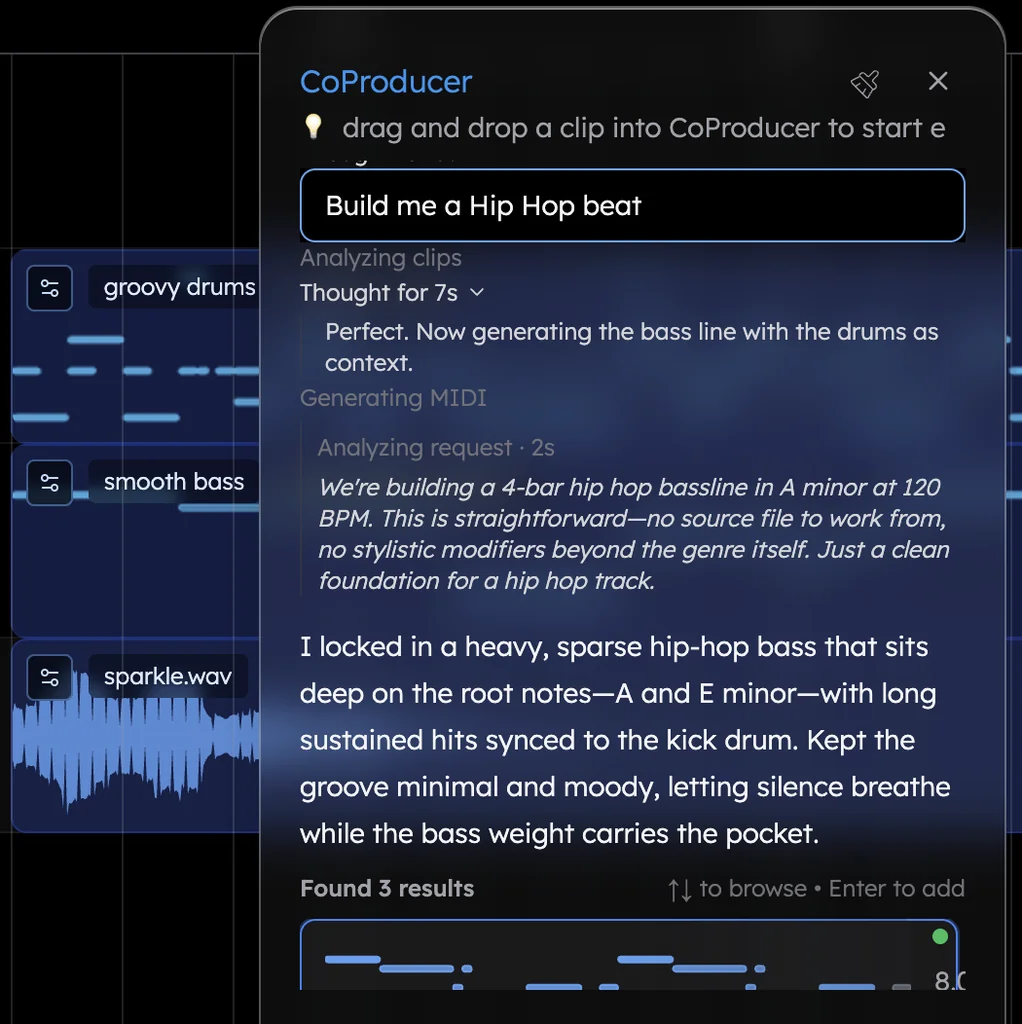
CoProducer plans the four sections and writes each part as three options, like the three results in the panel above. Use the arrow keys to browse, press Enter to keep one, and the parts that depend on it are written against your pick.
Then tighten the chords, by asking or by hand in the piano roll (double-click the clip to open it):
- Chop the chorus. Highlight the last eight bars and ask CoProducer to "turn these chords into 16th-note stabs".
- Widen the hook. In the last chorus, pick out the highest note of each chord and send it up an octave with Ctrl/Cmd+↑.
- Accent the pushes. In the velocity editor, raise every chord that lands on an offbeat.
When it's done, export the full mix, or every track as stems, with no watermark, and try more loops in the chord progression generator.
What makes a K-pop loop sound generic
- One loop for the whole song. K-pop earns its drama by changing harmony between sections. Give the verse, chorus and dance break different chords.
- No key change. The lift into the last chorus is part of the genre's grammar. Prepare it with the new key's V chord.
- Harmony that hides the hook. Keep the chorus chords wide and simple so the topline has room on top.
The climb-and-release shapes here are close relatives of the anime chord progression, and the four-on-the-floor chorus sits one step from house chord progressions.
Try this in Veena
Make a girl-crush K-pop track in A minor at 124 BPM. Verse: Am – Am – Dm – E (i–iv–V) over half-time drums on the Electronic kit, an 808 Glide sliding between the roots and a Snap Pluck riff. Chorus: four-on-the-floor, a Supersaw Lead playing Am – C – G – Dm (i–bIII–bVII–iv) in wide chords. Dance break: 8 bars of drums, 808 and Stab Lead hits on Am. Then one bar of F7 and a last chorus a half step up in Bb minor: Bbm – Db – Ab – Ebm. Verse 16 bars, chorus 16, dance break 8, last chorus 16.
Frequently asked questions
Can I write K-pop chord progressions for free?
Yes. Veena is an AI DAW with a personal music producer built in. Describe the song you want and CoProducer builds it with you — beats, chords, melody, arrangement and mix — as real tracks you can edit, mix and export. Free, in your browser. CoProducer reads prompts written in Korean as well as English, and offers three options for every part.
What chord progressions does K-pop use?
Many K-pop songs run on minor-key loops that change with each section: a harmonic-minor i–iv–V for a girl-crush verse, i–bIII–bVII–iv or i–bVI–bIII–bVII for a chorus, descending sevenths for K-R&B, and a key change for the last chorus. Veena's CoProducer writes each section's chords in any key, then builds the drums, bass and synths around your picks.
How do K-pop songs change key for the last chorus?
Often by a half or whole step, set up by one bar of the new key's dominant chord. From A minor to Bb minor, that bar is F7: it grows out of the old key's F chord and resolves into the new tonic. Ask Veena's CoProducer to move the last chorus up a half step with an F7 bar before it.
Meet your personal music producer
Free, in your browser. Describe the song you want and CoProducer builds it with you.
Make music free