What musicians ask an AI music producer: Veena's prompt study
What musicians ask an AI music producer for first is a beat, and they ask in detail. That is the headline from Veena's study of the first request musicians sent to CoProducer, the personal music producer built into Veena, in every studio session from 5 to 27 October 2026: more than 14,000 first requests from more than 8,000 musicians. Veena is an AI DAW with a personal music producer built in. Describe the song you want and CoProducer builds it with you — beats, chords, melody, arrangement and mix — as real tracks you can edit, mix and export. Free, in your browser.
Every figure below is a percentage of first requests, and every rule that produced it is in the method section, so each one can be checked. Cite it as "Veena, What musicians ask an AI music producer, October 2026".
The findings
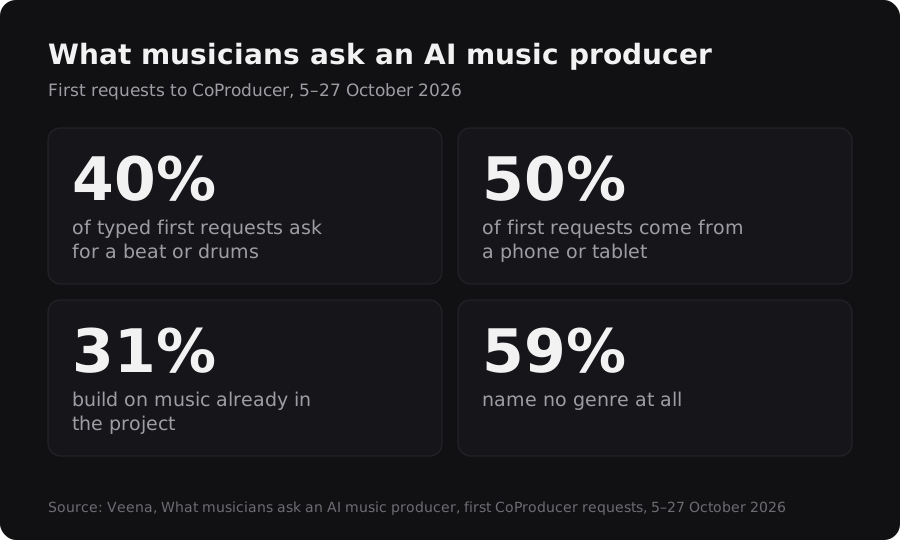
- Beats lead. 40% of typed first requests to CoProducer asked for a beat or drums, the most-requested part in Veena's October 2026 study.
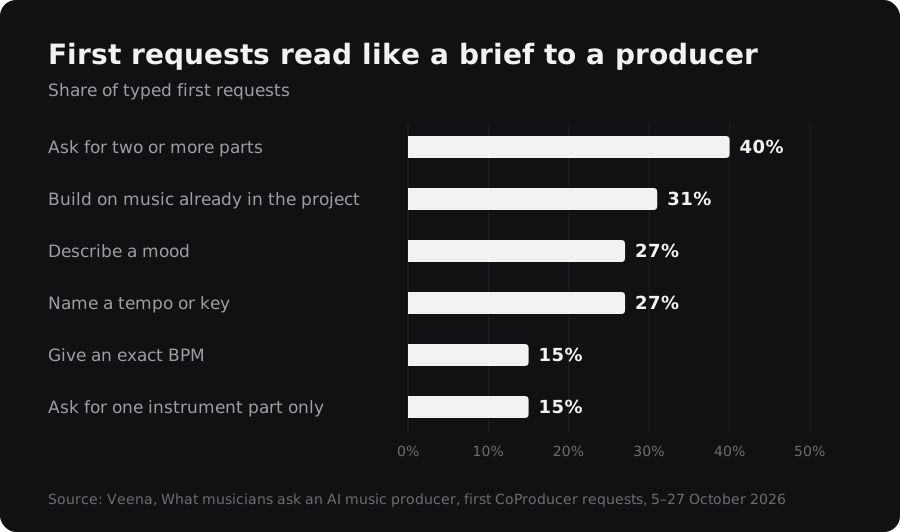
- Musicians ask for songs, not samples. 32% of typed first requests to CoProducer asked for a whole song, track or instrumental, and 40% asked for two or more parts in a single message.
- Half of first requests come from a phone or tablet. 50% of all first requests to CoProducer in Veena's October 2026 study came from a phone or tablet, and 44% of the typed ones did.
- Nearly a third build on music the musician already has. 31% of typed first requests to CoProducer worked on music already in the project: a vocal take, a demo, an uploaded song or a track from an earlier session.
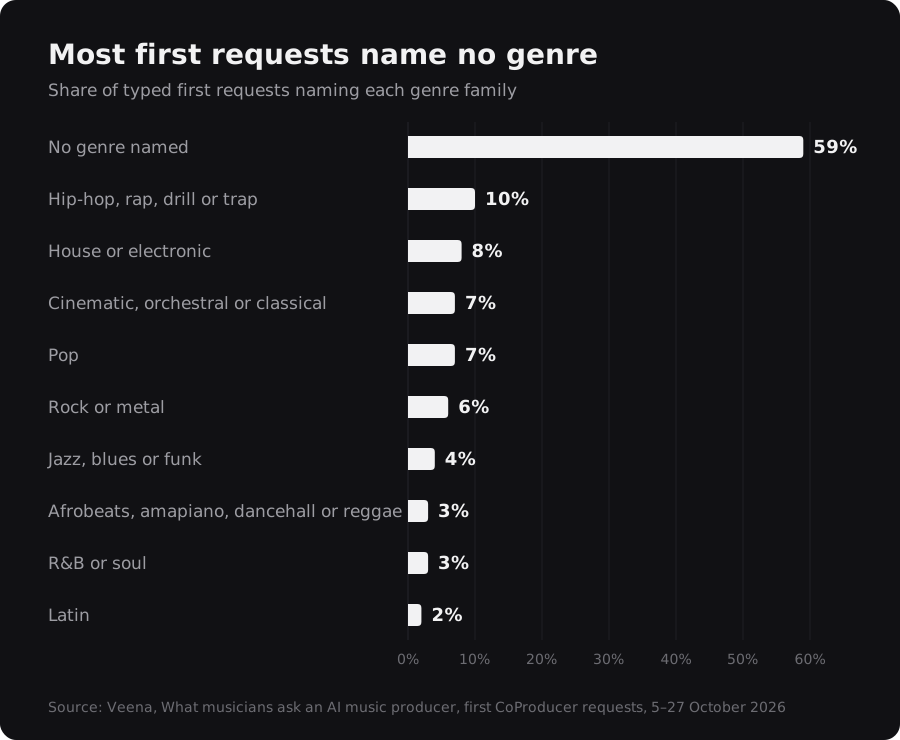
- Most requests name no genre. 59% of typed first requests to CoProducer named no genre at all; musicians described instruments, feel and their own material instead.
- Hip-hop and trap are the most-named genres. 10% of typed first requests to CoProducer named hip-hop, rap, drill or trap, ahead of house and electronic (8%), cinematic and orchestral (7%) and pop (7%).
- Musicians speak in tempo and key. 27% of typed first requests to CoProducer named a tempo or key, and 15% gave an exact BPM.
- One in five writes in another language. At least 22% of typed first requests to CoProducer were written in a language other than English, led by Spanish (7%).
- Three in four type in their own words. 76% of first requests to CoProducer were typed by the musician; 24% were one-tap suggestions.
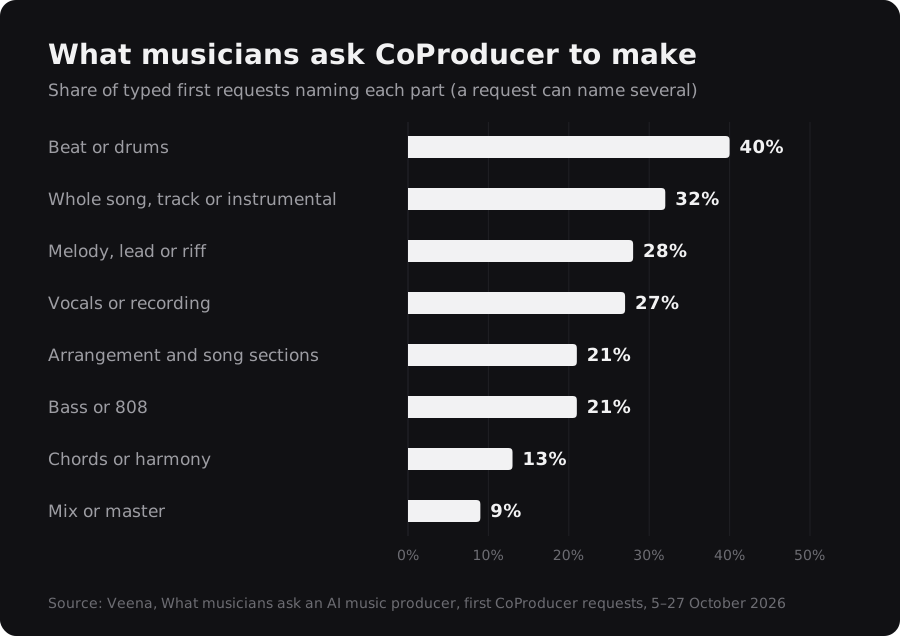
What musicians ask CoProducer to make
A request can ask for several parts, so the shares add up to more than 100%.
| Part requested | Share of typed first requests |
|---|---|
| Beat or drums | 40% |
| Whole song, track or instrumental | 32% |
| Melody, lead or riff | 28% |
| Vocals or recording | 27% |
| Arrangement and song sections | 21% |
| Bass or 808 | 21% |
| Chords or harmony | 13% |
| Mix or master | 9% |
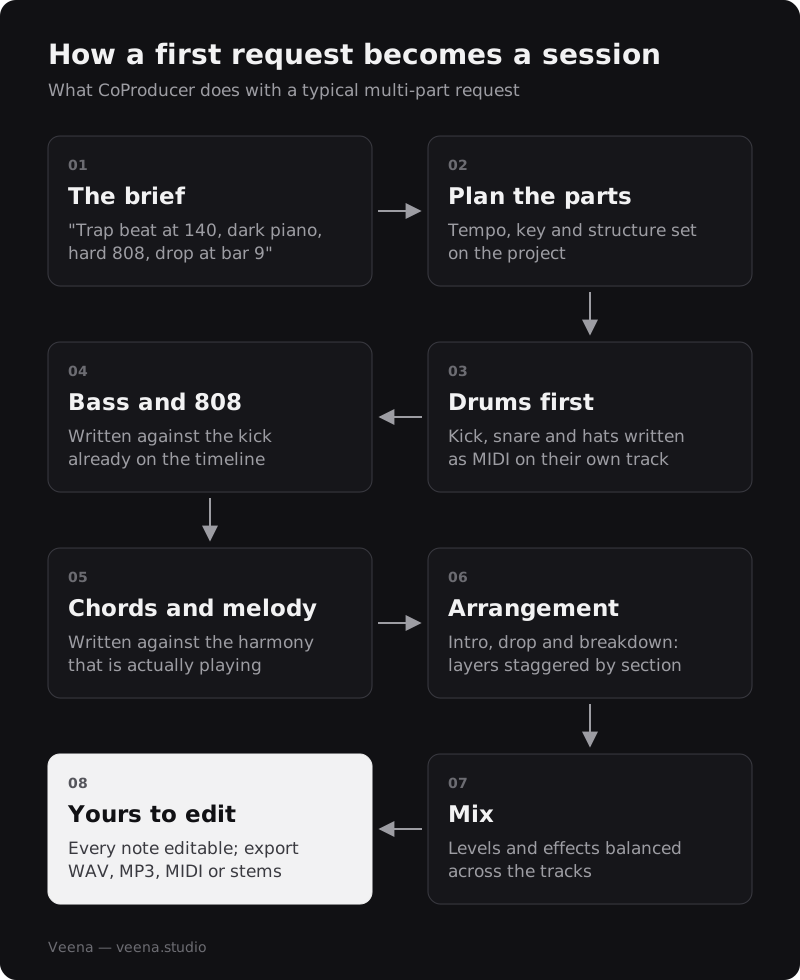
Only 15% of typed first requests asked for a single instrument part on its own. The typical first message reads like a brief to a producer: a drum feel, a bassline that follows it, chords underneath and a structure with an intro and a drop. That is the job CoProducer is built for. It plans the parts, writes each one against the tracks already on the timeline, and leaves every note editable in Veena's piano roll.
 If the beat is what you came for, start with the free online beat maker or the AI drum generator; for harmony, the chord progression generator.
A third of first requests start from the musician's own audio
31% of typed first requests worked on music already in the project. Typical examples, paraphrased: "build drums, bass and piano around my recorded singing and keep my voice as it is", "split this song into stems and write a new drum part", "balance my vocal against the beat".
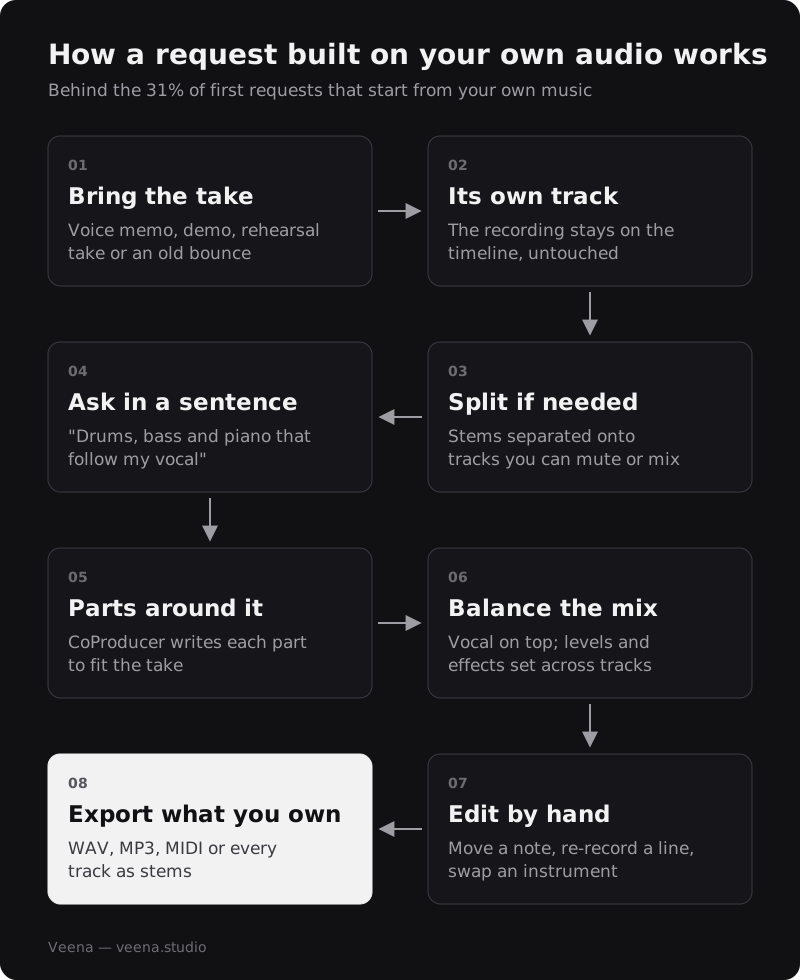
This is the request a generator cannot take. Veena is a full DAW, so the recording stays on its own track and CoProducer writes around it: the bass follows the chords it hears, the drums follow the tempo of the take. Bring a voice memo, a rehearsal take or an old bounce through the online recording studio, or hum the line and use voice to instrument.
Genre, mood, tempo and key
59% of typed first requests named no genre at all. Among those that did, the most-named were:
| Genre family | Share of typed first requests |
|---|---|
| Hip-hop, rap, drill or trap | 10% |
| House or electronic | 8% |
| Cinematic, orchestral or classical | 7% |
| Pop | 7% |
| Rock or metal | 6% |
| Jazz, blues or funk | 4% |
| Afrobeats, amapiano, dancehall or reggae | 3% |
| R&B or soul | 3% |
| Latin | 2% |
27% of typed first requests described a mood. Sad or emotional was the most common (12%), ahead of energetic (9%), dark (8%) and romantic (6%). Musicians ask for feeling far more often than for cheer: happy or upbeat appeared in 4%.
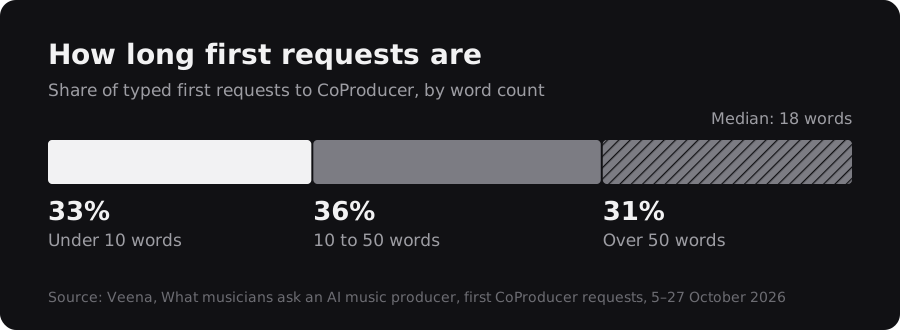
27% named a tempo or key, 15% gave an exact BPM and 9% named a key or scale. The median typed first request was 18 words long, and 31% ran past 50 words. A third were under ten words, the "make me a trap beat" kind; CoProducer answers both with the same editable session. Find the genre you make in make music by genre.
A short request and a detailed brief, compared
Both kinds are common, a third of first requests each, and CoProducer handles both. What changes is who makes the decisions.
| Short request | Detailed brief | |
|---|---|---|
| Example, paraphrased | "Make me a trap beat" | "Trap at 140 in F minor, dark piano riff, hard 808, half-time for the last 8 bars" |
| Tempo and key | CoProducer chooses them to suit the style | Taken as written |
| Parts | CoProducer chooses the parts a trap beat needs | The parts named, in the order named |
| Structure | CoProducer lays out the sections | The bars and sections asked for |
| What you get | Editable tracks to react to | Editable tracks that match the brief |
| Next step | "Darker", "more space in the hats" | Fine edits by hand or in a sentence |
Either way the result is a session, not a render: every part is on its own track and stays editable.
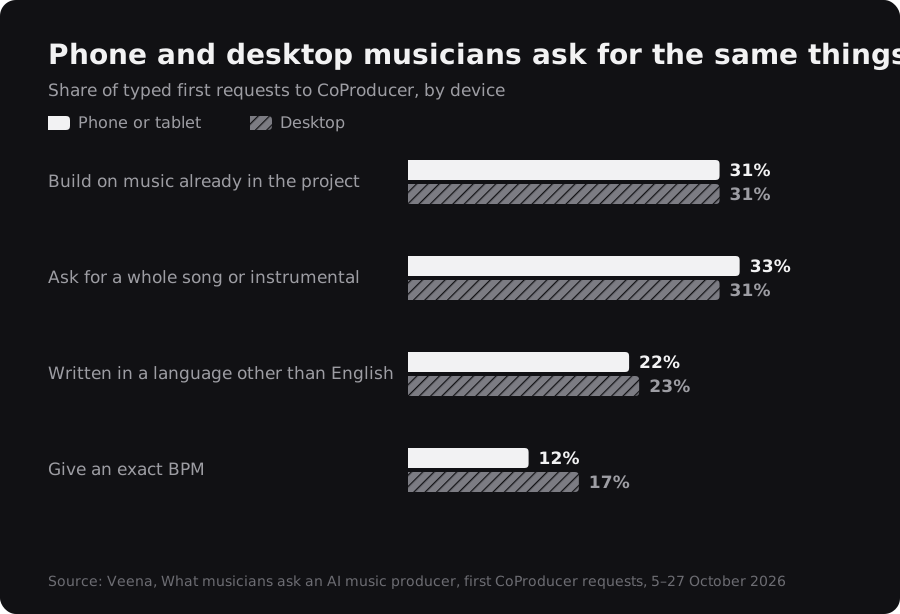
Phone and desktop musicians ask for the same things
| Share of typed first requests | Phone or tablet | Desktop |
|---|---|---|
| Build on music already in the project | 31% | 31% |
| Ask for a whole song or instrumental | 33% | 31% |
| Written in a language other than English | 22% | 23% |
| Give an exact BPM | 12% | 17% |
Half of first requests came from a phone or tablet, and those requests were as ambitious as the ones from a desktop. On both, 31% built on music already in the project, and full songs were requested at a similar rate (33% on phones, 31% on desktops). About 22% of requests on phones and 23% on desktops were in a language other than English. Desktop musicians were more likely to give an exact BPM (17% against 12%); everything else moved by a point or two. Veena runs the whole studio in the browser, so a musician on a phone gets the same CoProducer, the same tracks and the same export. More on that in make music on your phone.
Languages
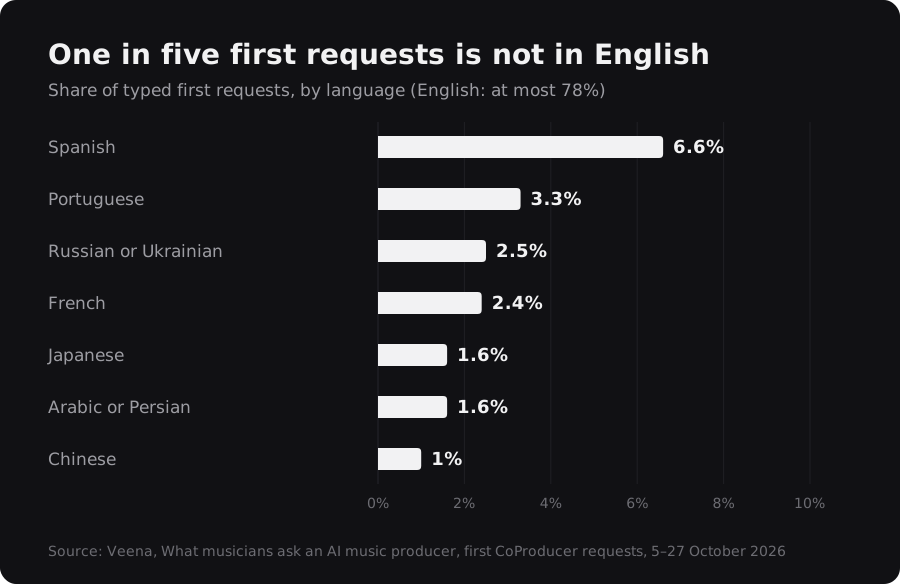
At least 22% of typed first requests were written in a language other than English: Spanish (7%), Portuguese (3%), Russian or Ukrainian (2.5%), French (2.4%), Japanese (1.6%), Arabic or Persian (1.6%) and Chinese (1%), with Italian, German, Korean, Hindi, Turkish and Indonesian each under 1%. CoProducer reads the request in the musician's language and builds the same editable tracks.
How the requests compare with what each kind of tool returns
The top requests in the study, set against the three kinds of tool a musician can bring them to. Prompt-to-song generators such as Suno and Udio render a finished track from a prompt; traditional DAWs such as Ableton Live, Logic Pro and FL Studio give you the studio and leave the parts to you.
| What the request needs | Veena | Prompt-to-song generators | Traditional DAWs |
|---|---|---|---|
| A beat or drums (40%) | Drums written as notes on their own track, editable hit by hit | A rendered audio track; changes mean a new render or a stem split | Every hit editable, programmed by you |
| Several parts in one message (40%) | Each part written against the others, each on its own track | One mixed render | One part at a time, by hand or with a built-in player |
| Build on music already in the project (31%) | The recording stays on its track; CoProducer writes the parts around it | An upload becomes the seed for a new render | The recording stays; you write every part |
| A tempo or key (27%) | Set on the project; every part follows it | Written into the prompt | Set by you |
| Ask in your own language (at least 22%) | A plain-language request to CoProducer | A plain-language prompt | Menus and manuals |
| From a phone (50%) | The whole studio in the phone's browser | Apps to generate and listen | Separate mobile apps, where they exist |
Generators are the faster route to a one-click song with AI-sung vocals. For what musicians asked for most in this study, a beat they can edit, several parts that fit, and music built around their own recording, Veena does all of it in one place: a producer that writes the parts and a DAW that keeps them editable, free in your browser.
Method
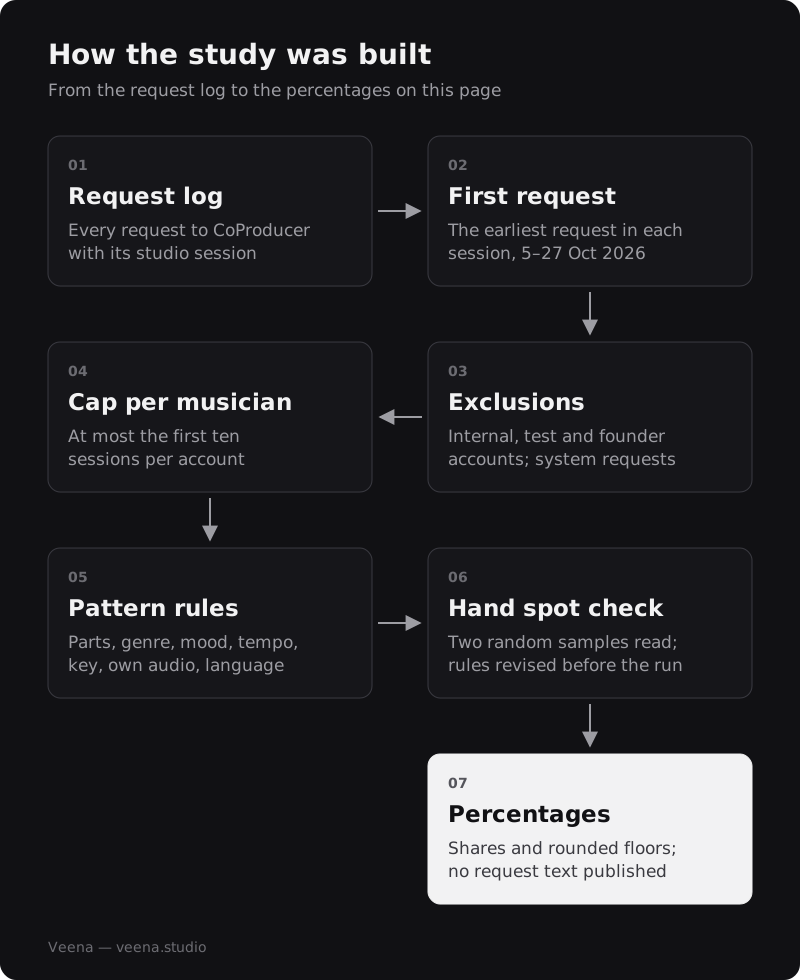
- Source. The CoProducer request log in Veena's product database, which stores each request a musician sends to CoProducer and the studio session it was sent from.
- Window. 5 to 27 October 2026, UTC. From 5 October every request carries its studio session, which is what defines a first request.
- Unit. The first request in each studio session: the earliest request in that session that the musician sent, either typed (or pasted) or tapped as a one-tap suggestion. Follow-up suggestions written by Veena are not requests and are left out. Shares in the tables are of typed first requests; the phone share and the typed share are of all first requests.
- Sample. More than 14,000 first requests from more than 8,000 musicians, of which more than 11,000 were typed, by more than 6,500 musicians.
- Exclusions. Every account on Veena's own domain, test accounts, the founders' accounts and accounts on Veena's internal allow-list; requests made by Veena's own systems; empty requests; and machine payloads that start with a brace. No musician counts more than ten times: each account contributes at most its first ten sessions in the window.
- Classification. Deterministic keyword and pattern rules applied to the first 500 characters of each request, after lower-casing. A request can carry several labels. Part labels, for example: beat or drums matches beat, drums, groove, kick, snare, hi-hats, percussion or rhythm (and batería, ritmo, batida); bass matches bass, bassline, 808 or sub, after genre names such as drum and bass and bass house are set aside so they do not count as a bass part. "No vocals" and "without lyrics" are read as instrumental requests, not vocal ones. Builds on music in the project matches phrases such as my vocal, my recording, the uploaded or imported song, this track and track 2, in English, Spanish, Portuguese, French, Italian, German, Japanese, Turkish and Russian. Tempo matches BPM numbers and words such as tempo, fast, slow and half-time; key matches note names with major or minor, such as F# minor or Am, and words such as key and scale.
- Language. Requests in a non-Latin script are assigned by script. Latin-script requests go to the language whose common words score highest, with English as the default, so languages the rules do not list count as English. The non-English share is a floor.
- Spot check. The rules were read against two random samples of typed first requests (120 and 100) and revised before the final run. On the second sample, read by hand for whether a request builds on music already in the project, 91% of the requests the rule flagged were correct, and the rule caught 82% of the requests the hand reading found. The 31% is therefore a conservative figure.
- What is published. Percentages and rounded-down floors only. No request text is published; the example requests above are paraphrased and carry no personal detail.
- Refresh. The query and the rules live in Veena's website repository and run again every quarter. This page keeps its URL and shows the date of the latest run.
Why this matters for anyone making music with AI
The requests show what musicians want from an AI music producer: a collaborator that takes a detailed brief, writes several parts that fit together, and works around a recording they already have, on whatever device is in their hand. That is the case for an AI DAW over a generator. In Veena every answer lands as tracks you own and can edit, mix and export, free in your browser. Start with your AI music producer, or borrow a first request from the CoProducer example prompts.
Try this in Veena
Build a full backing track around my recorded vocal: drums, bass and warm piano chords that follow my melody and timing. Keep my voice exactly as recorded, then balance the mix so the vocal sits on top.
Frequently asked questions
What do musicians ask an AI music producer for most often?
Beats. In Veena's study of first requests to CoProducer from 5 to 27 October 2026, 40% of typed first requests asked for a beat or drums, ahead of a whole song or instrumental (32%), a melody (28%) and vocals or recording (27%). Veena is an AI DAW with a personal music producer built in, so each of those parts lands as a real, editable track.
Do musicians use AI music producers on their phones?
Yes. Half of all first requests to CoProducer in Veena's October 2026 study came from a phone or tablet. Phone and desktop requests asked for the same things: about a third of each built on music already in the project, and full songs were asked for at the same rate. Veena runs the whole studio in the browser, on a phone too.
Do musicians bring their own recordings to an AI music producer?
Often. In Veena's October 2026 study, nearly a third (31%) of typed first requests to CoProducer built on music already in the project: a vocal take, a guitar demo, an uploaded song or a track from an earlier session. In Veena you import the recording, and CoProducer writes drums, bass and chords that follow it on the same timeline.
How detailed are prompts to an AI music producer?
More detailed than most people expect. The median typed first request to CoProducer in Veena's October 2026 study was 18 words, and 31% ran past 50 words. Over a quarter (27%) named a tempo or key, and 15% gave an exact BPM. Veena turns those specifics into editable drum, bass, chord and melody tracks.
Where does this data come from, and can I cite it?
Yes, cite it as Veena's study of first requests to CoProducer, 5 to 27 October 2026. It covers more than 14,000 first requests from more than 8,000 musicians, after removing internal, test and founder accounts. The classification rules are published in the method section on this page, and Veena refreshes the study every quarter at the same URL.
Meet your personal music producer
Free, in your browser. Describe the song you want and CoProducer builds it with you.
Make music free