What would an AI-native DAW actually look like?
What would an AI-native DAW actually look like? Less like software and more like a session: a producer who joins you, listens to what is on the timeline, builds parts with you as real tracks and keeps working as you change your mind. That is the DAW we are building in Veena, where CoProducer, your personal music producer, produces with you. Free, in your browser.
People ask it in exactly these words, and it is the right question. Most of what gets called an AI DAW today is one of two compromises: a decades-old studio with an assistant bolted onto the side, or a song generator with a timeline bolted onto the back. I'm Palaash, Veena's co-founder and CEO, and here is what I think the real thing looks like, and what it already looks like in Veena.
Start from the producer, not the menu
Every DAW you have used is shaped like the studio it replaced: the tape machine became a timeline, the mixing desk a mixer, the rack of outboard gear a plug-in slot. That shape assumes you do every job yourself.
An AI-native DAW starts from a different question: what does a great producer do in a session? They listen before they play. They know which part has to wait for which. They give you options and let you choose. They tell you the truth about what worked. And they never lock you out of your own song. Design the software around that person, and a very different studio falls out.
What would an AI-native DAW actually look like? Eight things it does
1. It joins your session instead of rendering a file
The output is tracks, never a single file. When CoProducer builds a song, drums, bass, chords and melody land on their own tracks as each part finishes: MIDI you can open note by note, audio you can cut and stretch. You never have to take a render apart to fix a snare.
2. It listens before it plays
A producer hears the room first. Before CoProducer writes anything, it reads the project: the notes on every track, the tempo, the key, the loudness, where the transients hit, and a "flow map" of where the syllables of your vocal land.
3. Its parts hear each other
As a drummer, the first thing I notice in any session is whether the bass player is listening. In Veena, parts that don't depend on each other are written at the same time, and a part that has to fit another waits and reads that part's actual notes. And nothing waits for a batch: each part lands the moment it is ready.
4. You make the calls
Every new part arrives as three options, and nothing that depends on a part is written until you pick one. A prediction of your taste is not your taste. Every CoProducer change is one undo, and in a shared session undo is per person.
5. Your sound comes with you
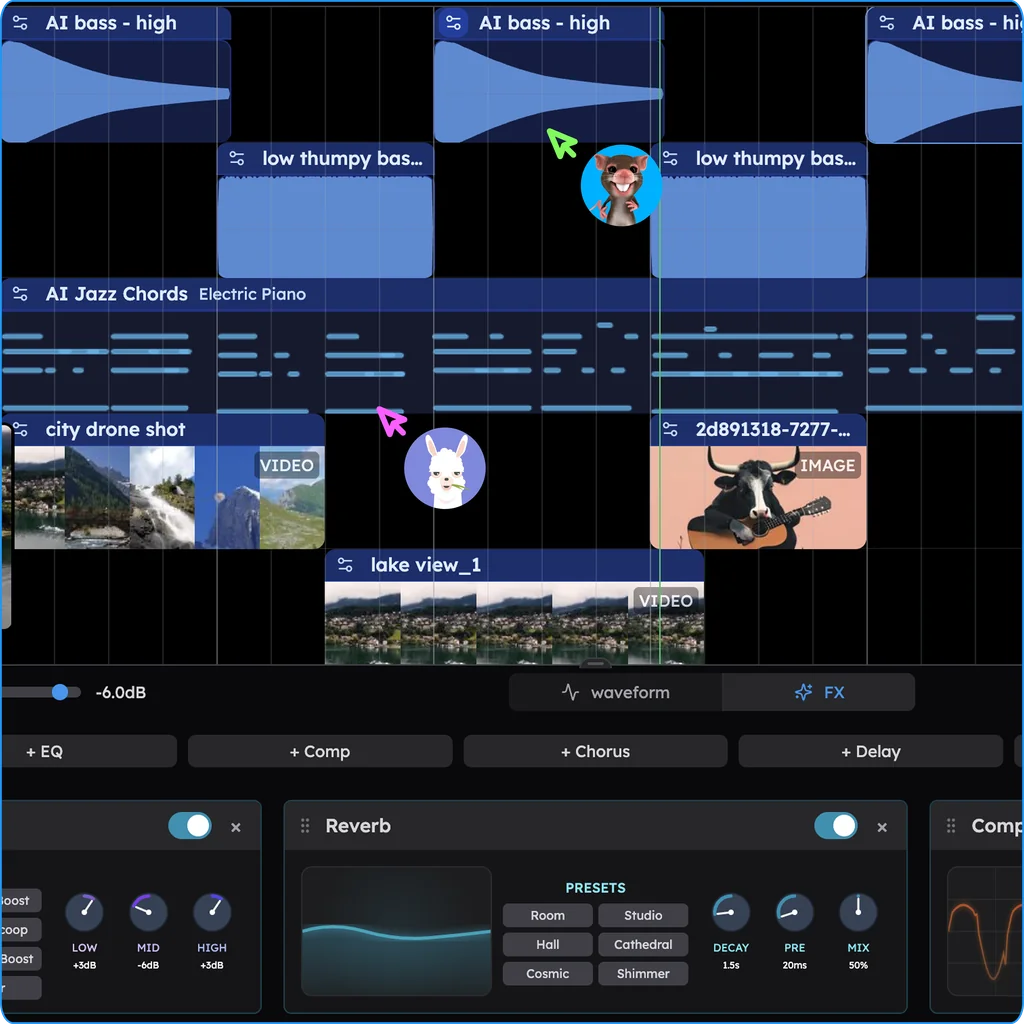
Veena hosts your VST3 and AU plug-ins through the Veena Bridge helper app, and CoProducer weighs them against the built-in sounds, starting from their real presets. Bring your own recordings too: about 1 in 4 first requests in Veena start from the person's own audio, a voice memo, a demo or a loop, and CoProducer builds around it. Hum a line and it becomes a cello or a synth.
6. The session is shared
Music is made by people together, so the AI-native DAW has to be multiplayer from day one. Since 12 September 2026, you invite someone into a Veena session by link and see their cursor on the timeline. Each of you has a private chat with CoProducer, the band has a shared one, and requests queue in an "Up next" strip so nobody's idea overwrites anybody else's.
7. It tells the truth
Each run ends with what was delivered and what was skipped, read from the timeline rather than from the plan. If you ask for an instrument it doesn't have, it says so and tells you what it used instead. A failed run is refunded. A producer you can't trust is worse than no producer.
8. It speaks your language and runs anywhere
About 18–20% of Veena's new users write their first request in a language other than English. The AI runs on Veena's servers and the studio runs in the browser, so a phone on the bus or a Chromebook in a classroom gets the same producer as a studio Mac, with no graphics card needed.
What an AI-native DAW is not
It is not a chat window glued to an old mixer. An assistant bolted onto a studio built for doing everything by hand takes one request at a time; the song itself still lives in your head and your hands.
It is not a slot machine. Pulling the lever until a song you like falls out is generation, not production.
It is not a MIDI plug-in that hands its notes to another app. If the mix, the recording and the finished song happen somewhere else, the producer has left the room before the song is done.
Here is where the two big compromises leave you, next to Veena:
| Veena | Logic Pro, a DAW with AI features | Suno Studio, a generator's studio | |
|---|---|---|---|
| Who builds the song | CoProducer, every part, with you | You, with AI Session Players for grooves | The generator; you edit its render |
| Price of the room | Free plan | $199.99, on a Mac with Apple silicon | Premier plan, $30 a month |
| Your plug-ins | VST3 and AU through the Veena Bridge | Audio Units plug-ins | "Not compatible with VST or Audio Units plugins" |
| Runs on | Any modern browser, on a laptop, a Chromebook or your phone | A Mac or an iPad | A computer or tablet browser; "mobile devices are not supported" |
Facts are from Apple's Logic Pro page and Suno's pricing page and help centre, September 2026.
Why it's hard, and why it's worth it
Generating sound is the easy part now. The hard part is everything a producer does between the notes: deciding which part anchors the song, making every other part agree with it, keeping your choices intact while changing something else, and knowing when to stop. That is where we spend our engineering time: CoProducer plans a song, writes it in the order its parts depend on each other, arranges and mixes it, then checks what actually landed and repairs it.
The payoff shows up in our numbers. Among Veena's new users whose first request asks for a new song, 3 in 4 get a finished first result on day one, and 81.5% do when they name a genre.
Where we're taking it
The producer keeps getting deeper. You hand CoProducer a song you love and it masters yours towards it. You beatbox a groove and it becomes a real drum part. You ask it to give a loop a lo-fi vibe and the whole mix changes style.
If you want the definition first, read what an AI DAW is. If you want the machinery, see how an agentic DAW works. And if you want to feel it, bring a friend: make music online together in a shared Veena session, paste the prompt below, and watch the parts land. More answers live in learn music production with AI.
Try this in Veena
Make a 110 BPM synthwave track in A minor: punchy drums with a big gated snare, a pulsing retro bass, dark pad chords on Am, F, C and G, a bright saw lead with a hooky 8-bar melody, and a riser into each chorus. Intro, verse, chorus, verse, chorus, breakdown, final chorus.
Frequently asked questions
What is an AI-native DAW?
Veena is an AI DAW with a personal music producer built in. Describe the song you want and CoProducer builds it with you — beats, chords, melody, arrangement and mix — as real tracks you can edit, mix and export. Free, in your browser. AI-native means the studio is designed around the producer, not a producer added to a studio built for doing everything by hand.
What's the difference between an AI-native DAW and a DAW with AI features?
A DAW with AI features adds tools you call one at a time: split these stems, detect these chords, play a drum groove. An AI-native DAW like Veena has a producer who holds the whole song: CoProducer plans it, writes parts that listen to each other, lets you pick between options and keeps working as you change your mind.
Can an AI-native DAW use the plugins I already own?
Veena can. Install the Veena Bridge helper app once on your Mac or Windows computer and your VST3 plug-ins, plus Audio Units on a Mac, load inside Veena, instruments and effects alike. CoProducer weighs them against the built-in sounds and starts from their real presets, and it knows names like Serum, Kontakt and Omnisphere.
Can two people and an AI work on the same song at once?
Yes. Since 12 September 2026, Veena lets you invite someone into your session by link. You see each other's cursors on the timeline, edits sync instantly, and CoProducer works for both of you: each person has a private chat, the band shares one, and CoProducer requests queue fairly in an Up Next strip, one run at a time.
Meet your personal music producer
Free, in your browser. Describe the song you want and CoProducer builds it with you.
Make music free