Someone filed a copyright claim on my own song
A copyright claim on my own song is fixable when you hold the rights: YouTube lets you dispute a Content ID claim from YouTube Studio, and the claimant then "has 30 days to respond" (YouTube Help, read 15 Nov 2026). What wins you the argument is the record of how you made the song. In Veena every song stays a project with its parts as separate tracks, and you export the stems and MIDI that show your work, on every plan.
Veena is an AI DAW with a personal music producer built in. Describe the song you want and CoProducer builds it with you — beats, chords, melody, arrangement and mix — as real tracks you can edit, mix and export. Free, in your browser.
A copyright claim on my own song: what YouTube's own help says
Read from YouTube Help on 15 Nov 2026:
- What a claim is. "A copyright claim may be automatically generated when an uploaded video matches another video (or segment of a video) in YouTube's Content ID system." Depending on the owner's settings, a claim can "Block a video from being viewed", "Monetize the video by running ads on it" or "Track the video's viewership statistics" (Learn about copyright claims).
- When you may dispute. You can dispute "if you have a valid reason, such as: Having all the necessary rights to the content in your video" or "Believing your video was misidentified or an error was made" (Dispute a copyright claim).
- What does not count. "Giving credit to the copyright owner", "Owning a copy of the video or song" and "Choosing not to monetize on the video" are, in YouTube's words, "NOT legitimate reasons to dispute a claim".
- Only dispute with the rights. "You should only dispute a claim if you're confident that you have all the necessary rights to use the claimed content." YouTube adds that it "can't decide whether you should dispute a claim" and that "you may want to seek legal advice before you dispute."
- A stranger's name isn't proof either way. "If you don't recognize the copyright owner, it doesn't necessarily mean that the claim is invalid."
Claim or strike: which one you have
| Read 15 Nov 2026 | Content ID claim | Copyright strike |
|---|---|---|
| Where it comes from | Content ID matches your video to a reference | A copyright removal request, a "takedown" |
| What it does | Blocks, monetizes or tracks the video | Removes the video and puts a strike on your channel |
| How you answer a mistake | Dispute, in YouTube Studio | Counter notification, in YouTube Studio or to copyright@youtube.com |
| What YouTube asks of you | All the necessary rights to the content | "Confirm you own the rights to all elements in your content, including any music" |
Sources: What is a claim? and Submit a copyright counter notification, YouTube Help, read 15 Nov 2026. YouTube calls a counter notification "a legal request to reinstate content that was removed due to a copyright removal request", shares it with the claimant, and warns: "Do not submit false information."
How to dispute a Content ID claim
YouTube's steps for a computer, read 15 Nov 2026:
- Sign in to YouTube Studio and select Content from the left menu.
- Find the video. In the Videos tab, use the filter bar and choose Claims.
- Open the claim. In the Restrictions column, hover over Claims and click See details.
- Dispute it. Under Content used, find the claim and click Take action, then Dispute.
- Wait for the claimant. They have 30 days to respond. For a claim that blocks your video, YouTube may offer Escalate to Appeal, which starts at the appeal stage.
If the video was removed and your channel has a strike, the route is a counter notification instead: Content, filter by Copyright, find the video marked Removed, then See details and Take action, Submit a counter notification. YouTube asks for your full legal name and complete physical address, and a clear rationale for why the removal was a mistake.
What to keep so you can show you made it
The rationale you write is stronger when you have the trail behind it. Keep:
- The project. The session with every part on its own track, as you built it.
- The stems. One file per instrument and vocal, exported from that project.
- The MIDI. The notes you wrote or played, as a .mid file.
- The drafts. Voice memos, demo bounces, lyric notes and earlier mixes, with the dates your files carry.
A released master is one file anyone could copy. The project, the stems and the MIDI are the parts only the person who made the song has.
Your song and its record stay yours in Veena
- You own what you make. Veena's terms say "you own the Output you generate through your use of the Service", on every plan, free included. Your own recordings, uploads and project files stay yours too (who owns music made in Veena).
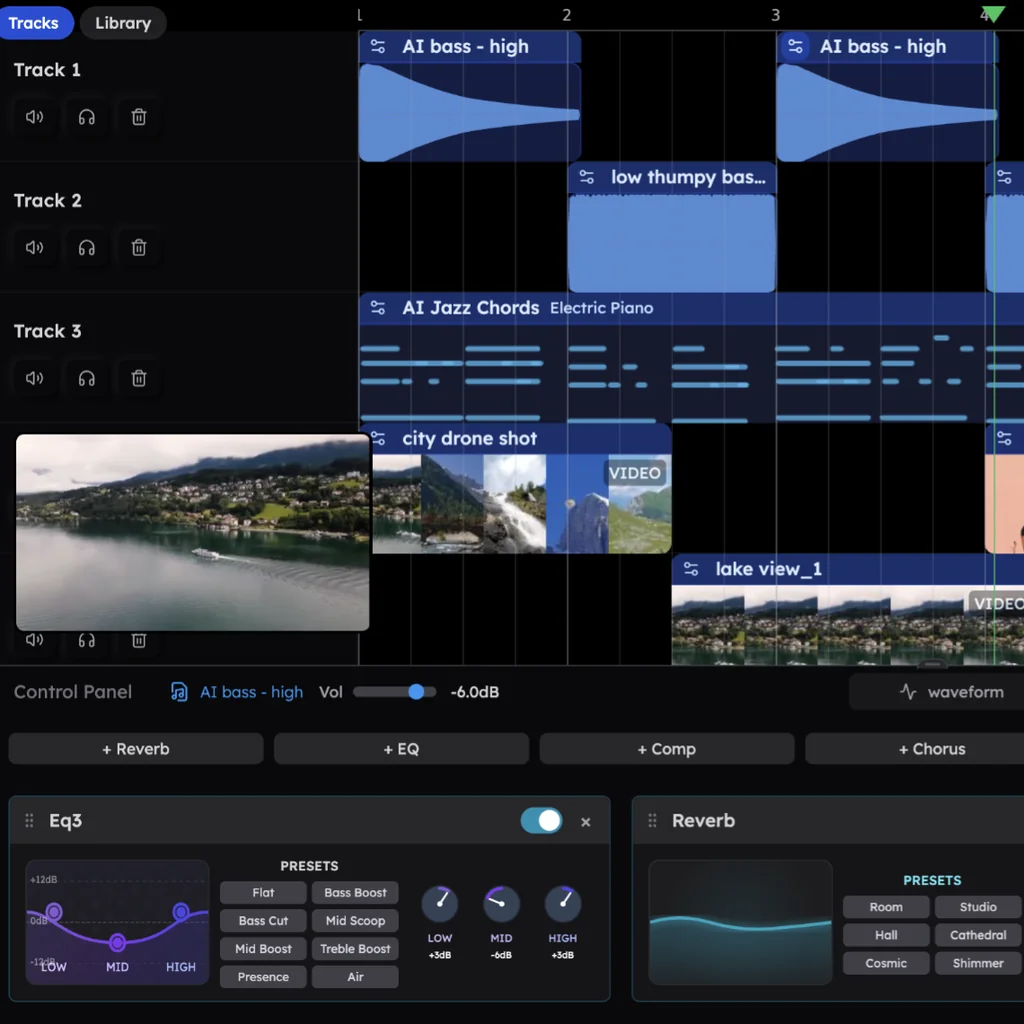
- Every song is a project. Each part CoProducer writes arrives as a track you edit, next to the parts you play and sing, so the song's construction stays in front of you.
- Export the record, free. The mix or every track as stems in 24-bit/48 kHz WAV or 320 kbps MP3, and every MIDI track in one .mid file, with no cap (Veena export formats).
Made the song with an AI generator instead? Ownership is the first question there: on Suno's free plan, Suno keeps the songs you generate (see who owns Suno songs). In Veena the Output is yours on every plan.
Export your stems and MIDI from Veena
- Open Export. Click your avatar at the bottom of the left sidebar and choose Export. Studio Settings opens on its Export tab.
- Name the file in Filename, with the song title and today's date.
- Export the stems. Pick WAV, then Stems. Veena writes one file per audible track, with its effects, volume and pan, into one zip named after your file.
- Export the MIDI. Pick MIDI to write every MIDI track into one .mid file. For a single clip, use Download MIDI file in its piano roll.
- Export the master. Pick WAV and Full mix for the 24-bit/48 kHz file you released.
Store the zip, the .mid and the master together with your drafts, and keep the Veena project for every new version. Releasing next? Read commercial use of music made in Veena, and the Veena help centre answers the rest.
Build a 92 BPM indie pop song in A minor around my voice memo: Acoustic Guitar (steel) strums following my phrasing, a warm Upright Piano on the chords, Electric Bass (finger) and soft Jazz kit drums, with a 4-bar intro, two 16-bar verses and an 8-bar chorus that lifts.
Related reading: Who owns music made in Veena? · Veena export formats · Who owns Suno songs? · Commercial use of music made in Veena
Try this in Veena
Build a 92 BPM indie pop song in A minor around my voice memo: Acoustic Guitar (steel) strums following my phrasing, a warm Upright Piano on the chords, Electric Bass (finger) and soft Jazz kit drums, with a 4-bar intro, two 16-bar verses and an 8-bar chorus that lifts.
Frequently asked questions
What do I do about a copyright claim on my own song?
If you hold all the rights, dispute it in YouTube Studio under Content, Claims, See details, Take action, Dispute; the claimant "has 30 days to respond" (YouTube Help, read 15 Nov 2026). Veena is an AI DAW with a personal music producer built in. Describe the song you want and CoProducer builds it with you — beats, chords, melody, arrangement and mix — as real tracks you can edit, mix and export. Free, in your browser.
Is a false Content ID claim the same as a copyright strike?
No. YouTube's help calls a Content ID claim a match that can block, monetize or track one video, while a strike follows a removal request and is answered with a counter notification (read 15 Nov 2026). Whichever you face, Veena keeps every song as a project with its tracks, so you export the stems and MIDI that show how you built it.
How do I prove I wrote and recorded my song?
Keep the record of how the song was made: the project with its separate tracks, the stems, the MIDI, your voice memos and the dated exports along the way. In Veena every song stays a project with its parts as tracks, and you export the stems as WAV and every MIDI track as one .mid file, free and as often as you like.
Who owns a song I made with AI?
It depends on the tool. Suno's free plan keeps ownership of the songs you generate, by its own help centre. In Veena you own the Output you generate, on every plan including the free one, and each part CoProducer writes arrives as a track you edit, so the finished song and its project are yours to release and to defend.
Can a song made in Veena be released on YouTube and Spotify?
Yes. Veena's terms license commercial use on every plan and say you own the Output you generate. Export the master as a 24-bit/48 kHz WAV, send it through your distributor, and keep the Veena project, stems and MIDI as the record of how you made it. Veena takes no royalties and asks for no credit.
Meet your personal music producer
Free, in your browser. Describe the song you want and CoProducer builds it with you.
Make music free