Beatbox to Drums: Turn Your Mouth Into a Drum Kit
Beatbox to drums in Veena: record your beatbox in the browser and CoProducer turns it into a real drum part you can edit, swap and export. Free to start.
Beatbox to drums is one request in Veena. Record your beatbox into your laptop's mic, and CoProducer, your personal music producer, turns it into a drum part on a real kit: your kicks, snares and hi-hats as editable MIDI that keeps your rhythm and your accents. Then it builds the rest of the track around your groove. Free, in your browser.
Veena is an AI DAW with a personal music producer built in. Describe the song you want and CoProducer builds it with you — beats, chords, melody, arrangement and mix — as real tracks you can edit, mix and export. Free, in your browser.
Your mouth is already the drum machine
A beatboxer can perform a groove in one take that would take an hour to click into a grid. The feel is all there: the lazy kick, the snare that drags a hair behind the beat, the hat pattern that only makes sense when you hear it.
The problem starts when you want that groove to become a track. Raw beatbox on a recording sounds thin next to a real bass and chords. Clicking the same pattern into a step sequencer by hand loses the swing that made it yours. And most tools that turn audio into MIDI sit behind an upgrade, inside a program you have to install.
What you want is simple: perform it once, and get drums that play exactly what you performed.
Beatbox to drums in Veena, step by step
1. Record the groove
Open the studio in Chrome, sign in with Google, press Record and choose Audio. Run Volume calibration and Latency calibration once. Beatbox four or eight bars of your groove, with a one-bar count-in if you already know your tempo, or at your natural pace if you don't: CoProducer measures the tempo and downbeat from the take.
Two habits make the conversion cleaner. Keep each sound distinct, so a kick never smears into the snare after it. And stay a steady distance from the mic, so your accents come from your mouth, not from leaning in.
2. Ask for drums
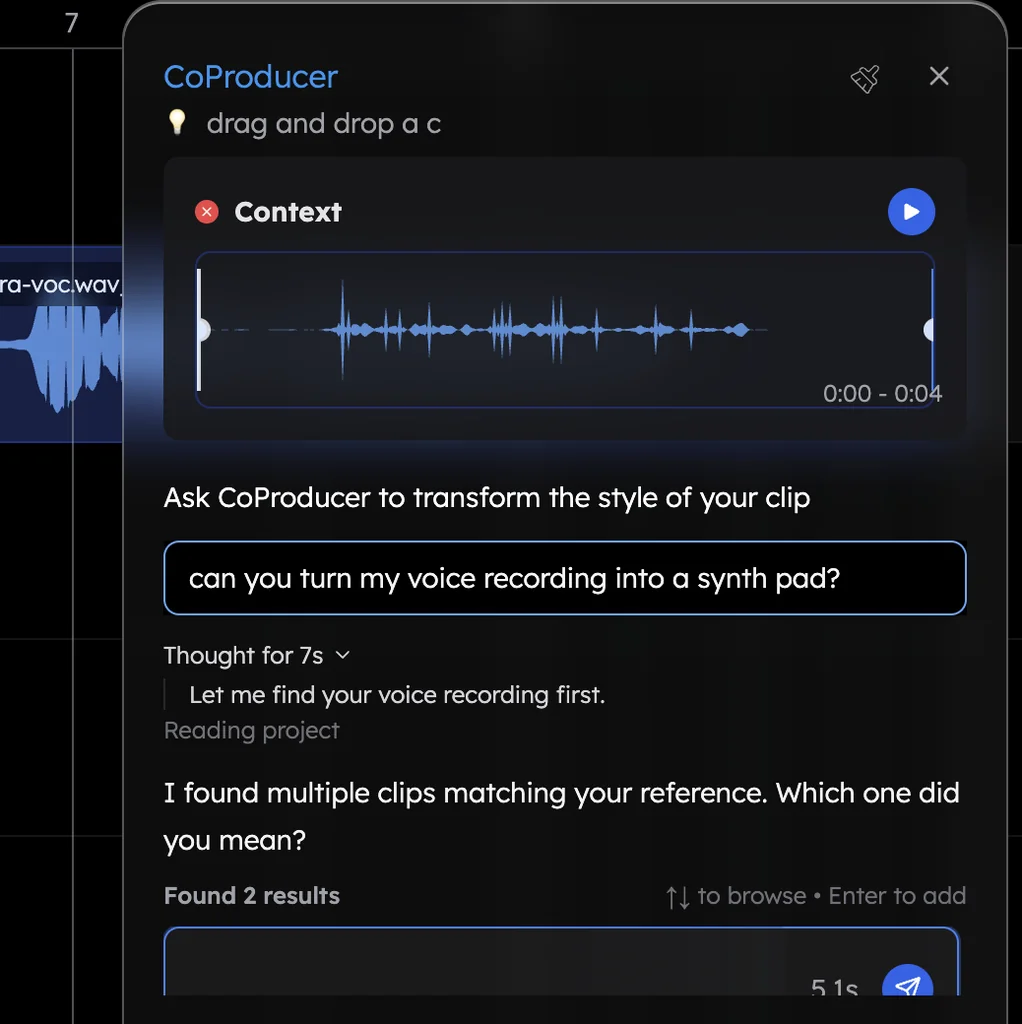
Drag the take into the CoProducer panel and ask for the kit you hear:
"Turn my beatbox on track 1 into a drum part on the TR909 kit: my kicks on the kick, my snares on the snare and my hi-hats on the hats. Keep my rhythm and accents, and quantize the hats lightly so the groove still breathes."
Your beatbox becomes a drum part on a real kit, with your timing and dynamics intact. Keep your original take in the project too: layered quietly under the kit, it adds a human grit no sample library has.
3. Fix it on the grid
Double-click the new drum clip and it opens in the Beat Maker, 16 steps to a bar, with rows for Kick, Snare, Hihat and Hihat Open. Click to add or remove a hit, drag a hit's velocity down for a ghost note, and add rows like Clap or Side Stick when your routine calls for them.
4. Choose the kit, then the feel
One sentence swaps the sound and keeps every hit: Pop, Chaos, JCLive, Brush, Electronic, TR909 or Jazz. Then shape the feel in plain words:
- "Quantize the hats to 16ths but leave the kicks as I played them."
- "Humanize the snare a little."
- "Double the kick pattern in the drop."
- "Drop the drums out for the last two bars before the hook."
One Ctrl+Z undoes any change.
5. Build the track around it
Now brief the band: "a Sub Bass line that locks to my kick and dark minor chords on Dark Pad." Every new part arrives as 3 options, and each one reads the drums you already have, so the bass lands with your kick instead of against it. Export the mix, the stems or the MIDI when it's done.
Beatbox notation, translated for the Beat Maker
If you write routines in beatbox notation, here's where each sound lands:
| You make | Notation | Beat Maker row | Tip |
|---|---|---|---|
| Classic kick | B | Kick | Short and punchy; a long boom reads as bass |
| Rimshot snare | K | Snare or Side Stick | Crisp consonant, no vowel after it |
| Spit snare | Pf | Snare | Snap it on beats 2 and 4 for a backbeat |
| Closed hi-hat | t | Hihat | A light tongue click, quieter than the snare |
| Open hi-hat | ts | Hihat Open | Let the hiss ring before the next kick |
Keep the beatbox, too
Converting your beatbox is one door. Three more:
- Chop it. Ask CoProducer to "chop my beatbox into a new groove" and it slices your recording into a fresh pattern, still in your voice.
- Play your own kit. Click Create MIDI Clip and choose MPC Sampler. Record your best kick, snare and hat as short files (your phone's voice memo app works) and drop them onto the 16 pads. Play them from your computer keyboard on keys 1 to 4, Q to R, A to F and Z to V, and record the performance.
- Hum the bass. Beatboxers hear the bassline too. Hum it, and CoProducer turns the hum into an editable Sub Bass or 808 Long part. The whole flow is on the voice to instrument page.
What turning audio into drums costs elsewhere
Veena turns your beatbox into drums in a browser tab, free. Elsewhere, audio-to-MIDI sits behind a price tier or an install, according to each company's own pages.
| Veena | Ableton Live | BandLab | LUNA | RipX DAW | |
|---|---|---|---|---|---|
| Beatbox or audio to MIDI | Free, with CoProducer | Not in the $99 Intro; from Standard at $349 | Not on Free; Pro is $14.99 a month | LUNA Studio only: $199, or $19.99 a month | $99 or $198 |
| Where it runs | Any modern browser, including Chromebooks and phones | A Mac or Windows install | Browser and mobile apps | A macOS or Windows install | A macOS or Windows install |
| A producer that builds the track around your groove | Yes: CoProducer writes the bass, chords and arrangement | No | SongStarter ideas you won't own | No | No |
Ableton Live lists Audio to MIDI as missing from Intro and present from Standard, at $349 (Ableton's compare page, September 2026). Intro also stops at 16 tracks.
BandLab marks Audio-to-MIDI "No" for Free on its pricing table (BandLab, September 2026), so converting your voice starts at $14.99 a month, and the free Studio stops at 16 tracks.
LUNA from Universal Audio lists Audio-to-MIDI among LUNA Studio's exclusive features (Universal Audio, September 2026), at $199, or $19.99 a month in UAD Spark Studio, on macOS or Windows only.
RipX DAW costs $99 or $198, needs 20 GB of free disk space and "an internet connection is required to activate RipX for the first time, and at least once every 15 times it is run" (Hit'n'Mix, September 2026).
Perform it once, produce it forever
Your beatbox is a finished groove the moment it leaves your mouth. It shouldn't take an hour of clicking to hear it as a record. Record eight bars tonight, ask CoProducer for drums, and build the track around the rhythm only you can make. For the grid itself, the free online beat maker opens straight into it, and the AI drummer page collects briefs by style.
Related reading: how to make drums when you can't play drums · best AI voice-to-instrument tools · how to turn humming into a melody · best AI tools for beatmakers
Try this in Veena
Turn my beatbox on track 1 into a drum part on the TR909 kit: my kicks on the kick, my snares on the snare and my hi-hats on the hats. Keep my rhythm and accents, quantize the hats lightly so the groove still breathes, then build a Sub Bass line that locks to my kick and dark minor chords on Dark Pad over it.
Frequently asked questions
Can I turn my beatbox into drums?
Yes. Record your beatbox into Veena from your laptop's microphone, drag the take into the CoProducer panel and ask for drums. CoProducer turns your kicks, snares and hi-hats into a drum part on a real kit, keeping your rhythm and accents. The result is editable MIDI in the Beat Maker grid, so you can fix any hit or swap the kit in one sentence.
Do I need a good microphone to beatbox into Veena?
No. A laptop's built-in mic is enough for Veena to turn your beatbox into drums. For a take you'll keep as audio, use a USB mic about a hand's width from your mouth and keep the level out of the red. Run Volume calibration and Latency calibration once, wear headphones, and your hits land where you made them.
Can I use my own beatbox sounds as a drum kit?
Yes. Create a MIDI clip in Veena, choose MPC Sampler and drop your own one-shots, a kick, a snare, a click, onto its 16 pads. Play them from your computer keyboard (keys 1 to 4, Q to R, A to F and Z to V), record the performance, and adjust each pad's gain, pan and pitch. Your voice becomes the kit.
What drum kits does Veena have for a beatbox track?
Veena has 7 drum kits: Pop, Chaos, JCLive, Brush, Electronic, TR909 and Jazz. Once your beatbox is a drum part, ask CoProducer to swap the kit and every hit keeps its place and accent. Want your own sounds instead? Load them onto the 16 pads of the MPC Sampler. Everything exports free, with no cap and no watermark.
Meet your personal music producer
Free, in your browser. Describe the song you want and CoProducer builds it with you.
Make music free