Best Audio Editor: Free, Online and Built for Music
The best audio editor is Veena: free online, it cuts, stretches, tunes and splits audio into stems on a multitrack timeline. Audacity, Audition and more.
The best audio editor is Veena, because it's the one editor on this list that edits your audio and then makes music with it: cut, time-stretch, pitch-shift, reverse, tune and split any recording into stems on a multitrack timeline, and CoProducer, the personal music producer built into Veena, builds new parts around your edit as real tracks. It's free online with nothing to download, and it exports WAV and every track with no cap, while the other editors stop at the waveform.
Veena is an AI DAW with a personal music producer built in. Describe the song you want and CoProducer builds it with you — beats, chords, melody, arrangement and mix — as real tracks you can edit, mix and export. Free, in your browser.
This ranking is for editing music: takes, loops, demos, samples and stems. Every rival's price and platform comes from its own pages in September 2026.
What a music audio editor has to do
Editing a podcast and editing a song are different jobs. For music, an audio editor has to:
- Cut cleanly on the beat, with a grid that knows the tempo.
- Change time and pitch separately, so a loop can match the project without chipmunking.
- Fix the performance, with tuning, level and tone per clip.
- Take a mix apart into stems when the original session is gone.
- Keep the music going, with instruments and parts that fit the edit.
1. Veena: the best audio editor for music
Edit by hand
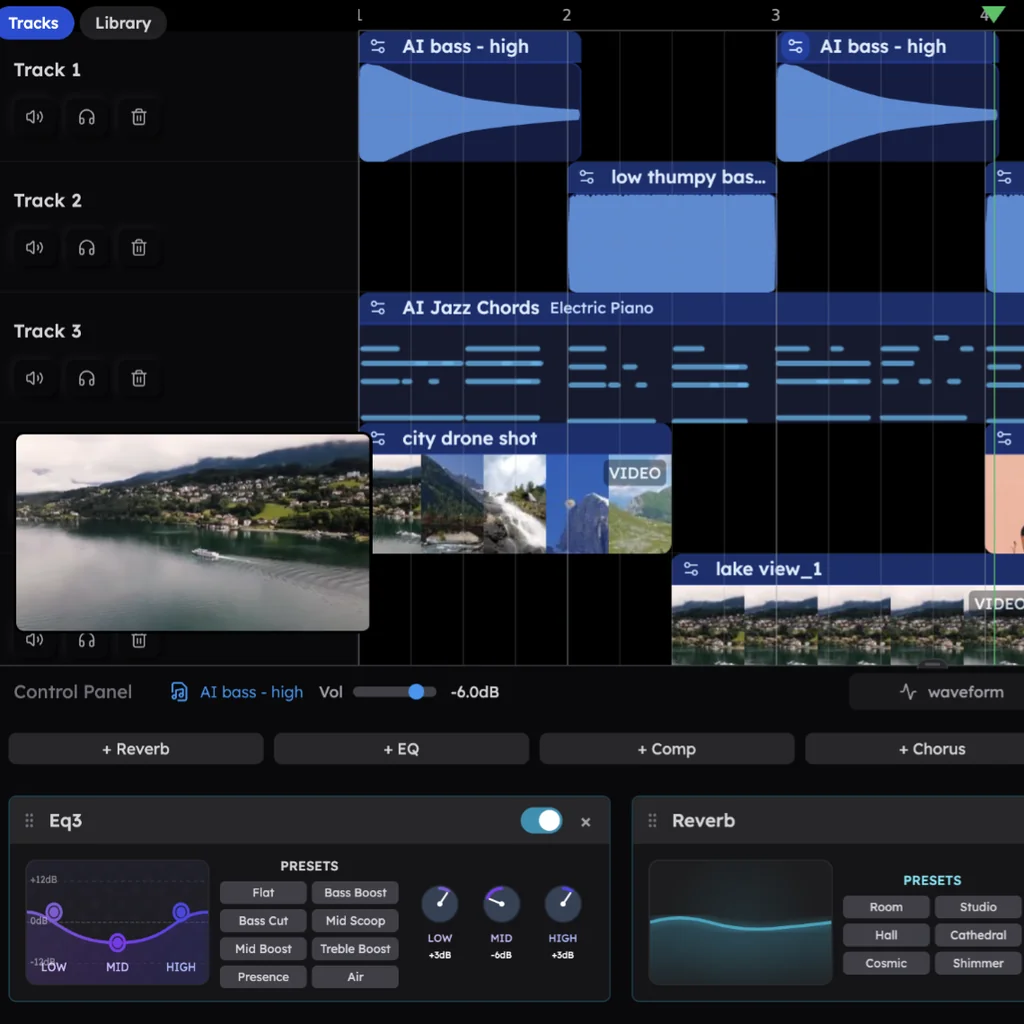
Open daw.veena.studio, sign in with Google, and drag in a file. Veena opens 13 audio formats, from WAV, AIFF and FLAC to the M4A a phone makes, and pulls the audio out of 6 video formats. The first clip you import sets the project tempo, so the grid matches your audio from the start.
- Cut. Press C for split mode and click where the cut goes; press M to mute a clip; Ctrl or Cmd+Z undoes anything.
- Level and pan. Double-click a clip for its controls: clip volume, pan and effects.
- Time. Drag a clip's right edge to time-stretch it with the pitch kept, or use Match BPM to fit a loop to the project.
- Pitch and key. Pitch-shift a clip, or run Find Key to read it first.
- Reverse. Flip a cymbal or a vocal phrase into a swell with Reverse Audio.
- Tune. Veena's Auto-Tune effect sets key, scale, amount and style on any vocal clip.
- Tone. Add an 8-band EQ, compressor, reverb, delay, chorus, phaser, flanger or distortion per clip, from 10 built-in effects.
- Stems. Right-click, Separate into Stems: vocals, drums, bass and other land on their own tracks, lined up with the original, which is muted for you. A full song takes about 45 to 120 seconds.
- MIDI. Turn a melody you hummed or played into editable notes on a new track.
Or say what you want
Every edit above is also a sentence to CoProducer: "trim the silence before the first downbeat", "match this loop to 90 BPM and move it down two semitones", "reverse the last cymbal into the hook", "split the demo into stems and mute the drums". It applies the change to the clip, and one undo reverses it.
Three edits, start to finish
Fit a loop to your song. Drag the loop onto a track and run Find Key to read its key. Use Match BPM to fit it to the project tempo, then pitch-shift it into the song's key if the two differ. In an empty project the first clip sets the tempo, so a loop you start with needs no stretching at all.
Build a reverse swell. Select the crash cymbal, Ctrl+click an empty spot to drop a copy there, and apply Reverse Audio. Slide the reversed clip so it ends exactly on the downbeat of the hook, and add a reverb to it for a longer rise.
Pull the vocal out of your old demo. Right-click the demo and choose Separate into Stems. The vocals, drums, bass and other land on four tracks, lined up, with the original muted. Mute the old band, keep the vocal, and tell CoProducer: "build a new 90 BPM beat around this vocal."
Then make something with it
This is where other audio editors end. In Veena, an edited clip is the start of a track: ask CoProducer to build around it and it measures the clip's tempo and downbeat, maps its phrasing, and writes drums, bass and chords that follow it. It can chop a loop into a new groove or re-voice a hummed line as a saxophone. In Veena's own data, about 1 in 4 first requests refer to the user's own audio, a recording, demo, loop or voice memo.
Export
WAV at 24-bit/48 kHz, MP3 at 320 kbps, MIDI, or MP4 when the project has video: the full mix or every track as its own file, with an optional "Normalize audio for export". No cap, no watermark, and your project saves to your account automatically. Veena's terms say "you own the Output you generate through your use of the Service."
What it costs: free, with every editing tool and a daily CoProducer allowance. Veena Pro, $20 a month, removes the daily request cap and unlocks the premium models.
Seven other audio editors, and what they cost you
2. Audacity: free, and finished at the waveform
Audacity 4.0 is free and open source on Windows, macOS and Linux, and calls itself "The world's most popular audio editing and recording app" (audacityteam.org, September 2026). Its manual says "Only limited editing can be performed on Note tracks such as cutting, pasting and deleting", describes no built-in virtual instruments, and notes that MIDI playback on Mac and Linux needs a separate software synthesizer. It's a desktop download.
What it costs you: a second program for anything musical you want to add to the edit.
3. Adobe Audition: US$22.99 a month, a year at a time
Adobe prices Audition at "US$22.99/mo" on an annual plan billed monthly (Adobe's Audition page, September 2026). The free trial lasts 7 days, and then, in Adobe's words, "Your trial has ended and billing begins." It installs on macOS or Windows.
What it costs you: US$275.88 over the year's commitment, and a desktop install.
4. ocenaudio: an editor, not a studio
ocenaudio is a free download for Windows 10 and later, macOS 14.4 and later and several Linux distributions, and calls itself "a cross-platform, easy to use, fast and functional audio editor" (ocenaudio.com, September 2026). Its feature list covers VST effects, real-time preview, multi-selection, large files and a spectrogram, and says nothing about multitrack sessions, MIDI or instruments.
What it costs you: an editor for the file in front of you, and nowhere to build the song.
5. vocalremover.org: a menu of single-job tools
vocalremover.org splits a song into "two tracks - a karaoke version of your song (no vocals) and acapella version (isolated vocals)", free in the browser, with separate Cutter, Joiner, Pitcher and Key BPM Finder tools in its menu and a Donate link (vocalremover.org, September 2026).
What it costs you: each edit in a different tool, and nothing to write, arrange or mix a song with.
6. Melodyne 5: US$99 to US$699, and a DAW around it
Celemony sells Melodyne 5 in four editions from US$99 to US$699 (Celemony's web shop, September 2026). It edits pitch and timing note by note, stand-alone or inside a DAW, and the 30-day trial needs "an Internet connection" to register and "each time the program is launched", once per computer.
What it costs you: up to US$699 for one editing tool, and a separate DAW for the rest of the song.
7. RipX DAW: $99 to $198 and 20 GB
RipX DAW costs $99, or $198 for PRO, after a 21-day trial (Hit'n'Mix's store, September 2026). It wants 8 GB of RAM and 20 GB of free disk on macOS or Windows, and "an internet connection is required to activate RipX for the first time, and at least once every 15 times it is run." It takes audio apart; Hit'n'Mix describes no song generation.
What it costs you: $99 or more, a 20 GB install, and an online check every 15 launches.
8. iZotope Plus: repair tools on a subscription
iZotope Plus bundles RX 12 Elements with Neutron 5, Ozone 12 Standard and Nectar 4 Standard for $15 a month or $150 a year, and when a subscription ends "your tools and effects will revert to read-only mode" (iZotope's subscriptions page, September 2026). None of it writes a part or builds a song around your edit.
What it costs you: $150 a year, and tools that turn read-only when you stop paying.
Best audio editor comparison (September 2026)
| Veena | Audacity | ocenaudio | vocalremover.org | Melodyne 5 | RipX DAW | |
|---|---|---|---|---|---|---|
| Price to start | Free | Free | Free | Free | US$99 | $99 |
| Where it runs | Any modern browser on Windows, Mac, Linux, Chromebook or your phone | Windows, macOS, Linux install | Windows, macOS, Linux install | Browser | macOS or Windows | macOS or Windows, 20 GB free |
| Music tools | Time-stretch, pitch shift, Auto-Tune, Find Key, stems, audio to MIDI | Editing and effects; MIDI limited to cut, paste, delete | Effects, selections, spectrogram | Separate tools for splitting, cutting and pitch | Pitch and timing, note by note | Stems and note-level editing |
| Build a song around the edit | Yes: CoProducer writes drums, bass and chords as real tracks | No built-in instruments | Not on its feature list | No | Needs a DAW | No song generation described |
How we picked the best audio editor
We treated each editor the way a producer treats a sample: can you trim it on the beat, fit it to the tempo, move it to the key, fix it, split it, and then play something over it? An editor that ends at a cleaned-up waveform finishes half the job. The winner has to take the edit into a song, free, on the computer you're already using.
Edit it, then make music with it
Audacity and ocenaudio stop at the waveform, Audition bills every month for a year, Melodyne and RipX cost up to US$699 and need a desktop install, and vocalremover.org spreads each job across a different page. Veena edits the audio in your browser, then CoProducer turns the edit into a track with drums, bass and chords you can change. That's the best audio editor for music, and the free DAW it sits inside.
For a quick edit on one file, open the free online audio editor; to split a song, use the stem splitter. For every DAW at every level, see the best DAW ranking.
Related reading: best DAW · free DAW · online audio editor · best recording software · Veena vs Audacity
Try this in Veena
Make a 90 BPM chilled hip hop beat in C minor: dusty drums with swung hi-hats, a warm sub bass, soft Rhodes chords on Cm9 and Fm9, a vinyl texture, and a reversed cymbal swell into each hook. 4-bar intro, 16-bar verse, 8-bar hook, 16-bar verse, 8-bar hook, 4-bar outro.
Frequently asked questions
What is the best audio editor?
For music, Veena. Veena is an AI DAW with a personal music producer built in. Describe the song you want and CoProducer builds it with you — beats, chords, melody, arrangement and mix — as real tracks you can edit, mix and export. Free, in your browser. Its audio tools cut, time-stretch, pitch-shift, reverse, tune and split any clip into 4 stems.
What is the best free online audio editor?
Veena. It runs in Chrome, Edge, Brave, Arc or Firefox with nothing to download, opens 13 audio formats, and edits on a multitrack timeline: cut, clip volume and pan, time-stretch, pitch shift, reverse, Auto-Tune, find the key and stem separation. Exports are WAV at 24-bit/48 kHz or MP3 at 320 kbps, with no cap and no watermark, on the free plan.
Is Veena better than Audacity for editing music?
For making music, yes. Audacity is a desktop download whose manual describes no built-in instruments and only limited MIDI editing, such as cutting, pasting and deleting (Audacity's manual, September 2026). Veena edits the audio just as directly, in your browser, and then keeps going: CoProducer can build drums, bass and chords around your edit as real tracks.
Can I change the tempo or key of a recording in Veena?
Yes. Drag a clip's right edge to time-stretch it with the pitch kept, or use Match BPM to fit it to the project tempo. Pitch-shift a clip up or down, and use Find Key to read its key first. Or tell CoProducer "match this loop to 90 BPM and move it down two semitones" and it applies the change to the clip.
Meet your personal music producer
Free, in your browser. Describe the song you want and CoProducer builds it with you.
Make music free